
Commercial Mortgage: A Practical UK Buying Guide
19 October 2026 · 17 min read

The lowest headline rate may not be the best fit for your business. With a commercial mortgage, the property’s intended use, deposit, fees and repayment structure all affect whether the borrowing works for your cash flow.
It can be hard to know where to start. A mortgage for premises your business will occupy may be assessed differently from finance for an investment property, and lenders apply their own criteria. The rate matters, but so do the total costs, the term and your ability to keep up repayments if trading conditions change.
This guide explains how commercial mortgages work, how to compare key terms and what lenders may assess when reviewing your business and the property. You’ll find practical ways to prepare for an application and compare borrowing with your plans. Lending Box is a UK-wide, whole-of-market broker for limited companies and LLPs. It matches businesses with lenders and provides a dedicated relationship manager to guide the application and paperwork.
Key Takeaways
- Match a commercial mortgage to the property’s purpose, whether your business will occupy it or earn rental income.
- Compare the rate type, repayments, fees and flexibility together, rather than judging an option by its headline rate alone.
- Test affordability against weaker trading and possible rate changes before committing to repayments secured against property.
- Prepare a clear account of the property’s intended use, your business finances and existing commitments before applying.
- Lending Box matches UK limited companies and LLPs with lenders across the market. Its company-data eligibility insights do not impact credit scores.
What a commercial mortgage can do for a UK business
A commercial mortgage is finance secured against property used for business operations or investment. The property acts as security, and the business repays the loan over an agreed term. It can fund a purchase, support a move to larger or additional premises, or refinance borrowing on an existing property. The right purpose depends on what the business needs the property to do, not just its market value.
Buying rather than renting can give a business more control over its premises and longer-term plans. But ownership brings a financial commitment alongside trading costs. Renting may offer more flexibility if the business expects its space needs to change. Compare both options against projected cash flow, how long the premises are likely to suit the business and the funds needed for day-to-day operations.
A commercial mortgage is for business or investment property, not a residential home loan. For a foundational overview of the structure and terminology, see What is a Commercial Mortgage?
Owner-occupied or investment property: what is the difference?
With owner-occupied borrowing, a business buys premises for its own use, such as a warehouse, office or workshop. A lender may look at the business’s trading position and how the premises support its operations. Commercial buy-to-let is different: the borrower buys a property to let to business tenants. In that case, expected rental income and the property’s suitability as a letting investment may form part of the assessment.
Be clear about the intended use from the outset. It can affect the mortgage structure, the evidence a lender considers and the terms available. A property combining business and other uses may need separate consideration, so describe how each part will be used.
When might a commercial mortgage fit the business plan?
Start with the plan for the property. Will the business occupy it, need room to grow or hold it as an investment? Consider how long the premises are likely to suit the operation, whether they support customers or staff, and how the purchase fits the company’s wider strategy. A property that looks suitable on paper still needs to work for the business’s expected trading needs.
Ownership can give the business more control over its premises and reduce reliance on a landlord’s decisions. It also ties up capital and creates ongoing repayment obligations. Test the plan against less favourable trading conditions, not only the expected case. The right structure and terms depend on the business, the property and the lender’s assessment. Lending Box helps limited companies and LLPs explore property and secured finance routes across the market, matching them with lenders rather than lending directly.
How commercial mortgages work: security, repayments and terms
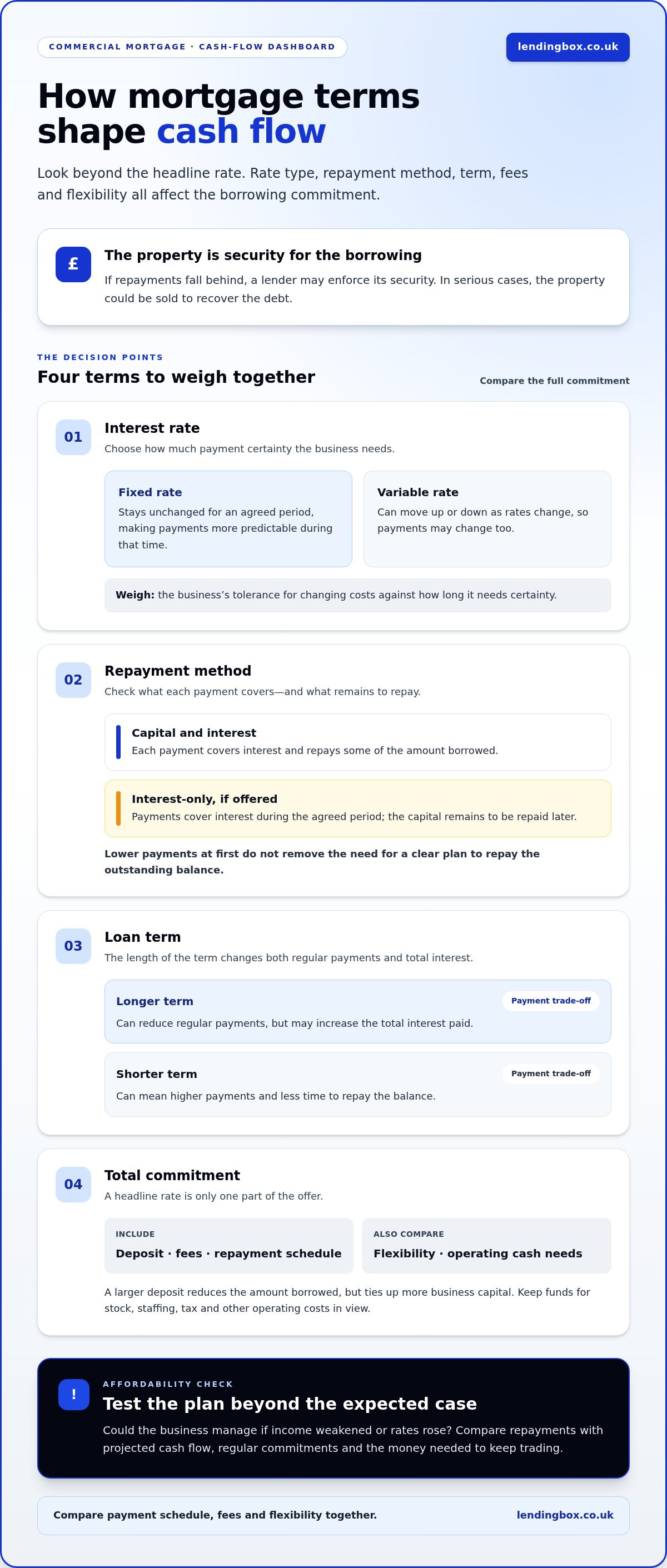
A commercial mortgage uses the property as security for the borrowing. If the business falls behind on repayments, the lender may take steps to enforce that security. In serious cases, this could lead to the property being sold to recover the debt. Repayment planning is essential, especially if the property is also central to the business’s operations.
The offer sets out the deposit, interest rate, repayment method, term and fees. These vary by lender and application. A larger deposit may reduce the amount borrowed, but it also ties up more of the business’s capital. Compare the full commitment with the cash needed for stock, staffing, tax and other operating costs.
What does the lender take into account?
Lenders assess the property and borrower together. They may consider the property’s valuation, condition, intended use and potential as security, alongside the business’s finances and ability to meet repayments. Trading history can show how the business has performed, while forecasts can explain how it expects to manage future commitments. Lenders give different weight to these factors, so no single criterion guarantees a particular outcome.
Prepare to explain how the borrowing fits the business plan. If projected income depends on moving into larger premises, for example, set out the assumptions behind the forecast and how the business would manage a slower start. Existing debts and regular commitments matter too, because they affect the cash available for repayments.
How do interest and repayment structures affect cashflow?
A fixed rate stays unchanged for an agreed period, making payments more predictable during that time. A variable rate can move up or down, so payments may change as rates change. A fixed rate can support budgeting, while a variable rate exposes the business to movements in either direction. Consider the business’s tolerance for changing costs and how long it needs certainty before choosing between them.
With capital-and-interest repayments, each payment covers interest and repays some of the amount borrowed. An interest-only structure, if offered by the lender, covers interest during the agreed period, leaving the capital to be repaid later. Payments may be lower at first, but the outstanding balance still needs a clear repayment plan.
The term also shapes the cost. Spreading repayments over a longer period can reduce regular payments but may increase the total interest paid. A shorter term can mean higher payments and less time to repay the balance. Compare the payment schedule, fees and flexibility together. Then test whether the business could manage if income weakened or rates rose. For wider borrowing context, see Lending Box’s business finance options.
How to compare commercial mortgage options and manage the risks
A headline rate tells only part of the story. Compare each offer with the property’s purpose, the business’s cash flow and the plan for repaying the borrowing. A lower rate may still be a poor fit if the repayment structure is restrictive or the business cannot absorb changes in income.
Use a side-by-side comparison. Record the full offer details, then consider how each option would work in practice.
- Property use: Is the property for the business to occupy, or will it be let to business tenants?
- Rate type: Is the rate fixed for a period or variable? What could a change mean for payments?
- Repayment structure: Will payments repay capital as well as interest? What happens to any balance at the end of the term?
- Fees: What arrangement, valuation, legal or other charges apply, and when are they payable?
- Flexibility: Can the business make overpayments, repay early or change its plans without extra cost or restrictions?
Which mortgage structure matches the property’s purpose?
An owner-occupied mortgage supports a business buying premises for its own trading activity. A commercial buy-to-let mortgage is for a property bought to rent to business tenants. The income case differs: trading premises are linked to the business’s finances and operational use, while an investment property may depend more on rental income and tenant demand. Lender criteria can differ too. For wider context on borrowing secured against assets, explore Lending Box’s secured finance options.
What risks should a business test before committing?
Run the figures against less favourable conditions, not just the forecast. What if revenue falls, costs rise, a key customer pays late or variable interest increases? For an investment property, allow for periods without a tenant, repairs and other ongoing property costs. Check whether available cash could cover repayments through those periods without disrupting core business spending.
A secured mortgage puts the property at risk. If the borrower fails to meet the agreed repayments, the lender may enforce its security, and the property could ultimately be repossessed and sold to recover the debt. Set out a realistic repayment plan and consider what the business would do if it needed to sell, refinance or change premises before the term ends.
Keep the alternatives distinct. A commercial mortgage is generally structured around property purchase or refinancing over an agreed term. Bridging finance is typically short-term funding for a defined interim need, while a secured business loan may use business or other assets as security for a different purpose. Each has its own costs, terms and risks, so compare the structure with the actual funding need. Lending Box helps UK limited companies and LLPs explore property and secured finance routes across the market, matching borrowers with lenders rather than lending directly.
How to prepare a commercial mortgage application
A clear application starts with a clear plan. Organise the property details, business figures and repayment case before applying. Requirements differ by lender and transaction, so use this as a preparation checklist rather than a fixed list of documents every applicant must provide.
- Set out the property’s intended use. Explain whether the business will occupy the premises or let them to tenants. Include the expected purchase or refinancing timeline and how the property supports the company’s plans.
- Work out a realistic borrowing requirement. Consider the deposit, likely purchase costs and how much working capital the business needs to keep available. Do not base the amount solely on the maximum a lender might consider.
- Build an affordability picture. Map potential repayments against operating cash flow, existing borrowing and other regular commitments. Test the figures against a weaker trading period or unexpected costs, not only the central forecast.
- Gather and check supporting information. Make sure company, financial and property details are current and consistent across documents. Resolve gaps or differences before submission where possible.
What business and property information may be needed?
Lenders may ask for company accounts, recent management information and forward-looking projections. These help explain past performance and how the business expects to meet its commitments. Be ready to describe the assumptions behind forecasts, such as planned growth, a move to larger premises or expected rental income.
Property information may include the address, purchase details, intended use, existing tenancy information and valuation material. A lender may arrange its own valuation as part of the assessment. The precise evidence required depends on the lender, applicant and transaction. Keep records organised and respond to requests with relevant, up-to-date documents.
How can directors prepare for affordability and security questions?
Prepare a simple cash-flow view showing when income arrives and when key costs fall due. Include existing finance repayments and consider how the business would cope if revenue dipped or a customer paid late. If the property will generate rent, allow for possible empty periods and costs that could reduce the income available for repayments.
Be clear about the security being offered. If repayments are not met, the lender may enforce its rights over the property. Read the proposed terms carefully, including any personal guarantee requirement, and understand what that could mean for the person giving it. Requirements vary, so do not assume a guarantee will apply in every case.
Accurate, complete paperwork gives the lender a coherent view of the application and can help avoid delays caused by missing or conflicting information. Lending Box provides a dedicated relationship manager to guide applicants through the paperwork. For broader funding comparisons, consider how property finance sits alongside other UK business funding options.
Prepare your figures and property details, then explore property finance options with Lending Box. Lending Box uses company data to provide eligibility insights without impacting credit scores, and matches UK limited companies and LLPs with lenders across the market.
How Lending Box can help you explore a commercial mortgage
Comparing property finance can mean weighing different lender criteria, terms and application requirements. Lending Box is a UK-wide, whole-of-market commercial finance broker for limited companies and LLPs. It matches businesses with lenders rather than lending directly. The lender makes the final decision on any application.
Start with the decision in front of you. Are you buying premises for your own operations, investing in a property to let, or refinancing an existing one? Bring a clear view of the property, its intended use and the funding you’re seeking. This gives the discussion a practical focus from the outset.
What happens when you explore property finance with Lending Box?
Lending Box uses company data to provide eligibility insights without impacting credit scores. These insights help assess potential lender routes in light of the business and its funding needs. They are not an approval or a promise of terms. Each lender applies its own assessment, and any offer depends on that lender’s decision.
If you decide to progress, a dedicated relationship manager guides you through the application and paperwork. This support helps keep the process organised as information is gathered and lender requirements are addressed. Clear, consistent details about the company and property make it easier to explain the funding request and respond to questions.
Move forward with a clearer funding plan
Before taking the next step, pull together a concise outline of the proposal. Include:
- Whether the business will occupy the property or let it to tenants.
- What the funding will support, such as a purchase, expansion or refinancing.
- How the expected repayments fit alongside existing financial commitments.
- What questions you need to resolve about the structure, terms or application.
This gives your relationship manager a useful starting point and helps focus the discussion on the decision your business needs to make. It also gives you a basis for considering whether a proposed route fits your plans, rather than focusing on a single feature in isolation.
Property finance is a significant business commitment. Take time to set out your plans and understand the lender’s assessment before deciding how to proceed. Lending Box can help you explore routes across the market and guide you through the application paperwork. The lender remains responsible for its decision and any terms offered.
Explore commercial property finance with Lending Box and outline the property plans and funding decision you’re working through.
Turn your property plans into a clear next step
A property decision should support where your business is heading, not just solve an immediate space or funding need. Before moving forward, decide what the property must make possible and what level of repayment the business can sustain. This gives you a practical basis for exploring a commercial mortgage and weighing lender options against your plans.
Lending Box works as a whole-of-market broker for UK limited companies and LLPs, matching businesses with lenders rather than lending directly. Its company-data eligibility insights do not impact credit scores, providing an initial view as you consider possible routes. If you progress, a dedicated relationship manager can guide you through the application and paperwork.
Set out the property you have in mind and the decision you need to make. Then explore commercial property finance with Lending Box. A clearer funding plan starts with knowing what you need the property to do. Take the next step with confidence.
Frequently Asked Questions
Can a new business get a commercial mortgage?
Yes, a new business may be able to apply, although limited trading history can make the lender’s assessment more dependent on other evidence. A lender may consider directors’ relevant experience, the business plan, financial projections, available deposit and the property itself. For a newly formed company, prepare clear forecasts and explain how the business expects to generate income. Eligibility and terms depend on the lender’s criteria and assessment.
Can a limited company apply for a commercial mortgage?
Yes. A limited company can apply for finance to buy or refinance property for business use or investment, subject to the lender’s criteria. The company’s accounts, trading position, commitments and plans may all inform the assessment. Directors should be ready to explain the proposed borrowing and how the company expects to manage it. The lender decides whether to proceed and what terms, if any, to offer.
Can a commercial mortgage be used to refinance a business property?
Yes, refinancing can replace existing borrowing secured against a business property, subject to lender assessment. A company might explore it as its current mortgage approaches the end of a deal period or if its funding needs have changed. Prepare details of the existing loan, outstanding balance, property and business finances. Compare the proposed terms and any costs of changing finance before deciding whether refinancing supports the company’s plans.
Does a commercial mortgage always require a personal guarantee?
No. A personal guarantee is not automatic, but a lender may require one depending on its criteria and view of the application. If a director gives a guarantee, they may become personally responsible for some or all of the debt if the company does not meet its obligations. Read the wording carefully and understand the potential personal exposure before signing. The lender’s offer sets out any guarantee requirements.
Is a commercial mortgage regulated in the UK?
Commercial mortgages for business purposes are generally not regulated by the Financial Conduct Authority in the same way as residential home loans. The exact regulatory position can depend on the borrower, purpose and property involved, so do not assume every property-backed loan has the same status. Read the lender’s documents carefully and establish which protections and complaints routes apply to the specific agreement before committing.
What happens if a business cannot keep up with commercial mortgage repayments?
Missed payments can put the business in default under its mortgage agreement and may lead to further action by the lender. Because the property secures the borrowing, the lender may enforce its security, which could ultimately result in the property being repossessed and sold. If cash-flow problems emerge, review the agreement and speak to the lender promptly. Early communication may help clarify what options are available under the terms.
Can a commercial mortgage cover a mixed-use property?
It may be possible to finance a mixed-use property, such as premises combining a shop with a flat, but the lender’s criteria and the property’s exact layout and use matter. Be prepared to explain which parts will be used by the business, let to tenants or occupied for another purpose. The lender may assess the property and proposed use as a whole. Terms depend on its assessment.
Frequently Asked Questions
With owner-occupied borrowing, a business buys premises for its own use, such as a warehouse, office or workshop. A lender may look at the business’s trading position and how the premises support its operations. Commercial buy-to-let is different: the borrower buys a property to let to business tenants. In that case, expected rental income and the property’s suitability as a letting investment may form part of the assessment. Be clear about the intended use from the outset. It can affect the mortgage structure, the evidence a lender considers and the terms available. A property combining business and other uses may need separate consideration, so describe how each part will be used.
Start with the plan for the property. Will the business occupy it, need room to grow or hold it as an investment? Consider how long the premises are likely to suit the operation, whether they support customers or staff, and how the purchase fits the company’s wider strategy. A property that looks suitable on paper still needs to work for the business’s expected trading needs. Ownership can give the business more control over its premises and reduce reliance on a landlord’s decisions. It also ties up capital and creates ongoing repayment obligations. Test the plan against less favourable trading conditions, not only the expected case. The right structure and terms depend on the business, the property and the lender’s assessment. Lending Box helps limited companies and LLPs explore property and secured finance routes across the market, matching them with lenders rather than lending directly. A commercial mortgage uses the property as security for the borrowing. If the business falls behind on repayments, the lender may take steps to enforce that security. In serious cases, this could lead to the property being sold to recover the debt. Repayment planning is essential, especially if the property is also central to the business’s operations. The offer sets out the deposit, interest rate, repayment method, term and fees. These vary by lender and application. A larger deposit may reduce the amount borrowed, but it also ties up more of the business’s capital. Compare the full commitment with the cash needed for stock, staffing, tax and other operating costs.
Lenders assess the property and borrower together. They may consider the property’s valuation, condition, intended use and potential as security, alongside the business’s finances and ability to meet repayments. Trading history can show how the business has performed, while forecasts can explain how it expects to manage future commitments. Lenders give different weight to these factors, so no single criterion guarantees a particular outcome. Prepare to explain how the borrowing fits the business plan. If projected income depends on moving into larger premises, for example, set out the assumptions behind the forecast and how the business would manage a slower start. Existing debts and regular commitments matter too, because they affect the cash available for repayments.
A fixed rate stays unchanged for an agreed period, making payments more predictable during that time. A variable rate can move up or down, so payments may change as rates change. A fixed rate can support budgeting, while a variable rate exposes the business to movements in either direction. Consider the business’s tolerance for changing costs and how long it needs certainty before choosing between them. With capital-and-interest repayments, each payment covers interest and repays some of the amount borrowed. An interest-only structure, if offered by the lender, covers interest during the agreed period, leaving the capital to be repaid later. Payments may be lower at first, but the outstanding balance still needs a clear repayment plan. The term also shapes the cost. Spreading repayments over a longer period can reduce regular payments but may increase the total interest paid. A shorter term can mean higher payments and less time to repay the balance. Compare the payment schedule, fees and flexibility together. Then test whether the business could manage if income weakened or rates rose. For wider borrowing context, see Lending Box’s business finance options. A headline rate tells only part of the story. Compare each offer with the property’s purpose, the business’s cash flow and the plan for repaying the borrowing. A lower rate may still be a poor fit if the repayment structure is restrictive or the business cannot absorb changes in income. Use a side-by-side comparison. Record the full offer details, then consider how each option would work in practice.
An owner-occupied mortgage supports a business buying premises for its own trading activity. A commercial buy-to-let mortgage is for a property bought to rent to business tenants. The income case differs: trading premises are linked to the business’s finances and operational use, while an investment property may depend more on rental income and tenant demand. Lender criteria can differ too. For wider context on borrowing secured against assets, explore Lending Box’s secured finance options.
Run the figures against less favourable conditions, not just the forecast. What if revenue falls, costs rise, a key customer pays late or variable interest increases? For an investment property, allow for periods without a tenant, repairs and other ongoing property costs. Check whether available cash could cover repayments through those periods without disrupting core business spending. A secured mortgage puts the property at risk. If the borrower fails to meet the agreed repayments, the lender may enforce its security, and the property could ultimately be repossessed and sold to recover the debt. Set out a realistic repayment plan and consider what the business would do if it needed to sell, refinance or change premises before the term ends. Keep the alternatives distinct. A commercial mortgage is generally structured around property purchase or refinancing over an agreed term. Bridging finance is typically short-term funding for a defined interim need, while a secured business loan may use business or other assets as security for a different purpose. Each has its own costs, terms and risks, so compare the structure with the actual funding need. Lending Box helps UK limited companies and LLPs explore property and secured finance routes across the market, matching borrowers with lenders rather than lending directly. A clear application starts with a clear plan. Organise the property details, business figures and repayment case before applying. Requirements differ by lender and transaction, so use this as a preparation checklist rather than a fixed list of documents every applicant must provide.
Lenders may ask for company accounts, recent management information and forward-looking projections. These help explain past performance and how the business expects to meet its commitments. Be ready to describe the assumptions behind forecasts, such as planned growth, a move to larger premises or expected rental income. Property information may include the address, purchase details, intended use, existing tenancy information and valuation material. A lender may arrange its own valuation as part of the assessment. The precise evidence required depends on the lender, applicant and transaction. Keep records organised and respond to requests with relevant, up-to-date documents.
Prepare a simple cash-flow view showing when income arrives and when key costs fall due. Include existing finance repayments and consider how the business would cope if revenue dipped or a customer paid late. If the property will generate rent, allow for possible empty periods and costs that could reduce the income available for repayments. Be clear about the security being offered. If repayments are not met, the lender may enforce its rights over the property. Read the proposed terms carefully, including any personal guarantee requirement, and understand what that could mean for the person giving it. Requirements vary, so do not assume a guarantee will apply in every case. Accurate, complete paperwork gives the lender a coherent view of the application and can help avoid delays caused by missing or conflicting information. Lending Box provides a dedicated relationship manager to guide applicants through the paperwork. For broader funding comparisons, consider how property finance sits alongside other UK business funding options. Prepare your figures and property details, then explore property finance options with Lending Box. Lending Box uses company data to provide eligibility insights without impacting credit scores, and matches UK limited companies and LLPs with lenders across the market. Comparing property finance can mean weighing different lender criteria, terms and application requirements. Lending Box is a UK-wide, whole-of-market commercial finance broker for limited companies and LLPs. It matches businesses with lenders rather than lending directly. The lender makes the final decision on any application. Start with the decision in front of you. Are you buying premises for your own operations, investing in a property to let, or refinancing an existing one? Bring a clear view of the property, its intended use and the funding you’re seeking. This gives the discussion a practical focus from the outset.
Lending Box uses company data to provide eligibility insights without impacting credit scores. These insights help assess potential lender routes in light of the business and its funding needs. They are not an approval or a promise of terms. Each lender applies its own assessment, and any offer depends on that lender’s decision. If you decide to progress, a dedicated relationship manager guides you through the application and paperwork. This support helps keep the process organised as information is gathered and lender requirements are addressed. Clear, consistent details about the company and property make it easier to explain the funding request and respond to questions.
Yes, a new business may be able to apply, although limited trading history can make the lender’s assessment more dependent on other evidence. A lender may consider directors’ relevant experience, the business plan, financial projections, available deposit and the property itself. For a newly formed company, prepare clear forecasts and explain how the business expects to generate income. Eligibility and terms depend on the lender’s criteria and assessment.
Yes. A limited company can apply for finance to buy or refinance property for business use or investment, subject to the lender’s criteria. The company’s accounts, trading position, commitments and plans may all inform the assessment. Directors should be ready to explain the proposed borrowing and how the company expects to manage it. The lender decides whether to proceed and what terms, if any, to offer.
Yes, refinancing can replace existing borrowing secured against a business property, subject to lender assessment. A company might explore it as its current mortgage approaches the end of a deal period or if its funding needs have changed. Prepare details of the existing loan, outstanding balance, property and business finances. Compare the proposed terms and any costs of changing finance before deciding whether refinancing supports the company’s plans.
No. A personal guarantee is not automatic, but a lender may require one depending on its criteria and view of the application. If a director gives a guarantee, they may become personally responsible for some or all of the debt if the company does not meet its obligations. Read the wording carefully and understand the potential personal exposure before signing. The lender’s offer sets out any guarantee requirements.
Commercial mortgages for business purposes are generally not regulated by the Financial Conduct Authority in the same way as residential home loans. The exact regulatory position can depend on the borrower, purpose and property involved, so do not assume every property-backed loan has the same status. Read the lender’s documents carefully and establish which protections and complaints routes apply to the specific agreement before committing.
Missed payments can put the business in default under its mortgage agreement and may lead to further action by the lender. Because the property secures the borrowing, the lender may enforce its security, which could ultimately result in the property being repossessed and sold. If cash-flow problems emerge, review the agreement and speak to the lender promptly. Early communication may help clarify what options are available under the terms.
It may be possible to finance a mixed-use property, such as premises combining a shop with a flat, but the lender’s criteria and the property’s exact layout and use matter. Be prepared to explain which parts will be used by the business, let to tenants or occupied for another purpose. The lender may assess the property and proposed use as a whole. Terms depend on its assessment.