
Business Lending Bank: Is a Bank Loan Right for Your Business?
12 October 2026 · 17 min read

The bank with the lowest headline rate may not offer the funding that best fits your business. If you’re weighing up a business lending bank against revenue-based finance, start by asking how repayments would work with your cash flow, especially when income rises and falls.
Borrowing cost matters, but so do the repayment schedule, any personal guarantee and the lender’s assessment of your business. A bank loan may involve scheduled repayments, while revenue-based finance links repayments to revenue. Neither structure suits every business.
This guide compares bank business loans with revenue-based finance and explains what to consider before weighing up offers. You’ll find practical ways to test repayments against uneven cash flow, questions to ask about guarantees and total borrowing costs, and a clear distinction between banks, direct lenders and brokers. Lending Box is a whole-of-market commercial finance broker for UK limited companies and LLPs. It helps businesses explore options across the market, with a dedicated relationship manager to guide them through the application and paperwork.
Key Takeaways
- Choose a business lending bank or another funding route based on how repayments fit your cash flow, not just familiarity.
- Compare repayment schedules, funding purpose, assessment criteria and any security requirements before weighing up options.
- Set out the amount you need and how you expect to repay it before reviewing finance offers.
- A broker can help UK limited companies and LLPs explore business loans and revenue-based finance across the market.
- Understand the difference between a lender and a broker, and the practical support each can provide through an application.
Business lending from a bank: what it means for your company
Funding needs to fit the business, not just sound familiar. A bank may be one route to consider, but “bank finance” describes who lends the money, not whether the repayments suit your trading pattern or plans. The phrase business lending bank can also blur an important distinction: a bank is a lender, while a finance broker helps businesses explore and arrange funding with lenders.
A direct lender provides finance itself. A broker doesn’t make the lending decision or provide the funds. Instead, a broker can help identify and arrange options from lenders, then support the application process. Lending Box is a UK commercial finance broker for limited companies and LLPs. It arranges business loans and revenue-based finance, but does not lend directly.
What does a bank business loan involve?
A business loan is borrowed capital that the company repays under agreed terms. The agreement sets out the repayment schedule, interest and other charges, and whether security is required. Some loans are secured against an asset; others may be unsecured. A personal guarantee may also form part of an offer, depending on the lender and product. These details vary, so review the specific agreement rather than relying on the label “bank loan”. For a wider overview of types and structures, see this guide to the business loan.
The lender assesses the application and decides whether to offer finance, and on what terms. A broker has a different role: helping a business consider potential routes and supporting the application and paperwork. Using a broker doesn’t guarantee approval. The lender’s own criteria and assessment still apply.
Why businesses consider more than one funding route
Start with what the funding needs to do. A company buying equipment may want to compare options designed for an asset purchase with a general business loan. A business managing the gap between issuing invoices and receiving payment has a different funding need. Timing matters too: finance for a planned investment may call for a different repayment approach from funding intended to support day-to-day cash flow.
Next, consider how reliably money comes in. A business with predictable receipts may find agreed repayments easier to plan around. If income varies by season or project, fixed commitments may put more pressure on quieter months. That doesn’t automatically rule out a bank loan, just as variable repayments don’t automatically make another structure suitable. The fit depends on the terms and the company’s ability to meet them.
Lenders may consider trading history and affordability when assessing an application. A newer company, or one with uneven receipts, may present a different picture from a business with established accounts and steady income. There’s no universal outcome: eligibility, terms and approval depend on the lender and the details of the individual application. Compare the funding purpose, repayment source and full commitments before deciding which route to explore.
How bank loans and revenue-based finance work differently
The main difference is how repayments are calculated. A bank loan commonly sets out agreed repayments in advance. Revenue-based finance links repayments to business revenue under the facility terms. That distinction can affect how each option fits your cash flow, but the label alone won’t tell you the full cost or commitment.
Purpose: Either route may support a business need, subject to the product and lender’s criteria. Be clear about what the funding will pay for.
Repayment basis: A loan usually follows an agreed schedule. Revenue-based finance uses a revenue-linked repayment structure set out in the agreement.
Assessment: Lenders may consider trading performance, affordability, the funding purpose and available financial information. Their criteria vary.
Security: Security or a personal guarantee may apply, depending on the lender and product. Read the offer carefully.
How repayments are structured
A scheduled loan repayment gives the business a set amount or calculation to plan around, but frequency, rate and other terms can differ between products. Check whether repayments are fixed or variable, how long they run, and whether the agreement allows them to change.
With revenue-based finance, repayments are linked to revenue according to the facility terms. The pattern may respond to trading receipts, but that doesn’t remove the need to understand the commitment. Check how revenue is measured, how often payments are collected, and whether minimum payments or other conditions apply. The agreement matters more than the product name.
What lenders may consider
Assessment can include the company’s trading performance, ability to afford repayments, intended use of funds and financial information provided with the application. The weight given to each factor depends on the lender and funding product. A business with seasonal receipts, for example, should consider how quieter periods affect affordability under the proposed terms.
Pay particular attention to security and personal guarantees. Understand what the agreement requires, who is responsible, and what could happen if the business can’t meet its commitments. Don’t assume every bank loan is secured, or that revenue-based finance never involves security. Terms vary.
For UK businesses, the useful comparison is between the specific products and terms available to the company. Review each lender’s criteria, proposed repayment structure and written offer. This gives you a more practical basis for comparing finance routes than broad descriptions of how a particular type of lending works.
Before comparing a business lending bank with a revenue-based option, map the proposed repayments against expected receipts and read the full agreement. A broker such as Lending Box can help UK limited companies and LLPs explore finance options across the market and guide them through applications and paperwork.
Bank lending versus revenue-based finance: which fits your cash flow?
Compare the repayment pattern with the way money reaches your business. A regular schedule may be easier to plan around when receipts are steady. If income moves with sales, projects or seasons, repayments linked to revenue may be worth exploring. Neither structure is automatically more suitable. The right choice depends on affordability and the business’s repayment capacity.
Consider three questions: how predictable are your receipts, what will the funding pay for, and how much flexibility does the agreement provide? A business lending bank may offer a loan with scheduled repayments, but the product terms matter more than the provider label. Revenue-based finance also varies by agreement, so check how repayments are calculated before comparing it with a loan.
When predictable repayments may suit the business
A planned investment and steady receipts can make scheduled repayments easier to forecast. For example, a business with regular customer payments that wants to fund a defined project could model a set repayment against its expected income. This is an illustration, not a recommendation or a prediction about whether a lender would approve an application.
Test the figures against ordinary and weaker trading periods, not just an average month. Include existing commitments, operating costs and the possibility that customers pay later than expected. If a repayment would leave little room for an unexpected bill or a quiet spell, reconsider the amount, timing or structure before proceeding.
When revenue-linked repayments merit consideration
A business with seasonal sales or fluctuating project income may want to explore a structure that links repayments to revenue. For example, a company that earns more during particular trading periods could ask how repayments would change as receipts rise or fall. This example is for illustration only; suitability depends on the business and the facility terms.
Read how the agreement defines revenue, calculates each repayment and handles a period when income drops. Check whether there are minimum payments, limits or other conditions, and understand the total commitment. A revenue link doesn’t, by itself, mean repayments will always be affordable or flexible enough for your needs.
For a fuller explanation of the product, consult the article’s guide to revenue-based finance. Use it to understand the structure, then compare the actual terms available to your business rather than relying on a general description.
Funding purpose should shape the comparison too. Money for a one-off purchase may be easier to plan against a defined repayment schedule if receipts support it. Working capital for a business with uneven sales may lead you to examine how each option performs through quieter periods. In either case, map repayments against cash available after essential costs, not gross sales alone.
For example, a seasonal retailer could compare a loan schedule against its lowest-revenue months, while a consultancy with milestone-based invoices could consider how payment delays affect either structure. These are prompts for analysis, not recommendations. The lender, product and application determine the available terms.
Before deciding, sketch a simple cash-flow forecast for stronger, typical and weaker periods. Then compare payment dates and amounts with expected receipts. This makes the trade-off clearer: predictability can help with planning, while revenue-linked calculations may respond to changing sales, subject to the written agreement.
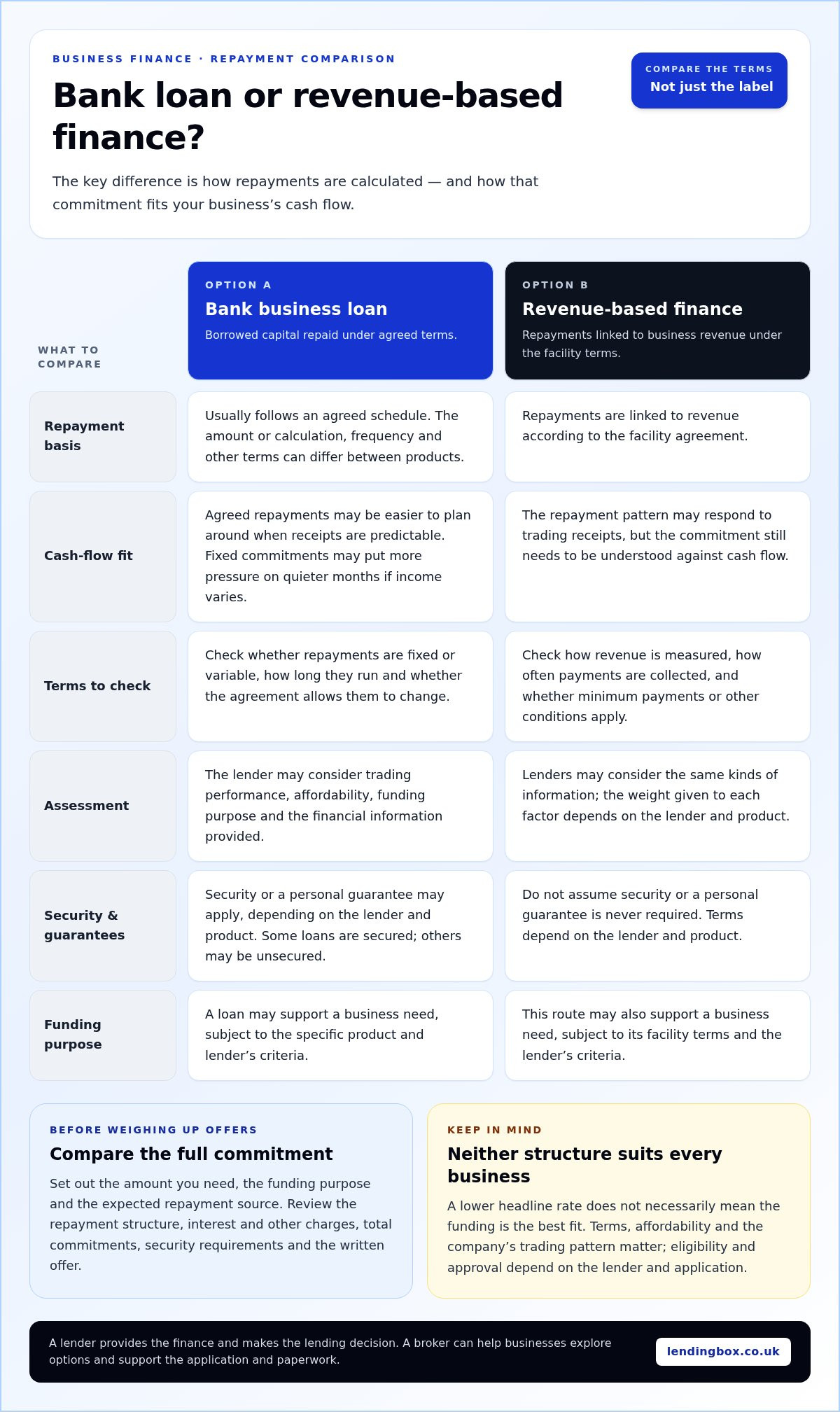
What to compare before choosing a business lending route
Compare the commitment, not just the amount offered. Before choosing a business lending bank or another finance route, define what the funding will pay for, how much the business needs and where repayments will come from. Then work through this checklist to compare suitability, affordability and the details that shape your obligations.
- Define the funding need. Set out the planned use, amount required and when the funds are needed. Separate essential costs from optional spending. Borrowing more than the business needs can increase the commitment without solving a bigger problem.
- Name the repayment source. Identify which income will support repayments, such as regular customer receipts or revenue from a specific project. Consider whether that income is predictable, seasonal or dependent on customers paying on time. Match the repayment pattern to realistic cash flow, not best-case sales.
- Compare the full obligation. Look beyond the headline rate. Check the total amount repayable, any fees, repayment frequency and duration. Confirm whether payments can change, and what the agreement says about missed or late payments. Compare offers on the same basis to see the practical differences.
- Understand security and guarantees. Read whether the agreement requires business assets as security or asks a director to provide a personal guarantee. Check who could be responsible and what the terms mean if the business can’t repay. If any part is unclear, consider independent legal or financial advice before signing.
- Test affordability with current figures. Bring together recent management accounts, forecasts and details of existing borrowing or other financial commitments. Model repayments against realistic trading scenarios, including a weaker period or delayed receipts. Preparation helps you assess affordability and support an application, but it doesn’t guarantee approval.
Questions to ask about the agreement
Read the written terms before committing. How often are repayments due, and for how long? What fees apply, and what happens if a payment is missed? Are repayments fixed or linked to revenue? Is security or a director’s personal guarantee required? Make sure you understand the answers, not just the product description. If the consequences or wording are unclear, seek independent advice suited to your circumstances.
Prepare a clear picture of affordability
Use up-to-date records to build a grounded view of what the business can repay. Compare forecasts with actual trading, account for existing commitments and test how payments fit in ordinary and weaker periods. A forecast is a planning tool, not a promise of future income. Review assumptions carefully, particularly where sales fluctuate or receipts arrive unevenly.
If you’re weighing up a business loan against revenue-based finance, Lending Box can help UK limited companies and LLPs explore options across the market. Explore business finance options with support through the application and paperwork.
How Lending Box helps businesses explore bank and alternative finance
A search for a business lending bank can raise another question: should you approach a lender yourself, or use a broker to explore more than one route? Lending Box is a whole-of-market commercial finance broker for UK limited companies and LLPs. It arranges finance but does not lend directly. The lender assesses the application and decides whether to offer finance and on what terms.
That distinction matters. A broker can help you compare potential funding structures against your business’s needs, but it can’t control a lender’s decision or promise that finance will be available. The aim is to make the options and application process easier to understand, so you can consider the terms in light of your cash flow and priorities.
What support does a finance broker provide?
Lending Box helps businesses consider business loans and revenue-based finance across the market. A dedicated relationship manager guides clients through the available options, application and paperwork. This support can help you organise the information a lender needs and understand how a proposed repayment structure relates to your funding purpose.
Lending Box also uses an in-house lending model to provide eligibility insights without impacting credit scores. These insights can help inform your next steps, but they aren’t an approval, an offer of finance or a guarantee of funding. Each lender makes its own assessment using its criteria and the details of your application.
Keep the roles clear: the broker helps arrange finance and supports the application; the lender assesses it. The proposed amount, repayment terms, security requirements and any personal guarantee depend on the lender, product and individual business. Read the written offer carefully before deciding whether it works for you.
Where a personal guarantee is part of an offer, Lending Box can also arrange personal guarantee insurance for directors through Purbeck Insurance. Review the cover and its terms alongside the guarantee before making a decision.
Take a clear next step with Lending Box
Start with three points: what the funding is for, what the business can afford to repay, and which repayment structure works alongside expected receipts. Use current accounts and realistic forecasts to explain the business’s position. If income varies, consider how proposed payments would fit weaker as well as typical trading periods.
These details give the comparison a practical focus. Rather than choosing based on the words “bank loan” or “revenue-based finance” alone, assess how each option’s terms relate to the business’s purpose, affordability and repayment capacity. Lending Box helps UK limited companies and LLPs explore potential finance options and guides them through the application process. Lender decisions and funding outcomes remain subject to assessment.
Explore business finance options with Lending Box.
Make your next funding decision with clarity
Before acting on a business lending bank offer, turn your cash-flow forecast into a practical test. Note the repayment dates, the income expected to cover them and the room left for normal operating costs. This gives you a clear basis for weighing an offer against the demands of running your business.
If you want to explore alternatives, Lending Box helps UK limited companies and LLPs consider options across the market as a commercial finance broker. A dedicated relationship manager guides you through applications and paperwork, while eligibility insights from its in-house model don’t impact credit scores. Those insights can inform your next step, but they aren’t a lender’s approval or a guarantee of finance.
Focus on a structure your business can afford, not simply the most familiar route. Explore business finance options with Lending Box and take your next step with a clearer view of the choices.
Frequently Asked Questions
Is a bank loan the same as a business loan?
No. A bank loan is one type of business loan; companies may also seek finance from non-bank lenders. A broker has a separate role: it helps arrange finance but doesn’t provide the loan or make the lender’s decision. Two offers both called business loans could have different repayment dates, security terms and eligibility requirements. Compare the written agreements and repayment structures, not just the product names.
Can a limited company get a business loan from a bank?
Yes, a limited company can apply, but the lender decides whether it meets the relevant criteria. It may review trading performance, affordability, accounts and existing commitments, alongside the company’s funding purpose. A business lending bank won’t necessarily assess every application in the same way. Applying doesn’t guarantee approval. A broker can help the company explore finance options and organise application paperwork, but the lender makes the credit decision.
How does revenue-based finance differ from a bank loan?
A bank loan usually has repayments set out under agreed terms, whilst revenue-based finance links repayments to revenue as defined in its agreement. Neither structure is automatically cheaper or more flexible. For instance, a business with variable sales should check how the revenue calculation responds to stronger and weaker periods. Review the full obligations and test expected repayments against realistic cash-flow forecasts before deciding whether either structure fits.
Do business bank loans require a personal guarantee?
Not always. Whether a personal guarantee is required depends on the lender, product and application. A guarantee may make a director personally responsible for specified borrowing if the company doesn’t meet its obligations. Before signing, establish its scope, the circumstances in which it could apply and the potential implications for you personally. If the wording or consequences are unclear, consider independent legal or financial advice rather than relying on assumptions.
Will checking business finance eligibility affect my credit score?
The effect depends on the type of search and the finance provider’s process. Lending Box provides eligibility insights through its in-house lending model without impacting credit scores. An insight can help a business understand potential options, but it isn’t the same as a formal lender application or credit decision. It doesn’t guarantee an offer or approval. Clarify what kind of check is being made before proceeding with any separate finance application.
What should I compare before accepting a business loan offer?
Compare the full commitment, not only the headline rate. Check the repayment schedule, total amount repayable, fees, duration and payment dates. Review any security or personal guarantee, plus what the agreement says about missed payments. Then test repayments against a realistic cash-flow forecast that includes existing commitments and quieter trading periods. Lender and product terms differ, so use the written offer as your reference before accepting.
Frequently Asked Questions
A business loan is borrowed capital that the company repays under agreed terms. The agreement sets out the repayment schedule, interest and other charges, and whether security is required. Some loans are secured against an asset; others may be unsecured. A personal guarantee may also form part of an offer, depending on the lender and product. These details vary, so review the specific agreement rather than relying on the label “bank loan”. For a wider overview of types and structures, see this guide to the business loan. The lender assesses the application and decides whether to offer finance, and on what terms. A broker has a different role: helping a business consider potential routes and supporting the application and paperwork. Using a broker doesn’t guarantee approval. The lender’s own criteria and assessment still apply.
Lending Box helps businesses consider business loans and revenue-based finance across the market. A dedicated relationship manager guides clients through the available options, application and paperwork. This support can help you organise the information a lender needs and understand how a proposed repayment structure relates to your funding purpose. Lending Box also uses an in-house lending model to provide eligibility insights without impacting credit scores. These insights can help inform your next steps, but they aren’t an approval, an offer of finance or a guarantee of funding. Each lender makes its own assessment using its criteria and the details of your application. Keep the roles clear: the broker helps arrange finance and supports the application; the lender assesses it. The proposed amount, repayment terms, security requirements and any personal guarantee depend on the lender, product and individual business. Read the written offer carefully before deciding whether it works for you. Where a personal guarantee is part of an offer, Lending Box can also arrange personal guarantee insurance for directors through Purbeck Insurance. Review the cover and its terms alongside the guarantee before making a decision.
No. A bank loan is one type of business loan; companies may also seek finance from non-bank lenders. A broker has a separate role: it helps arrange finance but doesn’t provide the loan or make the lender’s decision. Two offers both called business loans could have different repayment dates, security terms and eligibility requirements. Compare the written agreements and repayment structures, not just the product names.
Yes, a limited company can apply, but the lender decides whether it meets the relevant criteria. It may review trading performance, affordability, accounts and existing commitments, alongside the company’s funding purpose. A business lending bank won’t necessarily assess every application in the same way. Applying doesn’t guarantee approval. A broker can help the company explore finance options and organise application paperwork, but the lender makes the credit decision.
A bank loan usually has repayments set out under agreed terms, whilst revenue-based finance links repayments to revenue as defined in its agreement. Neither structure is automatically cheaper or more flexible. For instance, a business with variable sales should check how the revenue calculation responds to stronger and weaker periods. Review the full obligations and test expected repayments against realistic cash-flow forecasts before deciding whether either structure fits.
Not always. Whether a personal guarantee is required depends on the lender, product and application. A guarantee may make a director personally responsible for specified borrowing if the company doesn’t meet its obligations. Before signing, establish its scope, the circumstances in which it could apply and the potential implications for you personally. If the wording or consequences are unclear, consider independent legal or financial advice rather than relying on assumptions.
The effect depends on the type of search and the finance provider’s process. Lending Box provides eligibility insights through its in-house lending model without impacting credit scores. An insight can help a business understand potential options, but it isn’t the same as a formal lender application or credit decision. It doesn’t guarantee an offer or approval. Clarify what kind of check is being made before proceeding with any separate finance application.
Compare the full commitment, not only the headline rate. Check the repayment schedule, total amount repayable, fees, duration and payment dates. Review any security or personal guarantee, plus what the agreement says about missed payments. Then test repayments against a realistic cash-flow forecast that includes existing commitments and quieter trading periods. Lender and product terms differ, so use the written offer as your reference before accepting.