
Business Loans UK: A Practical Guide for Growing Businesses
10 October 2026 · 16 min read

The lowest headline rate isn’t automatically the best fit for your business. The right borrowing route depends on what the money needs to do, how you’ll repay it and what level of risk your business can manage. If you’re comparing business loans UK options, those questions matter as much as the amount you want to borrow.
It’s understandable if the choices feel unclear. A term loan, invoice finance and asset finance work differently, while lender checks, personal guarantees and repayment terms can all affect your decision. Getting to grips with the essentials first can help you assess whether borrowing is realistic for your cash flow.
This guide explains the main UK business finance options, what lenders may consider and how to compare repayments with your business’s income and commitments. It also covers what to prepare before exploring finance, and how eligibility insights can help you consider options before a formal application. The aim is to help you understand the choices and decide on a practical next step.
Key Takeaways
- Business borrowing provides capital under agreed repayment terms. Match the finance type to its purpose, whether that’s investment, working capital or a temporary cash-flow gap.
- Compare business loans UK options by how the funds will be repaid. Term loans, invoice finance, asset finance and revenue-based finance each work differently.
- Build a realistic cash-flow forecast before borrowing. Test repayments against weaker trading periods and consider any security or personal guarantee requirements.
- Separate a specific, time-bound funding need from a persistent cash-flow shortfall. Define the need, repayment source and risks before exploring finance.
- Lending Box arranges finance as a broker, not a lender. Its eligibility insights help limited companies and LLPs explore options without impacting credit scores.
What are business loans in the UK, and when can they help?
Business borrowing provides capital that a company repays under agreed terms. A lender may set a repayment schedule, interest rate and other conditions based on the finance and the business’s circumstances. Funds can support a defined business need, but borrowing also creates a commitment that must fit future cash flow.
A business loan is funding borrowed by a business and repaid under agreed terms; applying does not guarantee approval. When comparing business loans UK options, start with the purpose of the funding and the likely source of repayment.
The legal borrower matters. With company borrowing, the limited company or LLP takes on the debt rather than a director borrowing personally. However, a lender may require a director to provide a personal guarantee. If the business cannot meet its obligations, that guarantee may expose the guarantor to personal liability under its terms. Read the agreement carefully and understand who is responsible before committing.
What can a UK business loan be used for?
Funding might help a company buy stock ahead of a busy period, invest in expansion, purchase equipment or bridge a timing gap between paying suppliers and receiving customer payments. The best-fit finance depends on what the money will fund and how the business expects to repay it. Buying a specific asset may point towards asset finance, while a broader investment could suit a term loan.
Separate a planned investment from a persistent trading shortfall. Borrowing for a defined project may make sense if the business can explain the expected benefit and map a realistic repayment source. Using new debt to cover ongoing losses can add repayments without resolving the underlying problem. Review cash-flow forecasts and identify what needs to change before taking on more commitments.
Industry context can also help you test assumptions about a project or trading cycle. The UK business and trade associations list offers a starting point for finding relevant industry organisations, which may provide useful context for planning.
Who can apply for business finance?
Lending Box works with UK limited companies and LLPs. That describes the types of businesses it supports, not an automatic route to funding. Lenders set their own criteria, which can differ by product, provider and business circumstances. A company’s structure or time trading alone doesn’t determine whether it will qualify.
Assessment may take account of the funding purpose and the business’s ability to repay, alongside information requested by the lender. Before exploring options, set out the amount needed, what it will fund and where repayments are expected to come from. This gives you a clearer basis for considering finance without assuming every product will suit every company.
Which UK business finance types could match your funding need?
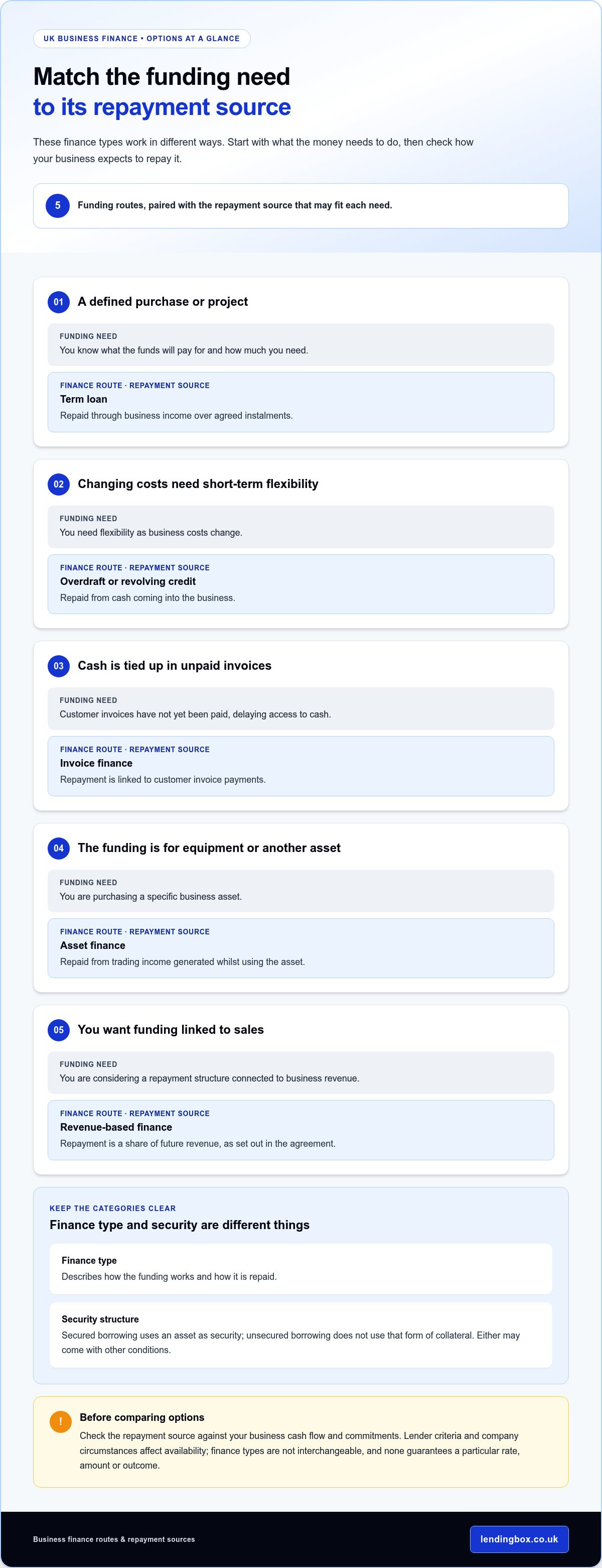
Start with what the funding needs to do, then consider how the business will repay it. These options work in different ways, so they aren’t interchangeable. Availability depends on lender criteria and your company’s circumstances.
| Funding need | Finance type | Typical repayment source |
|---|---|---|
| A defined purchase or project | Term loan | Business income over agreed instalments |
| Short-term flexibility for changing costs | Overdraft or revolving credit | Cash coming into the business |
| Cash tied up in unpaid invoices | Invoice finance | Customer invoice payments |
| Equipment or another business asset | Asset finance | Trading income generated while using the asset |
| Funding linked to sales | Revenue-based finance | A share of future revenue, as set out in the agreement |
A term loan provides a set amount for a defined purpose, repaid according to an agreed schedule. Invoice finance relates to unpaid customer invoices, while asset finance is connected to an asset. Revenue-based finance has its own repayment structure, linked to revenue rather than a standard fixed instalment pattern. Review the agreement to understand exactly how repayments are calculated.
These are finance types, not security labels. Secured borrowing involves an asset being offered as security, while unsecured borrowing doesn’t use that form of collateral. Either structure may come with other conditions, and neither guarantees a particular rate, amount or outcome.
When might a business loan be a better fit?
A term loan may suit a company that knows how much it needs, what the funds will pay for and where repayments should come from. For example, a business planning a specific refurbishment could forecast how the investment may support income, then compare that with the proposed repayment schedule. Offers differ, so compare the total commitment and terms rather than assuming one structure fits every company.
When should you consider an alternative finance route?
Invoice finance may be relevant if unpaid customer invoices are delaying access to cash. Asset finance may fit a purchase tied to equipment or another business asset. Revenue-based finance is another distinct option, with repayments linked to revenue under the agreement. For early-stage businesses, the government-backed Start Up Loan scheme is another route to explore.
When choosing between business loans UK options, start with the repayment source: regular business income, customer receipts, an asset or future sales. Lending Box arranges finance as a broker, matching companies with lender options. Review business finance options to explore routes that may suit your company’s funding need.
Can your business manage repayments, security and personal guarantees?
Borrowing can support operations or help a company act on a growth plan. But repayments remain a business commitment, even if sales fall or customers pay late. Before comparing business loans UK, test whether the business can keep up with repayments without relying on best-case trading assumptions.
Security and personal guarantees create different forms of risk. With secured borrowing, an asset is offered as security. If the business doesn’t meet its obligations, the lender may have rights over that asset under the agreement. A personal guarantee is a separate commitment made by a director or another individual. These arrangements can apply in different combinations, so check what each specific offer requires.
How should you assess repayment affordability?
Build a cash-flow forecast that sets expected money coming in against regular outgoings, existing finance commitments and proposed repayments. Use realistic timing: a profitable month on paper may still leave a cash shortage if customer invoices are paid late.
Test the forecast against weaker trading periods, seasonal changes and unexpected costs. Ask whether repayments remain manageable if income arrives later than expected or a key expense rises. There’s no universal affordability threshold for every business. Lenders assess applications differently, and a lender’s decision doesn’t replace your own assessment of what the company can sustain.
Compare a normal forecast with a more cautious version. If the business can meet repayments only under the most optimistic scenario, pause and review the amount, timing or funding route before proceeding.
What does a personal guarantee mean for a director?
A director who signs a personal guarantee may accept personal liability if the company doesn’t repay as agreed. A personal guarantee can expose a director’s personal assets if the company can’t meet its obligations, subject to the guarantee’s terms. The exact scope depends on the wording and conditions in the agreement.
Before signing, understand which obligations the guarantee covers, when it could be called on and whether it has limits or conditions. Don’t treat it as a routine formality. If any wording is unclear, seek independent professional advice before committing.
Lending Box arranges personal guarantee insurance through Purbeck Insurance. This is an option to consider, not a substitute for understanding the guarantee itself. Think about how the potential liability fits your personal risk tolerance as well as the company’s ability to repay.
Keep the forecast, existing commitments and proposed terms together. This makes it easier to see whether repayments and any security or guarantee obligations remain workable if trading conditions become less favourable.
How can you judge whether business borrowing fits your plans?
A clear decision starts before you compare offers. Set out what the business needs, how the funds will be used and what will repay the borrowing. This helps you judge whether business loans UK could support a defined plan or whether another response is needed.
- Define the need. Describe the business purpose and work out the amount required. Treat this as an internal estimate, not a sum a lender is certain to offer.
- Identify the repayment source. Pinpoint the income or receipts expected to cover repayments, and when they should arrive.
- Assess the risk. Review current commitments, possible cash-flow changes and any security or personal guarantee a finance offer may involve.
- Explore options. Compare finance types and terms against the need and repayment plan, rather than starting with the maximum amount available.
Start with the business need and repayment source
Be specific about the intended use. A time-bound need, such as funding a planned project with a clear start and end point, differs from a recurring gap between income and outgoings. Borrowing may support a defined trading or investment plan, but repeated shortfalls call for a closer look at costs, margins and payment timing. New finance alone may not fix an ongoing cash-flow problem.
Then map the repayment source. Will it come from general trading income, a project’s anticipated returns or customer receipts? Note the timing as well as the source. If repayments begin before the expected income arrives, the business may need enough working capital to cover the gap.
Check the impact before pursuing an offer
Set proposed repayments alongside existing borrowing and a realistic cash-flow forecast. Consider what could change if customer payments are delayed, sales dip or costs rise. Also account for any asset offered as security and any personal guarantee requested. The aim is to understand the effect on the company and, where relevant, the individual taking on a commitment.
An eligibility insight and a formal lender assessment are different stages. Lending Box’s in-house model provides eligibility insights without impacting credit scores. These insights can help a business explore potential routes, but they aren’t a lending decision or a promise of approval. A lender makes its own assessment when considering a formal application.
Keep this stage focused on whether borrowing fits. Once you’ve made that decision, you can prepare the information and paperwork needed for an application.
If you’ve defined the need and repayment source, explore business finance options with Lending Box. As a broker, Lending Box matches UK limited companies and LLPs with lender options and guides them through the application process.
How Lending Box helps UK companies explore business loans
Comparing business loans UK can mean weighing different lenders, requirements and repayment structures. Lending Box helps UK limited companies and LLPs explore those options as a whole-of-market commercial finance broker. It arranges finance by matching businesses with lenders. Lending Box isn’t the lender, and each lender makes its own decision on an application.
The process starts with company information, which helps provide an initial eligibility insight and a basis for exploring potential options before a full lender application. Lending Box’s in-house model provides these insights without impacting credit scores. An insight isn’t a credit decision or a promise of approval; formal assessments and outcomes rest with lenders.
What happens when a business explores options with Lending Box?
The company’s funding need and circumstances help inform the options explored. Lending Box matches limited companies and LLPs with lender options across the market rather than lending directly. A dedicated relationship manager guides the business through the process, helps explain the available routes and handles application paperwork. This support can make the process easier to navigate, while the lender remains responsible for assessing the application and deciding whether to offer finance.
Clear information about the intended use of funds and expected repayment source helps focus the discussion. It also helps distinguish between products that may look similar at first but work differently in practice.
Which funding routes can Lending Box help businesses explore?
Options include business loans and several forms of alternative finance. The right route depends on the funding purpose, the company’s circumstances and lender criteria. Lending Box can arrange:
- Business loans for a defined funding requirement, subject to lender terms and assessment.
- Revenue-based finance linked to business revenue under the terms of the finance agreement.
- Invoice finance connected to unpaid customer invoices.
- Asset finance linked to equipment or another business asset.
- Property and secured finance, where the proposed funding involves property or security.
- Business credit cards for business spending, subject to the provider’s terms.
- The Growth Guarantee Scheme, where a business and facility meet scheme and lender requirements.
These routes aren’t interchangeable, and no product, rate, decision time or approval is guaranteed. Consider the proposed repayments, any security or guarantee requirements, and how the finance fits the business’s plans before proceeding.
If your company is ready to explore its options, start a conversation with Lending Box. A relationship manager can guide you through the process and paperwork; any offer, decision and funding remain subject to the lender’s assessment and terms.
Move forward with a funding plan you can stand behind
Turn a funding idea into a decision-ready plan by setting out what the money would make possible, when it’s needed and how the business expects to manage the commitment. That gives you a practical basis for exploring business loans UK without treating borrowing as an automatic answer.
For UK limited companies and LLPs, Lending Box provides whole-of-market commercial finance brokerage, not direct lending. Its in-house eligibility insights don’t impact credit scores. A dedicated relationship manager can guide you through lender options and handle application paperwork, helping you focus on what each route means for your business.
Explore business finance options with Lending Box and take the next step with a clearer view of potential routes. Eligibility insights aren’t lender decisions, and any offer or funding remains subject to the lender’s assessment and terms.
Frequently Asked Questions
Can a limited company get a business loan in the UK?
Yes, a UK limited company can apply for business finance, but approval depends on the lender’s criteria and the company’s circumstances. Lenders may consider factors such as cash flow, trading performance, existing commitments and the purpose of borrowing. When comparing business loans UK, check whether an option is intended for companies and what information the lender needs. Lending Box works with limited companies and LLPs to explore finance options.
Will checking business loan eligibility affect my credit score?
It depends on the type of check. Lending Box’s in-house eligibility insights don’t impact credit scores. A later lender application may involve a credit search, and the type of search can vary by lender and product. Before proceeding, understand whether the next step is an initial eligibility check or a formal application. They’re different stages, and an eligibility insight isn’t a lender’s final decision.
Do UK business loans always require a personal guarantee?
No. Whether a personal guarantee is required depends on the lender, product and application. One offer may rely on business security, while another may ask a director to guarantee some or all of the borrowing. Terms can differ, so check who is giving the guarantee, what obligations it covers and when it may be called on. Don’t assume a company loan creates no personal exposure just because the company is the borrower.
Can a business get finance with bad credit?
It may be possible to explore finance with a poor credit history, but options and terms depend on the lender’s assessment. A past missed payment doesn’t tell the whole story: the lender may also consider current trading, cash flow, existing debts and the reason for the credit issue. Lending Box arranges bad credit options, but this doesn’t mean every application will be accepted or offered the same terms.
Can a start-up get a business loan in the UK?
Yes, a start-up may be able to apply, although a short trading history can affect which finance routes are suitable. Lenders set their own criteria, so prepare a clear account of the business model, expected income and how repayments could be met. Early-stage businesses can also review the government’s Start Up Loan scheme, which has its own eligibility rules and terms. An application doesn’t guarantee funding.
Is Growth Guarantee Scheme funding a guaranteed business loan?
No. The Growth Guarantee Scheme doesn’t guarantee that a business will receive a loan. It provides a government guarantee to participating lenders, while the lender still assesses each application and decides whether to offer finance. The business remains responsible for repaying any borrowing under the agreed terms. Check current scheme requirements and the specific facility conditions, as eligibility and lender criteria apply.
Can business loan funds be used for any business expense?
Not necessarily. The permitted use can depend on the lender, finance product and terms of the agreement. Some facilities are linked to a defined purpose, such as buying equipment, while others may cover broader business needs. Before accepting an offer, make sure the intended spending fits the facility conditions and clarify any restrictions. Don’t assume business borrowing can be used for personal costs or an unrelated purpose.
Frequently Asked Questions
Funding might help a company buy stock ahead of a busy period, invest in expansion, purchase equipment or bridge a timing gap between paying suppliers and receiving customer payments. The best-fit finance depends on what the money will fund and how the business expects to repay it. Buying a specific asset may point towards asset finance, while a broader investment could suit a term loan. Separate a planned investment from a persistent trading shortfall. Borrowing for a defined project may make sense if the business can explain the expected benefit and map a realistic repayment source. Using new debt to cover ongoing losses can add repayments without resolving the underlying problem. Review cash-flow forecasts and identify what needs to change before taking on more commitments. Industry context can also help you test assumptions about a project or trading cycle. The UK business and trade associations list offers a starting point for finding relevant industry organisations, which may provide useful context for planning.
Lending Box works with UK limited companies and LLPs. That describes the types of businesses it supports, not an automatic route to funding. Lenders set their own criteria, which can differ by product, provider and business circumstances. A company’s structure or time trading alone doesn’t determine whether it will qualify. Assessment may take account of the funding purpose and the business’s ability to repay, alongside information requested by the lender. Before exploring options, set out the amount needed, what it will fund and where repayments are expected to come from. This gives you a clearer basis for considering finance without assuming every product will suit every company. Start with what the funding needs to do, then consider how the business will repay it. These options work in different ways, so they aren’t interchangeable. Availability depends on lender criteria and your company’s circumstances. A term loan provides a set amount for a defined purpose, repaid according to an agreed schedule. Invoice finance relates to unpaid customer invoices, while asset finance is connected to an asset. Revenue-based finance has its own repayment structure, linked to revenue rather than a standard fixed instalment pattern. Review the agreement to understand exactly how repayments are calculated. These are finance types, not security labels. Secured borrowing involves an asset being offered as security, while unsecured borrowing doesn’t use that form of collateral. Either structure may come with other conditions, and neither guarantees a particular rate, amount or outcome.
A term loan may suit a company that knows how much it needs, what the funds will pay for and where repayments should come from. For example, a business planning a specific refurbishment could forecast how the investment may support income, then compare that with the proposed repayment schedule. Offers differ, so compare the total commitment and terms rather than assuming one structure fits every company.
Invoice finance may be relevant if unpaid customer invoices are delaying access to cash. Asset finance may fit a purchase tied to equipment or another business asset. Revenue-based finance is another distinct option, with repayments linked to revenue under the agreement. For early-stage businesses, the government-backed Start Up Loan scheme is another route to explore. When choosing between business loans UK options, start with the repayment source: regular business income, customer receipts, an asset or future sales. Lending Box arranges finance as a broker, matching companies with lender options. Review business finance options to explore routes that may suit your company’s funding need. Borrowing can support operations or help a company act on a growth plan. But repayments remain a business commitment, even if sales fall or customers pay late. Before comparing business loans UK, test whether the business can keep up with repayments without relying on best-case trading assumptions. Security and personal guarantees create different forms of risk. With secured borrowing, an asset is offered as security. If the business doesn’t meet its obligations, the lender may have rights over that asset under the agreement. A personal guarantee is a separate commitment made by a director or another individual. These arrangements can apply in different combinations, so check what each specific offer requires.
Build a cash-flow forecast that sets expected money coming in against regular outgoings, existing finance commitments and proposed repayments. Use realistic timing: a profitable month on paper may still leave a cash shortage if customer invoices are paid late. Test the forecast against weaker trading periods, seasonal changes and unexpected costs. Ask whether repayments remain manageable if income arrives later than expected or a key expense rises. There’s no universal affordability threshold for every business. Lenders assess applications differently, and a lender’s decision doesn’t replace your own assessment of what the company can sustain. Compare a normal forecast with a more cautious version. If the business can meet repayments only under the most optimistic scenario, pause and review the amount, timing or funding route before proceeding.
A director who signs a personal guarantee may accept personal liability if the company doesn’t repay as agreed. A personal guarantee can expose a director’s personal assets if the company can’t meet its obligations, subject to the guarantee’s terms. The exact scope depends on the wording and conditions in the agreement. Before signing, understand which obligations the guarantee covers, when it could be called on and whether it has limits or conditions. Don’t treat it as a routine formality. If any wording is unclear, seek independent professional advice before committing. Lending Box arranges personal guarantee insurance through Purbeck Insurance. This is an option to consider, not a substitute for understanding the guarantee itself. Think about how the potential liability fits your personal risk tolerance as well as the company’s ability to repay. Keep the forecast, existing commitments and proposed terms together. This makes it easier to see whether repayments and any security or guarantee obligations remain workable if trading conditions become less favourable. A clear decision starts before you compare offers. Set out what the business needs, how the funds will be used and what will repay the borrowing. This helps you judge whether business loans UK could support a defined plan or whether another response is needed.
The company’s funding need and circumstances help inform the options explored. Lending Box matches limited companies and LLPs with lender options across the market rather than lending directly. A dedicated relationship manager guides the business through the process, helps explain the available routes and handles application paperwork. This support can make the process easier to navigate, while the lender remains responsible for assessing the application and deciding whether to offer finance. Clear information about the intended use of funds and expected repayment source helps focus the discussion. It also helps distinguish between products that may look similar at first but work differently in practice.
Options include business loans and several forms of alternative finance. The right route depends on the funding purpose, the company’s circumstances and lender criteria. Lending Box can arrange: These routes aren’t interchangeable, and no product, rate, decision time or approval is guaranteed. Consider the proposed repayments, any security or guarantee requirements, and how the finance fits the business’s plans before proceeding. If your company is ready to explore its options, start a conversation with Lending Box. A relationship manager can guide you through the process and paperwork; any offer, decision and funding remain subject to the lender’s assessment and terms. Turn a funding idea into a decision-ready plan by setting out what the money would make possible, when it’s needed and how the business expects to manage the commitment. That gives you a practical basis for exploring business loans UK without treating borrowing as an automatic answer. For UK limited companies and LLPs, Lending Box provides whole-of-market commercial finance brokerage, not direct lending. Its in-house eligibility insights don’t impact credit scores. A dedicated relationship manager can guide you through lender options and handle application paperwork, helping you focus on what each route means for your business. Explore business finance options with Lending Box and take the next step with a clearer view of potential routes. Eligibility insights aren’t lender decisions, and any offer or funding remains subject to the lender’s assessment and terms.
Yes, a UK limited company can apply for business finance, but approval depends on the lender’s criteria and the company’s circumstances. Lenders may consider factors such as cash flow, trading performance, existing commitments and the purpose of borrowing. When comparing business loans UK, check whether an option is intended for companies and what information the lender needs. Lending Box works with limited companies and LLPs to explore finance options.
It depends on the type of check. Lending Box’s in-house eligibility insights don’t impact credit scores. A later lender application may involve a credit search, and the type of search can vary by lender and product. Before proceeding, understand whether the next step is an initial eligibility check or a formal application. They’re different stages, and an eligibility insight isn’t a lender’s final decision.
No. Whether a personal guarantee is required depends on the lender, product and application. One offer may rely on business security, while another may ask a director to guarantee some or all of the borrowing. Terms can differ, so check who is giving the guarantee, what obligations it covers and when it may be called on. Don’t assume a company loan creates no personal exposure just because the company is the borrower.
It may be possible to explore finance with a poor credit history, but options and terms depend on the lender’s assessment. A past missed payment doesn’t tell the whole story: the lender may also consider current trading, cash flow, existing debts and the reason for the credit issue. Lending Box arranges bad credit options, but this doesn’t mean every application will be accepted or offered the same terms.
Yes, a start-up may be able to apply, although a short trading history can affect which finance routes are suitable. Lenders set their own criteria, so prepare a clear account of the business model, expected income and how repayments could be met. Early-stage businesses can also review the government’s Start Up Loan scheme, which has its own eligibility rules and terms. An application doesn’t guarantee funding.
No. The Growth Guarantee Scheme doesn’t guarantee that a business will receive a loan. It provides a government guarantee to participating lenders, while the lender still assesses each application and decides whether to offer finance. The business remains responsible for repaying any borrowing under the agreed terms. Check current scheme requirements and the specific facility conditions, as eligibility and lender criteria apply.
Not necessarily. The permitted use can depend on the lender, finance product and terms of the agreement. Some facilities are linked to a defined purpose, such as buying equipment, while others may cover broader business needs. Before accepting an offer, make sure the intended spending fits the facility conditions and clarify any restrictions. Don’t assume business borrowing can be used for personal costs or an unrelated purpose.