
Finance for Business: Understand Your UK Funding Options
11 October 2026 · 16 min read

The best finance for business isn’t always the option with the lowest headline rate. It’s the structure that fits the cash-flow need you’re addressing and that your business can manage to repay.
A business loan, invoice finance and revenue-based finance work in different ways. Choosing a structure that doesn’t fit your income pattern could put pressure on cash flow. Eligibility, application paperwork and personal guarantees can also affect which options are available and what you’re comfortable taking on.
This guide explains the main business-finance options in plain English and how to connect a funding need with a suitable structure. You’ll learn what to compare before applying, including repayment timing, security and the information lenders may request. Lending Box uses company information to provide initial eligibility insights without impacting credit scores, and a dedicated relationship manager can guide you through application paperwork. Start with the need, then assess the options.
Key Takeaways
- Start with the business need, then consider which finance for business structure may address it.
- Compare options by how repayments work, whether security is involved and the likely effect on cash flow.
- Prepare for an application by defining the purpose, reviewing cash flow and organising company information.
- Lenders set their own eligibility criteria, so the information required can vary between applications.
- A whole-of-market broker can help compare funding structures and guide you through application paperwork.
Finance for business: start with the need behind the funding
Business finance is money a business uses to keep operating, invest in what it needs or fund planned growth. The term covers different ways of accessing funds, and the right option depends on what the money needs to do. A gap between paying suppliers and receiving customer payments calls for a different assessment from buying equipment or expanding into new premises.
Separate the funding need from the finance product. The need is the problem or plan; the product is how funds are provided and repaid. This distinction keeps the focus on the repayment source and timing, rather than the product name alone. For a wider overview, see Understanding Business Finance.
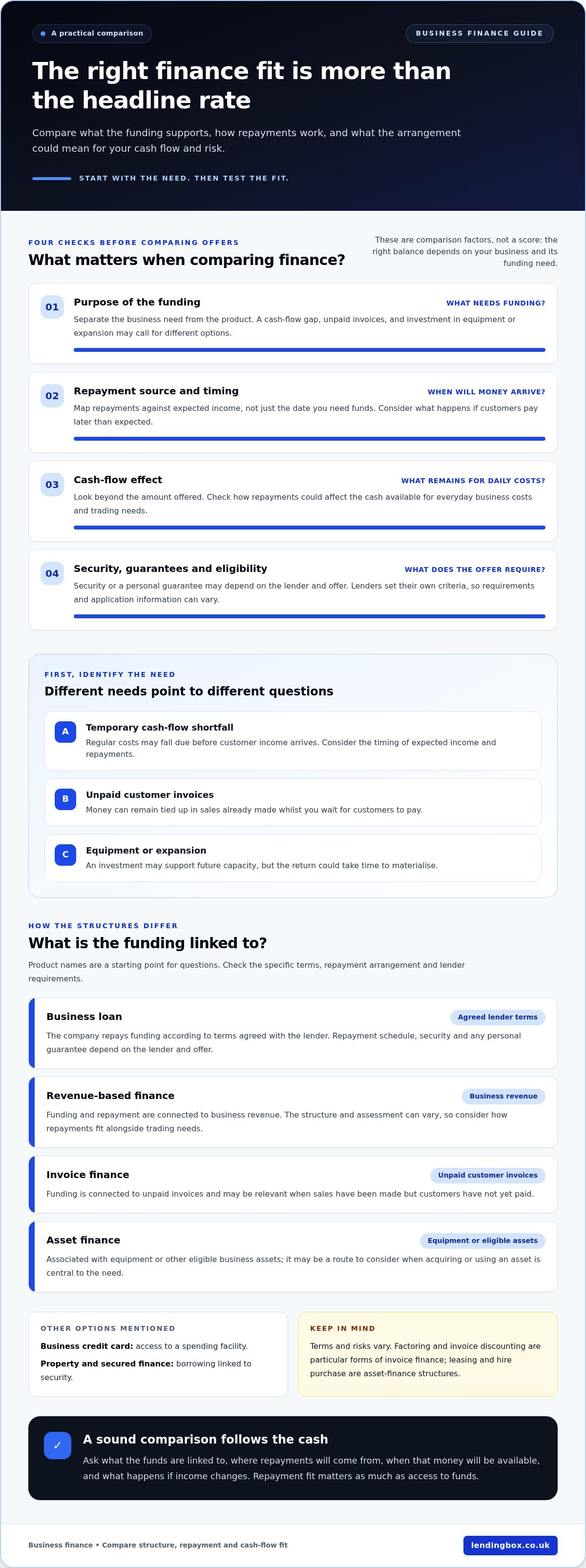
Write down what the funds would cover and when the business expects to benefit. For example:
- A temporary cash-flow shortfall may arise when regular costs fall due before customer income arrives.
- Unpaid invoices can leave money tied up in sales the business has already made.
- Equipment investment or expansion may support future capacity, but the return could take time to materialise.
This purpose can narrow the options worth comparing. It also points to the next question: where will repayments come from, and when will that money be available?
Which business needs might call for external finance?
Working-capital pressure is often about timing. A business may need funds to cover a short-term gap while waiting for customer payments or managing uneven income. Planned investment is different: equipment, additional capacity or expansion may be intended to generate value over a longer period. In either case, map repayments against expected income, not just the date the funds are needed. If repayment depends on invoices being paid, consider what happens if customers pay later than expected.
Who can explore finance for a UK business?
A limited company is legally separate from its owners. An LLP is a separate legal structure whose members run the business. A sole trader operates as an individual, without a separate legal entity for the business. These structures can affect how a finance application is assessed, but lenders set their own criteria and may request different information. Meeting a basic description does not guarantee eligibility.
Lending Box supports UK limited companies and LLPs with finance options from lenders across the market. It uses company information to provide initial eligibility insights without impacting credit scores. This can help indicate which routes may be relevant before you progress an application, while the final decision remains with the lender.
How the main finance for business options work
Finance products can address similar needs, but they don’t all provide funds in the same way. The key differences are what the funding is linked to, how repayment is structured and what the lender assesses. Understanding these distinctions helps you shortlist options before comparing terms.
A business loan is repaid under agreed lender terms, while invoice and asset finance are linked to specific business invoices or assets. This is a useful starting point, not a decision about which option suits your company. Your purpose, financial position and the lender’s criteria all matter.
Loans and revenue-based finance at a glance
A business loan provides funding that the company repays according to terms agreed with the lender. It may suit a defined business need, but the repayment schedule and any security or personal guarantee depend on the lender and the offer.
Revenue-based finance is a distinct option where the funding and repayment arrangement is connected to business revenue. The structure and assessment can vary, so don’t assume it will suit every company or income pattern. Consider how the proposed repayments would fit alongside your trading needs. A guide to revenue-based finance can explain the structure in more detail.
Invoice finance and asset finance at a glance
Invoice finance connects funding to unpaid customer invoices. It may be relevant when a business has made sales but is waiting for customers to pay. Asset finance is associated with equipment or other eligible business assets, making it a potential route when acquiring or using an asset is the central need. The specific arrangements depend on the lender and product.
These broad descriptions aren’t a substitute for checking the terms. Factoring and invoice discounting are particular forms of invoice finance; leasing and hire purchase are asset-finance structures. Each works differently, so a guide to invoice finance or asset finance can help explain those distinctions before you compare offers.
Other options may suit different requirements. A business credit card can provide access to a spending facility, while property and secured finance involves borrowing linked to security. Terms and risks vary. For a wider view of support routes, GOV.UK provides information on UK Government Business Finance Support.
Use the product label as a prompt for questions, not as the answer. Ask what the funds are linked to, how repayment is expected to work and what could happen if business income changes. A finance broker can help compare options from lenders across the market. Explore finance options with Lending Box to consider which structures may fit your company’s needs.
Compare business finance by cash flow, repayment, and risk
A useful comparison goes beyond the amount offered. Consider what the funding supports, how repayments are calculated or scheduled, whether security or a personal guarantee is involved, and how the arrangement could affect cash available for everyday costs.
Repayment fit matters as much as access to funds. A structure that meets an immediate need may still be difficult to manage if its repayment pattern clashes with when the business receives income. Use the table as a starting point, then check the details of each lender’s proposal.
| Finance type | Possible funding purpose | Repayment basis | Security and cash-flow points |
|---|---|---|---|
| Business loan | A defined business cost or investment | Set out in the lender’s agreed terms | Security or a personal guarantee may be required. Assess scheduled repayments against expected income. |
| Revenue-based finance | A business need where a revenue-linked structure may be relevant | Linked to business revenue under the agreed arrangement | Consider how payments could interact with changing revenue and the business’s other commitments. |
| Invoice finance | Cash tied up in unpaid customer invoices | Connected to invoices and the arrangement’s terms | Review how the facility works alongside invoice payments and customer collection timings. |
| Asset finance | Equipment or another eligible business asset | Set out in the agreement for the asset-related funding | Check the asset and agreement terms, and the effect of repayments on available working capital. |
Match the funding structure to the business need
Start with the pressure point. If working capital is tight because customer receipts arrive after regular bills fall due, focus on repayment timing and the expected date of incoming cash. If unpaid invoices are the main issue, compare invoice finance. For equipment, assess asset finance alongside the cost and timing of the investment. Revenue-based finance is another possible structure, not a default recommendation. The business’s trading pattern, purpose and lender criteria all affect suitability.
Then test the proposal against the intended use of funds. Does the repayment period make sense alongside the benefit the funding is meant to support? Will repayments leave enough cash for wages, suppliers, tax and other commitments? These questions can reveal a poor fit before you commit.
Assess affordability, security, and personal guarantees
Forecast repayments against realistic cash-flow scenarios, not just an optimistic sales plan. Include a slower-income period or delayed customer payments, then check whether the business could still meet its obligations. Compare total repayment obligations and associated terms, not only a headline rate or cost. Fees, repayment timing and conditions can all affect the overall picture.
Some lenders may require security or a director’s personal guarantee. Read the proposed terms carefully and understand the responsibility they create. Personal guarantee insurance is a separate option to consider, but it should not be treated as a promise that every loss or circumstance will be covered.
Prepare a stronger finance application without overpromising
A clear application starts with a clear purpose. Explain what the funding would support, why it’s needed now and how the business expects to meet repayments. This gives you a practical basis for exploring finance for business and assessing whether a proposed structure fits.
Preparation won’t guarantee an offer. Lenders set their own eligibility criteria, assess applications individually and may request different information. Use this sequence to organise your thinking and records:
- Define the purpose. Describe the planned use of funds and estimate what the business needs. Connect the amount to a specific requirement rather than using a broad, unsupported figure.
- Review cash flow. Check income, regular outgoings and upcoming commitments. Consider how the business would manage repayments if receipts were delayed or trading income fell below expectations.
- Organise company information. Gather relevant financial records and business details so you can respond clearly to requests. The information needed may vary by lender and finance type.
- Assess the terms. Before progressing, understand the repayment basis, total obligations, any security and whether a personal guarantee applies.
Information to organise before exploring finance
Prepare a short explanation of the funding purpose, an estimate of the amount needed and the expected business benefit. Bring together current account records, cash-flow forecasts and up-to-date company information where available. These can help you describe how money moves through the business and identify possible repayment pressure points. Treat this as preparation, not a fixed document checklist. Lenders decide what they need to assess each application.
Make sure the figures tell a consistent story. If the funding is intended for a particular purchase or business plan, your estimate and forecast should reflect that purpose. Note seasonal income patterns and significant planned costs too. Clear context can make discussions about the business’s needs more focused.
Understand checks, decisions, and responsibilities
An initial eligibility insight is not a loan offer or approval. It can indicate which options may be relevant, but the lender makes its own assessment and decision. Lending Box uses company information to provide initial eligibility insights without impacting credit scores. A lender may still request further information or carry out additional checks as part of its process.
Before accepting an offer, read the terms carefully. Check when repayments are due, how they’re worked out and what the agreement says about security or a personal guarantee. If a guarantee is involved, understand the responsibility it creates before proceeding. Don’t rely on an eligibility indication as confirmation that funding will be approved or that repayments will suit your cash flow.
Once you’ve organised the key information, explore finance options for your business with Lending Box. A dedicated relationship manager can guide you through the application paperwork and help you consider options from lenders across the market.
Explore finance for business with Lending Box
Comparing funding options can take time, particularly when lenders assess applications in different ways. Lending Box is a UK whole-of-market commercial finance broker, not a direct lender. It helps limited companies and LLPs explore options from lenders across the market, matching the business’s funding need with relevant structures.
Options include business loans, revenue-based finance, invoice finance and asset finance. These serve different purposes and have different terms. The right route depends on the company’s circumstances, the use of funds and lender criteria. A broker can help you compare possible routes, while the lender makes its own assessment and decides whether to offer finance.
What support does a relationship manager provide?
A dedicated relationship manager guides you through the process. They can help you consider relevant finance options, explain the application steps and handle paperwork with you. They can also help organise information and guide you through the application process. This doesn’t guarantee a lender’s decision or change the criteria used to assess your application.
Lending Box also uses company information to provide initial eligibility insights without impacting credit scores. These insights can help frame the next steps, but they aren’t an offer or approval. The lender may request further information and will make its own decision.
Take the next step with a clear funding purpose
Before exploring options, prepare a concise summary of what the business needs funding for, how the funds will be used and what benefit you expect them to support. The need might relate to cash flow, unpaid invoices or equipment investment. A clear purpose helps keep the discussion practical and makes it easier to consider which finance structures may be relevant.
Be ready to discuss how repayments could fit the company’s cash flow and whether a proposed arrangement includes security or a personal guarantee. The terms matter as much as the funding purpose, so take time to understand the obligations before progressing.
Finance for business should be considered in the context of your company’s needs, not chosen by product name alone. If your organisation is a UK limited company or LLP, you can explore business finance options with Lending Box. Share the funding purpose and relevant company information to begin considering potential routes. Any finance application remains subject to the lender’s criteria, assessment and decision.
Make your next funding decision with clarity
Before pursuing finance for business, turn your funding purpose into a practical decision brief. Set out what the money will support, when it’s needed and how repayments could fit the company’s plans. This gives you a clearer basis for weighing possible routes and deciding what questions to resolve before an application moves forward.
Lending Box helps UK limited companies and LLPs compare options from lenders across the market. Company information can provide initial eligibility insights without impacting credit scores, while a dedicated relationship manager can guide you through the application and paperwork. These steps can make the process more structured, but lender criteria and decisions still apply.
When you’re ready, explore finance options for your business with Lending Box. Bring your funding purpose into the conversation to assess possible routes and decide your next move carefully.
Frequently Asked Questions
Can a limited company get finance for business?
Yes. A limited company can explore finance for business, subject to the lender’s criteria and assessment. The company’s trading history, financial position and reason for borrowing can help shape which options are relevant. For example, a business planning a major purchase may compare different structures from one facing a short-term cash gap. An initial eligibility insight isn’t a confirmed offer.
Does checking business finance eligibility affect my credit score?
Lending Box’s initial eligibility insights use company information and don’t impact credit scores. This differs from a lender’s later assessment of a full application, where checks and processes may vary. Before progressing, review the information provided about the checks involved and make sure you understand what will happen to the application and the data supplied.
Do all business finance applications require a personal guarantee?
No. Requirements depend on the lender, finance structure and circumstances of the application. Some lenders may ask a director to provide a personal guarantee, even where the finance isn’t secured against a specific business asset. If a guarantee is proposed, read its terms carefully and understand the personal responsibility it creates. Personal guarantee insurance is a separate consideration, not an automatic feature of finance or a guaranteed outcome.
How quickly can a business finance application be decided?
There isn’t one decision time that applies to every application. The timeframe can depend on the lender’s process, the type of finance and whether the information supplied is complete. Further questions or requests for company records may affect progress. A broker can help organise paperwork, but can’t guarantee when a lender will decide. Avoid making business commitments on the assumption that funding will arrive by a particular date.
Can an LLP apply for business finance in the UK?
Yes. A UK limited liability partnership can explore business finance, and Lending Box supports LLPs as well as limited companies. The options available depend on the LLP’s purpose, financial information and the criteria of the lender assessing the application. Prepare details about the partnership’s trading and funding need, but expect requirements to vary. Eligibility insights can indicate which routes may be worth exploring, not confirm approval.
Can a business use more than one type of finance?
Potentially, yes. A business might use one facility for an asset purchase and another to address a separate cash-flow need, subject to lender criteria and affordability. The combined repayments and obligations matter: existing finance can affect how much room remains in the budget and how a new application is assessed. Keep a clear record of current commitments and consider their combined effect on cash flow before taking on further borrowing.
Frequently Asked Questions
Working-capital pressure is often about timing. A business may need funds to cover a short-term gap while waiting for customer payments or managing uneven income. Planned investment is different: equipment, additional capacity or expansion may be intended to generate value over a longer period. In either case, map repayments against expected income, not just the date the funds are needed. If repayment depends on invoices being paid, consider what happens if customers pay later than expected.
A limited company is legally separate from its owners. An LLP is a separate legal structure whose members run the business. A sole trader operates as an individual, without a separate legal entity for the business. These structures can affect how a finance application is assessed, but lenders set their own criteria and may request different information. Meeting a basic description does not guarantee eligibility. Lending Box supports UK limited companies and LLPs with finance options from lenders across the market. It uses company information to provide initial eligibility insights without impacting credit scores. This can help indicate which routes may be relevant before you progress an application, while the final decision remains with the lender. Finance products can address similar needs, but they don’t all provide funds in the same way. The key differences are what the funding is linked to, how repayment is structured and what the lender assesses. Understanding these distinctions helps you shortlist options before comparing terms. A business loan is repaid under agreed lender terms, while invoice and asset finance are linked to specific business invoices or assets. This is a useful starting point, not a decision about which option suits your company. Your purpose, financial position and the lender’s criteria all matter.
A dedicated relationship manager guides you through the process. They can help you consider relevant finance options, explain the application steps and handle paperwork with you. They can also help organise information and guide you through the application process. This doesn’t guarantee a lender’s decision or change the criteria used to assess your application. Lending Box also uses company information to provide initial eligibility insights without impacting credit scores. These insights can help frame the next steps, but they aren’t an offer or approval. The lender may request further information and will make its own decision.
Yes. A limited company can explore finance for business, subject to the lender’s criteria and assessment. The company’s trading history, financial position and reason for borrowing can help shape which options are relevant. For example, a business planning a major purchase may compare different structures from one facing a short-term cash gap. An initial eligibility insight isn’t a confirmed offer.
Lending Box’s initial eligibility insights use company information and don’t impact credit scores. This differs from a lender’s later assessment of a full application, where checks and processes may vary. Before progressing, review the information provided about the checks involved and make sure you understand what will happen to the application and the data supplied.
No. Requirements depend on the lender, finance structure and circumstances of the application. Some lenders may ask a director to provide a personal guarantee, even where the finance isn’t secured against a specific business asset. If a guarantee is proposed, read its terms carefully and understand the personal responsibility it creates. Personal guarantee insurance is a separate consideration, not an automatic feature of finance or a guaranteed outcome.
There isn’t one decision time that applies to every application. The timeframe can depend on the lender’s process, the type of finance and whether the information supplied is complete. Further questions or requests for company records may affect progress. A broker can help organise paperwork, but can’t guarantee when a lender will decide. Avoid making business commitments on the assumption that funding will arrive by a particular date.
Yes. A UK limited liability partnership can explore business finance, and Lending Box supports LLPs as well as limited companies. The options available depend on the LLP’s purpose, financial information and the criteria of the lender assessing the application. Prepare details about the partnership’s trading and funding need, but expect requirements to vary. Eligibility insights can indicate which routes may be worth exploring, not confirm approval.
Potentially, yes. A business might use one facility for an asset purchase and another to address a separate cash-flow need, subject to lender criteria and affordability. The combined repayments and obligations matter: existing finance can affect how much room remains in the budget and how a new application is assessed. Keep a clear record of current commitments and consider their combined effect on cash flow before taking on further borrowing.