
Best UK business lenders 2026: compare options
11 October 2026 · 16 min read

The lender with the lowest advertised rate may not be the right fit for your business. The best business lenders are those whose criteria, finance structure and repayments match your trading history, cash flow and plans.
Banks, challenger banks and specialist finance providers assess businesses in different ways. To narrow your options, start by understanding what you need the funding for and what information a lender may use to assess your application.
This guide compares lender types and finance options, from business loans to invoice and asset finance. It explains how to weigh up total cost, repayment fit and application requirements, and how a broker can use company-data-led eligibility insights to help identify potential options before you proceed. You’ll also find practical steps for comparing terms and preparing an application.
Key Takeaways
- The best business lenders are the ones whose criteria, finance structure and repayments suit your company, not simply those with the lowest headline rates.
- Compare banks, specialist lenders and finance providers by the types of businesses and funding needs they may suit.
- Look beyond the advertised rate. Check the full repayment obligation, fees, repayment frequency, term and early repayment conditions.
- Build a shortlist by defining your funding need, choosing a finance type and testing how repayments fit your forecasts before applying.
- A broker can connect your business with potential lenders and support the application process, but can’t guarantee approval or funding times.
Best business lenders: what makes a lender right for your company?
The best business lenders for your company are those whose eligibility criteria, finance structure and repayments fit the way your business trades. A familiar name or an attractive headline rate is only a starting point. Suitability depends on what you need the money for, your trading history, cash flow and whether you can offer security.
This comparison focuses on UK finance options for trading companies. It isn’t a universal ranking: a lender that suits an established company with regular invoices may not suit a newer business buying equipment. Before comparing providers, define the funding purpose and consider how repayments would fit alongside your usual costs. A general overview of types of business loans can help clarify the broad options.
It also helps to distinguish a lender from a broker. A lender assesses an application and provides finance if it approves it. A broker doesn’t lend. It helps businesses compare or arrange options with lenders and may support the application process. Lending Box is a broker for limited companies and LLPs, with company-data-led eligibility insights designed not to impact credit scores.
Why the highest-profile lender may not be the best fit
Lenders set their own criteria and assess risk differently. They may consider trading history, financial performance, sector, cash flow and security in different ways. A well-known bank may suit a business with established accounts and a straightforward borrowing need, whilst a specialist provider may consider a different finance structure or business profile. Recognition alone won’t tell you whether your company is eligible.
Speed and suitability are separate considerations. A quick decision can help when timing matters, but it doesn’t make a repayment plan affordable. Check whether repayments would remain manageable during quieter trading periods as well as stronger ones. If your plan relies on an optimistic sales forecast, a fast offer could still put pressure on working capital.
Match the finance type to the business need
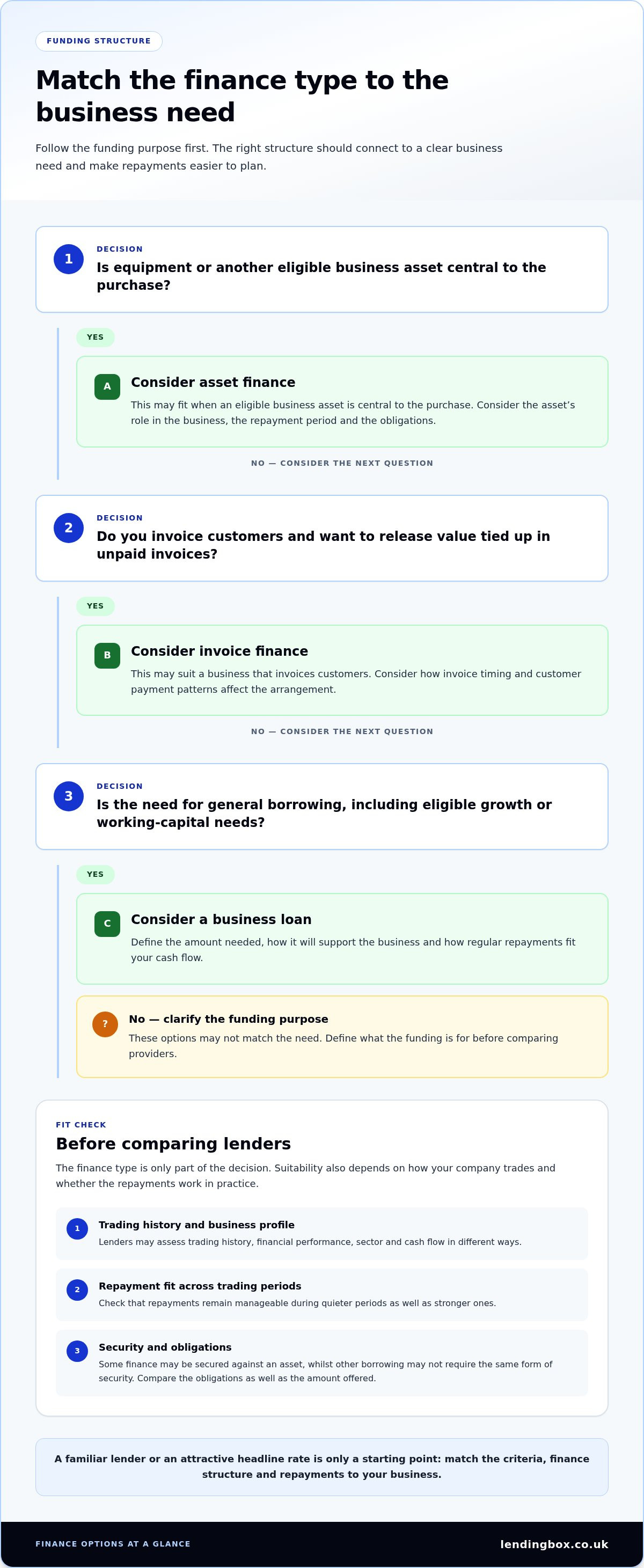
Start with the purpose of the funding. The right structure can make repayments easier to plan and connect the borrowing to a clear business need.
- Business loan: Consider this for general borrowing, including eligible growth or working-capital needs. Define the amount required, how it will support the business and how regular repayments fit your cash flow.
- Invoice finance: This may suit a business that invoices customers and wants to release value tied up in unpaid invoices. Consider how invoice timing and customer payment patterns affect the arrangement.
- Asset finance: This may fit when equipment or another eligible business asset is central to the purchase. The asset and its role in the business are important parts of the funding decision.
Security can also affect which options are relevant. Some finance may be secured against an asset, whilst other borrowing may not require the same form of security. Compare the obligations as well as the amount offered. Next, assess lenders by category and compare their terms against your company’s needs.
Best business lenders by type: banks, specialist lenders and finance providers
Different lender categories serve different needs. Banks may offer lending alongside wider banking relationships, whilst specialist lenders and finance providers may focus on a particular type of funding, asset or business profile. The examples below are illustrative, not a ranking or a promise of eligibility. Products and criteria can change, so compare the current terms that apply to your company.
| Category | Typical focus | Possible fit | Points to compare |
|---|---|---|---|
| High-street and challenger banks | Business lending, sometimes alongside wider banking services | Companies seeking a loan and an established banking relationship | Eligibility, security, repayment structure and support |
| Specialist lenders | Particular sectors, assets or funding needs | Businesses whose requirements suit a specialist approach | Sector or asset criteria, terms and repayment flexibility |
| Invoice finance providers | Releasing value tied up in unpaid invoices | Businesses that invoice customers and need funding linked to receivables | How funding and repayments relate to invoice payments |
| Asset finance providers | Funding centred on eligible business assets | Companies acquiring equipment or another business asset | Asset requirements, repayment period and obligations |
| Business finance brokers | Comparing or arranging options with lenders | Companies wanting support to assess different finance routes | Which lenders and finance structures are considered |
Banks and challenger banks
A bank may be a natural place to explore if your company already has a business banking relationship, but that relationship alone doesn’t establish eligibility or make its finance the best match. OakNorth is one illustrative example of a UK bank with business finance and digital banking propositions, and a stated focus on ambitious businesses. It isn’t ranked here. Compare its current offer, as you would any bank’s, against your funding purpose and the terms available to your company.
Look closely at the full criteria, any security required, the repayment structure and the support provided through the application. A digital process or quick decision may be convenient, but the repayment plan still needs to work with your trading cycle.
Specialist lenders and finance providers
Specialist lenders may focus on particular sectors, assets or funding situations. Finance structures also differ: a business loan involves borrowing an agreed amount; revenue-based finance links repayments to revenue; invoice finance centres on unpaid invoices; and asset finance is built around an eligible asset. These options aren’t interchangeable, and none suits every company. Match the structure to how your business earns and uses cash.
Brokerage is a separate route, not a type of lender. Lending Box is a whole-of-market broker for limited companies and LLPs. Its company-data-led eligibility insights are designed not to impact credit scores, and a dedicated relationship manager guides clients through lender requirements and application paperwork. Explore business finance options with Lending Box.
How to compare business lenders beyond headline rates
The lowest advertised rate doesn’t always mean the lowest-cost or most manageable offer. Compare the full amount your company would repay, including interest and any fees, then check how the schedule fits your trading cycle. Compare like with like: the same borrowing need, term and finance structure. A rate on its own can’t show whether repayments will remain workable through a quieter month.
Use this checklist to compare the best business lenders on more than price:
- Total cost: Review interest, arrangement or other stated fees, and the full repayment obligation.
- Repayment terms: Check frequency, term, whether the rate is fixed or variable, and any early repayment conditions.
- Security: Establish what assets may be used as security and whether a personal guarantee may be requested.
- Service: Understand what the application requires, who supports it and how the lender handles the account afterwards.
Eligibility, credit checks and application impact
Criteria vary by lender. Compare requirements for trading history, turnover evidence, company structure and sector with your business records. A lender may ask for accounts, management information or other details to assess the company. Prepare the information requested and make sure it reflects your current position.
Separate an initial eligibility search from a full application. Search methods and their effects on your credit record can differ, so establish what type of search will take place before proceeding. Lending Box uses company data to provide eligibility insights designed not to impact credit scores. These insights can help you assess potential options before making a lender application.
Repayments, security and personal guarantees
Test repayments against your own cash-flow forecast, not just your expected average month. Include seasonal dips, existing commitments and the timing of customer payments. Check whether repayments are weekly, monthly or linked to revenue, and whether early repayment changes the amount due. A shorter term may mean larger regular commitments, so assess the schedule as well as the total cost.
If security or a personal guarantee is involved, read the written terms closely. Understand what property or assets are covered, the guarantee’s scope and duration, and the conditions for release. Don’t assume a guarantee ends when borrowing reduces or the business changes. Personal guarantee insurance is a separate consideration, not automatic cover; review its terms independently.
Before accepting an offer, make sure the written terms match what you’ve been shown. Check fees, repayment dates, conditions and the process for ongoing servicing. Raise anything unclear before signing. You should be able to understand both the company’s commitments and any personal exposure, then compare the actual obligations rather than relying on speed or a headline rate.
Build a business lender shortlist that fits your funding need
A useful shortlist starts with your company’s numbers, not a provider’s name. Define what the funding needs to achieve, when you need it and how the business expects to repay it. Then compare finance types and lender criteria against that picture. This focuses your search on the best business lenders for your circumstances, rather than encouraging broad applications in the hope that one option fits.
Work through these steps in order:
- Define the need. Set out the planned use of funds, the amount required and the timing. Separate an immediate cash-flow gap from a longer-term investment, such as equipment or expansion.
- Select a finance type. Match the purpose to a suitable structure, such as a business loan for general borrowing, invoice finance for unpaid invoices or asset finance for an eligible purchase.
- Assess fit. Compare each lender’s stated criteria with your trading history, company structure, sector and financial information. Remove options that clearly don’t match.
- Compare terms. Review repayment amounts and timing, total cost, security requirements and any conditions that could affect the business later.
- Apply selectively. Once you understand the relevant criteria and have comparable information ready, proceed with the options that best fit your needs.
Start with the funding purpose and repayment plan
Quantify the need using your own forecasts. For example, map when an equipment purchase must be paid for against when it may contribute to revenue. For a cash-flow requirement, identify the timing and likely duration of the gap. Test proposed repayments against expected income, regular outgoings and quieter trading periods. This helps distinguish urgent funding from investment that can be planned on a longer timetable.
If you’re weighing up a bank loan, consider whether a bank loan fits your business. For a wider view of available structures, the UK business funding options guide can help put the shortlist in context.
Prepare a focused, comparable application
Organise current management accounts, bank statements, forecasts and details of existing borrowing. Use consistent figures and business information when comparing indicative options. Different assumptions can make offers difficult to assess side by side. Check what each relevant lender asks for and how it assesses applications. Avoid applying indiscriminately; a focused approach keeps your comparison tied to your actual funding need.
Lending Box supports limited companies and LLPs in comparing finance routes. Its company-data-led eligibility insights are designed not to impact credit scores, and a dedicated relationship manager supports clients with lender requirements and application paperwork.
Use a business finance broker to navigate lender options
A broker can help turn a broad search into a focused comparison. It connects a business with potential lenders, helps assess finance routes and supports the application process. A broker isn’t the lender: the lender makes its own decision, and no broker can guarantee approval or funding times.
Broker support can make lender criteria and paperwork easier to manage, but it doesn’t remove the need to compare the offer itself. Your company still needs to assess proposed repayments, costs, security and written terms before deciding whether to proceed.
What support can a broker provide?
Lending Box is a whole-of-market broker for limited companies and LLPs across the UK. It helps businesses explore potential lender options rather than lending directly. A dedicated relationship manager guides clients through the process, helps with lender requirements and handles application paperwork.
The comparison can span different structures, including business loans, revenue-based finance, invoice finance and asset finance. Each works differently. A loan may suit a defined borrowing need; invoice finance relates to unpaid invoices; asset finance centres on an eligible business asset; and revenue-based finance links repayments to revenue. The relevant route depends on your funding purpose, trading profile and forecast cash flow.
Company-data-led eligibility insights can help you assess potential options before proceeding. Lending Box designs these insights not to impact credit scores. They aren’t a lending decision or a promise of approval. The chosen lender will still assess the application against its own criteria.
Broker support can help you understand the information a lender needs and manage the application steps. A relationship manager can help organise paperwork and explain requirements, so you can focus on whether an option suits the business, not just whether it appears available.
Move from shortlist to next steps
Before taking an application forward, revisit four points: what the funding is for, whether the company fits the lender’s criteria, how repayments work with your forecasts, and what security or personal obligations may apply. Then read the written terms carefully. Check that they reflect the offer you’re considering, including repayment timing, conditions and any early repayment provisions. Seek clarity on anything you don’t understand before accepting.
The best business lenders aren’t simply the ones a broker can introduce. They’re the options whose structure and obligations make sense for your company. Use support to compare, then make your decision against your own needs and numbers.
If you’re ready to explore possible routes for your limited company or LLP, compare business finance options with Lending Box. The team can help you navigate lender requirements and application paperwork, whilst the lender retains responsibility for its decision.
Make your next funding decision with confidence
Turn your shortlist into a decision you can explain and plan for. Set out what the finance will enable, how it fits your forecasts and which commitments your business can manage. This gives you a clear basis for weighing offers, rather than choosing under pressure or focusing on a single headline term.
Lending Box works across the market for UK limited companies and LLPs. Its company-data-led eligibility insights are designed not to impact credit scores, and a dedicated relationship manager can guide you through lender requirements and application paperwork. Lending Box is a broker, not a lender, so the lender makes the decision on any application.
Explore business finance options with Lending Box to take the next step with a clearer view of what may fit your company.
Frequently Asked Questions
Who is the best business lender for a small UK company?
There isn’t one lender that suits every small company. The best business lenders for you depend on the funding purpose, how long you’ve traded, your cash-flow pattern and the repayments you can manage. A company waiting for customer payments, for example, may need a different structure from one buying equipment. Compare options against that specific need, rather than choosing by brand recognition alone.
Can I compare business lenders without affecting my credit score?
Often, you can make an initial comparison without a full credit search, but the method varies. Some eligibility checks use a soft search or business information; a formal application may involve a lender checking credit records. Before proceeding, establish what type of search will happen and whose file it may affect, such as the company’s or a director’s. Don’t assume every comparison tool uses the same process.
Do business lenders always require a personal guarantee?
No. Whether a lender asks for a personal guarantee depends on its assessment and the finance terms. If one is requested, read the guarantee document carefully before signing. Check which obligations it covers, whether it has a limit, how long it lasts and what conditions allow release. A guarantee can create personal exposure if the company can’t meet its obligations. Any personal guarantee insurance is separate, not automatic cover.
Can a UK company get business finance with bad credit?
Possibly. Some finance options may consider businesses with adverse credit, but approval and terms depend on the lender’s assessment. Be ready to explain the circumstances, whether the issue has been resolved and what has changed since. Recent trading information can help show the company’s current position. Give accurate details in an application; missing or inconsistent information can make it harder for a lender to assess the request.
Are online business lenders different from banks?
Online describes how a lender takes applications or serves customers, not necessarily a separate type of lender. Some banks have online application journeys, whilst specialist finance providers may also operate digitally. The important differences lie in the lender’s criteria, finance structure, servicing and written terms. Compare those features directly. A streamlined online process may save administration, but it doesn’t by itself show whether the finance suits your company.
Can a new business qualify for finance from a lender?
Potentially, though a short trading record can limit the evidence available to assess an application. Some routes may place more weight on forecasts, contracts, assets or the directors’ experience. The UK Start Up Loans scheme allows eligible businesses trading for up to five years to apply for up to £25,000 per individual. Check the scheme’s current eligibility rules and terms before relying on it as a funding route.
Does using a business finance broker guarantee approval?
No. A broker can help identify potential options and support an application, but the lender makes the lending decision. It assesses the business against its own criteria and may ask for further information or impose conditions. Even an initial indication isn’t the same as a final offer or completed funding. Treat broker support as help with the search and application, not as a promise of approval or timing.
Frequently Asked Questions
Lending Box is a whole-of-market broker for limited companies and LLPs across the UK. It helps businesses explore potential lender options rather than lending directly. A dedicated relationship manager guides clients through the process, helps with lender requirements and handles application paperwork. The comparison can span different structures, including business loans, revenue-based finance, invoice finance and asset finance. Each works differently. A loan may suit a defined borrowing need; invoice finance relates to unpaid invoices; asset finance centres on an eligible business asset; and revenue-based finance links repayments to revenue. The relevant route depends on your funding purpose, trading profile and forecast cash flow. Company-data-led eligibility insights can help you assess potential options before proceeding. Lending Box designs these insights not to impact credit scores. They aren’t a lending decision or a promise of approval. The chosen lender will still assess the application against its own criteria. Broker support can help you understand the information a lender needs and manage the application steps. A relationship manager can help organise paperwork and explain requirements, so you can focus on whether an option suits the business, not just whether it appears available.
There isn’t one lender that suits every small company. The best business lenders for you depend on the funding purpose, how long you’ve traded, your cash-flow pattern and the repayments you can manage. A company waiting for customer payments, for example, may need a different structure from one buying equipment. Compare options against that specific need, rather than choosing by brand recognition alone.
Often, you can make an initial comparison without a full credit search, but the method varies. Some eligibility checks use a soft search or business information; a formal application may involve a lender checking credit records. Before proceeding, establish what type of search will happen and whose file it may affect, such as the company’s or a director’s. Don’t assume every comparison tool uses the same process.
No. Whether a lender asks for a personal guarantee depends on its assessment and the finance terms. If one is requested, read the guarantee document carefully before signing. Check which obligations it covers, whether it has a limit, how long it lasts and what conditions allow release. A guarantee can create personal exposure if the company can’t meet its obligations. Any personal guarantee insurance is separate, not automatic cover.
Possibly. Some finance options may consider businesses with adverse credit, but approval and terms depend on the lender’s assessment. Be ready to explain the circumstances, whether the issue has been resolved and what has changed since. Recent trading information can help show the company’s current position. Give accurate details in an application; missing or inconsistent information can make it harder for a lender to assess the request.
Online describes how a lender takes applications or serves customers, not necessarily a separate type of lender. Some banks have online application journeys, whilst specialist finance providers may also operate digitally. The important differences lie in the lender’s criteria, finance structure, servicing and written terms. Compare those features directly. A streamlined online process may save administration, but it doesn’t by itself show whether the finance suits your company.
Potentially, though a short trading record can limit the evidence available to assess an application. Some routes may place more weight on forecasts, contracts, assets or the directors’ experience. The UK Start Up Loans scheme allows eligible businesses trading for up to five years to apply for up to £25,000 per individual. Check the scheme’s current eligibility rules and terms before relying on it as a funding route.
No. A broker can help identify potential options and support an application, but the lender makes the lending decision. It assesses the business against its own criteria and may ask for further information or impose conditions. Even an initial indication isn’t the same as a final offer or completed funding. Treat broker support as help with the search and application, not as a promise of approval or timing.