
Invoice Finance UK: How to Choose the Right Funding Option
13 October 2026 · 17 min read

The best invoice finance UK option may not be the one that releases the most cash. It’s the one that fits how you manage customers, collections and day-to-day costs. When invoices remain unpaid during agreed payment terms, it can be harder to cover wages or supplier bills, even after work is complete. Invoice finance may help bridge that timing gap, but the differences between facilities, fees and customer-facing arrangements matter.
This guide explains how invoice finance works and compares factoring, invoice discounting and selective funding. You’ll see what to weigh up around control, collections and recourse, and what information to prepare before exploring an option. Use those details to assess whether a facility fits your invoicing pattern and cash-flow needs.
Lending Box is a whole-of-market commercial finance broker for UK limited companies and LLPs. We match businesses with lenders and provide a dedicated relationship manager to guide applications and paperwork. Read on to understand how each structure works, what to compare and how to match a facility to your credit-control process.
Key Takeaways
- See how invoice finance UK may help bridge the gap between issuing an invoice and receiving payment.
- Understand the usual steps from submitting invoices to reconciling customer payments, and why facility terms vary.
- Compare factoring, invoice discounting and selective finance by collections responsibility, invoice scope and operational fit.
- Use your invoice volumes, customer payment patterns and credit-control process to assess whether a facility may suit your business.
- Learn which agreement terms to compare and how Lending Box helps UK limited companies and LLPs explore lender options.
Invoice finance UK: when can unpaid invoices create a cash-flow gap?
You issue an invoice today, but your customer pays later under the agreed terms. In the meantime, wages, supplier bills and other costs still fall due. That delay can create a cash-flow gap even when the work is complete and you expect the customer to pay.
Invoice finance UK businesses use is funding linked to eligible unpaid invoices. A lender may advance part of an invoice’s value before the customer pays, then reconcile the account when payment arrives. The lender’s assessment and the agreement determine which invoices qualify, how much may be advanced and what the facility costs. An invoice isn’t automatically eligible just because it has been issued.
Invoice finance releases working capital against unpaid invoices; a conventional term loan provides borrowing repaid over an agreed schedule. To compare the two, consider when you need cash, how reliably your customers pay and whether the facility’s terms suit the way your business operates.
How invoice finance connects invoices to working capital
The process starts when your business completes work or supplies goods and issues an invoice. You submit eligible invoices under the facility. After assessing them against its criteria, the lender may provide an agreed advance. The amount advanced and any balance held back depend on the facility terms.
When the customer pays, the payment is used to settle the finance against the invoice. The lender then accounts for any retained balance and charges as set out in the agreement. With invoice discounting, the business generally remains responsible for managing customer payments, although arrangements vary. The customer still owes the invoiced amount in every structure. Funding changes when your business can access some of that value, not the customer’s obligation to pay.
Which cash-flow problems might invoice finance address?
Invoice finance may help bridge a timing mismatch. For example, a business might need to pay staff this month while a customer’s invoice falls due later. A supplier deposit or materials bill may also arrive before payment for completed work. A growing company can face a similar gap when it needs to meet new orders before customers settle existing invoices.
That’s different from being unable to meet obligations because income or margins are persistently insufficient. Finance linked to invoices brings forward some cash, but it doesn’t fix an underlying shortfall or make an unprofitable contract viable. Any repayments and charges still need to fit the business’s wider cash-flow plan.
Look at the pattern, not just the immediate gap. Regular invoices to established customers, with payment dates that can be understood from past experience, may make future cash needs easier to assess. Irregular billing, disputed invoices or customers who often pay late can make the amount and timing of available funds less predictable. Before exploring a facility, map when invoices are raised, when customers usually pay and which commitments fall due in between. This can help you judge whether the pressure is a temporary timing gap that may align with invoice funding, or a broader cash-flow problem that needs a different response.
How invoice finance works: advances, repayments and recourse
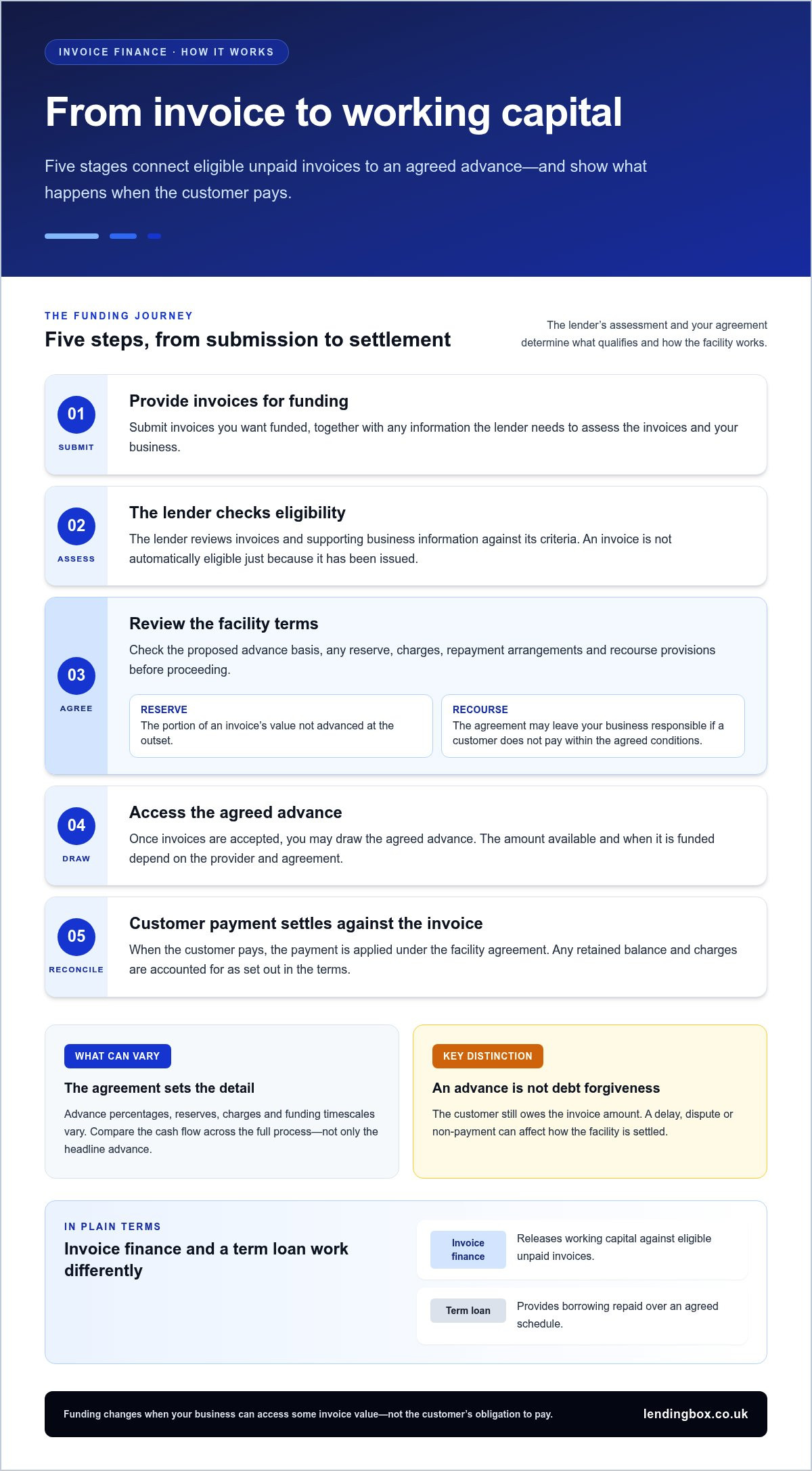
An invoice finance facility can provide earlier access to working capital, but it doesn’t simply transfer the full invoice value to your business. The lender assesses the invoices and business, then sets out how advances, charges and repayments will work. These are the main steps to understand:
- Submit invoices. Provide invoices for funding, along with any information the lender needs to assess them and your business.
- Assess eligibility. The lender reviews the invoices and supporting business information against its criteria.
- Agree terms. Review the proposed advance basis, any reserve, charges, repayment arrangements and recourse provisions before proceeding.
- Draw funds. Once invoices are accepted, you may draw the agreed advance. How much is available and when depends on the provider and agreement.
- Reconcile payment. When the customer pays, the payment is applied under the facility agreement. Any retained balance and charges are accounted for as set out in the terms.
Advance percentages, reserves, charges and funding timescales vary. A reserve is the portion of an invoice’s value that isn’t advanced at the outset; the agreement explains how it is handled. Compare the cash flow across the full process, not just the headline advance. The GOV.UK account of support for invoice finance also describes its role in helping small firms access working capital.
What happens after a business submits an invoice?
The funder checks the invoice and relevant business information against its assessment criteria. If the invoice is accepted, an agreed advance can give the business access to part of its value before the customer pays. When payment arrives, it’s reconciled under the facility agreement. The customer still owes the invoice amount, and the business remains responsible for meeting the agreement’s terms.
Invoice finance advances cash against invoices; it doesn’t forgive unpaid debt. The advance is linked to the customer’s payment, so a delay, dispute or non-payment can affect how the facility is settled.
What recourse means for the business
With recourse, the agreement may leave your business responsible for an invoice if the customer doesn’t pay within the agreed conditions. The facility can improve the timing of cash coming in, but it doesn’t necessarily transfer the risk of non-payment to the funder.
Non-recourse arrangements may provide protection in defined circumstances, but don’t assume they remove every bad-debt risk. Cover can depend on the reason for non-payment and the contract’s exclusions. Compare the written definitions, qualifying events, time limits and responsibilities. Facilities using the same label can set out different protections.
Understanding these mechanics helps you weigh earlier access to cash against the costs and risks in an invoice finance UK agreement. Lending Box matches UK limited companies and LLPs with lenders and supports applications through to completion. A Lending Box invoice finance discussion can help you explore lender options and understand the application paperwork with support from a dedicated relationship manager.
Factoring vs invoice discounting vs selective invoice finance
These facilities differ mainly in who handles customer collections and how much of your invoice book you choose to fund. The right structure depends on your credit-control capacity, cash-flow pattern and preferred level of customer involvement. Use this comparison as a starting point, then read how the lender defines the facility and its responsibilities.
| Facility | Who manages collections? | Invoice scope | Operational fit to consider |
|---|---|---|---|
| Factoring | The provider may manage collections, subject to the agreement. | Often linked to a broader group of invoices or the sales ledger. | May suit a business that wants support with credit control or has limited in-house capacity. |
| Invoice discounting | The business generally manages customer collections. | Often linked to a broader debtor book, depending on the facility. | May suit a business with established processes that wants to retain day-to-day customer contact. |
| Selective invoice finance | Arrangements vary by facility and agreement. | Chosen invoices rather than necessarily the full sales ledger. | May be worth assessing when funding needs arise against particular invoices rather than consistently across the ledger. |
Factoring or invoice discounting: who manages collections?
With factoring, the provider may take on some or all collection activity. Customers may know about the arrangement because payment instructions or collection contact can involve the provider, but the exact process depends on the agreement. This can reduce your day-to-day credit-control workload, while changing how collection conversations are handled.
With invoice discounting, the business generally keeps responsibility for its sales ledger and customer payments. This preserves direct control of collections, but requires people and processes to monitor due dates, follow up late payments and resolve queries. Neither structure is automatically cheaper, faster or better. Compare the service, charges and customer-facing arrangements in the written terms.
When selective invoice finance may fit
Selective finance lets a business put forward chosen invoices rather than routinely funding a broader debtor book. This may be relevant if a cash requirement is occasional or relates to a particular customer or project. It isn’t automatically a match for every irregular cash gap. Consider how often you need funds, which invoices qualify and whether the facility’s terms work for that pattern.
To narrow the options, map your regular collection workload, the invoices you’d want to fund and how often a shortfall occurs. Then compare the operational trade-offs alongside the financial terms. The Invoice Finance Explained: Factoring & Discounting Guide provides further background on those two structures. When choosing invoice finance UK businesses can use, focus on the facility that fits your invoicing and collections process, not just its label.
How to assess invoice finance suitability and compare terms
Start with the pattern behind your cash-flow need. It’s easier to assess an invoice facility when you can show how often you invoice, how long customers take to pay and what commitments fall due before the money arrives. Consider these points together:
- Invoice volume: Is billing regular, seasonal or occasional?
- Customer concentration: Does a large share of sales depend on one customer?
- Payment patterns: How often do customers pay on time, late or after querying an invoice?
- Credit control: Can your team manage follow-ups, disputes and ledger records if the facility requires it?
These details help you describe what you need from a facility. They don’t create a universal pass or fail rule. Eligibility depends on the lender’s assessment and the proposed terms, not one standard turnover, trading-age or credit-score threshold.
Which business and invoice details affect suitability?
Prepare recent management accounts, debtor information and representative sales invoices. A clear view of who owes money, how much and when invoices fall due helps explain the working-capital need. Include context for overdue balances, disputed invoices and credit notes, as these may affect how a lender assesses invoices and expected collections.
Funders may also consider customer quality and trading history. If one customer accounts for a large share of your debtor book, concentration limits in a facility could affect how much funding is available. Be ready to explain unusual payment delays or changes in sales patterns. A concise, accurate picture is more useful than assuming every invoice will be treated alike.
How to compare the full facility commitment
Look beyond the headline advance percentage. Compare the complete fee structure and how charges apply over time. Then review the written agreement for:
- The basis for calculating advances and any retained reserve.
- Service or transaction charges, and any minimum terms.
- Contract duration, notice periods and termination conditions.
- Recourse provisions and what happens if invoices remain unpaid.
- Rules for disputes, credit notes, late payments and customer concentration.
- Who manages collections and what the customer will see or experience.
Read the terms as a complete operating arrangement. A higher advance may not suit your business if charges, notice requirements or collections responsibilities create friction elsewhere. Compare a realistic month of invoicing and customer payments against the facility wording. For a broader view of funding choices, Business Loans UK: A Practical Guide for Growing Businesses can help place invoice finance alongside other business funding routes.
Lending Box matches UK limited companies and LLPs with lenders rather than lending directly. A dedicated relationship manager guides clients through lender options and application paperwork. Explore invoice finance options with Lending Box once you’ve assembled your figures and identified the terms that matter most.
Explore UK invoice finance with Lending Box
Once you’ve identified the cash-flow gap and the terms that matter, explore facilities that fit your business. Lending Box is a whole-of-market commercial finance broker for UK limited companies and LLPs. We match businesses with lenders and support applications through to completion; we aren’t a direct lender. This means you can explore lender options with support through the application process.
What support does a Lending Box enquiry involve?
Lending Box analyses company data through its in-house lending model to provide initial eligibility insights without impacting credit scores. Treat these as an early indication, not an approval decision or promise of funding. A lender makes its own assessment and sets out any offer and terms.
A dedicated relationship manager guides you through the options and application paperwork. This can help keep the process organised, particularly when you’re comparing facility structures or gathering information about invoices and customers. You’ll have support in understanding the steps, while the lender remains responsible for its assessment and decision.
You don’t need every detail resolved before starting. A clear outline of the funding need and how your sales ledger works gives the conversation a useful starting point. The more accurately you can describe your invoicing and collection patterns, the easier it is to consider which kind of facility may align with them.
Prepare for a focused invoice finance discussion
Before exploring invoice finance UK options, bring together a practical picture of your cash flow and how customers pay. Note:
- What the funds would support and when the cash gap occurs.
- How frequently you issue invoices, and whether volumes change seasonally.
- The payment terms you offer and how customers typically settle invoices.
- Whether you want to manage collections yourself or would consider provider involvement.
- Any existing finance commitments that affect your business cash flow.
These details help focus the discussion on how your business operates, not just the amount you hope to access. If customer payments are concentrated among a small number of accounts or invoice volumes vary, explain that clearly. This gives the broker useful context when exploring lender options and helps you compare proposed terms with your actual requirements.
Gathering representative invoices and a recent view of debtor balances can also help you describe your ledger. You can then discuss the facility’s scope, collections arrangements and key agreement terms with a clearer sense of what your business needs to retain control of.
Ready to explore the options? Explore invoice finance options with Lending Box. A relationship manager can guide you through lender options and application paperwork, helping you take the next step with a clearer view of the process.
Take the next step with a clear funding brief
Before exploring invoice finance UK options, turn your cash-flow need into a practical brief. Set out when you need funds, which invoices might support the facility, how customers usually pay and how much control you want over collections. Keep these priorities in view as you assess lender terms. The aim isn’t to choose the largest advance, but to find an arrangement that works with your business’s cash cycle and day-to-day processes.
Lending Box matches UK limited companies and LLPs with lenders and supports them through the application paperwork. Its founders bring more than ten years of direct business-lending experience. An initial eligibility indication is not an approval decision, so use it as a starting point for exploring options and preparing the right information.
Explore invoice finance options with Lending Box and take your next step with a clear funding brief. Bring your invoicing and collection details so you can focus on the terms that matter to your business.
Frequently Asked Questions
Is invoice finance a loan?
Invoice finance isn’t usually structured like a conventional term loan. It provides funding linked to eligible invoices, with the customer’s payment used to settle the facility under its terms. The amount available can therefore change as invoices are raised, accepted and paid, rather than following a fixed loan schedule. Check the agreement to understand how advances, charges and repayment obligations work in your arrangement.
Can a small UK business use invoice finance?
A small UK business may be able to use invoice finance, but size alone doesn’t determine suitability. A funder may look at the company’s trading history, customers, invoices and payment records. For example, a smaller firm with regular business-to-business invoices may have a different profile from one with occasional project billing. There isn’t one universal turnover or trading-age threshold that applies to every facility.
How much does invoice finance cost in the UK?
There’s no single UK price for invoice finance. The total cost can depend on the facility structure, how much funding you use, how long it’s outstanding and the charges in the agreement. Ask for a written breakdown explaining each charge and when it applies. Compare the complete commitment, including any minimum term or notice requirements, rather than relying on an advertised advance percentage alone.
What happens if a customer does not pay an invoice?
If a customer doesn’t pay, the outcome depends on the facility agreement and whether it’s recourse or non-recourse. Under a recourse arrangement, your business may have to repay or replace the advance if the invoice remains unpaid. Non-recourse terms may cover defined events, but don’t assume they protect against every cause of non-payment. Check how the contract treats disputes, credit notes and overdue balances.
Does invoice finance affect my customers?
It can affect how customers make payments and who contacts them about overdue invoices. In some arrangements, they may pay the finance provider or deal with its collections team; in others, your business may continue managing the relationship. Consider how this fits your usual payment process, especially if customers have specific accounts-payable procedures. The facility agreement should explain the payment instructions and customer communications that apply.
Can I use invoice finance for only some invoices?
Selective invoice finance can let a business put forward chosen invoices rather than fund a wider group, subject to the facility’s rules. It may be worth considering if a particular project or customer creates an occasional cash requirement. Check whether selected invoices must meet specific criteria and how each advance is charged. Selective funding won’t necessarily suit every irregular cash gap or invoice pattern.
Do I need to tell customers that I use invoice finance?
It depends on the facility and how collections are arranged. A factoring agreement may involve the provider contacting customers or receiving payments, making the arrangement visible. Some invoice discounting facilities are designed for the business to retain customer collections. Read the agreement for notification requirements, payment instructions and restrictions. Don’t assume the arrangement is confidential simply because your business handles customer contact.
Frequently Asked Questions
Invoice finance may help bridge a timing mismatch. For example, a business might need to pay staff this month while a customer’s invoice falls due later. A supplier deposit or materials bill may also arrive before payment for completed work. A growing company can face a similar gap when it needs to meet new orders before customers settle existing invoices. That’s different from being unable to meet obligations because income or margins are persistently insufficient. Finance linked to invoices brings forward some cash, but it doesn’t fix an underlying shortfall or make an unprofitable contract viable. Any repayments and charges still need to fit the business’s wider cash-flow plan. Look at the pattern, not just the immediate gap. Regular invoices to established customers, with payment dates that can be understood from past experience, may make future cash needs easier to assess. Irregular billing, disputed invoices or customers who often pay late can make the amount and timing of available funds less predictable. Before exploring a facility, map when invoices are raised, when customers usually pay and which commitments fall due in between. This can help you judge whether the pressure is a temporary timing gap that may align with invoice funding, or a broader cash-flow problem that needs a different response. An invoice finance facility can provide earlier access to working capital, but it doesn’t simply transfer the full invoice value to your business. The lender assesses the invoices and business, then sets out how advances, charges and repayments will work. These are the main steps to understand: Advance percentages, reserves, charges and funding timescales vary. A reserve is the portion of an invoice’s value that isn’t advanced at the outset; the agreement explains how it is handled. Compare the cash flow across the full process, not just the headline advance. The GOV.UK account of support for invoice finance also describes its role in helping small firms access working capital.
The funder checks the invoice and relevant business information against its assessment criteria. If the invoice is accepted, an agreed advance can give the business access to part of its value before the customer pays. When payment arrives, it’s reconciled under the facility agreement. The customer still owes the invoice amount, and the business remains responsible for meeting the agreement’s terms. Invoice finance advances cash against invoices; it doesn’t forgive unpaid debt. The advance is linked to the customer’s payment, so a delay, dispute or non-payment can affect how the facility is settled.
With factoring, the provider may take on some or all collection activity. Customers may know about the arrangement because payment instructions or collection contact can involve the provider, but the exact process depends on the agreement. This can reduce your day-to-day credit-control workload, while changing how collection conversations are handled. With invoice discounting, the business generally keeps responsibility for its sales ledger and customer payments. This preserves direct control of collections, but requires people and processes to monitor due dates, follow up late payments and resolve queries. Neither structure is automatically cheaper, faster or better. Compare the service, charges and customer-facing arrangements in the written terms.
Prepare recent management accounts, debtor information and representative sales invoices. A clear view of who owes money, how much and when invoices fall due helps explain the working-capital need. Include context for overdue balances, disputed invoices and credit notes, as these may affect how a lender assesses invoices and expected collections. Funders may also consider customer quality and trading history. If one customer accounts for a large share of your debtor book, concentration limits in a facility could affect how much funding is available. Be ready to explain unusual payment delays or changes in sales patterns. A concise, accurate picture is more useful than assuming every invoice will be treated alike.
Lending Box analyses company data through its in-house lending model to provide initial eligibility insights without impacting credit scores. Treat these as an early indication, not an approval decision or promise of funding. A lender makes its own assessment and sets out any offer and terms. A dedicated relationship manager guides you through the options and application paperwork. This can help keep the process organised, particularly when you’re comparing facility structures or gathering information about invoices and customers. You’ll have support in understanding the steps, while the lender remains responsible for its assessment and decision. You don’t need every detail resolved before starting. A clear outline of the funding need and how your sales ledger works gives the conversation a useful starting point. The more accurately you can describe your invoicing and collection patterns, the easier it is to consider which kind of facility may align with them.
Invoice finance isn’t usually structured like a conventional term loan. It provides funding linked to eligible invoices, with the customer’s payment used to settle the facility under its terms. The amount available can therefore change as invoices are raised, accepted and paid, rather than following a fixed loan schedule. Check the agreement to understand how advances, charges and repayment obligations work in your arrangement.
A small UK business may be able to use invoice finance, but size alone doesn’t determine suitability. A funder may look at the company’s trading history, customers, invoices and payment records. For example, a smaller firm with regular business-to-business invoices may have a different profile from one with occasional project billing. There isn’t one universal turnover or trading-age threshold that applies to every facility.
There’s no single UK price for invoice finance. The total cost can depend on the facility structure, how much funding you use, how long it’s outstanding and the charges in the agreement. Ask for a written breakdown explaining each charge and when it applies. Compare the complete commitment, including any minimum term or notice requirements, rather than relying on an advertised advance percentage alone.
If a customer doesn’t pay, the outcome depends on the facility agreement and whether it’s recourse or non-recourse. Under a recourse arrangement, your business may have to repay or replace the advance if the invoice remains unpaid. Non-recourse terms may cover defined events, but don’t assume they protect against every cause of non-payment. Check how the contract treats disputes, credit notes and overdue balances.
It can affect how customers make payments and who contacts them about overdue invoices. In some arrangements, they may pay the finance provider or deal with its collections team; in others, your business may continue managing the relationship. Consider how this fits your usual payment process, especially if customers have specific accounts-payable procedures. The facility agreement should explain the payment instructions and customer communications that apply.
Selective invoice finance can let a business put forward chosen invoices rather than fund a wider group, subject to the facility’s rules. It may be worth considering if a particular project or customer creates an occasional cash requirement. Check whether selected invoices must meet specific criteria and how each advance is charged. Selective funding won’t necessarily suit every irregular cash gap or invoice pattern.
It depends on the facility and how collections are arranged. A factoring agreement may involve the provider contacting customers or receiving payments, making the arrangement visible. Some invoice discounting facilities are designed for the business to retain customer collections. Read the agreement for notification requirements, payment instructions and restrictions. Don’t assume the arrangement is confidential simply because your business handles customer contact.