
Asset Finance: A Practical Guide for UK Businesses
17 October 2026 · 17 min read

The finance agreement can matter as much as the equipment you’re buying. Asset finance can help your business spread the cost of a vehicle, machine or other essential asset, but the terms determine how repayments work and whether you’ll own it at the end.
It’s worth comparing agreements before committing. Hire purchase, finance leases and operating leases can sound similar, yet differ in who owns the asset, what happens at the end of the term and how payments affect cash flow. The right structure depends on how long you plan to use the asset, what it is worth and what your business can comfortably repay.
This guide explains the main types of asset finance and the practical differences between them. You’ll learn what to weigh up before applying, including cash-flow pressure, security and ownership. Lending Box is a UK commercial finance broker. A dedicated relationship manager can guide you through finance options and the application process, helping you make a clearer, better-informed decision before taking the next step.
Key Takeaways
- See how asset finance can help fund vehicles, machinery and other business assets over an agreed term.
- Compare hire purchase, finance leases, operating leases and contract hire to understand how ownership and end-of-term choices differ.
- Learn when funding linked to a specific asset may suit your needs better than a general business loan.
- Use a four-step check to define the asset, clarify its purpose, model repayments and review the agreement terms.
- Find out how Lending Box helps limited companies and LLPs explore finance options and work through application paperwork.
What is asset finance, and what can a UK business use it for?
Asset finance is funding linked to acquiring or using a business asset. Instead of paying the full purchase cost at once, a business uses an agreement that spreads payments over an agreed term. The arrangement might be a lease or a hire purchase agreement. Each structure sets out who owns the asset, how it can be used and what happens when the agreement ends.
This can help a business put equipment to work while managing the timing of its outgoings. But spreading payments doesn’t remove the commitment. Repayments still need to fit the business’s cash flow, and the asset may be linked to the finance as security. Check the agreement’s obligations as carefully as the regular payment.
Which business assets can asset finance help fund?
Possible assets vary by agreement and lender criteria. Examples include:
- Vehicles: vans, lorries and other commercial vehicles used in day-to-day operations.
- Machinery: manufacturing machinery, agricultural equipment or tools used to deliver a service.
- Specialist equipment: production lines, construction equipment or other machinery designed for a particular trade.
- Business technology: computers, servers or other equipment that supports business operations.
These are examples, not a guarantee that a particular item will qualify. The asset’s type, condition and value may affect the options available, alongside the agreement and lender’s criteria. Some businesses also explore funding secured against assets they already own. This is related to asset-based lending, though the precise structure and purpose can differ.
How is asset finance different from paying upfront?
With an outright purchase, the business pays the full cost at the point of purchase and owns the asset. With asset finance, payments are spread across the agreed period. Depending on the structure, the business might own the asset after making the required payments, use it for a set term and return it, or have other end-of-agreement options. The agreement determines the details.
In short, paying upfront buys the asset outright; asset finance links its use or purchase to an agreement with payments over time. Spreading the cost may leave more cash available for wages, stock or other operating needs, but it also creates a repayment commitment. Compare the total obligations and ownership outcome, not just the initial cash required.
If you’re comparing asset finance with funding that isn’t tied to one specific item, this UK business loans guide explains the wider funding context. Start with the business need: identify the asset, consider how long it will be useful and decide whether ownership or ongoing use matters most.
Which asset finance agreements suit different ownership plans?
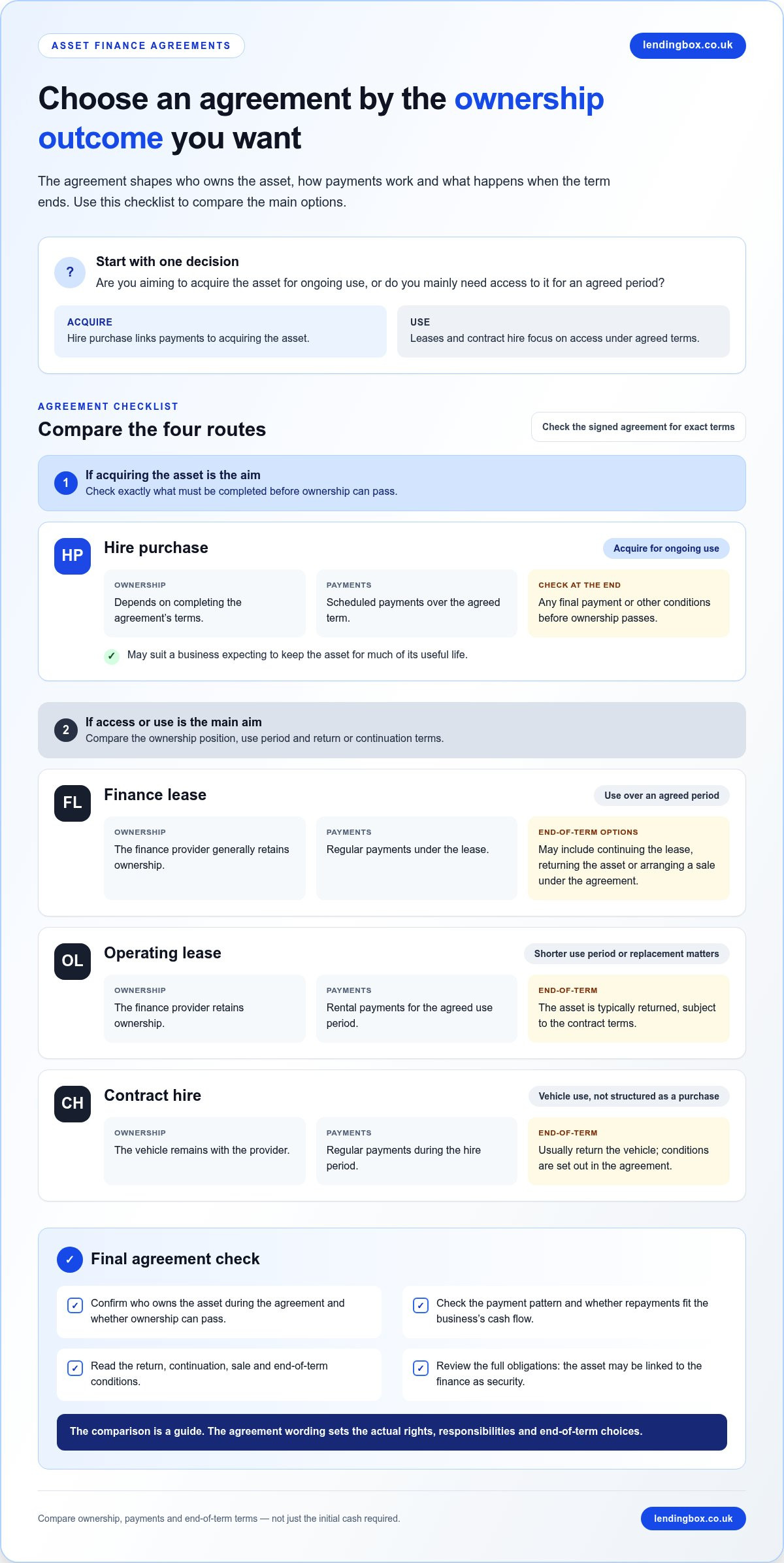
Start with the outcome you want. Are you aiming to acquire an asset for long-term use, or do you need access to it for a defined period? The agreement affects who owns the asset, what payments cover and what choices you have when the term ends. This comparison is a guide; the signed agreement sets the actual rights and obligations.
| Agreement | Typical purpose | Ownership position | Payment pattern | End-of-term consideration |
|---|---|---|---|---|
| Hire purchase | Acquire an asset for ongoing business use | Ownership depends on completing the agreement’s terms | Scheduled payments over the agreed term | Check what must be paid or completed before ownership can pass |
| Finance lease | Use an asset over an agreed period | The finance provider generally retains ownership | Regular payments under the lease | Options may include continuing the lease, returning the asset or arranging a sale under the agreement |
| Operating lease | Use an asset for a shorter period or where replacement may matter | The finance provider retains ownership | Rental payments for the agreed use period | The asset is typically returned, subject to the contract terms |
| Contract hire | Use a vehicle without structuring the agreement as a purchase | The vehicle remains with the provider | Regular payments during the hire period | Usually involves returning the vehicle, with conditions set out in the agreement |
The Finance & Leasing Association’s asset finance guidance provides further UK sector context. Use the table to identify the questions that matter, then check the agreement wording. Labels alone don’t explain every responsibility or end-of-term option.
How does hire purchase work for business assets?
With hire purchase, the business makes scheduled payments towards acquiring the asset. Ownership is not simply assumed from the start: it depends on meeting the agreement’s terms, including any required final payment or other stated conditions. This may suit a business that expects to keep an asset for much of its useful life. It differs from a lease focused on access and use rather than acquiring ownership.
How do finance leases, operating leases and contract hire differ?
These arrangements focus on using an asset under agreed terms, rather than automatically giving the business ownership. A finance lease may offer different end-of-term routes from an operating lease, whilst contract hire is commonly associated with vehicles. The business’s responsibilities and available choices depend on the contract, so compare the return, continuation and sale provisions before deciding.
The business finance options guide gives broader context if you’re comparing these structures with other funding routes. Lending Box helps businesses explore asset finance options. As a broker, it matches businesses with finance options, while a dedicated relationship manager guides you through the available options and application paperwork. Read more about Lending Box.
When does asset finance fit better than other business funding?
The key question is what the funding needs to do. If you’re buying a specific vehicle, machine or piece of equipment, finance linked to that asset may align the commitment with its use. A general business loan may offer a broader route to funding, depending on its terms. Neither is automatically the better choice. Match the structure to the purpose, the business’s repayment capacity and the agreement’s conditions.
For example, a manufacturer replacing a production machine may want funding tied to that purchase. A business covering several costs, such as stock, wages and marketing, may need funding that can support a wider working-capital need. Spreading payments could leave more cash available for day-to-day operations, but it doesn’t remove the cost or the obligation to pay.
What are the main advantages and trade-offs?
Potential benefits depend on the agreement and the asset’s role in the business. Consider both sides before deciding:
- Payments spread over time: This may reduce the amount paid upfront, but repayments remain due throughout the agreed term.
- Funding linked to an asset: The structure may suit an identifiable purchase, though the asset can also be linked to the finance as security.
- Payments related to asset use: A term that broadly matches the period you expect to use equipment may help with planning. The asset’s useful life and the repayment period may not align perfectly.
- Less flexibility in some agreements: Ownership or selling the asset may be restricted, and ending the agreement early may have consequences set out in its terms.
Cash-flow headroom is useful only if the ongoing commitment remains affordable. Model repayments alongside quieter trading periods, planned maintenance and other regular costs. Also consider what happens if the asset becomes less useful before the agreement ends. Depending on the terms, you may still have payments to make or conditions to meet.
When might another form of business finance be more suitable?
If funding is for several operating costs rather than one identified asset, a broader facility may fit the purpose more closely. A business loan, for example, can be considered for wider business funding needs, subject to its terms. Other options may suit different requirements. Base the comparison on where the money needs to go, not just the product label.
Before choosing, set out the amount required, the purpose, the expected repayment source and the time period the funding needs to cover. Then compare the repayment schedule, total commitment, security and any limits on how funds or assets can be used. A structure that appears manageable in a typical month may feel different when income falls or unexpected costs arise.
Choose around the business need and its capacity to repay. Funding an asset and covering broader cash-flow needs are different jobs. Clear forecasts and close attention to agreement terms can help you judge which route is more appropriate.
How can a business assess asset finance before applying?
A short assessment before applying can help clarify what the business needs and what it can reasonably commit to. Work through these four steps in order:
- Define the asset. Identify what you plan to acquire or use, its expected cost and when it needs to be available. Gather a supplier quote or product details if you have them.
- Set the purpose. Explain how the asset will support the business. For example, will it replace equipment, increase production capacity or help deliver a service? A clear purpose helps show how the funding relates to business activity.
- Model repayments. Compare potential payments with realistic cash-flow forecasts, not just an average month. Include quieter trading periods, existing commitments and likely operating costs. Leave room for unexpected pressure.
- Review the agreement terms. Look beyond the headline payment. Check the agreement length, total obligations, ownership position, security, maintenance responsibilities and end-of-term options. Understand the consequences of missed payments and any restrictions on selling or changing the asset.
What should a business check about affordability and terms?
Test whether repayments remain manageable if income falls or costs rise. A seasonal business, for instance, should assess payments against its quieter months as well as peak trading. Then consider whether the agreement runs for a suitable period relative to the asset’s expected use. If the equipment becomes unsuitable before the term ends, the business may still have obligations. Read the contract carefully, especially around security, maintenance and ending or settling the agreement.
What information may lenders consider?
Lenders may assess the business’s financial performance, financial position, credit history and the asset being proposed. Criteria differ between lenders and applications. There’s no universal eligibility threshold: a lender’s criteria and decision depend on the individual application.
Organise relevant information before starting. This could include:
- Basic business details and an outline of its trading activity.
- The asset description, intended use and supplier information, where available.
- Recent financial records and cash-flow forecasts that show how repayments could be met.
- Details of existing borrowing or other regular financial commitments.
Keep the figures consistent across your forecasts and records. If the asset’s purpose or the proposed repayment source changes, update your assessment before proceeding. Preparation won’t guarantee an outcome, but it can help you explain the request clearly and judge whether the commitment makes sense for the business.
Lending Box helps businesses explore asset finance options. As a broker, it matches businesses with finance options, and a dedicated relationship manager guides you through the application and paperwork. Find out more about Lending Box.
How can Lending Box help a business explore asset finance?
Once you’ve defined the asset, preferred ownership position and affordable repayment level, the next task is finding options that fit those requirements. Lending Box is a UK whole-of-market commercial finance broker for limited companies and LLPs. It matches businesses with finance options from lenders across the market, helping you explore asset finance alongside other relevant funding routes.
Lending Box doesn’t lend directly. Its role is to help businesses understand potential options and move through the application process. An in-house model provides eligibility insights without impacting credit scores. These insights can help inform your next steps, but they aren’t a promise of approval or an offer of finance. Lender criteria and decisions depend on the application.
What happens when a business explores asset finance through a broker?
You share the funding purpose, relevant company information and details of the asset or purchase. Clear information about how the asset will be used helps shape the search. Lending Box then matches the business with suitable options from lenders across the market. A dedicated relationship manager guides you through the options, application process and associated paperwork.
This support can help make a complex process easier to organise. You can discuss how the proposed structure relates to your needs, then work through the information required for an application. The lender makes the lending decision and sets its terms; the broker guides the process rather than providing the finance itself.
How should a business decide its next step?
Keep the decision grounded in your business requirements. Revisit the asset’s purpose, whether you want to own it or use it for a defined period, the repayments your forecasts can support and the agreement terms. Compare options against those priorities, including security, responsibilities and what happens at the end of the agreement. A lower initial payment alone doesn’t show whether an option is right for your business.
Preparing these points before exploring options can make conversations more focused. Set out what the asset needs to do, how long you expect to use it and how the business plans to meet repayments. Then consider the available structures in light of your cash-flow forecasts and preferred ownership outcome. The aim is to find a route worth examining, not to assume every option will suit or that an application will be approved.
Lending Box’s relationship managers guide businesses through finance options and application paperwork. The lender assesses the application and makes its decision. Read about business finance options with Lending Box.
Turn your funding priorities into a clear next step
Before moving forward, decide what a good outcome would look like for your business. Is it access to an essential asset, keeping more working capital available, or choosing an agreement that matches how long you expect to use the equipment? Set those priorities first. They’ll give you a practical basis for assessing asset finance options and discussing the trade-offs that matter most.
Lending Box helps UK limited companies and LLPs explore finance options across the market. Its eligibility insights don’t impact credit scores, and a dedicated relationship manager can guide you through applications and paperwork. Lending Box acts as a broker, not a direct lender, and any application remains subject to the lender’s assessment.
Explore business finance options with Lending Box to take the next step with a clearer view of what your business needs.
Frequently Asked Questions
Can asset finance be used to buy second-hand equipment?
Yes, second-hand equipment may be considered, but availability depends on the lender, asset and agreement. For example, a business looking to fund a used packaging machine may need to provide details of its age, condition, value and intended use. These factors can affect whether a lender considers it suitable and what terms may be available. There’s no universal rule that all used equipment qualifies, so assess the specific asset and application.
Do businesses need a deposit for asset finance?
Not always. Whether a deposit is required, and how much, depends on the lender’s criteria, the asset, the agreement and the business’s circumstances. A deposit may reduce the amount being financed, but it also uses cash that could be needed for other costs. Compare the upfront payment with the ongoing repayments and overall commitment. Don’t assume every agreement starts with the same deposit requirement.
Can a business repay an asset finance agreement early?
Possibly, but early repayment depends on the agreement. The contract may set out how to request a settlement figure, whether additional charges apply and how much remains payable. Don’t assume that paying early simply removes all future instalments. Before making a decision, review the settlement terms and compare the amount due with the cost of continuing payments. If the business is considering selling or replacing the asset, check how that affects the agreement too.
Does applying for asset finance affect a business credit file?
It can depend on the stage of the process and the lender’s checks. Lending Box provides eligibility insights without impacting credit scores, but that’s different from a lender assessing a formal application. Credit checks and how finance is recorded can vary. Before proceeding, understand what checks may be made and whether they relate to the business, its directors or both. Keeping up with repayments also matters, as payment problems may affect future access to finance.
Can a start-up apply for asset finance?
A start-up can explore an application, but a short trading history may mean there’s less financial information for a lender to assess. The decision will depend on the lender’s criteria and the full application, including the proposed asset and the business’s ability to meet repayments. Prepare a clear explanation of how the equipment will support trading, alongside available financial records and forecasts. There’s no single trading-history threshold that applies to every lender.
What happens if a business cannot keep up with asset finance repayments?
Act promptly and review the agreement. Missed payments may lead to charges, further action by the lender or consequences for the asset, depending on the contract and finance structure. The business’s credit position may also be affected. Don’t assume you can sell or return the asset to settle the balance. Contact the lender early to explain the difficulty and understand the options and obligations set out in the agreement.
Does asset finance have a tax advantage for a business?
It may have tax or accounting implications, but there isn’t one answer that applies to every agreement. Treatment can depend on the finance structure, the asset and the business’s circumstances, as well as current rules. Don’t assume that payments are automatically deductible or that ownership determines the tax outcome. Ask a qualified accountant to review the proposed agreement before committing, and keep the finance documents and asset details with your business records.
Explore business finance options with Lending Box to discuss asset finance alongside other funding routes for your business.
Frequently Asked Questions
Possible assets vary by agreement and lender criteria. Examples include: These are examples, not a guarantee that a particular item will qualify. The asset’s type, condition and value may affect the options available, alongside the agreement and lender’s criteria. Some businesses also explore funding secured against assets they already own. This is related to asset-based lending, though the precise structure and purpose can differ.
With an outright purchase, the business pays the full cost at the point of purchase and owns the asset. With asset finance, payments are spread across the agreed period. Depending on the structure, the business might own the asset after making the required payments, use it for a set term and return it, or have other end-of-agreement options. The agreement determines the details. In short, paying upfront buys the asset outright; asset finance links its use or purchase to an agreement with payments over time. Spreading the cost may leave more cash available for wages, stock or other operating needs, but it also creates a repayment commitment. Compare the total obligations and ownership outcome, not just the initial cash required. If you’re comparing asset finance with funding that isn’t tied to one specific item, this UK business loans guide explains the wider funding context. Start with the business need: identify the asset, consider how long it will be useful and decide whether ownership or ongoing use matters most. Start with the outcome you want. Are you aiming to acquire an asset for long-term use, or do you need access to it for a defined period? The agreement affects who owns the asset, what payments cover and what choices you have when the term ends. This comparison is a guide; the signed agreement sets the actual rights and obligations. The Finance & Leasing Association’s asset finance guidance provides further UK sector context. Use the table to identify the questions that matter, then check the agreement wording. Labels alone don’t explain every responsibility or end-of-term option.
With hire purchase, the business makes scheduled payments towards acquiring the asset. Ownership is not simply assumed from the start: it depends on meeting the agreement’s terms, including any required final payment or other stated conditions. This may suit a business that expects to keep an asset for much of its useful life. It differs from a lease focused on access and use rather than acquiring ownership.
These arrangements focus on using an asset under agreed terms, rather than automatically giving the business ownership. A finance lease may offer different end-of-term routes from an operating lease, whilst contract hire is commonly associated with vehicles. The business’s responsibilities and available choices depend on the contract, so compare the return, continuation and sale provisions before deciding. The business finance options guide gives broader context if you’re comparing these structures with other funding routes. Lending Box helps businesses explore asset finance options. As a broker, it matches businesses with finance options, while a dedicated relationship manager guides you through the available options and application paperwork. Read more about Lending Box. The key question is what the funding needs to do. If you’re buying a specific vehicle, machine or piece of equipment, finance linked to that asset may align the commitment with its use. A general business loan may offer a broader route to funding, depending on its terms. Neither is automatically the better choice. Match the structure to the purpose, the business’s repayment capacity and the agreement’s conditions. For example, a manufacturer replacing a production machine may want funding tied to that purchase. A business covering several costs, such as stock, wages and marketing, may need funding that can support a wider working-capital need. Spreading payments could leave more cash available for day-to-day operations, but it doesn’t remove the cost or the obligation to pay.
Potential benefits depend on the agreement and the asset’s role in the business. Consider both sides before deciding: Cash-flow headroom is useful only if the ongoing commitment remains affordable. Model repayments alongside quieter trading periods, planned maintenance and other regular costs. Also consider what happens if the asset becomes less useful before the agreement ends. Depending on the terms, you may still have payments to make or conditions to meet.
If funding is for several operating costs rather than one identified asset, a broader facility may fit the purpose more closely. A business loan, for example, can be considered for wider business funding needs, subject to its terms. Other options may suit different requirements. Base the comparison on where the money needs to go, not just the product label. Before choosing, set out the amount required, the purpose, the expected repayment source and the time period the funding needs to cover. Then compare the repayment schedule, total commitment, security and any limits on how funds or assets can be used. A structure that appears manageable in a typical month may feel different when income falls or unexpected costs arise. Choose around the business need and its capacity to repay. Funding an asset and covering broader cash-flow needs are different jobs. Clear forecasts and close attention to agreement terms can help you judge which route is more appropriate. A short assessment before applying can help clarify what the business needs and what it can reasonably commit to. Work through these four steps in order:
Test whether repayments remain manageable if income falls or costs rise. A seasonal business, for instance, should assess payments against its quieter months as well as peak trading. Then consider whether the agreement runs for a suitable period relative to the asset’s expected use. If the equipment becomes unsuitable before the term ends, the business may still have obligations. Read the contract carefully, especially around security, maintenance and ending or settling the agreement.
Lenders may assess the business’s financial performance, financial position, credit history and the asset being proposed. Criteria differ between lenders and applications. There’s no universal eligibility threshold: a lender’s criteria and decision depend on the individual application. Organise relevant information before starting. This could include: Keep the figures consistent across your forecasts and records. If the asset’s purpose or the proposed repayment source changes, update your assessment before proceeding. Preparation won’t guarantee an outcome, but it can help you explain the request clearly and judge whether the commitment makes sense for the business. Lending Box helps businesses explore asset finance options. As a broker, it matches businesses with finance options, and a dedicated relationship manager guides you through the application and paperwork. Find out more about Lending Box. Once you’ve defined the asset, preferred ownership position and affordable repayment level, the next task is finding options that fit those requirements. Lending Box is a UK whole-of-market commercial finance broker for limited companies and LLPs. It matches businesses with finance options from lenders across the market, helping you explore asset finance alongside other relevant funding routes. Lending Box doesn’t lend directly. Its role is to help businesses understand potential options and move through the application process. An in-house model provides eligibility insights without impacting credit scores. These insights can help inform your next steps, but they aren’t a promise of approval or an offer of finance. Lender criteria and decisions depend on the application.
You share the funding purpose, relevant company information and details of the asset or purchase. Clear information about how the asset will be used helps shape the search. Lending Box then matches the business with suitable options from lenders across the market. A dedicated relationship manager guides you through the options, application process and associated paperwork. This support can help make a complex process easier to organise. You can discuss how the proposed structure relates to your needs, then work through the information required for an application. The lender makes the lending decision and sets its terms; the broker guides the process rather than providing the finance itself.
Keep the decision grounded in your business requirements. Revisit the asset’s purpose, whether you want to own it or use it for a defined period, the repayments your forecasts can support and the agreement terms. Compare options against those priorities, including security, responsibilities and what happens at the end of the agreement. A lower initial payment alone doesn’t show whether an option is right for your business. Preparing these points before exploring options can make conversations more focused. Set out what the asset needs to do, how long you expect to use it and how the business plans to meet repayments. Then consider the available structures in light of your cash-flow forecasts and preferred ownership outcome. The aim is to find a route worth examining, not to assume every option will suit or that an application will be approved. Lending Box’s relationship managers guide businesses through finance options and application paperwork. The lender assesses the application and makes its decision. Read about business finance options with Lending Box. Before moving forward, decide what a good outcome would look like for your business. Is it access to an essential asset, keeping more working capital available, or choosing an agreement that matches how long you expect to use the equipment? Set those priorities first. They’ll give you a practical basis for assessing asset finance options and discussing the trade-offs that matter most. Lending Box helps UK limited companies and LLPs explore finance options across the market. Its eligibility insights don’t impact credit scores, and a dedicated relationship manager can guide you through applications and paperwork. Lending Box acts as a broker, not a direct lender, and any application remains subject to the lender’s assessment. Explore business finance options with Lending Box to take the next step with a clearer view of what your business needs.
Yes, second-hand equipment may be considered, but availability depends on the lender, asset and agreement. For example, a business looking to fund a used packaging machine may need to provide details of its age, condition, value and intended use. These factors can affect whether a lender considers it suitable and what terms may be available. There’s no universal rule that all used equipment qualifies, so assess the specific asset and application.
Not always. Whether a deposit is required, and how much, depends on the lender’s criteria, the asset, the agreement and the business’s circumstances. A deposit may reduce the amount being financed, but it also uses cash that could be needed for other costs. Compare the upfront payment with the ongoing repayments and overall commitment. Don’t assume every agreement starts with the same deposit requirement.
Possibly, but early repayment depends on the agreement. The contract may set out how to request a settlement figure, whether additional charges apply and how much remains payable. Don’t assume that paying early simply removes all future instalments. Before making a decision, review the settlement terms and compare the amount due with the cost of continuing payments. If the business is considering selling or replacing the asset, check how that affects the agreement too.
It can depend on the stage of the process and the lender’s checks. Lending Box provides eligibility insights without impacting credit scores, but that’s different from a lender assessing a formal application. Credit checks and how finance is recorded can vary. Before proceeding, understand what checks may be made and whether they relate to the business, its directors or both. Keeping up with repayments also matters, as payment problems may affect future access to finance.
A start-up can explore an application, but a short trading history may mean there’s less financial information for a lender to assess. The decision will depend on the lender’s criteria and the full application, including the proposed asset and the business’s ability to meet repayments. Prepare a clear explanation of how the equipment will support trading, alongside available financial records and forecasts. There’s no single trading-history threshold that applies to every lender.
Act promptly and review the agreement. Missed payments may lead to charges, further action by the lender or consequences for the asset, depending on the contract and finance structure. The business’s credit position may also be affected. Don’t assume you can sell or return the asset to settle the balance. Contact the lender early to explain the difficulty and understand the options and obligations set out in the agreement.
It may have tax or accounting implications, but there isn’t one answer that applies to every agreement. Treatment can depend on the finance structure, the asset and the business’s circumstances, as well as current rules. Don’t assume that payments are automatically deductible or that ownership determines the tax outcome. Ask a qualified accountant to review the proposed agreement before committing, and keep the finance documents and asset details with your business records. Explore business finance options with Lending Box to discuss asset finance alongside other funding routes for your business.