
Invoice Factoring: A Guide for UK Businesses in 2026
15 October 2026 · 18 min read

What if the cash tied up in unpaid invoices is only half the decision? Invoice factoring can release working capital, but it also changes who manages credit control and speaks to your customers. It is therefore a cashflow and customer-relationship decision, not simply an advance against sales.
If customers pay on long terms, waiting for cleared funds can make it harder to cover wages, suppliers and growth plans. Before choosing a facility, weigh the cashflow benefit against its costs, how collections will work and whether your debtor book is a good fit.
This guide explains how invoice factoring works in the UK, from submitting invoices to receiving funds and managing customer payments. It compares factoring with invoice discounting and selective invoice finance, and sets out the points to weigh around fees, collections, eligibility and customer relationships. You’ll also find practical steps for preparing information and assessing options against your cashflow pattern. Lending Box is a whole-of-market broker for UK limited companies and LLPs, with a relationship manager to support applications and paperwork.
Key Takeaways
- Invoice factoring can turn eligible unpaid invoices into working capital, while shifting customer collections to the finance provider.
- The process typically runs from an application and debtor-book assessment to invoice submission, an advance and settlement.
- Compare factoring with invoice discounting by looking at who manages collections, how visible the facility is to customers and how much administration stays with your team.
- Weigh the cashflow benefit against facility costs, which can vary with usage, your invoices and agreed terms.
- Prepare clear information about your invoices and customers, then explore suitable finance routes with Lending Box’s application support.
What is invoice factoring and how can it ease cashflow pressure?
A business can complete a job, send the invoice and still wait weeks for payment. Meanwhile, wages, supplier bills and other running costs continue to fall due. Invoice factoring can help bridge that gap by turning eligible unpaid invoices into working capital, rather than requiring the business to wait until customers pay.
Invoice factoring is a form of invoice finance where a provider advances funds against eligible unpaid invoices and typically manages credit control and collections. Invoice finance is the wider category; factoring is one type, distinguished by the provider’s role in following up for payment. For a broader overview of the What is Factoring? concept, see Wikipedia’s explanation of factoring in finance.
The advance isn’t necessarily the invoice’s full value. The facility sets how much may be released and when, while charges and any amount held back affect the funds ultimately available to the business. The customer still owes the invoice amount under the agreed payment terms. Factoring changes when the business can access some of that value and who handles the follow-up.
How invoice factoring turns unpaid invoices into working capital
The process is easiest to understand as a sequence:
- Submit an invoice. The business raises an invoice for completed work or supplied goods and submits eligible invoices under the facility.
- Receive an advance. The provider assesses the invoice against the facility terms, then advances an agreed amount. The available sum and timing depend on the provider, invoice and facility.
- Customer pays. The provider typically manages credit control, including following up with the customer. Payment is directed according to the facility arrangements.
- Final reconciliation. Once payment arrives, the provider accounts for the advance and applicable charges, then releases any remaining balance where the terms provide for one.
The invoice total and the cash available to spend aren’t always the same. The advance provides earlier access to part of the value; reconciliation happens later, after the customer pays.
Which businesses may consider invoice factoring?
Factoring may be worth exploring for a business that sells goods or services to other businesses and invoices customers on agreed payment terms. It can be relevant where invoices build up before payments arrive and that timing gap puts pressure on day-to-day cashflow.
Look beyond invoice volume. A facility’s fit can depend on how regularly the business invoices, the payment behaviour of its debtors and whether the team wants a provider to manage collections. A steady stream of invoices to reliable business customers may present a different profile from occasional invoices, disputed bills or a small number of slow-paying debtors.
Not every business or invoice will qualify. Providers assess the debtor book and other details against their facility criteria. Before exploring options, map how often you invoice, when customers tend to pay and where cashflow pinch points occur. This helps you judge whether earlier access to invoice funds could help and whether handing over collections suits your customer relationships.
How does invoice factoring work from invoice to settlement?
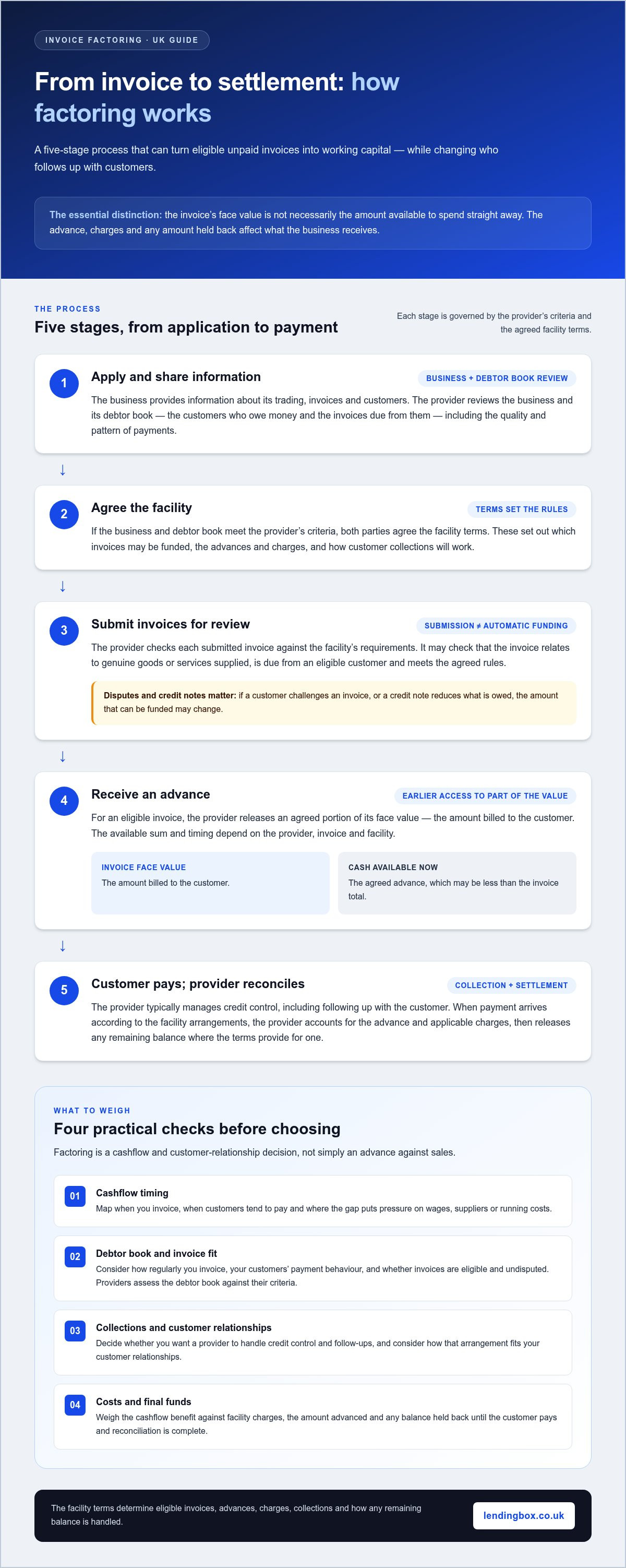
The process starts with a review of the business and its debtor book, meaning the customers who owe money and the invoices due from them. If the facility is agreed, the business can submit invoices for assessment. The provider determines which invoices meet the facility’s criteria and what advance, if any, applies.
- Apply and share information. The business provides details about its trading, invoices and customers. The provider assesses the business and debtor book to understand the quality and pattern of payments.
- Agree the facility. If the business and debtor book fit the provider’s criteria, the parties agree the facility terms. These set out matters such as eligible invoices, advances, charges and how collections will work.
- Submit invoices for review. The business sends invoices through the agreed process. The provider checks them against the facility’s requirements before deciding whether they can be funded.
- Receive an advance. For an eligible invoice, the provider releases an agreed portion of its face value. The face value is the amount billed to the customer; it isn’t necessarily the amount available to the business at this stage.
- Collect and reconcile. The customer pays according to the payment instructions. The provider records that payment against the advance and applicable fees, then handles any remaining balance in line with the agreed terms.
What happens after a business submits an invoice?
Submitting an invoice doesn’t automatically mean it will be funded. The provider reviews it and may check that it relates to genuine goods or services supplied, that payment is due from an eligible customer and that it meets the facility rules. The amount advanced can be less than the invoice’s full face value. Any balance is dealt with later through reconciliation, after the customer pays and charges or adjustments are accounted for.
Disputes can affect the process. If a customer challenges an invoice, or the business issues a credit note that reduces what’s owed, the fundable amount may change. An invoice can also fall outside the facility’s eligibility criteria. Keep records of invoice changes and customer queries organised. Clear documentation makes it easier to understand why an invoice was accepted, adjusted or excluded.
Who handles customer payments and credit control?
With factoring, the provider generally manages credit control and follows up with customers for payment. Customers are commonly informed about the arrangement, so they know where to direct payment and who may contact them about an outstanding invoice. This changes the day-to-day collection process, even though the business continues to manage its wider customer relationship.
Invoice discounting works differently: the business typically retains responsibility for collections and control of its sales ledger. That can suit a business that wants to manage customer contact itself. Consider who currently chases overdue accounts, how customers may respond to provider contact and whether the team wants to keep that work in-house.
Processes and terms vary by provider and facility. Lending Box helps UK limited companies and LLPs compare finance options, with a dedicated relationship manager guiding applications and handling paperwork. To explore invoice finance options, consider how your invoices, debtor book and collection needs fit together.
Invoice factoring vs invoice discounting: what changes for your business?
The key difference is who manages collections: with factoring, the provider typically chases customer payments; with invoice discounting, the business usually keeps control of its sales ledger and collections. That affects day-to-day administration and how customers interact with the finance arrangement. It doesn’t, by itself, determine which option suits your business.
| Consideration | Factoring | Invoice discounting | CHOCC arrangement |
|---|---|---|---|
| Collections | The provider typically manages credit control and follows up unpaid invoices. | The business generally manages collections and its own sales ledger. | The client handles its own credit control, subject to the facility terms. |
| Customer visibility | Customers are commonly told about the arrangement and given payment instructions. | Often set up confidentially, so customers may not be told that finance is in place. | Usually disclosed, though the precise customer communication and payment process can vary. |
| Administration | Some collection work moves to the provider, but the business still needs to supply accurate invoice information and manage customer queries. | The business keeps more responsibility for credit control and ledger administration. | The business retains collection tasks, despite the finance arrangement being disclosed. |
| Typical business fit | May suit a business that wants support with debtor administration. | May suit a business with established credit-control processes that wants to retain them. | May suit a business that wants to keep customer contact in-house within a disclosed arrangement. |
When might factoring fit better than invoice discounting?
Consider your team’s capacity as well as your preference for customer contact. If chasing overdue invoices takes staff time away from other work, provider-managed collections may be useful. If your credit-control process is established and close customer contact is central to how you operate, managing collections yourself may be a better fit. Disclosure isn’t automatically a drawback; clear payment instructions can help customers understand where to send funds. The practical question is whether the arrangement fits your relationships and routines.
What do disclosed, confidential and CHOCC arrangements mean?
A disclosed arrangement means customers are informed that invoice finance is in place, often with instructions about payment. A confidential arrangement is structured so customers aren’t told about the finance facility, and the business generally continues to handle collections. CHOCC means “Client Handles Own Credit Control”: the business manages customer contact and payment follow-up, even though the arrangement may be disclosed. Providers can use these terms differently, so focus on the actual process set out in the facility.
Compare the working arrangements, not just the product labels. Map who sends reminders, answers payment queries, records disputes and updates the ledger. Then consider whether your team has the time and systems to manage those tasks reliably. The right fit is the structure that supports cashflow without creating avoidable friction for staff or customers.
What should you weigh before choosing invoice factoring?
Earlier access to invoice funds can help cover payroll, stock or supplier bills before customers pay. But the value of that support depends on the full cost and how the facility fits your operations. Factoring can also shift collection work to a provider, changing how your customers receive payment reminders and raise queries.
Costs can depend on how much funding you use, your invoice profile and the agreed terms. Avoid judging a facility on one headline charge. Use your own invoices and cashflow to estimate how often you’d draw funds, how long invoices usually remain unpaid and whether customer payment patterns fluctuate through the year.
How to assess factoring costs and facility terms
Review a clear breakdown of every charge, what triggers it and how it is calculated. Then read the written terms alongside the headline fee. The amount you can draw, the invoices that qualify and the ongoing obligations all affect the facility’s practical value. Pay particular attention to:
- Advance rate: How the available advance is calculated and whether it can vary by invoice or customer.
- Concentration limits: Whether a large share of your ledger owed by one customer could restrict funding.
- Minimum periods: Whether the facility commits you for a set period or includes minimum usage requirements.
- Termination terms: How much notice is needed, what happens to outstanding invoices and whether exit charges apply.
- Service responsibilities: Who handles collections, customer queries, disputes and reporting, and what your team must continue to do.
Compare like with like. A facility with a lower headline charge may not be the better fit if its limits, required administration or exit terms don’t suit your trading pattern. Use the written terms to understand the expected cost in a typical month and a quieter one.
How factoring may affect cashflow and customer relationships
Map expected invoice volumes and payment patterns against the points when cash is needed, such as regular payroll or supplier cycles. Consider whether funding remains useful when sales rise or dip, and how the facility handles slow-paying customers. If a provider manages collections, think through how its reminders and query-handling process will fit alongside your usual customer service.
Also clarify whether the facility is recourse or non-recourse. With recourse factoring, the business generally remains responsible if a customer doesn’t pay. Non-recourse arrangements may transfer some defined bad-debt risk to the provider, but the scope and exclusions depend on the contract. Check which events are covered, how disputed invoices are treated and what responsibilities remain with your business. Don’t assume the label alone explains the risk allocation.
Before comparing options, prepare a recent debtor list, invoice history, payment timings and a forecast of cash needs. Lending Box matches UK limited companies and LLPs with finance options, and a dedicated relationship manager can guide the application and handle paperwork. Compare invoice finance options against your cashflow needs and the facility responsibilities.
How can a UK business explore invoice factoring with Lending Box?
Choosing a facility starts with understanding your invoices, debtor book and cashflow needs. Lending Box is a whole-of-market broker for UK limited companies and LLPs. It matches businesses with finance options, including invoice finance, so you can compare potential routes rather than assume one structure will fit every situation.
Lending Box is a broker, not a direct lender. Its in-house lending model provides eligibility insights without impacting credit scores, but those insights aren’t a funding decision or guarantee of approval. If you progress with an application, a dedicated relationship manager guides you through the process and handles paperwork. This support can make the application journey clearer and more manageable.
What information helps assess an invoice finance application?
There’s no single checklist that applies to every lender or facility. Preparing a clear snapshot of your business can, however, make it easier to discuss suitability and identify what further information may be needed. Useful starting points include:
- Recent accounts and management figures to show trading performance and current financial position.
- An aged debtor report showing who owes the business money, how much is outstanding and how long invoices have been unpaid.
- Invoice volumes and values across a typical period, including how regularly invoices are raised.
- Customer payment terms and payment patterns to show when cash is usually received.
- Details of disputes, credit notes or overdue accounts that could affect the invoices available for funding.
Keep the figures current and explain unusual changes, such as a seasonal rise in sales or one large customer making up a substantial share of the debtor book. The aim is to give a useful picture, not to assume every document will be required or that preparation guarantees an offer.
Compare suitable finance routes before progressing
Factoring may fit a business that wants support with collections. Discounting may be more suitable if the business wants to retain control of its sales ledger and has the capacity to manage customer payments. You can also compare invoice finance with other working-capital routes, considering how each aligns with your cashflow pattern, flexibility needs and day-to-day processes.
If you’re weighing invoice finance against borrowing for a broader business need, the UK business loans guide offers context on business borrowing. For a wider view of funding routes, explore business funding options.
Bring together your accounts, debtor information and a clear view of upcoming cash needs. Then explore finance options with Lending Box. A relationship manager can guide the application and paperwork, helping you understand the routes available without implying that eligibility insights secure approval.
Take a clear next step for your cashflow
Use your next planning session to map expected cash needs against incoming customer payments. That gives you a practical starting point for deciding whether invoice factoring belongs in your funding plan or whether another route better fits your priorities. Focus on the trade-offs your business can manage, not just the speed of access to funds.
Lending Box matches UK limited companies and LLPs with finance options across the market. Its dedicated relationship manager can guide an application and handle paperwork, while eligibility insights don’t impact credit scores. These insights can help inform your next step, but they don’t guarantee approval or funding.
Ready to compare routes for your business? Explore business finance options with Lending Box and take a considered next step for your cashflow.
Frequently Asked Questions
Is invoice factoring suitable for a small business?
Yes, invoice factoring may suit a small business that sells to other businesses on invoice terms and needs working capital before customers pay. For example, a small supplier might use it to help cover regular stock costs during a long customer payment cycle. Suitability depends on factors such as invoice consistency, customer payment records and facility terms. Compare the likely cashflow benefit with the cost and any changes to your collections process.
How does invoice factoring work when a customer pays an invoice?
The customer pays according to the facility’s payment instructions, which may direct payment to the finance provider. The provider then records the payment against the advance made on that invoice and accounts for charges under the agreement. Any balance due back to the business is handled through the facility’s reconciliation process. If a customer pays the business by mistake, follow the agreed process for transferring or recording the funds.
What is the difference between invoice factoring and invoice discounting?
The main difference is who manages customer collections. With factoring, the provider generally handles credit control and follows up unpaid invoices. With invoice discounting, the business usually keeps its sales ledger and manages collections itself. Discounting may suit a business with the staff and systems to manage debtor follow-up in-house; factoring may be worth considering if that administrative capacity is limited. Facility structures differ, so compare the actual responsibilities set out in the terms.
Can invoice factoring affect relationships with customers?
It can change how customers receive payment reminders or where they send funds, but disclosure doesn’t automatically harm a relationship. Clear, consistent communication helps: brief the staff who handle sales and accounts, explain any new payment instructions and make sure customers know whom to contact with a query. Consider how provider contact will fit your usual service style, particularly if you rely on regular conversations with a small number of key customers.
What happens if a customer does not pay an invoice?
The outcome depends on whether the facility is recourse or non-recourse and on the reason for non-payment. Under recourse terms, the business generally remains responsible for unpaid invoices, which may mean repaying the advance or replacing the invoice. Non-recourse terms may cover certain customer insolvency risks, but the protection is defined by the contract. A dispute, credit note or breach of terms may be treated differently, so review the specific exclusions and responsibilities.
How much does invoice factoring cost in the UK?
There’s no single cost that applies to every UK facility. Charges may include fees for administration or credit control, a charge linked to the funds drawn and other costs set out in the agreement. The calculation can depend on invoice and customer profiles, how much funding is used and how long it remains outstanding. Review the written breakdown of charges, minimums and exit costs, then compare the expected total against your likely usage.
Can a limited company use invoice factoring if it has a short trading history?
Possibly, but a short trading history can make assessment less straightforward, and approval isn’t guaranteed. A provider may consider the company’s financial information, invoice history, customer payment records and the strength of its debtor book. Prepare recent management figures, details of current contracts and a clear record of invoices raised and paid. The provider’s criteria and facility structure determine whether the available information is enough to assess an application.
Frequently Asked Questions
Factoring may be worth exploring for a business that sells goods or services to other businesses and invoices customers on agreed payment terms. It can be relevant where invoices build up before payments arrive and that timing gap puts pressure on day-to-day cashflow. Look beyond invoice volume. A facility’s fit can depend on how regularly the business invoices, the payment behaviour of its debtors and whether the team wants a provider to manage collections. A steady stream of invoices to reliable business customers may present a different profile from occasional invoices, disputed bills or a small number of slow-paying debtors. Not every business or invoice will qualify. Providers assess the debtor book and other details against their facility criteria. Before exploring options, map how often you invoice, when customers tend to pay and where cashflow pinch points occur. This helps you judge whether earlier access to invoice funds could help and whether handing over collections suits your customer relationships. The process starts with a review of the business and its debtor book, meaning the customers who owe money and the invoices due from them. If the facility is agreed, the business can submit invoices for assessment. The provider determines which invoices meet the facility’s criteria and what advance, if any, applies.
Submitting an invoice doesn’t automatically mean it will be funded. The provider reviews it and may check that it relates to genuine goods or services supplied, that payment is due from an eligible customer and that it meets the facility rules. The amount advanced can be less than the invoice’s full face value. Any balance is dealt with later through reconciliation, after the customer pays and charges or adjustments are accounted for. Disputes can affect the process. If a customer challenges an invoice, or the business issues a credit note that reduces what’s owed, the fundable amount may change. An invoice can also fall outside the facility’s eligibility criteria. Keep records of invoice changes and customer queries organised. Clear documentation makes it easier to understand why an invoice was accepted, adjusted or excluded.
With factoring, the provider generally manages credit control and follows up with customers for payment. Customers are commonly informed about the arrangement, so they know where to direct payment and who may contact them about an outstanding invoice. This changes the day-to-day collection process, even though the business continues to manage its wider customer relationship. Invoice discounting works differently: the business typically retains responsibility for collections and control of its sales ledger. That can suit a business that wants to manage customer contact itself. Consider who currently chases overdue accounts, how customers may respond to provider contact and whether the team wants to keep that work in-house. Processes and terms vary by provider and facility. Lending Box helps UK limited companies and LLPs compare finance options, with a dedicated relationship manager guiding applications and handling paperwork. To explore invoice finance options, consider how your invoices, debtor book and collection needs fit together. The key difference is who manages collections: with factoring, the provider typically chases customer payments; with invoice discounting, the business usually keeps control of its sales ledger and collections. That affects day-to-day administration and how customers interact with the finance arrangement. It doesn’t, by itself, determine which option suits your business.
Consider your team’s capacity as well as your preference for customer contact. If chasing overdue invoices takes staff time away from other work, provider-managed collections may be useful. If your credit-control process is established and close customer contact is central to how you operate, managing collections yourself may be a better fit. Disclosure isn’t automatically a drawback; clear payment instructions can help customers understand where to send funds. The practical question is whether the arrangement fits your relationships and routines.
A disclosed arrangement means customers are informed that invoice finance is in place, often with instructions about payment. A confidential arrangement is structured so customers aren’t told about the finance facility, and the business generally continues to handle collections. CHOCC means “Client Handles Own Credit Control”: the business manages customer contact and payment follow-up, even though the arrangement may be disclosed. Providers can use these terms differently, so focus on the actual process set out in the facility. Compare the working arrangements, not just the product labels. Map who sends reminders, answers payment queries, records disputes and updates the ledger. Then consider whether your team has the time and systems to manage those tasks reliably. The right fit is the structure that supports cashflow without creating avoidable friction for staff or customers. Earlier access to invoice funds can help cover payroll, stock or supplier bills before customers pay. But the value of that support depends on the full cost and how the facility fits your operations. Factoring can also shift collection work to a provider, changing how your customers receive payment reminders and raise queries. Costs can depend on how much funding you use, your invoice profile and the agreed terms. Avoid judging a facility on one headline charge. Use your own invoices and cashflow to estimate how often you’d draw funds, how long invoices usually remain unpaid and whether customer payment patterns fluctuate through the year.
There’s no single checklist that applies to every lender or facility. Preparing a clear snapshot of your business can, however, make it easier to discuss suitability and identify what further information may be needed. Useful starting points include: Keep the figures current and explain unusual changes, such as a seasonal rise in sales or one large customer making up a substantial share of the debtor book. The aim is to give a useful picture, not to assume every document will be required or that preparation guarantees an offer.
Yes, invoice factoring may suit a small business that sells to other businesses on invoice terms and needs working capital before customers pay. For example, a small supplier might use it to help cover regular stock costs during a long customer payment cycle. Suitability depends on factors such as invoice consistency, customer payment records and facility terms. Compare the likely cashflow benefit with the cost and any changes to your collections process.
The customer pays according to the facility’s payment instructions, which may direct payment to the finance provider. The provider then records the payment against the advance made on that invoice and accounts for charges under the agreement. Any balance due back to the business is handled through the facility’s reconciliation process. If a customer pays the business by mistake, follow the agreed process for transferring or recording the funds.
The main difference is who manages customer collections. With factoring, the provider generally handles credit control and follows up unpaid invoices. With invoice discounting, the business usually keeps its sales ledger and manages collections itself. Discounting may suit a business with the staff and systems to manage debtor follow-up in-house; factoring may be worth considering if that administrative capacity is limited. Facility structures differ, so compare the actual responsibilities set out in the terms.
It can change how customers receive payment reminders or where they send funds, but disclosure doesn’t automatically harm a relationship. Clear, consistent communication helps: brief the staff who handle sales and accounts, explain any new payment instructions and make sure customers know whom to contact with a query. Consider how provider contact will fit your usual service style, particularly if you rely on regular conversations with a small number of key customers.
The outcome depends on whether the facility is recourse or non-recourse and on the reason for non-payment. Under recourse terms, the business generally remains responsible for unpaid invoices, which may mean repaying the advance or replacing the invoice. Non-recourse terms may cover certain customer insolvency risks, but the protection is defined by the contract. A dispute, credit note or breach of terms may be treated differently, so review the specific exclusions and responsibilities.
There’s no single cost that applies to every UK facility. Charges may include fees for administration or credit control, a charge linked to the funds drawn and other costs set out in the agreement. The calculation can depend on invoice and customer profiles, how much funding is used and how long it remains outstanding. Review the written breakdown of charges, minimums and exit costs, then compare the expected total against your likely usage.
Possibly, but a short trading history can make assessment less straightforward, and approval isn’t guaranteed. A provider may consider the company’s financial information, invoice history, customer payment records and the strength of its debtor book. Prepare recent management figures, details of current contracts and a clear record of invoices raised and paid. The provider’s criteria and facility structure determine whether the available information is enough to assess an application.