
Commercial Property Finance UK: 2026 Guide for Businesses
14 October 2026 · 17 min read

The right commercial property finance UK option isn’t always a commercial mortgage. Buying premises to occupy, purchasing a property to let, refinancing or funding refurbishment can call for different types of borrowing, security and repayment plans.
It’s understandable to focus first on the deposit and monthly repayments. Lenders also consider how you’ll use the property, the strength of your business and whether cashflow can support the borrowing without squeezing day-to-day operations.
This guide explains the main routes, including commercial mortgages, bridging finance and other secured options. Compare how they work, where the trade-offs lie and what lenders may consider, so you can match funding to your plans and repayment capacity.
You’ll also find out what to prepare before exploring finance, from business and property details to a clear repayment or exit plan. Lending Box matches UK limited companies and LLPs with lenders for property and secured finance. Its company-data insights can help you understand eligibility without affecting your credit score, while a dedicated relationship manager supports the application process.
Key Takeaways
- Match commercial property finance UK to the property’s purpose, whether your business will occupy it or earn rental income from it.
- Compare mortgages, bridging and secured borrowing by timeframe, security and repayment plan.
- Test repayments against realistic cashflow forecasts before choosing a funding route.
- Prepare company accounts, management figures, forecasts and property details to organise an application.
- Explore lender options with a broker. Eligibility insights can help you understand your position without affecting your credit score.
Commercial property finance UK: what it covers and when businesses use it
Commercial property finance is funding used to buy, refinance or develop property for business use. It can help a company acquire premises for its own operations, or an investor purchase a property to let to another business. Depending on the purpose and application, the funding could be a commercial mortgage or another form of property-backed borrowing.
The intended use matters. An owner-occupier uses the premises for its own trading activity, such as a workshop, office or shop. An investor landlord aims to earn rent from a business tenant. The property’s use, the borrower’s circumstances, available security and capacity to make repayments all affect which routes may be suitable.
Property borrowing is also different from general working-capital finance. If the main need is to buy or refinance a building, define that as the core funding requirement. If you also need funds for stock, wages or other operating costs, set those out separately. A UK business loans guide can help put wider business borrowing needs in context.
Which business property plans may need finance?
Start by defining what the funding needs to achieve. A clear purpose helps frame the application and keeps the property costs distinct from other pressures on the business.
- Buying premises: A business may need finance to acquire a site it will occupy, bringing the property in line with its operational plans.
- Buying to let: A company purchasing premises for a business tenant has an investment purpose, rather than an owner-occupier purpose.
- Refinancing: A business may seek new borrowing to replace or restructure existing property finance. The lender will consider the property and the borrower’s repayment position.
- Refurbishment or a time-sensitive purchase: These plans may call for finance suited to the project’s purpose and timeframe. Short-term finance needs a credible repayment plan, such as a planned refinance or sale.
Keep the figures distinct. Property acquisition is a defined funding need; day-to-day cashflow is a separate one. Combining them without a clear breakdown can make it harder to assess affordability and choose a suitable borrowing structure.
Commercial property finance is not the same as a home mortgage
A commercial mortgage is one possible route, generally secured against commercial property. It is not a label for every kind of property finance. The commercial mortgage overview explains the basic structure and how this borrowing differs from residential mortgages. For a business, a lender’s assessment also considers the intended property use, the business’s circumstances, available security and its ability to meet repayments.
Terms depend on the lender and the individual application. Don’t use residential mortgage rules as a shortcut for estimating commercial borrowing: the purpose, security and repayment assessment can differ. Instead, consider how the proposed borrowing fits the business plan and whether repayments remain manageable under realistic cashflow forecasts.
Commercial property finance options: mortgages, bridging and secured borrowing
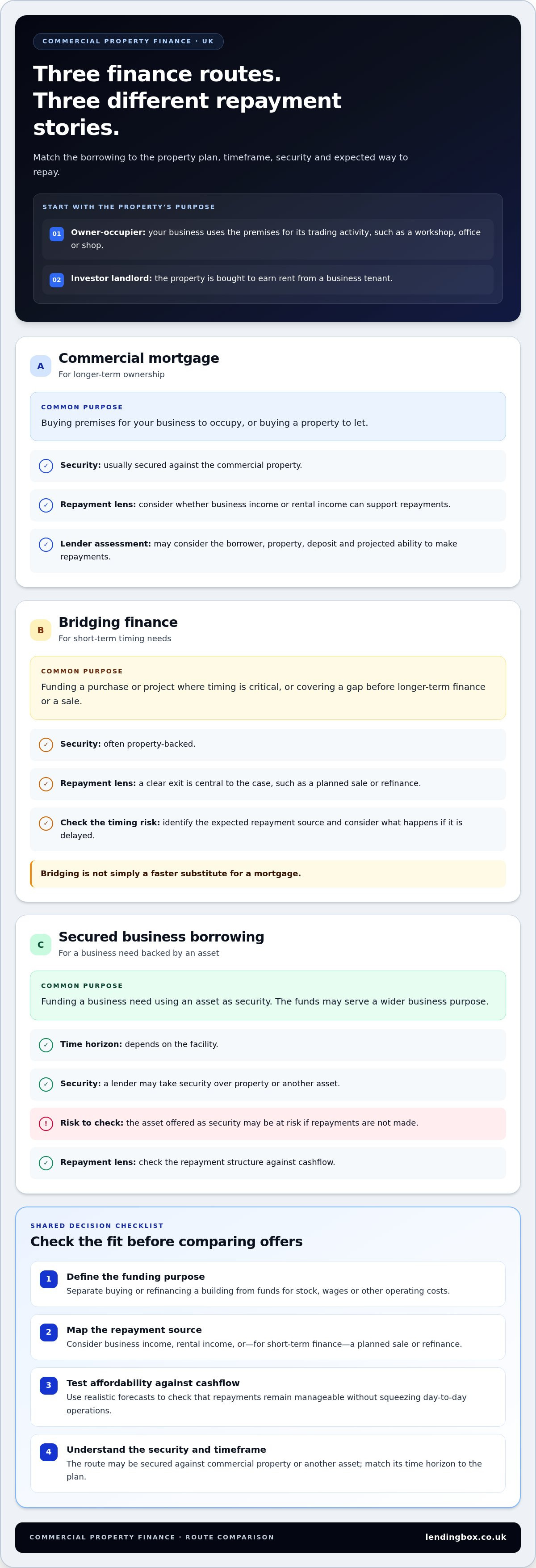
The right route depends on what the funds need to achieve and how the business expects to repay them. A long-term purchase, a time-sensitive acquisition and a broader business funding need are different cases. Use this comparison as a starting point, then consider lender criteria and the details of your application.
| Route | Common purpose | Typical time horizon | Security and repayment focus |
|---|---|---|---|
| Commercial mortgage | Buying premises to occupy or a property to let | Longer-term ownership | Usually secured against the property. Consider whether business income or rental income can support repayments. |
| Bridging finance | Funding a purchase or project where timing is critical | Short term | Often property-backed. A clear exit, such as a planned sale or refinance, is central to the case. |
| Secured business borrowing | Funding a business need using an asset as security | Depends on the facility | The asset offered as security may be at risk if repayments aren’t made. Check the repayment structure against cashflow. |
When could a commercial mortgage fit?
A commercial mortgage may suit a business planning to own and use its premises over the longer term, or a company buying property as an investment. Lenders assess the borrower, the property, the deposit and the projected ability to meet repayments. For example, a firm buying a workshop should explain how the premises support its operations and how repayments fit its trading forecasts. The UK Finance Commercial Finance overview provides wider context on commercial finance in the UK. For more detail on mortgages themselves, see a dedicated commercial mortgage guide.
When might bridging or secured finance be considered?
Bridging finance may suit a business that needs short-term funding to complete a purchase or cover a timing gap before longer-term finance or a sale. The exit plan is central: identify the expected repayment source and consider what happens if it’s delayed. Bridging is not simply a faster substitute for a mortgage.
Secured borrowing describes how finance is backed, not necessarily what the business uses it for. A lender may take security over property or another asset while the funds serve a wider business purpose. That asset could be at risk if the business can’t repay. Don’t treat secured borrowing and bridging as interchangeable. Compare their purpose, repayment demands and risks against the business case.
If property isn’t the only funding need, compare it with other business funding options. Lending Box matches limited companies and LLPs with lenders for property and secured finance. Its in-house model provides eligibility insights without impacting credit scores. Exploring commercial property finance UK through a broker can help you consider routes against your plans and repayment capacity. Explore property and secured finance with Lending Box.
How to compare commercial property finance against your business plan
Start with the reason for buying. Premises may support day-to-day operations, for example by giving a growing team room to work, or serve an investment aim by generating rental income. Some purchases do both. Be clear about the balance, then test whether the proposed finance supports the plan without putting pressure on the rest of the business.
Look beyond the purchase price. Compare the repayment amount and schedule with forecast income, existing borrowing and the property’s likely costs. Borrowing that appears manageable in a strong trading period could feel different during a seasonal dip or an unexpected interruption to rental income.
Match repayments to cashflow, not just the purchase plan
Set out expected repayments alongside monthly or seasonal trading patterns. Include existing commitments and allow for the costs of owning and maintaining the premises. If the property will be let, consider how the business would manage a gap between tenants or a delay in rent. Forecasts help you discuss affordability with a lender, but they don’t guarantee approval or a particular offer.
Then test the assumptions. Consider how the plan holds up if:
- Trading income falls or arrives later than forecast.
- A tenant leaves and rental income pauses.
- Refurbishment takes longer, or the property needs unplanned work.
- Existing business commitments rise or take longer to repay.
Use cautious figures rather than relying only on the most favourable outcome. If a small change would make repayments difficult, revisit the borrowing amount, timing or business plan before proceeding.
Check security, personal guarantees and exit risk
Property-backed borrowing puts the secured property at risk if the business can’t meet its obligations. A lender may also seek additional support. A personal guarantee is a commitment by an individual to repay some or all of a business debt if the business fails to do so. It is separate from security over company property, but it can still expose personal finances. Understand what is being offered as security and who is taking responsibility.
For short-term finance, identify a realistic exit route, such as refinancing or selling the property. Consider the consequences if that route takes longer than planned. Would the business have enough cash to meet repayments and cover operating costs in the meantime? If not, the exit plan may depend too heavily on events outside the business’s control.
Core fit test: Match the property’s purpose to the funding, the repayment plan to cashflow, the security to the risk the business can accept, and the exit plan to a realistic timeframe where one is needed. This gives you a practical basis for comparing commercial property finance UK options against the business plan, rather than judging them on the purchase alone.
Preparing a commercial property finance application in the UK
A well-organised application starts with a clear account of the project and how the business expects to manage the borrowing. Preparation helps lenders understand the request, but it doesn’t guarantee an offer, approval or a particular decision time. Requirements vary by lender and finance route, so use this as a practical starting point.
Work through the preparation in order:
- Define the property’s use. Say whether the business will occupy it, let it to another business, refinance existing borrowing or carry out a project such as refurbishment.
- Assess affordability. Map expected repayments against forecast trading income, existing commitments and the property’s costs. For an investment, allow for periods without rental income.
- Organise company information. Gather records that show how the business is performing and explain the purpose and proposed structure of the borrowing.
- Review suitable options. Compare routes against the property plan, repayment case, security and any exit strategy. Lender criteria will shape what can be considered.
What information helps lenders assess the application?
Prepare a concise picture of the company’s trading and financial position, including accounts, recent management figures, forecasts and details of existing borrowing or other commitments. Explain what the funds will cover and how the business expects to repay them. Include purchase details, information about the property and projected figures relevant to the proposed finance. These are common preparation points, not a fixed document list; requirements depend on the lender and application.
Keep the figures consistent. If a forecast assumes the property will generate rent, show how that income fits the repayment plan and make clear which assumptions support it. A short note explaining unusual trading changes can also put the figures in context.
Build a credible affordability and repayment case
Show how repayments could be met under ordinary trading conditions, not only in a best-case scenario. For owner-occupied premises, explain how the property supports the business and how repayments fit alongside operating costs. For an investment, set out the rental assumptions and consider how a void period or delayed tenant start could affect affordability.
If the borrowing is short term, describe the planned exit, such as a refinance or sale, and what the business would do if timing changed. A contingency makes the plan more considered; it doesn’t remove the risk that the exit could be delayed.
Property due diligence may also involve a valuation, legal work and checks on the property. These steps sit alongside the finance application and can affect the wider transaction timetable. Allow for them in the project plan rather than treating a finance decision as the only milestone.
Property transaction taxes and rules differ across the UK. Confirm the current requirements that apply to the purchase before finalising the figures, and factor appropriate professional advice into your planning.
For support organising a property finance application, explore property and secured finance with Lending Box. Its relationship managers support clients with application paperwork, while its in-house model provides eligibility insights without impacting credit scores.
Explore commercial property finance with Lending Box
Finding a suitable route for a commercial property purchase can mean comparing different lenders and criteria, not simply choosing a mortgage. Lending Box is a commercial finance broker, not a direct lender. It matches UK limited companies and LLPs with lenders for property and secured finance, then supports applications through to completion.
This broker-led approach can help structure a complex decision. Your plans, company information and property details help determine which options may be relevant. Lending Box’s in-house model also provides eligibility insights without impacting credit scores, giving your business an initial view of its position before progressing an application. These insights aren’t an approval, and lender decisions remain specific to each application.
What broker support can simplify
Whole-of-market lender matching gives businesses a way to explore property finance options across the market. Rather than treating the decision as a single product choice, consider how a route fits the property’s use, the borrowing purpose and your repayment plan. Lender criteria apply, and the final decision rests with the lender.
A dedicated relationship manager guides clients through the application journey and helps organise the required paperwork. This can make it easier to keep company and property information together, respond to requests and understand what needs attention next. Support can reduce administrative friction, but it can’t guarantee approval or a particular funding timeline.
Take the next step with a clear funding brief
Before exploring commercial property finance UK, pull the key details into a short brief. It doesn’t need to be a polished proposal. It should give a clear picture of what the business wants to do and how it expects the borrowing to work.
- Property purpose: Explain whether the business will occupy the premises, buy to let, refinance or fund a property project.
- Funding need: Set out what the borrowing will cover and how it relates to any separate business funding needs.
- Security: Identify the property or other assets that may be relevant to the application.
- Repayment plan: Summarise how repayments fit expected cashflow, and outline an exit plan if the finance is short term.
With that outline in hand, explore property finance options with Lending Box. A relationship manager can help organise the application information, while lender matching gives you a way to consider options suited to your business circumstances. The lender will assess the details and make its own decision.
A clear brief is a useful first step. It makes the initial finance discussion more focused, helps surface gaps early and gives the business a practical basis for exploring what comes next.
Make your next property decision with a clear brief
Your next step doesn’t need to be a commitment to borrow. Start with a focused discussion about what the property needs to do for your business, the funding you may require and the repayment plan you believe is workable. That gives you a clearer basis for exploring commercial property finance UK and deciding what to investigate further.
Lending Box works as a whole-of-market broker for UK limited companies and LLPs, matching businesses with lenders. Its in-house model provides eligibility insights without impacting credit scores, and a dedicated relationship manager supports applications through to completion. Lender criteria and decisions depend on each application, but you don’t have to organise the process alone.
Bring your property purpose, key figures and questions together. Then take the next step: Explore your commercial property finance options. A clear starting point can make the conversation more useful and help your business move forward with greater confidence.
Frequently Asked Questions
Can a limited company get finance to buy commercial property?
Yes, a limited company may be able to borrow to buy commercial property, subject to the lender’s criteria and assessment. The application will usually need to explain who will use the premises and how the company expects to manage repayments. For example, a company buying a unit for its own operations should set out how the site fits its trading plans. Both the property and the company’s financial position matter.
Is commercial property finance available for a new business?
It may be possible, but a newer business has less trading history for a lender to assess. Be ready to explain how the company will generate income, support repayments and manage costs during its early trading period. A business plan, cashflow forecast and details of directors’ relevant experience may help provide context. Lender requirements differ, and a short trading record does not by itself determine the outcome.
How much deposit do you need for commercial property finance?
There isn’t one deposit amount that applies to every commercial property application. The contribution required can depend on the property, how it will be used, the lender’s criteria and the company’s financial position. A lender may also assess the proposed borrowing against its view of the property’s value. Build a purchase budget that includes the deposit and other transaction costs, then test affordability without relying on the highest borrowing figure you hope to obtain.
Can commercial property finance cover refurbishment as well as a purchase?
Some finance routes may support refurbishment, but whether purchase and building work can be funded together depends on the lender, property and project. Prepare a clear breakdown of the acquisition and proposed works, with cost estimates and a realistic schedule. For substantial work, consider how the property will be used during the project and what will repay any short-term borrowing. Don’t assume a standard purchase mortgage will automatically cover refurbishment.
Do commercial property finance applications require a personal guarantee?
Not every application requires a personal guarantee. A lender may request one depending on its criteria and assessment of the company, transaction and available security. A personal guarantee is an individual’s promise to meet a business debt if the company cannot. Before agreeing, understand who is guaranteeing the borrowing, what obligations the document creates and how it relates to any security over the property. The terms are specific to the agreement.
What happens if a business cannot repay commercial property finance?
If repayments become difficult, contact the lender promptly and review the loan terms rather than waiting for the position to worsen. If the borrowing is secured against property, the lender may have rights to enforce that security under the agreement, putting the asset at risk. A personal guarantee could also expose the guarantor to repayment obligations. The consequences depend on the contracts and circumstances, so seek professional advice about your position.
Frequently Asked Questions
Start by defining what the funding needs to achieve. A clear purpose helps frame the application and keeps the property costs distinct from other pressures on the business. Keep the figures distinct. Property acquisition is a defined funding need; day-to-day cashflow is a separate one. Combining them without a clear breakdown can make it harder to assess affordability and choose a suitable borrowing structure.
A commercial mortgage may suit a business planning to own and use its premises over the longer term, or a company buying property as an investment. Lenders assess the borrower, the property, the deposit and the projected ability to meet repayments. For example, a firm buying a workshop should explain how the premises support its operations and how repayments fit its trading forecasts. The UK Finance Commercial Finance overview provides wider context on commercial finance in the UK. For more detail on mortgages themselves, see a dedicated commercial mortgage guide.
Bridging finance may suit a business that needs short-term funding to complete a purchase or cover a timing gap before longer-term finance or a sale. The exit plan is central: identify the expected repayment source and consider what happens if it’s delayed. Bridging is not simply a faster substitute for a mortgage. Secured borrowing describes how finance is backed, not necessarily what the business uses it for. A lender may take security over property or another asset while the funds serve a wider business purpose. That asset could be at risk if the business can’t repay. Don’t treat secured borrowing and bridging as interchangeable. Compare their purpose, repayment demands and risks against the business case. If property isn’t the only funding need, compare it with other business funding options. Lending Box matches limited companies and LLPs with lenders for property and secured finance. Its in-house model provides eligibility insights without impacting credit scores. Exploring commercial property finance UK through a broker can help you consider routes against your plans and repayment capacity. Explore property and secured finance with Lending Box. Start with the reason for buying. Premises may support day-to-day operations, for example by giving a growing team room to work, or serve an investment aim by generating rental income. Some purchases do both. Be clear about the balance, then test whether the proposed finance supports the plan without putting pressure on the rest of the business. Look beyond the purchase price. Compare the repayment amount and schedule with forecast income, existing borrowing and the property’s likely costs. Borrowing that appears manageable in a strong trading period could feel different during a seasonal dip or an unexpected interruption to rental income.
Prepare a concise picture of the company’s trading and financial position, including accounts, recent management figures, forecasts and details of existing borrowing or other commitments. Explain what the funds will cover and how the business expects to repay them. Include purchase details, information about the property and projected figures relevant to the proposed finance. These are common preparation points, not a fixed document list; requirements depend on the lender and application. Keep the figures consistent. If a forecast assumes the property will generate rent, show how that income fits the repayment plan and make clear which assumptions support it. A short note explaining unusual trading changes can also put the figures in context.
Yes, a limited company may be able to borrow to buy commercial property, subject to the lender’s criteria and assessment. The application will usually need to explain who will use the premises and how the company expects to manage repayments. For example, a company buying a unit for its own operations should set out how the site fits its trading plans. Both the property and the company’s financial position matter.
It may be possible, but a newer business has less trading history for a lender to assess. Be ready to explain how the company will generate income, support repayments and manage costs during its early trading period. A business plan, cashflow forecast and details of directors’ relevant experience may help provide context. Lender requirements differ, and a short trading record does not by itself determine the outcome.
There isn’t one deposit amount that applies to every commercial property application. The contribution required can depend on the property, how it will be used, the lender’s criteria and the company’s financial position. A lender may also assess the proposed borrowing against its view of the property’s value. Build a purchase budget that includes the deposit and other transaction costs, then test affordability without relying on the highest borrowing figure you hope to obtain.
Some finance routes may support refurbishment, but whether purchase and building work can be funded together depends on the lender, property and project. Prepare a clear breakdown of the acquisition and proposed works, with cost estimates and a realistic schedule. For substantial work, consider how the property will be used during the project and what will repay any short-term borrowing. Don’t assume a standard purchase mortgage will automatically cover refurbishment.
Not every application requires a personal guarantee. A lender may request one depending on its criteria and assessment of the company, transaction and available security. A personal guarantee is an individual’s promise to meet a business debt if the company cannot. Before agreeing, understand who is guaranteeing the borrowing, what obligations the document creates and how it relates to any security over the property. The terms are specific to the agreement.
If repayments become difficult, contact the lender promptly and review the loan terms rather than waiting for the position to worsen. If the borrowing is secured against property, the lender may have rights to enforce that security under the agreement, putting the asset at risk. A personal guarantee could also expose the guarantor to repayment obligations. The consequences depend on the contracts and circumstances, so seek professional advice about your position.