
Invoice Discounting in 2026: How It Works and When It Fits
16 October 2026 · 17 min read

What if the cash tied up in unpaid invoices could support your business before customers pay? That’s the practical idea behind invoice discounting: you receive an advance against eligible invoices, then repay it when your customer settles. The facility agreement sets out which invoices qualify and what happens if payment is late or never arrives.
It’s understandable to focus on how much cash you could release, but the advance is only one part of the decision. Consider the fees, settlement terms and the work your team will still need to do to collect payments. Unlike factoring, invoice discounting generally lets your business manage its sales ledger and collect payments, which can help you retain control of customer relationships.
This guide explains the advance and settlement process, compares discounting with factoring, and shows how to assess the fit against your cashflow needs and customers’ payment patterns. It also covers what to prepare before exploring funding. Lending Box is a whole-of-market commercial finance broker that matches UK limited companies and LLPs with lenders and supports them through applications.
Key Takeaways
- Invoice discounting can turn eligible unpaid invoices into working capital. The facility terms determine the advance and settlement process.
- Compare discounting and factoring to see how each affects customer contact, collections and administration.
- Review invoice volumes, payment terms and debtor concentration to assess whether funding could ease recurring, seasonal or growth-related cashflow gaps.
- Consider your team’s collection capacity and the risk of late or unpaid invoices when assessing the fit.
- Prepare a clear picture of your invoice profile and funding need to make a discussion about lender options more focused.
Invoice discounting explained: turning unpaid invoices into working capital
You’ve completed the work and sent the invoice. Your team still needs paying, stock still needs buying and overheads keep arriving. The gap between delivering work and receiving payment can put pressure on cashflow, especially when customers pay on agreed terms rather than straight away.
Invoice discounting is a facility that advances funds against eligible unpaid invoices, so your business can access working capital before customers pay. The invoice’s face value is not necessarily the amount available. The lender assesses the invoices and applies the advance rate and other terms set out in the facility.
Customer receipts normally provide the money used to settle the advance. Your business generally collects the invoice payment and repays the lender under the agreed process. Fees, any retained balance and the amount ultimately released depend on the facility terms. Review these together, not just the initial advance: they determine how much cash is available and what remains due once the customer pays.
For example, a £10,000 invoice does not automatically mean £10,000 of working capital. The lender may advance only an agreed portion, with the remaining balance handled according to the facility terms. The foundational explanation of invoice discounting also helps distinguish it from factoring, where collections are commonly handled by the finance provider.
What does invoice discounting mean for a business?
Your sales ledger, the record of invoices issued and payments due, helps show the lender what customers owe and when. The facility uses eligible receivables to support access to cash, but an invoice’s face value and the amount advanced against it are different figures. A revolving arrangement may let the business draw against eligible invoices as they arise, if the agreement allows it.
Which businesses commonly consider invoice discounting?
It may suit businesses that sell to other businesses and invoice them on agreed payment terms. Regular invoices and clear debtor records can help a lender understand sales patterns, payment behaviour and outstanding balances. They don’t guarantee eligibility: the lender assesses the business and proposed facility. To compare this with other forms of funding, explore UK business finance options.
How invoice discounting works, from invoice issue to settlement
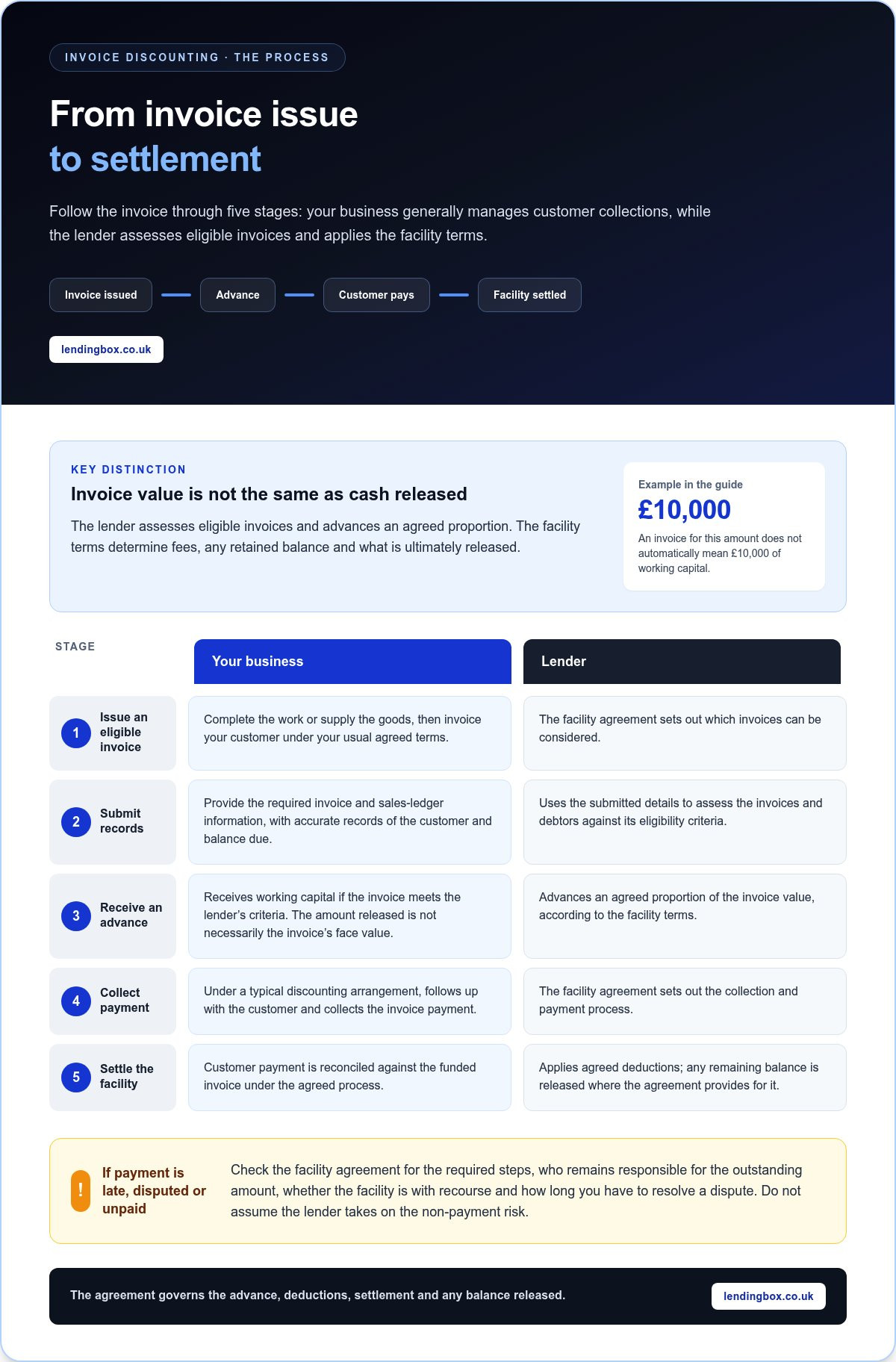
The facility follows the invoice from submission through to payment. Your business usually continues to manage customer collections, while the lender checks the records and applies the agreed terms. Knowing each stage helps you plan cashflow and understand what needs to happen if an invoice is delayed, disputed or left unpaid.
- Issue an eligible invoice. Complete the work or supply the goods, then invoice your customer under your usual agreed terms. The facility agreement sets out which invoices can be considered.
- Submit the invoice records. Provide the lender with the required invoice and sales-ledger information. Accurate records help match each invoice to the customer and the balance due.
- Receive an advance. If the invoice meets the lender’s criteria, the lender advances an agreed proportion of its value. The invoice amount is not the same as the amount released.
- Collect payment from your customer. Under a typical discounting arrangement, your business remains responsible for following up and collecting the invoice, in line with the facility terms.
- Settle the facility. The customer’s payment is reconciled against the funded invoice. The lender applies the agreed deductions, and any remaining balance is released where the agreement provides for it.
From invoice submission to the advance
Invoice records and sales-ledger details show the lender who owes the money, how much is outstanding and when it is due. The lender assesses the invoices and debtors against its own eligibility criteria, which can affect which invoices qualify and the advance offered. There is no single advance proportion or processing time for every facility. The agreement sets out the relevant terms.
What happens when the customer pays?
Customer payment is matched to the funded invoice, then used to settle the amount due under the facility. Depending on the agreement, the lender may retain fees or a reserve before releasing any remaining balance. Customer payment normally settles the advance, with any deductions and release of the balance governed by the facility agreement.
Payment delays need attention. If an invoice is late, disputed or unpaid, the agreement explains the required steps and who remains responsible for the outstanding amount. Review whether the facility is with recourse, what happens if a customer fails to pay, and how long you have to resolve a dispute. Don’t assume the lender takes on the non-payment risk. Allianz Trade’s guide to invoice discounting and factoring provides further background on the process and how these arrangements differ.
Before exploring options, organise a sample of invoices, payment records and sales-ledger information. A broker can help you understand how these details relate to potential lender criteria and support the application process. Explore invoice finance options with Lending Box, which matches businesses with lenders rather than lending directly.
Invoice discounting vs factoring: compare control, confidentiality and responsibility
The practical difference is often who manages customer collections. With discounting, your business commonly continues to collect payments and manage the sales ledger. With factoring, the finance provider commonly takes the lead on collections. This affects more than administration: it can change how customers experience the payment process and how much control your team retains.
| Point to compare | Invoice discounting | Invoice factoring |
|---|---|---|
| Collections control | Your business commonly collects payments. | The provider commonly manages collections. |
| Customer visibility | May be confidential, depending on the facility structure. | Customers are commonly notified because the provider handles collections. |
| Administration | Your team generally retains more credit-control work. | The provider generally takes on more of the collection process. |
| Typical fit | Businesses that want to keep customer payment management in-house. | Businesses that want provider-led collections and support with administration. |
How the two facilities differ in practice
These are common distinctions, not fixed rules for every agreement. Some discounting arrangements involve customer notification, so confidentiality isn’t automatic. The facility structure sets out what customers are told, who contacts them about overdue invoices and what your business must do. Review those responsibilities before deciding. If preserving direct control of customer conversations matters, consider how collections will work day to day, not just what the facility is called.
Factoring can shift some collection work to the provider, but that also means your customers may deal with another organisation about payment. Discounting can keep those conversations with your team, but your business remains responsible for the agreed collection tasks. Neither approach is universally better. The right balance depends on your internal capacity, customer relationships and preferred level of control. For a closer look at the related model, see this guide to invoice factoring for UK businesses.
When might another type of business finance fit better?
Receivables-led funding is linked to eligible invoices and customer payment patterns. It may be worth comparing with other funding if your need is a defined, one-off amount, such as paying for equipment or a planned project, rather than bridging cash tied up in invoices. A business loan may provide a fixed sum with repayments set out over an agreed term, subject to its own lender criteria and terms.
Start with the purpose. If the cash need rises and falls with invoice levels, funding linked to receivables may align more closely with that pattern. If you need a set amount and can plan repayments from forecast cashflow, a term loan may be relevant. Compare the repayment structure with your expected income and existing commitments. Lending Box matches businesses with lenders and supports applications, helping clarify which funding route may fit the requirement. Approval and terms remain subject to the lender’s assessment.
How to assess whether invoice discounting fits your business
Start with your receivables, then test the facility against your cashflow. A useful assessment looks beyond invoice totals. It considers which invoices are likely to qualify, how reliably customers pay and whether your team can manage collections. This helps you judge whether funding linked to invoices could address a recurring pressure or add complexity without solving the underlying gap.
Review invoices, customers and cashflow patterns
Build a snapshot of your sales ledger. Separate issued, unpaid, disputed and overdue invoices so you can distinguish expected receipts from balances that may be difficult to collect. Then work through these checks:
- Map invoice volume and timing. Review how regularly you invoice, the value of outstanding balances and the payment terms you offer. A consistent flow can make the funding need easier to understand than occasional, one-off invoices.
- Look at debtor concentration. Note whether a large share of your unpaid invoices is owed by a small number of customers. Consider what a delayed payment from one of them would mean for cashflow.
- Review payment behaviour and invoice quality. Identify late payers, recurring disputes, credit notes and incomplete records. Invoice quality and the customer profile can affect which receivables a lender considers and the terms available.
- Check your collection capacity. Discounting commonly leaves your business responsible for customer collections. Consider whether your team can follow up overdue invoices and keep records up to date alongside other finance tasks.
- Match the facility to the cash gap. Compare expected customer receipts with payroll, supplier commitments and other short-term obligations. Work out whether the pressure is recurring, seasonal or linked to growth, such as taking on work that requires spending before customers pay.
This review can show whether the underlying issue is a mismatch between payment timing and operating costs, or a wider cashflow shortfall. That distinction matters: a facility linked to receivables works differently from funding designed around a separate, fixed business need.
Understand the facility terms before proceeding
Terms vary by lender and agreement, so assess the full arrangement against your expected receipts. Establish how the advance is calculated, whether a reserve is held, what fees apply and how settlement works when a customer pays. Review the recourse terms too. With recourse, your business may remain responsible if a customer doesn’t pay, depending on the agreement.
Review how the facility handles late payments, disputed invoices and credit notes. These can affect the balance available or the steps you need to take. Consider whether the settlement rules fit the way customers actually pay, not simply the dates on their invoices. If cashflow is tight during particular months, test how delayed receipts could affect repayments and day-to-day commitments.
Once you’ve mapped your receivables and cash needs, explore your business finance options. Lending Box matches businesses with lenders and supports applications, helping you assess relevant funding routes. Lender criteria and decisions depend on the application.
How to explore invoice discounting with a finance broker
A broker-led discussion can turn a broad funding question into a clearer assessment. Bring together your cashflow requirement and invoice profile, then consider which lender options may suit your business. A broker doesn’t make the lender’s decision. Criteria, approval and timing depend on the application and the lender’s assessment, so treat an initial discussion as a way to understand possible routes, not a promise of an offer.
For invoice discounting, start with a practical picture of what you invoice, when customers usually pay and how much working capital you need. Explain whether the pressure comes from regular payment gaps, a seasonal pattern or growth that requires spending before customer receipts arrive. This context keeps the discussion focused on the business need, not just the headline value of unpaid invoices.
What information can help start the conversation?
Gather a current sales ledger, your usual invoice and payment terms, and a summary of outstanding balances. Separate overdue or disputed invoices from those you expect customers to pay as agreed. Recent management accounts can add context, while a short explanation of the cashflow requirement helps show what the funding needs to support.
Organised records make it easier to discuss your invoice profile and identify where lenders may need more detail. They don’t replace lender checks. During assessment, a lender may request further information about the business, its customers or particular invoices.
What support can a broker provide?
Lending Box matches businesses with lenders rather than lending directly. A dedicated relationship manager guides you through the application and paperwork, helping keep information clear as the funding need and lender requirements are discussed. This support can make a complex process easier to follow, without suggesting that a particular facility or outcome is assured.
Lending Box can also provide eligibility insights without impacting credit scores. These insights are not lender approval or a funding decision. The lender assesses the application and sets any offer, terms and timing. Use the discussion to understand which options may be relevant and what information could help move an application forward.
Before proceeding, make sure you understand the proposed facility’s advance calculation, fees, settlement process and what happens if customers pay late or dispute invoices. Compare those terms with your cashflow forecasts and collection capacity. A broker can help you work through the options and support the application, while the lender remains responsible for its own assessment.
If you’re ready to discuss your funding requirement and invoice profile, explore invoice finance options with Lending Box.
Take a clear next step with your funding plan
Before deciding whether invoice discounting belongs in your funding plan, use your cashflow forecast and debtor records to define the problem you need to solve. Which commitments must you meet, and when? How much of the pressure comes from customers paying later than your costs fall due? A focused summary can make the next conversation more useful.
Then compare the funding requirement with the practical effect on your business. Consider how a facility would sit alongside day-to-day cashflow, customer payment patterns and growth plans. If the fit isn’t clear yet, identify the specific question you need to resolve before taking an application further.
Lending Box is a whole-of-market commercial finance broker for UK limited companies and LLPs. It matches businesses with lenders and supports applications, so you can explore relevant options without assuming approval or particular terms are assured.
Explore invoice finance options with Lending Box and take the next step with a clearer view of what your business needs.
Frequently Asked Questions
Can invoice discounting be used for just one invoice?
Invoice discounting is commonly arranged as an ongoing facility against a pool of eligible receivables, rather than funding for one invoice alone. Some providers may structure single-invoice finance differently. If you have one unusually large customer bill, explain whether it’s a one-off gap or part of regular working capital pressure. The suitable structure depends on lender criteria, your invoices and the facility terms.
What happens if a customer pays an invoice late?
Late payment can keep an advance outstanding for longer, leaving less facility capacity available for later invoices or creating charges if the agreement provides for them. Continue the collection steps set out in your facility, including follow-up and any required updates to the lender. If a customer has raised a query, record the contact and issue promptly. The agreement determines how overdue balances are treated, so don’t plan cashflow around an assumed payment date.
Can a business use invoice discounting for overseas customers?
Overseas receivables may qualify under some invoice finance arrangements, but acceptance depends on lender policy and facility terms. A lender may consider where the customer is based, the invoice currency, payment terms and how the receivable can be verified. Include international debtors in your funding picture from the outset. This helps identify restrictions or additional information needed during an assessment.
Does invoice discounting affect a business’s credit score?
An initial eligibility insight isn’t the same as a lender’s formal credit assessment. Lending Box’s in-house model provides eligibility insights without impacting credit scores. If you make an application, the lender may carry out its own checks and assess the business under its criteria. Review what checks apply at each stage and distinguish an early indication from a decision. Neither an insight nor a check guarantees approval or a particular score outcome.
Can a business with disputed invoices use invoice discounting?
Possibly, but disputed invoices may be treated differently from straightforward receivables and may not qualify under a facility’s rules. For example, an unresolved query about delivery or an agreed credit note can change the balance a customer owes. Mark those items separately in your ledger rather than counting them as ordinary unpaid invoices. The lender’s criteria and agreement determine how disputes, claims and adjustments affect eligibility and funding.
Is invoice discounting suitable for a new business?
Possibly, but being new doesn’t by itself establish whether a facility will fit. The assessment may depend on trading history, completed credit sales, the customer base and lender criteria. A company with a short record and only a few invoices presents a different receivables profile from one with regular sales. Start with the invoices you can evidence and the cashflow gap you need to address, then assess options against that picture.
Do customers need to know that a business uses invoice discounting?
Not always. Some facilities are structured confidentially, while others require customer notification or visible changes to payment instructions. What a customer sees can depend on the facility structure and who is responsible for collections. Before proceeding, understand any notice requirements and the exact payment process, including where customers must send funds. Don’t assume the arrangement will remain private: the written terms and operating instructions determine how it works in practice.
Frequently Asked Questions
Your sales ledger, the record of invoices issued and payments due, helps show the lender what customers owe and when. The facility uses eligible receivables to support access to cash, but an invoice’s face value and the amount advanced against it are different figures. A revolving arrangement may let the business draw against eligible invoices as they arise, if the agreement allows it.
It may suit businesses that sell to other businesses and invoice them on agreed payment terms. Regular invoices and clear debtor records can help a lender understand sales patterns, payment behaviour and outstanding balances. They don’t guarantee eligibility: the lender assesses the business and proposed facility. To compare this with other forms of funding, explore UK business finance options. The facility follows the invoice from submission through to payment. Your business usually continues to manage customer collections, while the lender checks the records and applies the agreed terms. Knowing each stage helps you plan cashflow and understand what needs to happen if an invoice is delayed, disputed or left unpaid.
Customer payment is matched to the funded invoice, then used to settle the amount due under the facility. Depending on the agreement, the lender may retain fees or a reserve before releasing any remaining balance. Customer payment normally settles the advance, with any deductions and release of the balance governed by the facility agreement. Payment delays need attention. If an invoice is late, disputed or unpaid, the agreement explains the required steps and who remains responsible for the outstanding amount. Review whether the facility is with recourse, what happens if a customer fails to pay, and how long you have to resolve a dispute. Don’t assume the lender takes on the non-payment risk. Allianz Trade’s guide to invoice discounting and factoring provides further background on the process and how these arrangements differ. Before exploring options, organise a sample of invoices, payment records and sales-ledger information. A broker can help you understand how these details relate to potential lender criteria and support the application process. Explore invoice finance options with Lending Box, which matches businesses with lenders rather than lending directly. The practical difference is often who manages customer collections. With discounting, your business commonly continues to collect payments and manage the sales ledger. With factoring, the finance provider commonly takes the lead on collections. This affects more than administration: it can change how customers experience the payment process and how much control your team retains.
Receivables-led funding is linked to eligible invoices and customer payment patterns. It may be worth comparing with other funding if your need is a defined, one-off amount, such as paying for equipment or a planned project, rather than bridging cash tied up in invoices. A business loan may provide a fixed sum with repayments set out over an agreed term, subject to its own lender criteria and terms. Start with the purpose. If the cash need rises and falls with invoice levels, funding linked to receivables may align more closely with that pattern. If you need a set amount and can plan repayments from forecast cashflow, a term loan may be relevant. Compare the repayment structure with your expected income and existing commitments. Lending Box matches businesses with lenders and supports applications, helping clarify which funding route may fit the requirement. Approval and terms remain subject to the lender’s assessment. Start with your receivables, then test the facility against your cashflow. A useful assessment looks beyond invoice totals. It considers which invoices are likely to qualify, how reliably customers pay and whether your team can manage collections. This helps you judge whether funding linked to invoices could address a recurring pressure or add complexity without solving the underlying gap.
Gather a current sales ledger, your usual invoice and payment terms, and a summary of outstanding balances. Separate overdue or disputed invoices from those you expect customers to pay as agreed. Recent management accounts can add context, while a short explanation of the cashflow requirement helps show what the funding needs to support. Organised records make it easier to discuss your invoice profile and identify where lenders may need more detail. They don’t replace lender checks. During assessment, a lender may request further information about the business, its customers or particular invoices.
Lending Box matches businesses with lenders rather than lending directly. A dedicated relationship manager guides you through the application and paperwork, helping keep information clear as the funding need and lender requirements are discussed. This support can make a complex process easier to follow, without suggesting that a particular facility or outcome is assured. Lending Box can also provide eligibility insights without impacting credit scores. These insights are not lender approval or a funding decision. The lender assesses the application and sets any offer, terms and timing. Use the discussion to understand which options may be relevant and what information could help move an application forward. Before proceeding, make sure you understand the proposed facility’s advance calculation, fees, settlement process and what happens if customers pay late or dispute invoices. Compare those terms with your cashflow forecasts and collection capacity. A broker can help you work through the options and support the application, while the lender remains responsible for its own assessment. If you’re ready to discuss your funding requirement and invoice profile, explore invoice finance options with Lending Box. Before deciding whether invoice discounting belongs in your funding plan, use your cashflow forecast and debtor records to define the problem you need to solve. Which commitments must you meet, and when? How much of the pressure comes from customers paying later than your costs fall due? A focused summary can make the next conversation more useful. Then compare the funding requirement with the practical effect on your business. Consider how a facility would sit alongside day-to-day cashflow, customer payment patterns and growth plans. If the fit isn’t clear yet, identify the specific question you need to resolve before taking an application further. Lending Box is a whole-of-market commercial finance broker for UK limited companies and LLPs. It matches businesses with lenders and supports applications, so you can explore relevant options without assuming approval or particular terms are assured. Explore invoice finance options with Lending Box and take the next step with a clearer view of what your business needs.
Invoice discounting is commonly arranged as an ongoing facility against a pool of eligible receivables, rather than funding for one invoice alone. Some providers may structure single-invoice finance differently. If you have one unusually large customer bill, explain whether it’s a one-off gap or part of regular working capital pressure. The suitable structure depends on lender criteria, your invoices and the facility terms.
Late payment can keep an advance outstanding for longer, leaving less facility capacity available for later invoices or creating charges if the agreement provides for them. Continue the collection steps set out in your facility, including follow-up and any required updates to the lender. If a customer has raised a query, record the contact and issue promptly. The agreement determines how overdue balances are treated, so don’t plan cashflow around an assumed payment date.
Overseas receivables may qualify under some invoice finance arrangements, but acceptance depends on lender policy and facility terms. A lender may consider where the customer is based, the invoice currency, payment terms and how the receivable can be verified. Include international debtors in your funding picture from the outset. This helps identify restrictions or additional information needed during an assessment.
An initial eligibility insight isn’t the same as a lender’s formal credit assessment. Lending Box’s in-house model provides eligibility insights without impacting credit scores. If you make an application, the lender may carry out its own checks and assess the business under its criteria. Review what checks apply at each stage and distinguish an early indication from a decision. Neither an insight nor a check guarantees approval or a particular score outcome.
Possibly, but disputed invoices may be treated differently from straightforward receivables and may not qualify under a facility’s rules. For example, an unresolved query about delivery or an agreed credit note can change the balance a customer owes. Mark those items separately in your ledger rather than counting them as ordinary unpaid invoices. The lender’s criteria and agreement determine how disputes, claims and adjustments affect eligibility and funding.
Possibly, but being new doesn’t by itself establish whether a facility will fit. The assessment may depend on trading history, completed credit sales, the customer base and lender criteria. A company with a short record and only a few invoices presents a different receivables profile from one with regular sales. Start with the invoices you can evidence and the cashflow gap you need to address, then assess options against that picture.
Not always. Some facilities are structured confidentially, while others require customer notification or visible changes to payment instructions. What a customer sees can depend on the facility structure and who is responsible for collections. Before proceeding, understand any notice requirements and the exact payment process, including where customers must send funds. Don’t assume the arrangement will remain private: the written terms and operating instructions determine how it works in practice.