Asset refinance: How valuation shapes borrowing amounts
26 October 2026 · 11 min read

 Business funding
An asset’s current market value, not its original purchase price, shapes how much a business can borrow through asset refinance. Lenders typically advance between 60% and 90% of that value, with the asset’s condition, age and the business’s existing equity also influencing the amount. The figure is not simply the valuation: any finance already secured against the asset affects how much capital may be released.
It’s understandable to focus on the cash an asset refinance might release. But the borrowing amount is only part of the decision: repayments, the agreement term and the risk of securing borrowing against a business asset matter too. This article explains how refinancing works, what lenders assess when valuing an asset and how those factors affect a potential advance. It also covers when refinancing may help with cash flow, investment or restructuring existing finance, so you can weigh the potential benefits against the commitments.
Key Takeaways
- Borrowing is based on an asset’s current working value and the equity your business holds, not simply its original purchase price.
- Lenders typically advance 60% to 90% of an asset’s current market value. Its age, condition and resale position can affect the valuation.
- Compare the full repayment cost and agreement term, not just the amount released or the monthly payment.
- Refinancing can unlock funds for cash flow or growth, but the asset is at risk if repayments aren’t made.
What is Asset Refinancing?
Asset refinance can release capital from vehicles, machinery or equipment a business already uses. A lender assesses the asset and any existing finance to determine what funding may be available.
Releasing Capital from Business Assets
An asset refinance arrangement raises funds against an existing business asset, helping convert its value into working capital without selling it. For example, delivery vans valued at £50,000 could potentially release £35,000 to £40,000. Sale and leaseback involves selling the asset and leasing it back; refinancing generally uses it as security instead. A business loan is not necessarily tied to one specific asset.
Using Assets as Security
Business assets such as vehicles, machinery and equipment can secure the borrowing. The business continues using the asset, while the lender considers its condition, age and the proportion already owned. A business need not own 100% of an asset to use it as security. UK limited companies, LLPs and PLCs may be eligible, subject to lender criteria, affordability and credit assessment.
Business Benefits and Applications
Released funds may support cash flow, stock, wages, overheads or growth costs. For example, a firm preparing to fulfil a contract could use working capital for materials while continuing to use machinery offered as security. Whether this makes sense depends on the planned use of the funds and whether it justifies the repayments. Compare the agreement’s total cost and term with the business’s expected cash-flow needs.
Tax, VAT and Potential Risks
Tax and VAT treatment depends on the agreement’s structure and how the transaction is recorded. Interest may be offset against business profits in some cases, but that does not mean every cost is deductible or VAT is recoverable. Before refinancing, assess settlement costs, the new term and repayments. If payments are missed, the lender may take the asset, which the business remains responsible for maintaining and insuring.
Asset refinance definition and how it works
Asset refinance lets a business unlock funds using an asset it already owns or is still paying for. The lender assesses the asset and the company’s finances to determine the potential advance and repayment structure.
Meaning of Asset Refinancing
With asset refinance, a lender uses a business asset, such as a vehicle or machine, as security for new funding. This can help a business access capital without selling equipment it needs to trade. The amount available depends partly on the asset’s equity. If finance is still outstanding, the new lender will usually settle the existing balance, and the business receives any remaining advance.
The business continues using the asset during the agreement. Once the borrowing is repaid, ownership usually returns to the business. Refinancing may be relevant when an existing agreement is nearing its end or the business wants to release capital from equipment already in use.
The Refinancing Process
The process begins with information about the asset, its condition and any current finance. Lenders also assess credit history, credit score and affordability. These details help establish whether the asset is suitable security and what repayment structure may fit. A completed application can receive a decision within 48 hours.
If the business accepts the terms, the lender arranges settlement of existing finance where applicable. The business then repays under the new agreement. Compare the interest rate, total repayment and term before proceeding. A comparison of business finance options can help show how this route fits alongside other funding choices.
Asset valuation and borrowing amounts
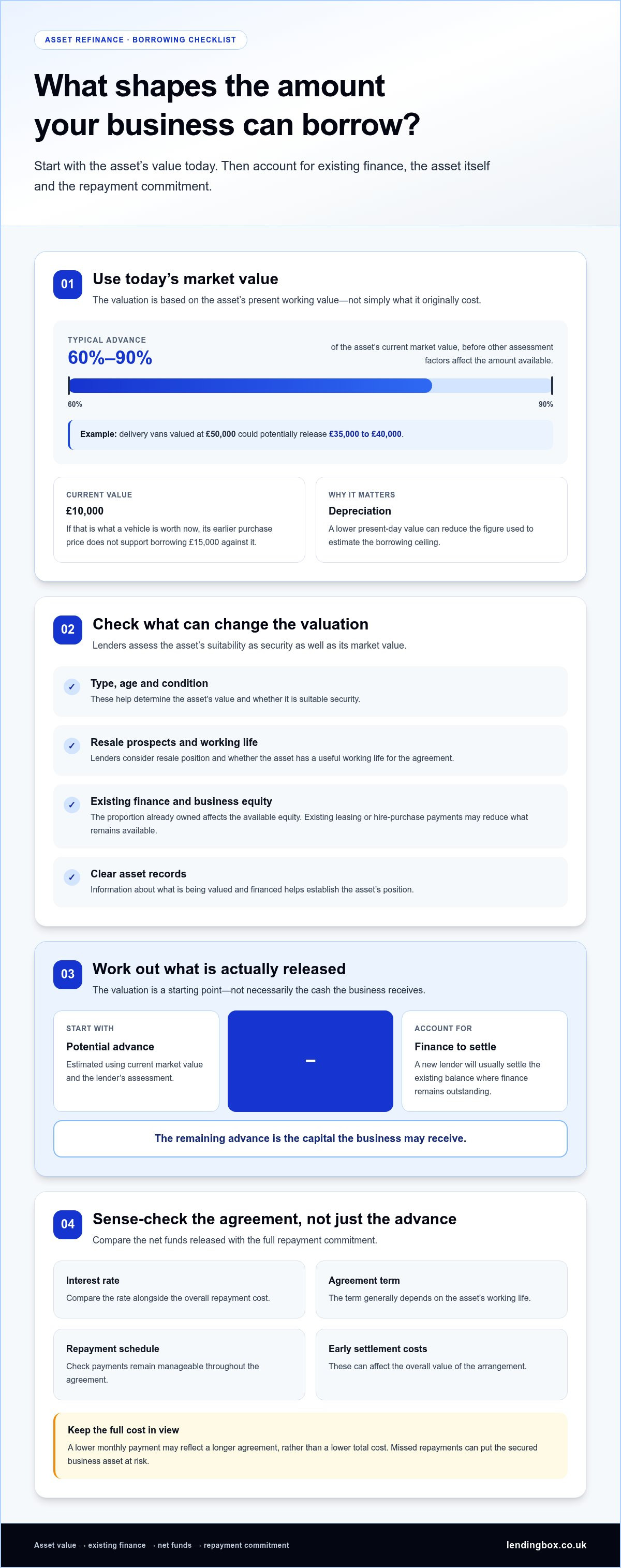
For an asset refinance, the valuation sets the starting point for estimating a possible advance. Lenders typically advance between 60% and 90% of an asset’s current market value, then account for existing finance and other assessment factors.
Assessing Asset Value
A valuation estimates the asset’s present working value, rather than its original purchase price. This matters because depreciation can reduce the figure used to calculate borrowing. If a vehicle is worth £10,000 now, its earlier purchase price doesn’t support borrowing £15,000 against it. The valuation helps establish the lending ceiling, while any outstanding balance affects how much cash remains available.
Factors Affecting Borrowing Amounts
Lenders consider the asset’s type, age, condition, resale prospects and suitability as security. They also assess how much the business already owns and whether the asset has a useful working life for the agreement. Existing leasing or hire-purchase payments can reduce available equity because the new facility may need to settle that balance. Clear asset records help establish what is being valued and financed.
Loan Amounts and Terms
The loan-to-value ratio compares the advance with the asset’s current market value. Use it to sense-check a proposed amount, while also accounting for settlement balances and the repayment schedule. The term generally depends on the asset’s working life. Check that payments remain manageable throughout the agreement, not just at the outset.
When assessing asset refinance, compare the net funds released with the full repayment commitment. The interest rate, term and any early settlement costs can affect the overall value of the arrangement. A lower monthly payment may reflect a longer agreement, rather than a lower total cost. Weigh the figures against the asset’s role in the business and the purpose of the funding before deciding.
Advantages of asset refinancing
The main advantage is accessing capital from vehicles or machinery without selling assets the business still needs. A haulage company, for example, refinanced 13 assets to raise cash for growth. This approach can turn equipment already in use into funding for stock, wages, production or contract costs, whilst keeping it available for day-to-day work.
Released funds can support working capital when trading demands change. A business preparing for a busy period could use the capital for materials, stock or overheads, then repay according to an agreed schedule. This may bridge the gap between paying suppliers and receiving customer income. The benefit depends on whether the expected cash-flow improvement justifies the new repayment commitment.
Refinancing may also help a firm invest in expansion or simplify existing finance. Replacing several agreements with one may make payments easier to manage, and a new arrangement may reduce monthly outgoings. However, a lower payment can result from extending the repayment term, which may increase the total cost. Compare the full repayment amount, settlement costs and term before consolidating debt.
Because the borrowing is secured against an asset, its interest rate may be more competitive than an unsecured business loan or credit card in some circumstances. Repayment terms may also be structured around business cash flow. But the security matters: if payments fall behind, the lender may take the asset. That risk is especially important if the equipment is essential for fulfilling contracts or generating income.
Weigh the funds released against the asset’s role, the full cost and the business purpose. If you’re assessing whether asset finance options fit a planned investment or cash-flow need, compare the arrangement with the expected return and repayment schedule.
Lending Box: Business loan
Lending Box helps UK limited companies and LLPs compare business finance options, including business loans and asset finance. If you’re weighing refinancing against another route, its in-house lending model analyses company data to provide eligibility insights without affecting credit scores.
A dedicated relationship manager guides you through suitable options and handles the paperwork. Depending on your funding needs, these may include asset finance, invoice finance or revenue-based finance. Comparing structures can help you assess what fits your cash flow and the assets your business uses, without treating refinancing as the only route.
Explore your options with Lending Box, or visit lendingbox.co.uk.
Choose the next step that fits your plans
Before committing to asset refinance, decide what the funding needs to achieve and how you will measure its effect on the business. A defined use, such as supporting a new contract or easing pressure between costs and customer payments, gives you a clearer basis for comparing options. Consider how repayments could affect future plans, not just your immediate cash position.
If borrowing against an asset is not the only route worth considering, Lending Box also arranges business loans, revenue-based finance and invoice finance. Comparing these approaches can help you assess which structure best matches your income pattern and funding purpose. The right option should support operations without putting avoidable pressure on cash flow.
Contact Lending Box to discuss your options and consider a practical next step for your business. A clear view of the purpose, repayments and alternatives can help you move forward with confidence.
Frequently Asked Questions
How much can be borrowed via refinancing?
UK lenders typically advance between 60% and 90% of an asset’s current market value. This is the gross advance, not necessarily the cash reaching your business. Any outstanding finance secured against the asset reduces the amount left after settlement. For planning, separate the proposed advance from the balance to repay, then compare the remaining funds with the business need.
How much cash can you release?
Cash released is generally the new advance minus existing finance that must be settled and any applicable charges. If an asset has little equity after its current agreement is cleared, for example, the net cash could be modest even with a strong valuation. Get the settlement figure and compare it with the proposed advance before relying on the funds for a purchase or project.
What affects the outcome?
The asset’s current value, age, condition, resale prospects and working life all influence the assessment. Lenders may also consider how much the business already owns, its credit history and whether repayments appear affordable. A newer machine with clear resale demand may be assessed differently from older specialist equipment. The proposed repayment plan also needs to fit the business’s cash flow.
What is commercial refinancing?
Commercial refinancing replaces or restructures borrowing taken out for business purposes. It may involve refinancing an existing facility, changing the repayment structure or using business assets as security for new funding. For instance, a firm could review finance linked to trading equipment when its needs change. Compare the new agreement’s total cost and term with the current facility before switching.
What is equipment refinancing?
Equipment refinancing uses business machinery or equipment to support a new borrowing arrangement. It can apply to equipment that is fully owned or still subject to finance, with the existing balance affecting the net funds available. A manufacturer might assess a production machine for refinancing. The machine’s condition, usefulness to operations and remaining working life help shape the lender’s assessment.
What is asset refinance in the UK and how does it work?
In the UK, asset refinance lets a business raise funding using an existing business asset as security. The lender assesses the asset and the company’s ability to meet repayments, then sets an agreement that may use lease or hire-purchase arrangements. The business remains responsible for maintaining and insuring the asset. If repayments are not made, the lender may take it to recover what is owed.
Frequently Asked Questions
UK lenders typically advance between 60% and 90% of an asset’s current market value. This is the gross advance, not necessarily the cash reaching your business. Any outstanding finance secured against the asset reduces the amount left after settlement. For planning, separate the proposed advance from the balance to repay, then compare the remaining funds with the business need.
Cash released is generally the new advance minus existing finance that must be settled and any applicable charges. If an asset has little equity after its current agreement is cleared, for example, the net cash could be modest even with a strong valuation. Get the settlement figure and compare it with the proposed advance before relying on the funds for a purchase or project.
The asset’s current value, age, condition, resale prospects and working life all influence the assessment. Lenders may also consider how much the business already owns, its credit history and whether repayments appear affordable. A newer machine with clear resale demand may be assessed differently from older specialist equipment. The proposed repayment plan also needs to fit the business’s cash flow.
Commercial refinancing replaces or restructures borrowing taken out for business purposes. It may involve refinancing an existing facility, changing the repayment structure or using business assets as security for new funding. For instance, a firm could review finance linked to trading equipment when its needs change. Compare the new agreement’s total cost and term with the current facility before switching.
Equipment refinancing uses business machinery or equipment to support a new borrowing arrangement. It can apply to equipment that is fully owned or still subject to finance, with the existing balance affecting the net funds available. A manufacturer might assess a production machine for refinancing. The machine’s condition, usefulness to operations and remaining working life help shape the lender’s assessment.
In the UK, asset refinance lets a business raise funding using an existing business asset as security. The lender assesses the asset and the company’s ability to meet repayments, then sets an agreement that may use lease or hire-purchase arrangements. The business remains responsible for maintaining and insuring the asset. If repayments are not made, the lender may take it to recover what is owed.