Business Debt Consolidation: Understand Costs, Credit and Refinancing
24 October 2026 · 16 min read

 Business funding
One monthly repayment can make several business debts easier to manage, but it doesn’t automatically make them cheaper. Business debt consolidation combines debts from different lenders into one new loan, usually repaid in a single monthly payment. If you’re managing several separate repayments, bringing them together may also make your finances easier to track.
That simplicity can help, but the full cost matters more. A lower monthly payment may come with a longer repayment term and more interest overall. Before deciding, compare how consolidation could affect your cash flow and the company’s credit profile.
This guide explains how consolidation works, what lenders may consider and how to compare a new repayment with existing commitments. It also distinguishes consolidation from refinancing: consolidation combines multiple debts, while refinancing generally replaces an existing loan. Use the steps below to assess affordability and decide whether a new facility could suit your business.
Key Takeaways
- Map each credit card balance, interest rate and repayment before deciding whether to combine it with other borrowing.
- Understand how a new application and repayment history may affect your company’s credit profile.
- Compare the full repayment cost, fees and term, not just the monthly payment.
- Test revised repayments against operating costs and expected cash flow to assess affordability.
- See how refinancing replaces an existing loan, while consolidation brings several debts together.
1. What is debt consolidation and how does it work?
Business debt consolidation brings existing borrowing together under a new facility, usually replacing several payments with one. Debts may include borrowing from lenders, business credit card balances, supplier debts or other creditor balances, subject to the facility’s terms. The aim is to simplify repayments, but one payment doesn’t automatically mean a lower total cost.
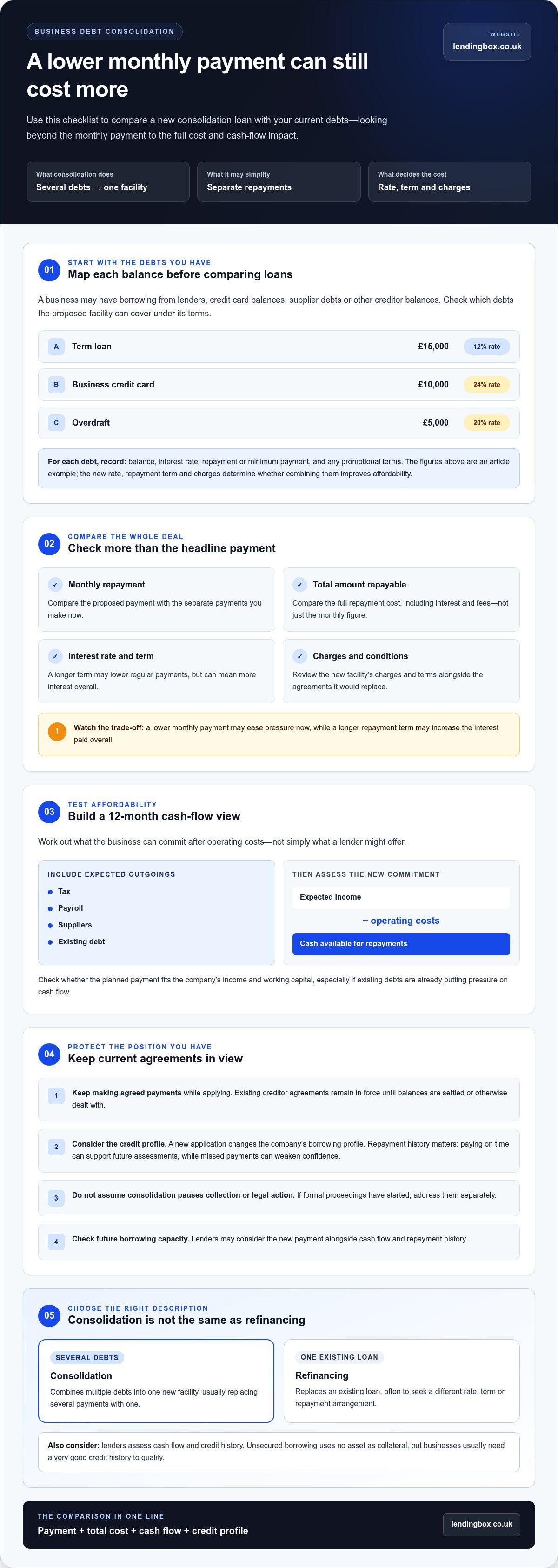
For example, a business might owe £15,000 on a term loan at 12%, £10,000 on a business credit card at 24%, and £5,000 on an overdraft at 20%. A consolidation loan could repay these balances, leaving the business with one agreement. The new rate, term and any charges determine whether the change improves affordability.
Credit card balances may be worth reviewing first when their interest rate is higher than that of other borrowing. List each card’s balance, rate, minimum payment and any promotional terms, then compare the cost of keeping those balances with the proposed loan. A longer term may reduce the regular payment but increase the interest paid overall.
Existing creditor agreements remain in force while a business applies for new borrowing. Keep making agreed payments until the relevant balances have been settled. Consolidation doesn’t automatically stop collection activity or legal action. If a creditor has started formal proceedings, address that separately rather than assuming a new application will pause them.
A new application and the repayment record that follows may affect how lenders assess the company’s credit history. Paying on time can support future assessments, while missed payments can weaken confidence. The effect of business debt consolidation depends on the company’s record and each lender’s assessment. Existing agreements remain in force until the debts are repaid or otherwise settled.
Free business debt advice is available from Business Debtline. If comparing regulated finance providers, use the Financial Conduct Authority’s register to check authorisation and permissions, then compare proposed terms with existing agreements.
Unsecured borrowing doesn’t use an asset as collateral, but businesses usually need a very good credit history to qualify. Lenders also assess cash flow and credit history. A director should review whether the planned payment fits the company’s income, especially where existing debts already put pressure on working capital.
Consolidation may also affect the company’s access to further credit. A new loan changes its outstanding commitments, and future lenders may consider the new payment alongside cash flow and repayment history. Before taking on more borrowing, map existing balances and the proposed facility to see how it could affect available cash.
2. Does consolidating affect my company's credit score?
A new application changes the company’s borrowing profile, and its repayment record on the new facility matters. Paying on time can support future assessments, while missed payments can weaken them. The effect depends on the company’s existing credit history and how the new commitment fits its cash flow.
Consolidation and refinancing address different situations. Consolidation groups several debts into one facility; refinancing replaces an existing loan, often to seek a different rate, term or repayment arrangement. A debt management plan arranges payments to creditors, while insolvency procedures address more serious financial difficulty.
Compare the monthly repayments and total interest, not just the headline payment.
The business’s legal structure affects who is responsible for its debts. A sole trader should identify the individual named on each agreement; a partnership should review the partners and obligations recorded in its contracts. For a limited company, check which company signed and whether a director gave a personal guarantee. Responsibility depends on the agreements and any guarantee.
In England and Wales, a limited-company director must act in the company’s best interests. If the company is insolvent or likely to become insolvent, directors must consider creditors’ interests rather than shareholders’. A company is insolvent when it can’t pay its debts. Taking on more borrowing when the business cannot trade out of its debts may expose a director to legal consequences.
Options depend on whether the company can afford repayments. A Company Voluntary Arrangement lets a business repay debts over time; creditors owed 75% of the debt by value among those voting must support it. Administration appoints an administrator through a formal recovery process. Pre-pack administration facilitates the sale of an insolvent company. These routes differ from taking a new loan and require careful assessment of the company’s position.
To compare UK consolidation loans with refinancing, debt management and insolvency options, first identify whether the issue is multiple repayments, one costly loan or debts the business cannot afford. Compare the proposed payment and total interest, then assess whether a restructuring route fits the company’s circumstances. A business finance comparison can help assess borrowing options alongside that review.
3. Consolidation loans and existing debt affordability
A consolidation loan replaces several repayments with one new agreement. Affordability depends on the new monthly payment, the interest rate and the repayment term. Build a cash flow forecast for the next 12 months, listing expected income, tax, payroll, suppliers and existing debt. This shows how much the business can commit after operating costs, not simply how much a lender might offer.
Compare the total amount repayable as well as the monthly payment. A longer term can ease pressure on cash flow, but interest accrues for longer. Many business loans calculate interest on the reducing balance, so charges apply to the amount still owed. Include any early repayment charges on existing debts and fees on the new facility when comparing options.
Stated eligibility criteria for a UK business debt consolidation loan include a business trading for at least 6 months and minimum monthly turnover of £5,000. Lenders also assess cash flow and credit history, particularly for unsecured borrowing. A forecast showing reliable income and planned debt payments gives a clearer view of whether the repayments fit the business.
An unsecured loan doesn’t require an asset as collateral. It can be harder to obtain and may come with less favourable repayment terms. A secured loan uses an asset, such as business property, as collateral. If the borrower misses agreed repayments, the lender can reclaim that asset. Secured borrowing therefore changes the consequences of default, not just the payment structure.
Some secured business loans can reach up to 75% of the business property’s value. That figure doesn’t establish affordability: the lender still considers the business’s finances and the facility terms. Compare the payment against operating costs, then test the forecast against lower income or delayed customer payments. A loan that only works under optimistic projections leaves little room for disruption.
Personal guarantees create a separate risk. Whether a director must provide one depends on the facility, the funder and the business’s financial strength. Read the guarantee alongside the loan agreement, and consider how missed payments could affect company assets and any personal commitment. Where a guarantee applies, the company loan can also affect a director’s personal finances.
Consolidation can reduce administration by replacing several creditor payments with one. It can also improve cash flow if the new payment is lower and remains affordable throughout the term. Before proceeding, compare each existing debt’s annual percentage rate, balance and settlement terms with the proposed facility. If revenue cannot cover operating costs and debt payments, adding borrowing won’t resolve the underlying shortfall.
4. How business debt consolidation works
Start by listing every debt the business wants to replace. Record each creditor, balance, interest rate, monthly payment, settlement figure and any early repayment charge. Include business credit cards, overdrafts and loans. This gives you a clear total to compare with a proposed facility, rather than relying on approximate balances.
Next, prepare the information a lender uses to assess the application. Applicants are typically asked for the last 3 months of business bank statements. A cash flow forecast can map expected income and spending over the next 12 months, helping show whether the proposed payment fits alongside wages, suppliers, tax and other operating costs.
A UK application proceeds through assessment and an offer. Lenders often consider the company’s cash flow, credit history, trading position and existing commitments. They determine the available amount, interest rate, repayment term and any security or guarantee requirements. Compare the written offer with your debt schedule before accepting.
Once agreed, the facility can be used to repay the debts included in the arrangement. A consolidation facility may pay existing creditors directly, so the business doesn’t necessarily need to settle those agreements before applying. Confirm which balances will be cleared and keep paying each creditor as agreed until settlement is complete. This helps avoid missed payments during the transition.
After settlement, check that each old account reflects the correct position and that the new repayment appears in the company’s cash flow plan. Keep settlement confirmations with the loan records. If a business credit card remains open, decide how it will be used. New spending while repaying the consolidation loan can rebuild the debt burden.
Before signing, compare the total repayable, not just the monthly figure. A lower payment may reflect a longer term, which can increase total interest. Include settlement charges and new-lender fees in the comparison. If the loan is secured, identify the asset at risk if repayments aren’t made. Whether a director must give a personal guarantee depends on the facility size, funder and the business’s financial strength.
Use this sequence to keep the application organised:
- List debts, balances, rates and settlement terms.
- Gather the last 3 months of business bank statements and prepare a 12-month cash flow forecast.
- Compare the proposed rate, term, payment, total interest and any guarantee or security requirement.
- Review the offer, then track creditor settlements and the new repayment.
These documents help a lender assess whether further borrowing is viable. The decision depends on the company’s credit history, cash flow and ability to meet payments while continuing to trade.
5. What business debt consolidation refinancing means
Refinancing means taking out a new loan to repay an existing one. Consolidation brings several debts together; refinancing can replace just one facility. The distinction matters: if a business has one expensive loan, refinancing may change its rate or term without combining other balances.
Consider a business with a loan whose interest rate no longer suits its finances. A replacement loan at a lower rate over the same repayment term could reduce monthly payments and total interest. The business still needs to borrow enough to clear the old balance, so compare the new agreement’s full cost with the existing loan’s settlement figure.
A longer term changes the calculation. It can lower each monthly payment and leave cash available for business investment, but interest accrues for longer. Refinancing may also provide additional borrowing. Separate the amount needed to repay the old loan from any extra funds, then assess whether both fit the business’s forecast income.
Check the exit costs before switching. Some business loans charge fees for early repayment or closing the agreement. The new lender may also charge fees, and its prepayment terms matter if the business refinances again later. Compare the annual percentage rates, repayment schedules and total amounts payable, not just the headline interest rate.
Security can change the risk. A secured refinancing loan uses an asset as collateral, which the lender may reclaim if agreed repayments aren’t made. The asset could be business property or another asset accepted under the facility. A personal guarantee may also be required, depending on the facility, funder and the business’s financial strength. Review these obligations separately from the monthly payment.
Assess a refinancing offer in a clear sequence: obtain the existing loan’s settlement figure and include any early repayment charge, then compare the proposed rate, term, fees and total repayment. Check whether the new agreement changes security or adds a guarantee. Finally, test the monthly payment against forecast cash flow, expected income and operating costs. This helps show whether a lower instalment improves affordability or simply extends repayment.
Refinancing can suit a business seeking better terms on one loan; consolidation can suit one managing several creditor payments. Compare business loan options against the purpose, repayment structure and security involved before choosing how to borrow.
Lending Box: Business loan
Lending Box is a whole-of-market broker helping UK limited companies and LLPs compare business finance when reviewing borrowing or refinancing. Entering a company name on its website provides an indicative quote, with no impact on your credit score for the initial match. A named relationship manager guides you through suitable options and the application paperwork.
Options include unsecured business loans, revenue-based finance, invoice finance and asset finance. Compare the proposed repayments and terms with existing debts before deciding whether new borrowing fits your cash flow. Consolidation may not suit a business whose income cannot cover operating costs and debt repayments. Indicative only. Subject to lender assessment and approval.
For a practical next step, contact Lending Box to discuss the financing options relevant to your business.
Make your next borrowing decision with clarity
Turn your debt review into a decision the business can explain and manage. Set out the outcome you need: fewer repayments, a different structure or a replacement for one costly facility. Business debt consolidation should support those priorities without creating a harder commitment to carry. Check that the proposed arrangement fits the company’s cash flow and plans.
Lending Box can help limited companies and LLPs explore financing options, with a dedicated relationship manager guiding the process and paperwork. Its options include a business loan, revenue-based finance and invoice finance. If you’re considering business debt consolidation, share the purpose of the funding and your current borrowing picture to focus the discussion on relevant routes.
Contact Lending Box to explore your finance options. A clear view of the choices gives you a stronger basis for deciding what comes next.
Frequently Asked Questions
What is debt consolidation and how does it work?
It replaces several separate business debts with one new borrowing arrangement. Start by matching each creditor’s settlement balance to the amount the new facility would repay. For example, a business with a credit card balance and two supplier debts should confirm which creditors the proposed loan covers. Once those balances are settled, the business follows the new agreement’s repayment schedule. Keep settlement records with its accounts.
Which business debts can you consolidate?
Businesses may seek to consolidate term loans, overdrafts, business credit card balances and debts owed to suppliers or other creditors. The new lender’s criteria and the debts’ settlement terms determine what can be included. Create a schedule showing each creditor, balance, interest rate and any settlement charge. Tax arrears and debts already subject to formal arrangements may need a different response, so distinguish them from ordinary borrowing before considering a new facility.
Consolidating vs refinancing: what's the difference?
Consolidation combines several debts, while refinancing replaces an existing loan with a new one. For example, a business with one loan may refinance to change its rate or repayment term without adding its credit card balance. A business with several separate balances may consolidate them instead. Compare the old agreement’s settlement terms with the new facility, including charges and total interest, to identify which structure addresses the problem.
Does consolidating affect my company's credit score?
Business debt consolidation can affect how lenders assess the company, but the result depends on its credit history and repayment behaviour. A new facility adds a commitment; consistent payments can show that the business manages it, while missed payments may affect future applications. Keep statements or confirmations showing that old accounts were settled. If a director gave a personal guarantee, they may also face personal financial exposure if the company defaults.
How can Refinancing help your business deal with financial challenges?
Refinancing can replace a loan whose repayments no longer fit the business’s trading pattern. A revised term may leave cash available for wages, stock or essential operating costs, while a lower rate over the same term may reduce interest and payments. Refinancing won’t fix a continuing gap between income and outgoings by itself. Use a cash flow forecast to test whether the revised commitment fits expected costs.
How can refinancing help with my monthly payment?
A lower interest rate over the same repayment term can reduce both the monthly payment and total amount repaid. Extending the term can also reduce each instalment, but usually means paying interest for longer. Compare the payment schedules and total repayable under both agreements. Include settlement charges and fees, then check whether the revised payment leaves enough cash for regular business costs and changes in customer payment timing.
How much can I borrow?
The amount depends on the debts to be repaid and the business’s ability to support the new payments. Lenders may assess cash flow, credit history, existing commitments and available security. Start with the settlement balances, add relevant charges and exclude any borrowing the business doesn’t need. A cash flow forecast helps show what payment may be sustainable. The amount offered can differ from the total debt being considered.
Is refinancing a good choice if my business's financial situation has changed?
Business debt consolidation may suit a business with several repayments that no longer fit its cash flow, but it won’t address every change in trading conditions. A decline in sales needs careful scrutiny: a lower monthly instalment can still cost more overall if the term is extended. Update the cash flow forecast to reflect current trading conditions and planned costs. If the business can’t meet operating costs and debt repayments, more borrowing may deepen the difficulty rather than solve it.
Frequently Asked Questions
It replaces several separate business debts with one new borrowing arrangement. Start by matching each creditor’s settlement balance to the amount the new facility would repay. For example, a business with a credit card balance and two supplier debts should confirm which creditors the proposed loan covers. Once those balances are settled, the business follows the new agreement’s repayment schedule. Keep settlement records with its accounts.
Businesses may seek to consolidate term loans, overdrafts, business credit card balances and debts owed to suppliers or other creditors. The new lender’s criteria and the debts’ settlement terms determine what can be included. Create a schedule showing each creditor, balance, interest rate and any settlement charge. Tax arrears and debts already subject to formal arrangements may need a different response, so distinguish them from ordinary borrowing before considering a new facility.
Consolidation combines several debts, while refinancing replaces an existing loan with a new one. For example, a business with one loan may refinance to change its rate or repayment term without adding its credit card balance. A business with several separate balances may consolidate them instead. Compare the old agreement’s settlement terms with the new facility, including charges and total interest, to identify which structure addresses the problem.
Business debt consolidation can affect how lenders assess the company, but the result depends on its credit history and repayment behaviour. A new facility adds a commitment; consistent payments can show that the business manages it, while missed payments may affect future applications. Keep statements or confirmations showing that old accounts were settled. If a director gave a personal guarantee, they may also face personal financial exposure if the company defaults.
Refinancing can replace a loan whose repayments no longer fit the business’s trading pattern. A revised term may leave cash available for wages, stock or essential operating costs, while a lower rate over the same term may reduce interest and payments. Refinancing won’t fix a continuing gap between income and outgoings by itself. Use a cash flow forecast to test whether the revised commitment fits expected costs.
A lower interest rate over the same repayment term can reduce both the monthly payment and total amount repaid. Extending the term can also reduce each instalment, but usually means paying interest for longer. Compare the payment schedules and total repayable under both agreements. Include settlement charges and fees, then check whether the revised payment leaves enough cash for regular business costs and changes in customer payment timing.
The amount depends on the debts to be repaid and the business’s ability to support the new payments. Lenders may assess cash flow, credit history, existing commitments and available security. Start with the settlement balances, add relevant charges and exclude any borrowing the business doesn’t need. A cash flow forecast helps show what payment may be sustainable. The amount offered can differ from the total debt being considered.
Business debt consolidation may suit a business with several repayments that no longer fit its cash flow, but it won’t address every change in trading conditions. A decline in sales needs careful scrutiny: a lower monthly instalment can still cost more overall if the term is extended. Update the cash flow forecast to reflect current trading conditions and planned costs. If the business can’t meet operating costs and debt repayments, more borrowing may deepen the difficulty rather than solve it.