Recovery Loan Scheme eligibility, thresholds and access
23 October 2026 · 15 min read

 Business funding
The Recovery Loan Scheme is no longer open to new applications. From 1 July 2024, it was extended and rebranded as the Growth Guarantee Scheme. Under the recovery loan scheme, the government guarantee covered part of the lender’s outstanding facility balance, but borrowers remained liable for their debt.
That change can make older guidance confusing, particularly if your business has already used a government-backed loan or you’re comparing historic eligibility rules with current options. Dates matter: the recovery loan scheme’s criteria and borrowing limits changed over time, and previous borrowing could affect how much support a business could access.
This guide explains what the scheme offered, which businesses could qualify, how turnover thresholds and earlier government-backed loans affected access, and what replaced it. It sets out the recovery loan scheme’s key dates so you can distinguish the former programme from finance options available now.
Key Takeaways
- Eligibility depended on factors such as UK trading income, business size and turnover, with specific provisions for charities and further education colleges.
- The government guarantee protected lenders, not borrowers: businesses remained responsible for repaying the full debt.
- Earlier government-backed borrowing did not automatically rule a business out, but it could affect the amount available.
- The scheme’s rules changed over time. Its replacement, the Growth Guarantee Scheme, launched on 1 July 2024.
- For finance outside the former scheme, compare options such as business loans, revenue-based finance, invoice finance and asset finance.
Business eligibility criteria
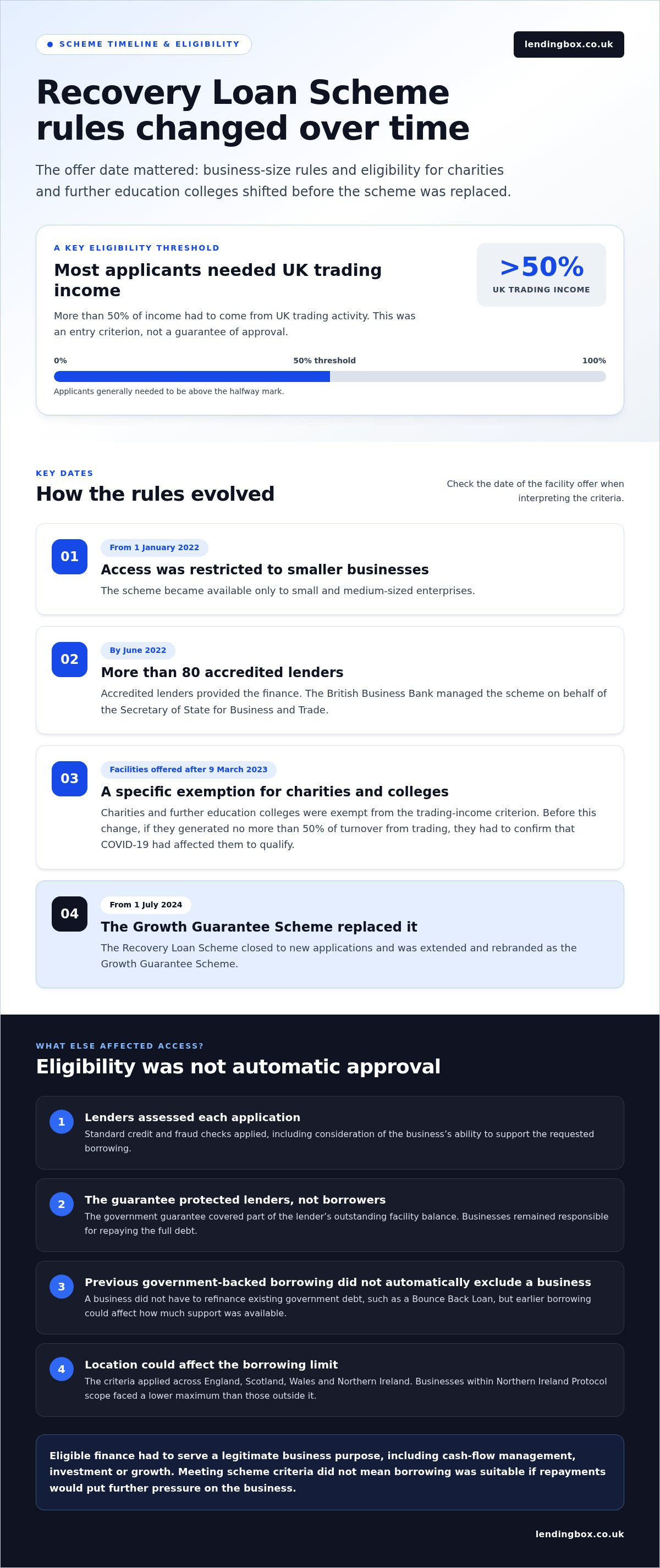
Eligibility for the Recovery Loan Scheme depended on trading activity, business size and the facility’s purpose. The rules also changed over time, so the date of an offer matters when comparing an earlier application with later scheme terms.
Most applicants had to generate more than 50% of their income from UK trading activity. From 1 January 2022, access was restricted to small and medium-sized enterprises. These thresholds helped determine whether a business could apply, but did not replace the lender’s assessment of the application.
Charities and further education colleges had specific trading-income rules under the Recovery Loan Scheme. If they generated no more than 50% of turnover from trading, they had to confirm that COVID-19 had affected them to qualify. For facilities offered after 9 March 2023, charities and further education colleges were exempt from the trading-income criterion. The date of the facility offer therefore matters when assessing their eligibility.
Which lenders participated in the scheme? Accredited lenders provided the finance, with more than 80 accredited by June 2022. The British Business Bank managed the scheme on behalf of the Secretary of State for Business and Trade. Eligibility criteria applied across England, Scotland, Wales and Northern Ireland, but Northern Ireland Protocol scope affected borrowing limits. Businesses within that scope faced a lower maximum than those outside it.
Lenders still carried out their standard credit and fraud checks, so eligibility did not mean automatic approval. Each lender assessed the application and the business’s ability to support the requested borrowing. Financial circumstances and supporting evidence mattered alongside the scheme’s entry criteria. The scheme did not make borrowing suitable if repayments would put further pressure on the business.
Finance had to serve a legitimate business purpose. Eligible uses included cash flow management, investment and growth. A business might use term loans to support an investment, or other facility types for a different operational need. A business could apply for a Recovery Loan Scheme facility even if it already had a government scheme loan, and it did not have to refinance existing government debt, such as a Bounce Back Loan. Earlier COVID-19 borrowing did not automatically rule it out; the lender still assessed the new application and available borrowing capacity.
Business eligibility criteria
Eligibility for the Recovery Loan Scheme depended on trading activity, business size and the facility’s purpose. As the rules changed over time, the offer date matters when comparing earlier applications with later scheme terms. Meeting the criteria did not guarantee finance.
Most applicants had to generate more than 50% of their income from UK trading activity. From 1 January 2022, access was restricted to small and medium-sized enterprises. These thresholds helped determine whether a business could apply, but did not replace the lender’s assessment of the application.
Charities and further education colleges had specific trading-income rules. If they generated no more than 50% of turnover from trading, they had to confirm that COVID-19 had affected them to qualify. For facilities offered after 9 March 2023, charities and further education colleges were exempt from the trading-income criterion. The date of the facility offer therefore matters when assessing eligibility under the recovery loan scheme.
Which lenders participated in the scheme? Accredited lenders provided the finance, with more than 80 accredited by June 2022. The British Business Bank managed the scheme on behalf of the Secretary of State for Business and Trade. Eligibility criteria applied across England, Scotland, Wales and Northern Ireland, but Northern Ireland Protocol scope affected borrowing limits. Businesses within that scope faced a lower maximum than those outside it.
Lenders still carried out their standard credit and fraud checks, so an eligible business was not automatically approved. They assessed the application and the business’s ability to manage the requested borrowing. Financial circumstances and supporting evidence mattered alongside the scheme’s entry criteria. The Recovery Loan Scheme did not make borrowing suitable if repayments would put further pressure on the business.
Finance had to serve a legitimate business purpose. Eligible uses included cash flow management, investment and growth. A business might use term loans to support an investment, or another facility type for a different operational need. It could apply for a facility even if it already had a government scheme loan, and it did not have to refinance existing government debt, such as a Bounce Back Loan. Earlier COVID-19 borrowing did not automatically rule it out; the lender still assessed the new application and available borrowing capacity.
Eligibility and turnover thresholds
Most businesses also needed to generate more than 50% of income from UK trading activity. These tests helped establish access to finance, but lenders still assessed credit and repayment capacity separately.
The threshold change relates to the newer guarantee scheme; it did not retrospectively alter the former programme. Check which scheme and application period a limit applies to before relying on it.
For a sole trader, a practical starting point is evidence of UK trading, turnover and the intended business use of the borrowing. Trading records, accounts and cash-flow forecasts can show how the business earns income and how repayments might fit. Meeting the scheme’s criteria did not replace the lender’s credit assessment.
Loan funds could be used for legitimate business purposes, including cash-flow management, investment and growth. For example, a business facing a gap between paying suppliers and receiving customer payments could assess whether working capital finance fits. An equipment purchase presents a different need, so the proposed use should match the facility requested.
The former programme supported several types of facility, with different minimum amounts and terms:
- Term loans and asset finance ran from three months to six years.
- Overdrafts and invoice finance ran from three months to three years.
These differences matter when matching finance to a project’s purpose and timing. Invoice finance is linked to unpaid invoices, while asset finance supports an asset purchase. A term loan provides a defined borrowing structure. The right product depends on the business need and lender assessment, not turnover alone.
On 12 July 2026, enhancements were announced to allow term loans and asset finance facilities of up to ten years, with implementation planned over the coming weeks.
Eligibility and facility limits are separate considerations. A business might meet a turnover test but request finance that does not fit its cash flow, purpose or credit position. Compare the scheme threshold, product type and repayment period together. The right combination should support the business without creating an unsuitable repayment burden.
Access after previous government-backed loan schemes
Earlier government-backed borrowing did not automatically prevent a further application. Its effect depended on the scheme, application date and subsidy already received.
Subsidy limits and previous support
A subsidy limit caps the public support a business can receive across eligible schemes during a defined period. Under the former Recovery Loan Scheme, the limit applied over any rolling three-year period, so support was assessed across that window rather than one financial year.
This mattered to businesses that had already received government assistance. Previous support could affect the remaining subsidy and, in turn, the amount available under a later facility. A business considering investment or invoice finance needed to take earlier assistance into account. Previous borrowing did not, by itself, make a new application ineligible.
For the Growth Guarantee Scheme, businesses that took CBILS, CLBILS, BBLS or a Recovery Loan Scheme facility before 30 June 2024 are not barred from applying. However, previous borrowing may reduce the eligible amount. This makes it important to distinguish eligibility from borrowing capacity: a business can pass the entry test yet have less capacity remaining.
Comparison with earlier loan schemes
The Recovery Loan Scheme followed Bounce Back Loans and CBILS, but previous use of those programmes did not automatically prevent access. Businesses that took CBILS, CLBILS or BBLS before 30 June 2022 were not automatically excluded from applying to the Recovery Loan Scheme.
How did the Recovery Loan Scheme compare with Bounce Back Loans and CBILS? Businesses could apply for another facility without refinancing existing government debt. A new facility was not a debt write-off: the borrower still had to repay it under the agreement.
Government underwriting supported the lender rather than transferring repayment responsibility from the borrower. For the Recovery Loan Scheme, the guarantee covered 70% of the outstanding facility balance after the lender completed its normal recovery process. The borrower remained liable for the full debt. This distinction applied even when earlier government support had helped the business manage trading pressures.
The British Business Bank managed RLS, BBLS, CBILS and CLBILS on behalf of, and with the financial backing of, the Secretary of State for Business and Trade. Shared government backing did not make their terms interchangeable. When comparing facilities, businesses needed to consider existing debt, remaining subsidy allowance, the purpose of new borrowing and repayment capacity together.
For example, a firm with an outstanding Bounce Back Loan could seek a separate facility for a new business purpose instead of refinancing that loan. The lender would still assess the credit application and proposed borrowing. Previous public support could influence the amount available, and the business would remain responsible for managing both repayment commitments.
Recovery Loan Scheme dates and replacement
The dates explain why older guidance can describe different versions of the Recovery Loan Scheme. The UK Government announced it on 3 March 2021, and the original programme opened on 6 April 2021. That first iteration ran until 30 June 2022, with eligibility and lending terms changing during that period.
An extension announced on 29 October 2021 kept the programme running beyond its original end date. Changes applied to offers made from 1 January 2022, including restricting access to small and medium-sized enterprises. The scheme then ran until 30 June 2022. A new iteration launched in August 2022, following a further two-year extension announced on 20 July 2022.
The later version was due to end in June 2024. Instead, from 1 July 2024, it was extended and rebranded as the Growth Guarantee Scheme. The key takeaway is that the Recovery Loan Scheme is closed to new applications. Businesses seeking government-backed finance now need to consider the successor scheme, rather than relying on an old application window.
The transition matters when comparing limits. These were maximum facility limits, not automatic entitlements. Lenders still assessed each application.
On 12 July 2026, the Chancellor announced an additional £6.5 billion of lending capacity over the following four years. That increase is expected to help an estimated 33,000 UK businesses access finance. It adds capacity to the successor scheme, not to the closed programme.
Facility type and intended use still determine what finance can support. The former scheme included term loans, overdrafts, invoice finance and asset finance. Overdrafts, for example, could address short-term cash-flow needs, while asset finance could support an equipment purchase. The Growth Guarantee Scheme also supports facilities such as term loans, overdrafts and asset finance, subject to its rules and lender assessment.
For current borrowing, compare the Growth Guarantee Scheme’s limits and eligible facility types with your business’s purpose and repayment plans. Explore Growth Guarantee Scheme finance to consider how a government-backed facility could fit your funding needs.
Lending Box: Business loan
Since the Recovery Loan Scheme closed, Lending Box has helped UK limited companies and LLPs compare business finance options. Its in-house model analyses company data to provide eligibility insights without impacting credit scores. A dedicated relationship manager guides the process and handles the paperwork.
A business loan may suit a defined funding need, while revenue-based finance links repayments to business revenue. Invoice finance may help bring forward cash tied up in unpaid invoices, and asset finance can support an asset purchase. The suitable option depends on the purpose of the funding and the business’s circumstances.
If your business needs finance beyond a government-backed scheme, explore the available options with Lending Box. Discuss your requirements or visit lendingbox.co.uk.
Make your next funding decision with purpose
Use your experience with the recovery loan scheme as a reference point, not a template. Start with the business need: protecting working capital, bringing forward invoice cash or funding a defined plan. Then consider how repayments would fit expected cash flow. This keeps the decision focused on suitability, rather than simply the size of the facility.
Lending Box offers business loans, revenue-based finance and invoice finance to address different funding needs. Set out what the funds would support, when you need them and how repayments could fit your trading cycle. These priorities provide a practical basis for comparing options and deciding what to explore next.
If you’re ready to discuss your funding needs, contact Lending Box to discuss funding. A clear view of the requirement is a useful first step towards a more informed decision.
Frequently Asked Questions
What were the rates?
There wasn’t one fixed rate for every borrower. Lenders priced facilities individually, but the annual effective interest rate and upfront and other fees could not exceed 14.99%. That cap helps frame comparisons, but it doesn’t tell you the actual cost of a specific facility. Consider the effective rate and fees together, then compare them with the repayment schedule and the business’s expected cash flow.
How much could each business borrow?
The maximum depended on the application date and the borrower’s circumstances.
How to calculate RLS?
There wasn’t one formula for calculating an eligible loan amount. Start with the scheme’s maximum for the relevant period and location, then account for group borrowing and earlier support. Separately, the government guarantee for applications made on or after 1 January 2022 covered 70% of the outstanding balance after the lender’s recovery process. That percentage protected the lender; it didn’t reduce the borrower’s repayment obligation.
What was the UK Recovery Loan Scheme and what was it designed for?
The recovery loan scheme was a government-backed finance programme for UK businesses seeking support with legitimate business needs. It could fund purposes such as managing cash flow, investment or growth. Accredited lenders offered facilities including term loans, overdrafts, invoice finance and asset finance. The guarantee reduced some lender risk after recovery action, while the borrower remained responsible for repaying the facility under its agreement.
What business finance schemes replaced the Recovery Loan Scheme?
The direct successor was the Growth Guarantee Scheme, which launched with accredited lenders on 1 July 2024. It continued the government-backed lending approach under a new name and programme. The change didn’t convert existing Recovery Loan Scheme borrowing into a new facility. Businesses with an existing loan still owe repayments under their original agreement, while new applications are considered under the successor scheme’s rules.
Who was eligible for the Recovery Loan Scheme?
From 1 January 2022, the scheme was restricted to small and medium-sized enterprises. Charities and further education colleges had specific trading-income provisions. Meeting scheme criteria didn’t itself secure finance: lenders still carried out standard credit and fraud checks on each application.
What were the maximum loan amounts and available finance types?
Accredited lenders could offer term loans, overdrafts, invoice finance and asset finance. Minimum facility sizes varied by type, so the product affected how much a business could request.
What interest rates, fees and repayment terms applied?
The annual effective interest rate, upfront fees and other fees were capped at 14.99% in total. Term loans and asset finance usually ran from three months to six years; overdrafts and invoice finance ran from three months to three years. In exceptional circumstances, a lender could extend a loan term to a maximum of 10 years. Borrowers could make full or partial early repayments without an Early Redemption Charge.
Frequently Asked Questions
There wasn’t one fixed rate for every borrower. Lenders priced facilities individually, but the annual effective interest rate and upfront and other fees could not exceed 14.99%. That cap helps frame comparisons, but it doesn’t tell you the actual cost of a specific facility. Consider the effective rate and fees together, then compare them with the repayment schedule and the business’s expected cash flow.
The maximum depended on the application date and the borrower’s circumstances.
There wasn’t one formula for calculating an eligible loan amount. Start with the scheme’s maximum for the relevant period and location, then account for group borrowing and earlier support. Separately, the government guarantee for applications made on or after 1 January 2022 covered 70% of the outstanding balance after the lender’s recovery process. That percentage protected the lender; it didn’t reduce the borrower’s repayment obligation.
The recovery loan scheme was a government-backed finance programme for UK businesses seeking support with legitimate business needs. It could fund purposes such as managing cash flow, investment or growth. Accredited lenders offered facilities including term loans, overdrafts, invoice finance and asset finance. The guarantee reduced some lender risk after recovery action, while the borrower remained responsible for repaying the facility under its agreement.
The direct successor was the Growth Guarantee Scheme, which launched with accredited lenders on 1 July 2024. It continued the government-backed lending approach under a new name and programme. The change didn’t convert existing Recovery Loan Scheme borrowing into a new facility. Businesses with an existing loan still owe repayments under their original agreement, while new applications are considered under the successor scheme’s rules.
From 1 January 2022, the scheme was restricted to small and medium-sized enterprises. Charities and further education colleges had specific trading-income provisions. Meeting scheme criteria didn’t itself secure finance: lenders still carried out standard credit and fraud checks on each application.
Accredited lenders could offer term loans, overdrafts, invoice finance and asset finance. Minimum facility sizes varied by type, so the product affected how much a business could request.
The annual effective interest rate, upfront fees and other fees were capped at 14.99% in total. Term loans and asset finance usually ran from three months to six years; overdrafts and invoice finance ran from three months to three years. In exceptional circumstances, a lender could extend a loan term to a maximum of 10 years. Borrowers could make full or partial early repayments without an Early Redemption Charge.