Single invoice finance for businesses seeking invoice funding
25 October 2026 · 16 min read

 Invoice finance
The choice between factoring and invoice discounting isn’t always the first decision. Single invoice finance lets a UK business fund one unpaid invoice rather than its whole sales ledger, with providers typically advancing 80-95% of the invoice’s value after approval. It can suit a one-off cash-flow gap without committing to a whole-ledger facility.
Before choosing single invoice finance, weigh the trade-off: how much cash you need now, what the advance depends on and how the invoice will be collected. Factoring and invoice discounting can both release funds against invoices, but they work differently and may cover a wider sales ledger.
This guide explains how one-off invoice funding works, what can affect the advance and when factoring or invoice discounting may fit better. It also covers personal guarantees and minimum invoice values, so you can weigh the practical details before choosing a route.
Key Takeaways
- Use one-off invoice funding to address a specific cash-flow gap without financing your whole sales ledger.
- Assess the advance against the invoice value, customer’s ability to pay and payment terms.
- Compare factoring, where the provider manages collections, with invoice discounting, where your business retains control of them.
- Check how personal guarantees and minimum invoice values could affect the funding arrangement.
- If you need funding regularly, consider whether a whole-ledger facility better fits your cash-flow pattern.
Businesses that may benefit
Single invoice finance can help bridge a cash-flow gap when a UK customer takes 30-90 days to pay. It funds one eligible invoice, so the business can seek capital for a specific need instead of its whole sales ledger.
Suitable Industries and Business Situations
Look at the payment cycle and invoice, rather than relying on an industry label. Construction firms may need capital for suppliers while commercial clients take 60 days to pay. Recruitment agencies can face a similar gap between paying staff and receiving client funds.
For example, a UK construction company invoicing £50,000 may seek an advance to cover project costs. A recruitment agency used this approach against an £8,000 invoice whilst waiting 45 days for payment. These examples show how funding an individual invoice can address a short-term need.
Selective invoice finance is designed for businesses trading directly with other businesses on credit terms. The invoice must be unpaid and relate to goods or services already delivered. If customers usually pay within 7-14 days, the cost may not justify funding. If a customer is due to pay in 60 days, compare the cash-flow benefit with the finance charge.
Business and Sole Trader Eligibility
UK limited companies and LLPs can assess funding against eligible business invoices. Sole traders should focus on whether the invoice is for a business customer, remains unpaid, and covers completed work or delivered goods. A finance provider also considers the customer’s ability to pay and the quality of the invoice records.
Turnover thresholds vary by facility. Selective invoice finance often has no minimum annual turnover, whilst traditional invoice finance facilities are generally unsuitable below £300,000 annual turnover. Some suitability guidance uses annual turnover over £100,000, so distinguish a one-off invoice from a whole-ledger facility. For a smaller business, single invoice finance may be more relevant than a traditional facility.
How do I choose a UK single invoice finance provider and apply? Compare how providers assess the debtor, invoice value, advance percentage, fees and collection process. Prepare the unpaid invoice, evidence of completed work, customer details and business records. Applicants may be asked for their last 6 months of business bank statements.
What fees and interest rates do UK providers charge? Charges can include a service fee and a charge for using the advance. The total depends on the invoice value, how long it takes the customer to pay, the customer’s credit profile and the provider’s terms. Compare the full cost with the cash-flow benefit before choosing single invoice finance.
Use the invoice due date to plan for settlement, and review the agreement’s terms for disputes or late payment. If you expect to fund invoices repeatedly, selective invoice finance lets you choose which invoices to fund over time.
Typical advance amounts and release of remaining funds
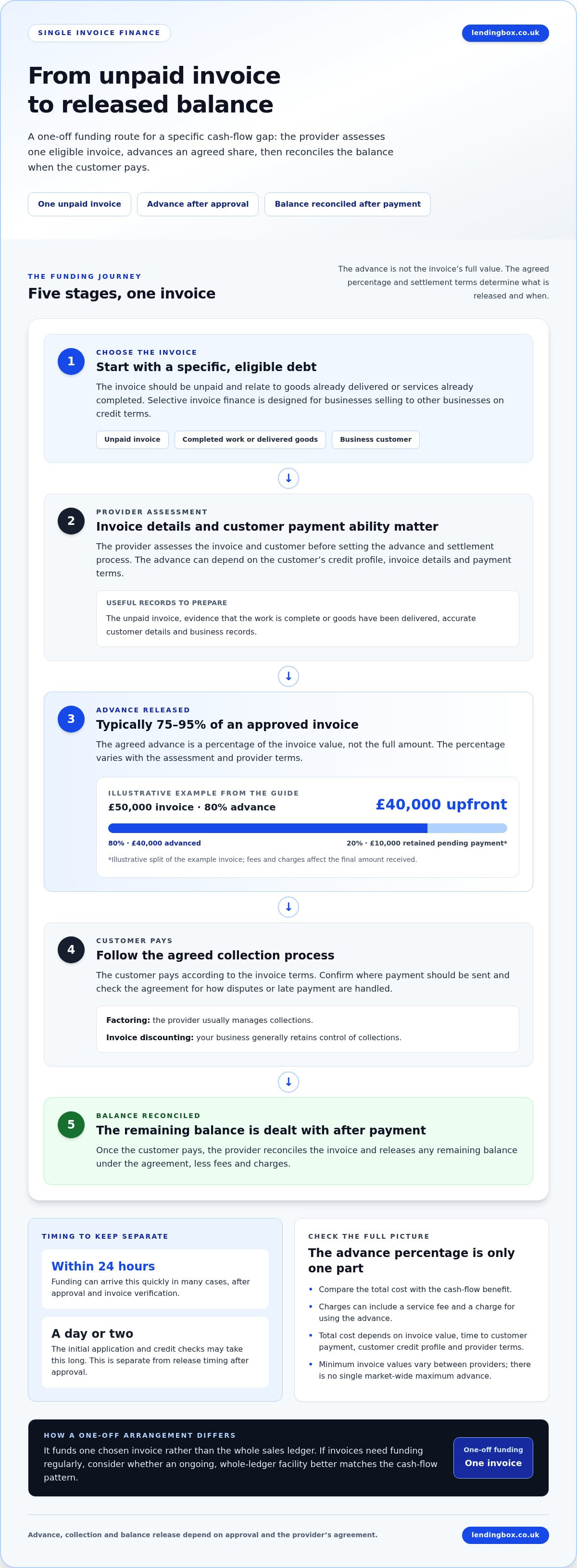
The advance is an agreed percentage of an approved invoice, not its full value. With single invoice finance, the provider assesses the invoice and customer before setting the advance and settlement process.
Advance Rates and Amounts
Providers typically advance 75-95% of an invoice’s value after approval. The agreed percentage depends on factors such as the customer’s credit profile, invoice details and payment terms. For example, an 80% advance against a £50,000 invoice would release £40,000 upfront.
Minimums vary between providers. There is no single maximum advance across the market: the invoice value and approved percentage determine the amount available. Treat examples as indicative, not as guaranteed terms.
The remaining balance is generally held until the customer pays, then reconciled under the agreement.
Check how the provider calculates the advance and handles disputed invoices or late payment. The advance percentage alone does not show the total cost or the final amount your business will receive. Single invoice finance is most useful when the advance addresses the cash-flow gap without relying on the retained balance being released too soon.
Funding Speed and Release Times
After approval and invoice verification, funding can arrive within 24 hours in many cases. Some selective invoice finance providers can release funds within 24 hours after verification. The initial application and credit checks may take a day or two, so separate the assessment stage from the release time after approval.
Prepare the invoice and supporting records before applying. Evidence that goods or services have been delivered helps the provider assess the debt. Accurate customer details and payment terms also support verification and can help avoid delays.
When the customer pays, the provider reconciles the invoice and releases any remaining balance, less fees and charges. A one-off arrangement ends after funding one invoice, unlike an ongoing facility that may cover invoices across the sales ledger.
For confidential funding, the customer may not be notified, depending on the facility. Factoring usually involves the provider managing collections; invoice discounting generally leaves that work with your business. Confirm where the customer should pay and how the provider releases the balance.
Compare the advance percentage, verification steps, release timing and balance treatment in each offer. If you’re assessing funding against a specific invoice, explore invoice finance options alongside the amount and timing your business needs.
Factoring or invoice discounting?
The main differences are who manages customer collections and how many invoices the arrangement covers. Match the structure to the level of control your business needs and whether funding is occasional or ongoing.
Spot Factoring and Confidential Discounting
Spot factoring funds one chosen invoice rather than requiring your entire sales ledger. The factor usually manages collection from the customer, who will know a finance provider is involved. This can suit a business that wants to outsource payment chasing for a particular debt.
Confidential invoice discounting keeps collection with your business and is designed to keep the funding arrangement private from customers. Compare who handles reminders, reconciles payment and releases the remaining balance. This distinction matters when customer relationships or internal credit control are important to your operation.
Selective Factoring and Discounting
Selective invoice finance lets a business choose invoices to fund over time. Selective factoring combines that choice with provider-managed collections; selective invoice discounting leaves collections with the business. Both differ from a single spot transaction, which ends after funding one invoice.
Choose based on how much control your team wants over collections and which invoices need funding. A business with one large debtor can select that invoice, while another may fund invoices from different customers as cash-flow needs arise.
Whole-ledger factoring and discounting usually cover the entire sales ledger under ongoing agreements. Factoring facilities typically have minimum contract terms of 3 to 12 months, whilst invoice discounting facilities typically run for 6 to 12 months. Some whole-ledger arrangements require a commitment of 12 or more months.
A broader facility can suit businesses seeking ongoing working capital across regular sales. It is less suited to a one-off funding gap if financing every invoice would exceed the immediate need. Compare the contract term and ledger coverage with your expected invoice pattern.
For example, a business seeking funding against one customer invoice can compare spot factoring with selective discounting. With the first, the factor handles collection; with the second, the business follows up on payment. Both focus on selected debts rather than automatically financing every sale.
Before choosing, map the process from invoice submission to final settlement. Identify who contacts the debtor, where the customer pays and how the provider accounts for the balance. Then compare whether the agreement covers one invoice, selected invoices over time or the entire sales ledger.
Factoring and discounting are not simply two labels for the same arrangement. Compare control of collections, confidentiality, invoice selection and contract commitment. These details show whether a one-off arrangement or an ongoing facility better fits your business.
Customer payment terms and concentration limits
Payment terms affect how long the advance remains outstanding and when the provider can settle the invoice. Customer concentration can also limit how much of a sales ledger supports funding.
What are the risks, drawbacks and contract terms of single invoice finance? A delayed or disputed invoice can postpone settlement and the release of any remaining balance. The agreement sets out payment routing, collection responsibilities, customer notification and how disputes are handled.
Customer Payment Terms
UK businesses commonly wait 30-90 days for customers to pay. Invoice finance is commonly used for terms of 30 to 120 days, but some providers may not approve invoices where customers take longer than 90 days. Match the invoice due date to the funding period in the contract.
In single invoice finance, a late customer payment means the advance stays outstanding for longer. That can affect charges and delay the release of the remaining balance. For example, if a customer has 60-day terms, plan cash flow around the expected payment date and allow for settlement taking longer.
Confirm who handles credit control before signing. With factoring, the provider generally manages collection and contacts the customer about an unpaid invoice. With invoice discounting, your business usually retains that role. Agree how reminders, queries and disputed work will be handled so the customer receives consistent information.
Customer Concentration Limits
A concentration limit caps the funding linked to one customer. Limits commonly restrict one customer’s share to 25% to 40% of the ledger. If one debtor represents a large share of unpaid invoices, compare that proportion with the facility’s limit before relying on the expected advance.
For example, if one customer accounts for most of a business’s sales ledger, a concentration limit could restrict funding. With single invoice finance, the provider still assesses the debtor and invoice rather than treating the rest of the ledger as diversified. Review how the contract calculates the limit and whether it uses invoice value or total ledger value.
Confidentiality depends on the facility. Factoring generally involves provider-led collections, making the provider’s role visible to the customer. Confidential invoice discounting is designed to keep the arrangement private while your business manages credit control. Check customer notification and payment instructions in the contract, as misdirected payments can delay reconciliation.
Traditional whole-ledger facilities can involve longer commitments than one-off funding. Factoring contracts typically run for 3 to 12 months, while invoice discounting contracts typically run for 6 to 12 months. Compare those terms with the duration of a one-off arrangement and consider the effect of payment delays, concentration limits and collection responsibilities on your cash flow.
Personal guarantees and minimum invoice values
A personal guarantee and an invoice minimum are separate parts of a funding decision. The guarantee concerns the commitment set out in the agreement; the minimum determines which invoices a provider will consider. Review each separately before using funding to support working capital.
There is no single minimum invoice value across UK providers. A value over £5,000 is also listed as a suitability indicator, but that is not a universal threshold. Compare the required minimum with the individual invoice you need to fund.
For example, a start-up business used funding against a £15,000 invoice. That illustrates why the invoice value alone may not tell the full story: the invoice must also be unpaid and relate to goods or services already delivered. Keep the invoice and delivery evidence together when preparing an application.
Before signing, read the personal guarantee wording separately from the invoice funding terms. Establish who gives the guarantee, what obligations it covers and what events could trigger it. Also identify how the agreement treats repayment, disputes and any remaining balance. These details help clarify the commitment beyond the immediate advance.
Use this practical review before proceeding:
- Compare the invoice value with the provider’s minimum for an individual invoice.
- Confirm the invoice is unpaid and the work or goods have been delivered.
- Read any personal guarantee clause and identify the person responsible.
- Understand how the agreement handles late payment, disputes and settlement.
- Compare the funding against individual invoices with invoice factoring across a wider ledger.
A smaller invoice can fall below one provider’s minimum yet meet another’s threshold. Equally, an invoice above £5,000 does not by itself establish eligibility. The provider assesses the invoice and the customer’s ability to pay. A sound decision weighs the working capital unlocked against the agreement’s obligations and the effort of funding one invoice.
If you’re weighing a guarantee alongside invoice funding, separate the personal commitment from the business cash-flow need. Read both parts of the agreement before accepting the advance. To review funding options for your invoice, explore invoice finance options.
Lending Box: Business loan
Lending Box helps UK limited companies and LLPs compare funding routes, including invoice finance and business loans. If one unpaid invoice won’t cover a wider working-capital need, a business loan, revenue-based finance or asset finance may also be relevant.
Lending Box analyses company data to provide eligibility insights without affecting your credit score for the initial match. A named relationship manager guides you through suitable options and handles the paperwork, helping you understand the route before proceeding.
Share your funding need and business details to explore which option fits your cash-flow requirements. Contact Lending Box to discuss the next step.
Make your next funding decision with clarity
Start with the business outcome you need to protect. Is the funding meant to keep a project moving, meet a supplier commitment or bridge a timing gap? Be clear about how the advance fits your cash-flow plan and how you expect to manage repayment. This gives you a practical basis for deciding whether single invoice finance fits or another route may be more suitable.
Consider the wider funding picture too. Lending Box offers invoice finance, business loans and revenue-based finance, so you can explore options against your business’s circumstances. Compare the fit, not simply the first available route.
Bring your funding requirement and business information together before taking the next step. A clear view of the purpose and repayment plan can help make the discussion more focused. Contact Lending Box about invoice finance and explore a suitable route for your business.
Frequently Asked Questions
How quickly can I receive funds?
After approval and invoice verification, funding can arrive within 24 hours. The application and credit checks can take a day or two, so allow for both stages when planning a supplier payment. For example, if a supplier invoice falls due before your customer pays, compare the expected funding date with the supplier’s deadline. The customer’s payment history and accurate invoice records can affect the process.
Is there a minimum invoice value?
Minimums depend on the provider, so there is no market-wide minimum to rely on. If an invoice falls below a provider’s threshold, it may not qualify, even if the customer is creditworthy. The invoice must also be unpaid and relate to goods or services already delivered.
What is single invoice finance in the UK?
Single invoice finance is a one-off way to raise funds against an unpaid business invoice, rather than financing the entire sales ledger. The provider advances an agreed portion of the invoice value, then settles the account when the customer pays. For example, a business with one large customer invoice can seek funding for that specific cash-flow gap without automatically including its other sales.
How does single invoice finance work, step by step?
The process usually starts by selecting an unpaid invoice for completed work or delivered goods. The business submits the invoice and customer details, and the provider assesses the debt and applicable terms. If approved, the provider advances an agreed share of the invoice. The customer then pays through the agreed process, after which the provider accounts for charges and releases any remaining balance.
Who is eligible for single invoice finance in the UK?
Eligibility depends on the business, invoice and customer, not turnover alone. The applicant generally needs to trade with another business on credit terms and have an unpaid invoice for completed work or delivered goods. The provider assesses the debtor’s ability to pay, the invoice records and payment terms. This type of funding is generally less suitable for a business that mainly sells to consumers.
How quickly can a business receive funds from a single invoice finance facility?
Once the invoice is approved and verified, funds can be released within 24 hours in many cases. That timing differs from the full application process, which can include a day or two for initial checks. Prepare a clear invoice, delivery evidence and accurate customer information to support assessment. If timing matters, plan around both approval and release, not just the expected transfer after approval.
What documents and information are needed to apply for single invoice finance?
Prepare the invoice, customer details and evidence that the goods or services have been delivered. Providers may also ask for the last 6 months of business bank statements. Keep supporting records consistent with the invoice, including any purchase order or delivery confirmation relevant to the work. Clear documentation helps the provider assess the debt, confirm who owes payment and understand the expected settlement date.
How does single invoice finance compare with invoice factoring, invoice discounting and business loans?
One-off invoice funding centres on an individual debt. Factoring usually includes provider-managed customer collections, while invoice discounting generally leaves credit control with your business; either arrangement can also cover a wider ledger. A business loan is repaid under a loan agreement rather than being tied to one customer invoice. Compare the effect on collections, repayment planning and funding purpose before choosing.
Frequently Asked Questions
After approval and invoice verification, funding can arrive within 24 hours. The application and credit checks can take a day or two, so allow for both stages when planning a supplier payment. For example, if a supplier invoice falls due before your customer pays, compare the expected funding date with the supplier’s deadline. The customer’s payment history and accurate invoice records can affect the process.
Minimums depend on the provider, so there is no market-wide minimum to rely on. If an invoice falls below a provider’s threshold, it may not qualify, even if the customer is creditworthy. The invoice must also be unpaid and relate to goods or services already delivered.
Single invoice finance is a one-off way to raise funds against an unpaid business invoice, rather than financing the entire sales ledger. The provider advances an agreed portion of the invoice value, then settles the account when the customer pays. For example, a business with one large customer invoice can seek funding for that specific cash-flow gap without automatically including its other sales.
The process usually starts by selecting an unpaid invoice for completed work or delivered goods. The business submits the invoice and customer details, and the provider assesses the debt and applicable terms. If approved, the provider advances an agreed share of the invoice. The customer then pays through the agreed process, after which the provider accounts for charges and releases any remaining balance.
Eligibility depends on the business, invoice and customer, not turnover alone. The applicant generally needs to trade with another business on credit terms and have an unpaid invoice for completed work or delivered goods. The provider assesses the debtor’s ability to pay, the invoice records and payment terms. This type of funding is generally less suitable for a business that mainly sells to consumers.
Once the invoice is approved and verified, funds can be released within 24 hours in many cases. That timing differs from the full application process, which can include a day or two for initial checks. Prepare a clear invoice, delivery evidence and accurate customer information to support assessment. If timing matters, plan around both approval and release, not just the expected transfer after approval.
Prepare the invoice, customer details and evidence that the goods or services have been delivered. Providers may also ask for the last 6 months of business bank statements. Keep supporting records consistent with the invoice, including any purchase order or delivery confirmation relevant to the work. Clear documentation helps the provider assess the debt, confirm who owes payment and understand the expected settlement date.
One-off invoice funding centres on an individual debt. Factoring usually includes provider-managed customer collections, while invoice discounting generally leaves credit control with your business; either arrangement can also cover a wider ledger. A business loan is repaid under a loan agreement rather than being tied to one customer invoice. Compare the effect on collections, repayment planning and funding purpose before choosing.