Asset refinance: release cash from eligible company assets
29 November 2026 · 12 min read

 Business funding
Company assets can do more than support day-to-day operations. Asset refinancing may help a business access funds while continuing to use an asset. Ownership transfers back after the finance is repaid in full.
Refinancing may be worth considering when cash is tied up in equipment or vehicles and selling them would disrupt operations. The trade-off is the cost of finance, which may include set-up fees and, depending on the arrangement, costs to repurchase the asset. If repayments become unmanageable, the lender may repossess the asset used as security.
This guide explains how asset refinance works, which assets may qualify and what lenders consider. It also covers the costs and alternatives, from other ways to fund business needs to options for extracting company money. You’ll have a clearer basis for deciding whether refinancing fits your plans and cash flow.
Key Takeaways
- See which assets, including commercial vehicles and property equity, may help unlock business funding.
- Compare refinancing with other ways to fund business needs, and understand the tax considerations that can affect your choice.
- Learn how sale and leaseback can release funds while allowing continued use of an asset, and what accounting and tax treatment may apply.
- Explore whether asset finance or alternatives such as business loans, revenue-based finance and invoice finance better fit your cash flow needs.
Costs and alternatives to asset refinancing
Asset refinance may involve set-up fees and costs to repurchase the asset. Compare the total commitment with the value of keeping the asset in use and the funds your business needs.
Tax and VAT treatment can affect the net proceeds from a sale, sale-and-leaseback or refinance. The implications depend on the transaction structure and the asset.
Tax and VAT implications
Tax and VAT implications are the effects a sale or finance arrangement can have on the company’s tax position and cash received. According to HM Revenue & Customs, Business Asset Disposal Relief applies a 10% capital gains tax rate to qualifying business disposals, up to a £1 million lifetime limit. A shareholder may qualify for this rate if they have held at least 5% of shares in a trading company for at least two years, subject to other conditions, according to HM Revenue & Customs. The UK dividend allowance is £500 for the 2024/25 tax year, according to HM Revenue & Customs. VAT treatment depends on the transaction and asset.
How a professional values assets
Lenders assess an asset’s type, condition, business use and value. For example, a vehicle used daily for deliveries may be assessed differently from equipment that is rarely used. Clear information about the asset and its role helps the lender assess potential funding and helps the company weigh the proceeds against the asset’s importance to operations.
Sale and leaseback costs
Sale and leaseback releases cash by selling an asset and leasing it back, so the company can continue using it. In the UK, lease terms typically match the asset’s remaining productive life and range from 1 to 7 years. Costs can include set-up fees and lease payments; repurchasing the asset may also carry a cost if the arrangement allows it.
For accounting, the asset is removed from the fixed asset register and replaced by a lease liability under IFRS 16 or FRS 102, as applicable. A sale and leaseback is treated as a disposal for tax purposes. Review the tax implications with the company’s accountant before proceeding, then compare the lease commitment with the cash released.
Options for extracting company funds
Asset-backed finance is one route, but the right option depends on where cash is tied up. Compare the asset, unpaid invoices and expected repayments with the purpose of the funds.
Releasing cash from unpaid invoices
Invoice finance can release cash tied up in unpaid customer invoices before they are paid. This may help bridge the gap between completing work and receiving payment. The provider assesses eligible invoices and the company’s trading position before advancing funds. The arrangement’s terms determine how much is available, how repayment works and the overall cost.
Invoice finance is most relevant when delayed customer payments are the main pressure point. It does not release value from machinery or vehicles. If a company has both unpaid invoices and valuable equipment, compare which funding source better matches its immediate cash-flow need.
Steps and supporting documents a finance provider needs
A finance provider assesses the company, the asset or invoices, and the proposed repayments. For asset finance, lenders generally need information about the asset, how the company uses it and its value. Asset details, ownership or existing finance records, and company accounts can help explain the business’s position.
For invoice finance, the relevant records focus on unpaid invoices and customer payments. Clear, consistent information helps the provider assess what is being financed and how repayment is expected to work. Each lender sets its own assessment requirements and decides whether the proposal meets them.
Companies House does not approve funding applications. The lender assesses the request, while directors must ensure they have authority to enter the arrangement under the company’s governance and any applicable lender conditions. If repayments are missed, the lender may repossess an asset used as security.
Before proceeding, directors can compare the repayment schedule with the cash-flow forecast and check that the financed asset remains useful to operations. If invoices are the main source of pressure, explore funding options for unpaid invoices; if an asset is central to the plan, asset-backed finance may be a closer fit.
Types of assets eligible for refinancing
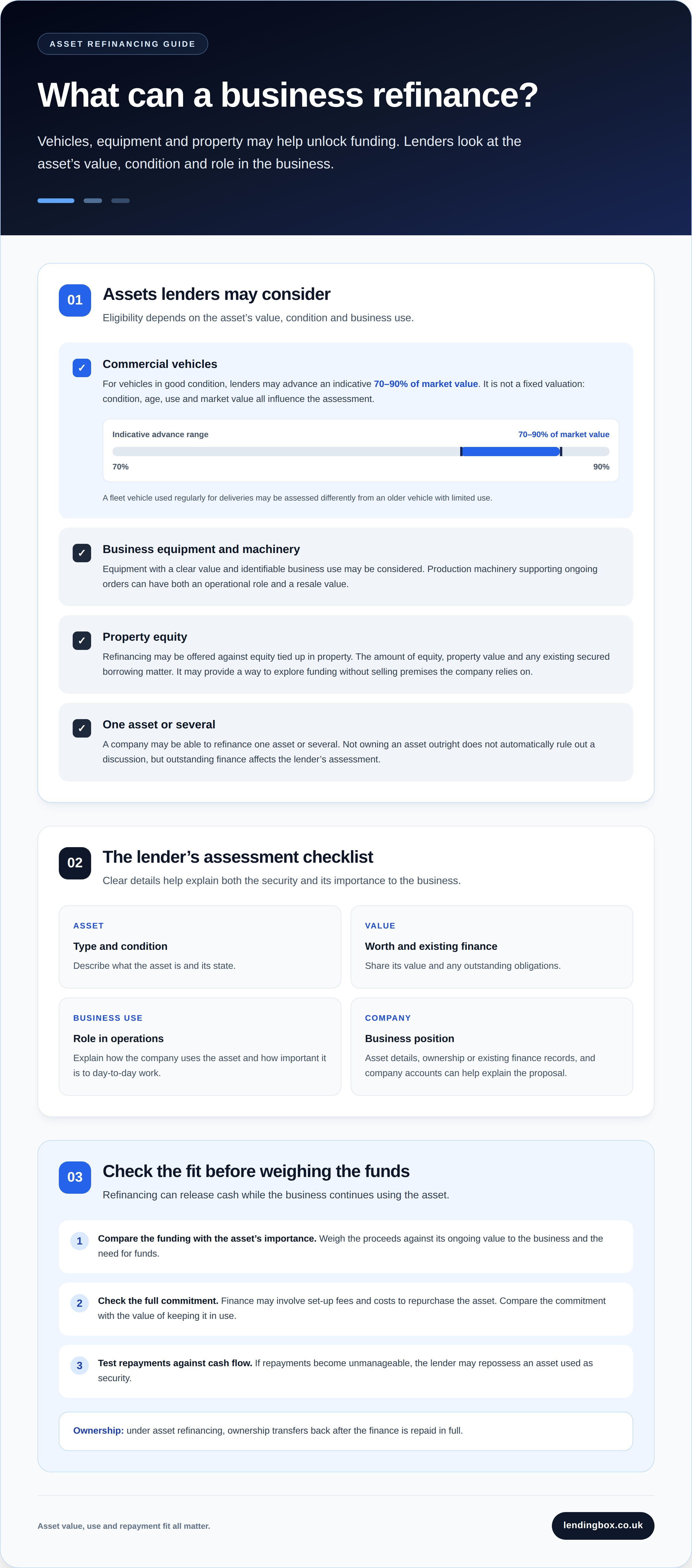
Eligibility depends on the asset’s value, condition and business use. Commercial vehicles, equipment and property may each represent capital a company can explore accessing.
Commercial vehicles are a familiar example. For vehicles in good condition, UK asset refinancing lenders may advance 70-90% of market value. This is an indicative range, not a fixed valuation: the vehicle’s condition, age, use and market value influence the assessment. A fleet vehicle used for regular deliveries may therefore be assessed differently from an older vehicle with limited use.
Business equipment and machinery may also be considered when they have a clear value and identifiable business use. Lenders generally need information about the asset, how the company uses it and its value. Production equipment supporting ongoing orders, for example, has both an operational role and a resale value. These details help the lender assess the security and funding request.
Property may provide another route. Lenders may offer refinancing against equity tied up in property. The amount of equity and the property’s value matter, as does any existing borrowing secured against it. This may help a company explore funding without selling premises it relies on, but repayments and security must fit its wider finances.
A company may be able to refinance one asset or several, including assets it does not own outright. Existing finance does not automatically rule out a discussion, but outstanding obligations affect the lender’s assessment. Compare the proposed funds with the remaining finance and the asset’s ongoing value to the business.
Focus on assets with clear ownership or finance records, a supportable value and a defined business role. A delivery vehicle, workshop machinery and commercial property each present a different case. The best fit is an asset that can support funding without undermining the company’s ability to trade.
How does sale and leaseback work for UK company assets, and what does it cost?
A sale-and-leaseback releases cash by selling a company asset and leasing it back. The business receives the sale proceeds and continues using the asset under a lease. For example, a company could sell a work vehicle and lease it back to keep making deliveries. The arrangement turns asset value into cash but creates an ongoing lease commitment.
The lease term typically matches the asset’s remaining productive life and ranges from 1 to 7 years in the UK. That term affects how long the company makes lease payments and how the arrangement fits its cash flow. Consider the asset’s continued usefulness alongside the upfront proceeds. A vehicle needed for daily operations has a different practical role from equipment nearing replacement.
Costs may include set-up fees and, if the arrangement includes repurchasing the asset, the cost of buying it back. Lease payments are also part of the ongoing commitment. There is no single cost for every transaction: the asset, sale terms and lease structure shape the total outlay. Compare these costs with the cash released and the expense of replacing the asset.
UK accounting treatment also changes. Under IFRS 16 or FRS 102, as applicable, the asset is removed from the fixed asset register and replaced by a lease liability. This can affect how the company presents its assets and liabilities in its accounts. A sale and leaseback is treated as a disposal for tax purposes, so the proceeds should be considered in that context.
Before proceeding, have the company’s accountant review the tax implications and accounting treatment. Then weigh the sale proceeds against fees, lease payments and any cost to repurchase. A sale and leaseback may suit a business that needs capital but still relies on the asset. If asset-backed funding is under consideration, explore asset finance options as part of the comparison.
Lending Box: Asset finance
Lending Box can help UK limited companies and LLPs explore asset finance when business assets may support a funding need. Its platform analyses company data to provide eligibility insights without impacting credit scores. A dedicated relationship manager guides the process and handles the paperwork, helping clarify the available options.
If asset refinance does not fit your plans, alternatives include a business loan, revenue-based finance or invoice finance. The right option depends on what is driving the cash requirement, such as an asset purchase, uneven revenue or unpaid invoices. Comparing options can help you focus on finance that fits your company’s needs and repayment capacity.
Contact Lending Box to discuss asset finance and related funding options.
Choose a funding route that supports your next move
Deciding how to release cash from company assets starts with the business need, not the finance product. Consider what the funds will enable, how repayments fit expected cash flow and whether the asset must remain available for daily operations. These points provide a practical basis for weighing the commitment against the opportunity.
Timing matters too. A planned equipment purchase, a temporary cash-flow gap and an urgent investment may call for different funding approaches. Set out the purpose and repayment capacity clearly, then compare the routes that fit your company’s circumstances.
Contact Lending Box to discuss your options and take the next step with a clearer view of the funding choices available to your business.
A considered decision can put company assets to work while keeping future commitments in view.
Frequently Asked Questions
Asset refinance, what’s that?
Asset refinance is finance secured against a company asset, with the business continuing to use it under the agreed arrangement. For example, a company could use a vehicle as security to raise funds for stock rather than sell it outright. The lender assesses the asset and the company’s finances, while repayment terms and security conditions shape the overall commitment.
Got cash tied up in assets and want to release it?
If your company owns valuable equipment or vehicles, asset-backed finance may provide access to funds without an outright sale. First consider what the money needs to cover and whether repayments fit expected cash flow. If unpaid customer invoices are the main issue, invoice finance may be more relevant. The right route depends on where cash is tied up and what the business needs next.
What does releasing cash from company assets mean in the UK?
It means turning value held in a business asset into cash the company can use. Understanding how to release cash from company assets starts with the difference between selling an asset and borrowing against it. Refinance may unlock funds while the business continues using the asset under the agreed arrangement. The proceeds can support business needs such as working capital or growth.
How can a UK company work with a finance provider to raise cash by selling assets?
A company can sell an asset outright or use sale-and-leaseback to sell it and lease it back for continued use. The company and provider agree the sale value and lease terms. For instance, a manufacturer might sell a machine and lease it back to keep production running. Consider the lease commitment and the asset’s operational importance before agreeing.
Can a UK company borrow against property, equipment, or other assets?
Yes, lenders may consider property equity, equipment and commercial vehicles as security, depending on the asset and the company’s circumstances. A business may also be able to refinance several assets or assets it does not own outright. Existing finance, condition, use and value all affect the assessment. Take particular care if the asset supports essential operations.
What are the risks of asset-backed lending, including charges, defaults, and repossession?
Asset-backed finance creates repayment obligations and may include set-up charges or costs to repurchase an asset. If the company defaults, the lender may repossess the asset used as security. Losing a vehicle or machine could disrupt operations and reduce the company’s assets. Before agreeing, weigh the funds released against the full commitment and the consequences if trading income falls short.
Frequently Asked Questions
Asset refinance is finance secured against a company asset, with the business continuing to use it under the agreed arrangement. For example, a company could use a vehicle as security to raise funds for stock rather than sell it outright. The lender assesses the asset and the company’s finances, while repayment terms and security conditions shape the overall commitment.
If your company owns valuable equipment or vehicles, asset-backed finance may provide access to funds without an outright sale. First consider what the money needs to cover and whether repayments fit expected cash flow. If unpaid customer invoices are the main issue, invoice finance may be more relevant. The right route depends on where cash is tied up and what the business needs next.
It means turning value held in a business asset into cash the company can use. Understanding how to release cash from company assets starts with the difference between selling an asset and borrowing against it. Refinance may unlock funds while the business continues using the asset under the agreed arrangement. The proceeds can support business needs such as working capital or growth.
A company can sell an asset outright or use sale-and-leaseback to sell it and lease it back for continued use. The company and provider agree the sale value and lease terms. For instance, a manufacturer might sell a machine and lease it back to keep production running. Consider the lease commitment and the asset’s operational importance before agreeing.
Yes, lenders may consider property equity, equipment and commercial vehicles as security, depending on the asset and the company’s circumstances. A business may also be able to refinance several assets or assets it does not own outright. Existing finance, condition, use and value all affect the assessment. Take particular care if the asset supports essential operations.
Asset-backed finance creates repayment obligations and may include set-up charges or costs to repurchase an asset. If the company defaults, the lender may repossess the asset used as security. Losing a vehicle or machine could disrupt operations and reduce the company’s assets. Before agreeing, weigh the funds released against the full commitment and the consequences if trading income falls short.