Business loans for ecommerce inventory and online retailers
27 November 2026 · 11 min read

 Business funding
A full warehouse can still leave an online retailer short of cash when suppliers need paying before sales come in. Lenders also assess whether the business can afford repayments.
Stock purchases often need funding before the sales they support reach the business account. The right finance depends on how revenue arrives, how repayments are collected and whether you’re comfortable giving a personal guarantee.
This guide explains who may qualify for ecommerce inventory finance and what lenders consider. It also compares revenue-based finance with unsecured loans, including how personal guarantees can affect the decision.
Key Takeaways
- Assess your stock funding need alongside cash flow and repayment affordability to understand what lenders may consider.
- Revenue-based finance links repayments to sales, which can suit retailers with changing income but affects how much revenue is available to the business.
- Unsecured borrowing and personal guarantees carry different commitments. Understand who may be responsible for repayment before choosing.
- A broker can review your company information, explain suitable finance routes and guide the application process.
Is my business eligible for e-commerce business loans?
Eligibility depends on trading history, turnover and whether repayments fit your cash flow. Lenders also consider what the funding is for and the strength of your application.
Turnover and trading history thresholds
These thresholds offer a starting point, not a complete assessment. Lenders may also consider how regularly sales arrive, whether revenue is growing and how much existing finance the business is repaying. Separate the amount needed for stock from other working-capital needs before applying.
Credit score eligibility
A credit score can influence finance eligibility, but it isn’t the only measure. Lenders may review the company’s payment history alongside turnover, existing commitments and the funds available for repayments. A weaker score may narrow the options or affect the terms offered, while stable trading and manageable borrowing can help explain the business’s position. Prepare a clear account of any past payment issues and how they were resolved.
Business readiness requirements
A stock purchase is easier to assess when its purpose and expected return are clear. Set out which products need replenishing, when supplier payments fall due and how sales are expected to replenish cash. Lenders may assess the last 3 to 6 months of bank statements and the average daily cash balance to judge affordability. These records help show whether the business can manage repayments alongside routine costs.
Compared with stock finance, a business loan usually provides a sum for broader business spending, while stock finance focuses on inventory. Trade credit delays payment to a supplier, while a business credit card provides access to a revolving balance. Each option affects cash flow differently, so match the repayment structure to your sales cycle.
There’s no single borrowing amount for every UK online retailer. Some lenders may offer up to five times the business’s most recent annual EBITDA, with the amount shaped by affordability, trading performance and existing commitments.
Revenue-based finance as an alternative to bank loans
Revenue-based finance links repayment to sales, offering a different cash-flow pattern from fixed monthly instalments. It can help fund stock or test a new product line, but repayments reduce the revenue available for other costs.
Marketplace seller finance
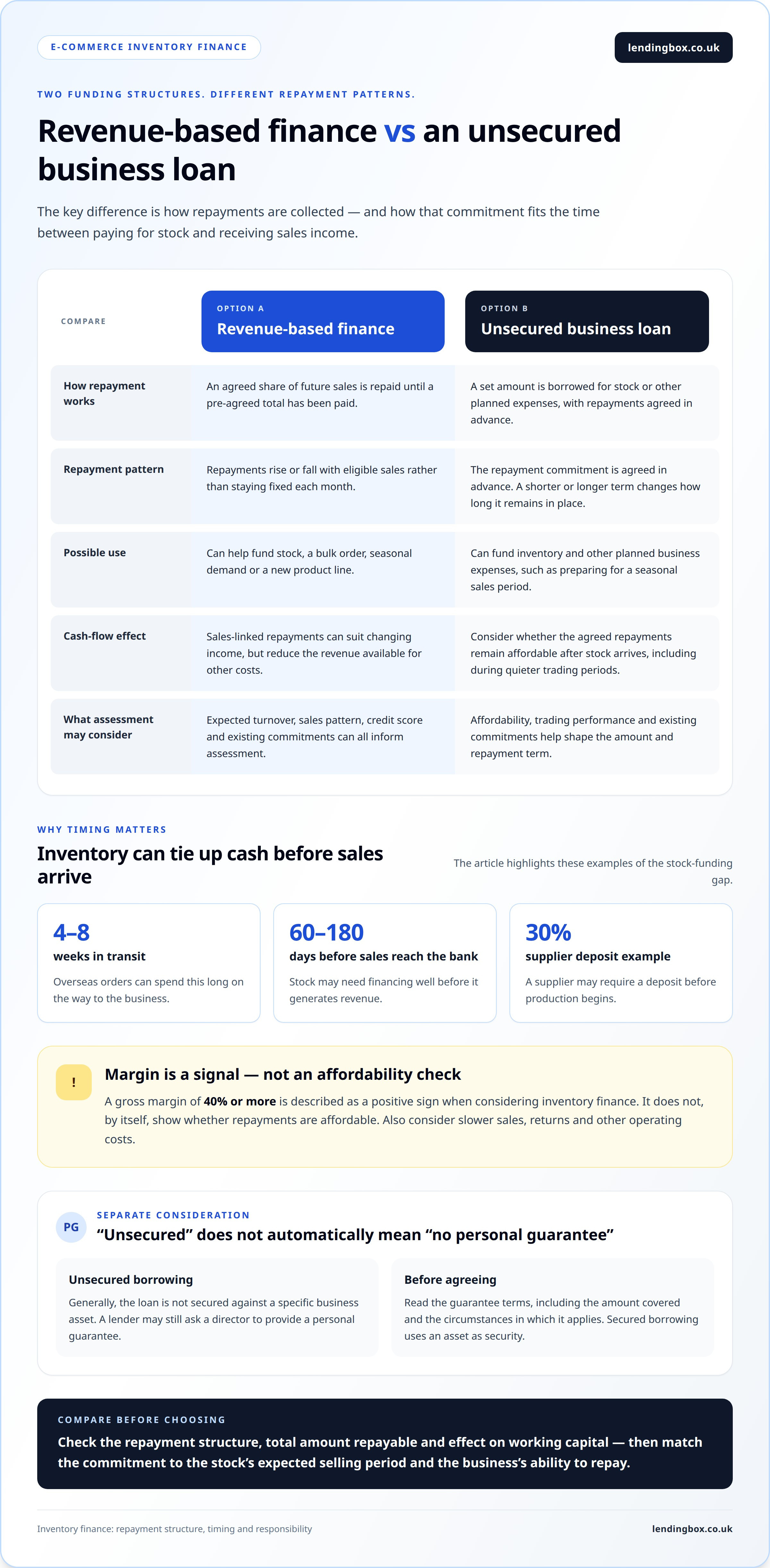
For Amazon and other marketplace sellers, revenue-based finance can repay an agreed share of future sales until a pre-agreed total is paid. This means repayments rise or fall with eligible sales rather than staying fixed each month. Before applying, map the repayment against expected turnover and existing commitments. A credit score may inform assessment, but the sales pattern and affordability also matter.
Bridging inventory cash flow
Inventory often needs capital well before it generates revenue. Overseas orders can spend 4 to 8 weeks in transit, and businesses may finance stock purchases 60 to 180 days before sales reach their bank account. Revenue-based finance can bridge that gap, including a supplier deposit of 30% before production begins. Set the repayment against the likely sales cycle, not just the delivery date.
The main benefit is timing: finance can support a bulk order, seasonal demand or a new product line without waiting for existing stock to sell. The risk is taking on repayments before the new inventory earns revenue. A gross margin of 40% or more is described as a positive sign when assessing whether inventory finance makes sense, but margin alone doesn’t show whether the business can afford repayments. Consider slower sales, returns and other operating costs too.
UK government-backed options may also be relevant. Start Up Loans may suit some new businesses, while eligibility and permitted use depend on the scheme’s terms.
Compare the repayment structure, total amount repayable and effect on working capital before choosing. A review of business finance options can help identify whether revenue-based finance or another route fits your stock cycle.
Unsecured loans and personal guarantees
UK ecommerce inventory can be funded through unsecured business loans, secured borrowing, revenue-based finance or a business credit card. An unsecured loan provides a set amount for stock and other planned expenses, with repayments agreed in advance. A business loan for ecommerce inventory may suit a retailer planning a bulk purchase or preparing for a seasonal sales period.
The amount and repayment term depend on affordability, trading performance and the lender’s assessment. A shorter-term loan may fit a stock order with a clear selling cycle. A longer term can spread repayments, but keeps the commitment in place for longer. Consider how each option affects cash flow after the goods arrive.
Use funding for a defined purpose. For example, a retailer could finance a bulk order of products expected to sell during a seasonal peak while planning for routine operating costs. Set the borrowing against the stock requirement and forecast cash flow after repayments. A business loan for ecommerce inventory should support a clear purchasing plan, not leave the business with more debt than its stock needs justify.
“Unsecured” generally means the loan isn’t secured against a specific business asset. It doesn’t automatically mean there’s no personal guarantee. A lender may ask a director to provide one, changing who stands behind the agreed borrowing. Read the guarantee terms carefully, including the amount covered and the circumstances in which it applies. Secured borrowing instead uses an asset as security.
Other routes work differently. A business credit card provides revolving credit for purchases, while revenue-based finance links repayments to sales. The Growth Guarantee Scheme may also be an option. Each route has different eligibility and repayment arrangements, so consider how the commitment fits the stock’s expected selling period.
Compare the total repayment, schedule and security requirements before choosing. Match the finance to the inventory plan and the business’s capacity to meet repayments, including during quieter trading periods.
Who can apply for an e-commerce loan?
UK limited companies and LLPs can apply for business finance, with lenders assessing trading performance and repayment affordability. A digital application can organise company information for review, while a broker can help match the funding need to suitable finance types.
Start-ups and newer ecommerce businesses can apply, but limited trading records can make affordability harder to demonstrate. Lenders also assess the owner’s age, business cash flow and stock demand. The applying owner must be over 18 years old.
For an application, lenders may assess the last 3 to 6 months of bank statements and the average daily cash balance. These show how revenue arrives, how existing commitments affect cash flow and whether repayments appear affordable. Prepare a clear breakdown of the stock purchase, expected selling period and other planned costs. Sales records from platforms such as Amazon can help explain demand and turnover patterns.
A broker can review company information, identify relevant lending routes and manage paperwork between the business and lender. Depending on the application, options may include an unsecured loan or revenue-based finance. With revenue-based finance, repayments are taken as an agreed share of future sales rather than a fixed monthly amount, so the sales pattern matters to the assessment.
During the process, the broker can present the funding need and financial records to lenders, then explain the terms received. Check the repayment amount, total payable, any personal guarantee and how the schedule fits quieter sales periods. For example, a retailer with seasonal demand needs to account for slower months, not just peak turnover.
To prepare, gather recent bank statements, company details, sales information and the stock order’s cost breakdown. Then review your ecommerce finance options with a broker who can guide the application and paperwork.
Lending Box: Business loan
Lending Box helps UK limited companies and LLPs assess finance options for ecommerce stock and business growth. Its in-house lending model analyses company data to provide eligibility insights without impacting credit scores.
One named relationship manager guides you through business loans, revenue-based finance, invoice finance and asset finance, then handles the application paperwork. This can help when weighing a set repayment schedule against repayments linked to sales, or when inventory is only part of a wider funding requirement. The right route depends on your company’s finances, planned use and repayment capacity.
Have your stock requirements and recent business information ready to support a focused discussion. Contact Lending Box to discuss finance for your ecommerce business.
Plan your next stock order with confidence
Before committing to a business loan for ecommerce inventory, connect the funding decision to your next buying cycle. Consider how the stock supports your trading plan, when customer payments should arrive and what repayments will leave for other business costs. A clear view of these factors can help you discuss the right structure and avoid treating the loan amount as the only decision.
Lending Box can help you explore a business loan, revenue-based finance or invoice finance in relation to your company’s funding needs. Its team can review the options with you and guide the application process, so you can make an informed decision about the next step.
Contact Lending Box about funding and take the next stock decision forward with a clearer plan.
Frequently Asked Questions
Can Amazon sellers get a business loan?
Yes, an Amazon seller may apply if the business is an active UK limited company or LLP registered at Companies House. Lenders assess the company’s finances and ability to repay, so marketplace sales alone don’t secure approval. Lending Box’s initial matching process has no impact on your credit score. A credit search only happens at full application, and only with your agreement.
Is stock finance available for UK e-commerce?
Yes. UK online retailers can explore business borrowing to fund stock, with the suitable structure depending on the business and its cash flow. A business loan can provide funding for planned purchases; revenue-based finance links repayments to sales. Invoice finance works differently, releasing funds against eligible unpaid invoices rather than stock itself. Match the facility to the expense it is designed to support.
What is ecommerce funding?
Ecommerce funding is business finance used to support an online retailer’s operating or growth needs. This could include paying for inventory, managing cash flow between supplier payments and customer receipts, or investing in a planned expansion. The finance may take the form of a loan, revenue-based finance or invoice finance. The key distinction is how funds are provided and how repayments are made.
Can I repay my loan early?
Possibly, but early repayment terms depend on the lender and the agreement. Before signing, check whether early settlement is permitted, how the settlement figure is calculated and whether any charges apply. Ask for the terms in writing and compare them with your expected cash flow. If a seasonal sales period may bring in extra funds, understand how early repayment would affect the total cost.
Can a UK Amazon FBA seller get pre-approved finance?
An Amazon FBA seller can receive an initial eligibility insight, but this isn’t a guaranteed offer or final approval. The business must be an active UK limited company or LLP registered at Companies House. Lending Box’s initial matching has no impact on your credit score, with no long forms before you see anything useful. There’s no obligation at any stage, and you can start with your company name.
How can finance help e-commerce and SaaS businesses?
Finance can help an ecommerce business pay for inventory or manage the gap between buying stock and receiving sales revenue. For a SaaS company, funding may support planned business costs or growth, while invoice finance can help release cash tied up in eligible unpaid invoices. The useful option depends on how the company earns revenue, what it needs to fund and how repayments fit its cash flow.
Frequently Asked Questions
Yes, an Amazon seller may apply if the business is an active UK limited company or LLP registered at Companies House. Lenders assess the company’s finances and ability to repay, so marketplace sales alone don’t secure approval. Lending Box’s initial matching process has no impact on your credit score. A credit search only happens at full application, and only with your agreement.
Yes. UK online retailers can explore business borrowing to fund stock, with the suitable structure depending on the business and its cash flow. A business loan can provide funding for planned purchases; revenue-based finance links repayments to sales. Invoice finance works differently, releasing funds against eligible unpaid invoices rather than stock itself. Match the facility to the expense it is designed to support.
Ecommerce funding is business finance used to support an online retailer’s operating or growth needs. This could include paying for inventory, managing cash flow between supplier payments and customer receipts, or investing in a planned expansion. The finance may take the form of a loan, revenue-based finance or invoice finance. The key distinction is how funds are provided and how repayments are made.
Possibly, but early repayment terms depend on the lender and the agreement. Before signing, check whether early settlement is permitted, how the settlement figure is calculated and whether any charges apply. Ask for the terms in writing and compare them with your expected cash flow. If a seasonal sales period may bring in extra funds, understand how early repayment would affect the total cost.
An Amazon FBA seller can receive an initial eligibility insight, but this isn’t a guaranteed offer or final approval. The business must be an active UK limited company or LLP registered at Companies House. Lending Box’s initial matching has no impact on your credit score, with no long forms before you see anything useful. There’s no obligation at any stage, and you can start with your company name.
Finance can help an ecommerce business pay for inventory or manage the gap between buying stock and receiving sales revenue. For a SaaS company, funding may support planned business costs or growth, while invoice finance can help release cash tied up in eligible unpaid invoices. The useful option depends on how the company earns revenue, what it needs to fund and how repayments fit its cash flow.