Revenue-Based Finance Eligibility: How Businesses Qualify
28 November 2026 · 11 min read

 Business funding
A short trading history or no property security doesn’t automatically rule a business out of revenue-based finance. The revenue-based finance eligibility criteria usually focus on trading history and the strength, consistency and traceability of sales. Lenders commonly expect at least six months of trading, but requirements vary.
It’s reasonable to want clarity before applying, especially if income rises and falls through the year or you’re unsure whether assets or a personal guarantee may be involved. These factors can affect a lender’s assessment, but they don’t all carry the same weight.
This guide explains how revenue-based finance works and what lenders may consider when assessing your business. You’ll learn how trading history, seasonal income, revenue patterns, existing debt, assets and personal guarantees can shape eligibility, helping you judge whether this type of funding suits your circumstances.
Key Takeaways
- Understand how repayments linked to revenue can affect cash flow, especially when sales fluctuate.
- See why seasonal income and existing debt can shape an application, and what may help show the business’s revenue pattern.
- Learn how trading history is weighed alongside recent sales, so a newer business can understand where it may stand.
- Find out how assets and personal guarantees may factor into an offer, and what recurring revenue can tell lenders about affordability.
What is Revenue-Based Finance?
Revenue-based finance provides a lump sum, repaid as an agreed share of future revenue until the repayment cap is reached. In practice, revenue based finance eligibility criteria focus on whether sales are traceable and can support repayments. A broker can assess company data, match finance options and manage the application paperwork.
Unlike a business loan, which usually has an agreed repayment schedule, revenue-based repayments can move with sales. A merchant cash advance is usually tied to card sales, while revenue-based finance can assess revenue from several channels. That difference may matter to businesses earning through both card payments and online sales.
Repayments may be collected daily or weekly as a percentage of card sales, online sales or other eligible revenue. Typical percentages range from 2% to 8% of daily or weekly revenue. These revenue based finance eligibility criteria make the payment amount responsive to trading, rather than a fixed sum every month.
Cash Flow and Repayment Fit
With percentage-based repayments, the amount due rises or falls with the revenue covered by the agreement. This can help cash flow when sales fluctuate, as weaker sales may mean a smaller repayment. The key is whether the remaining cash still covers stock, wages and other commitments. Strong headline turnover alone doesn’t show whether repayments fit day-to-day needs.
Repayment Caps and Multiples
A repayment multiple sets the total amount due against the advance, while the cap marks when repayments stop. The percentage determines the repayment pace; the multiple sets the agreed total. Compare both when deciding whether the finance suits your plans.
Repayment speed also affects effective APR: the same multiple repaid faster can carry a higher annualised cost. A 1.2x multiple repaid in six months is approximately 40% APR; repaid over 18 months, approximately 13% APR. The timeline matters alongside the cap when weighing this alternative.
Qualification challenges for seasonal or newer businesses
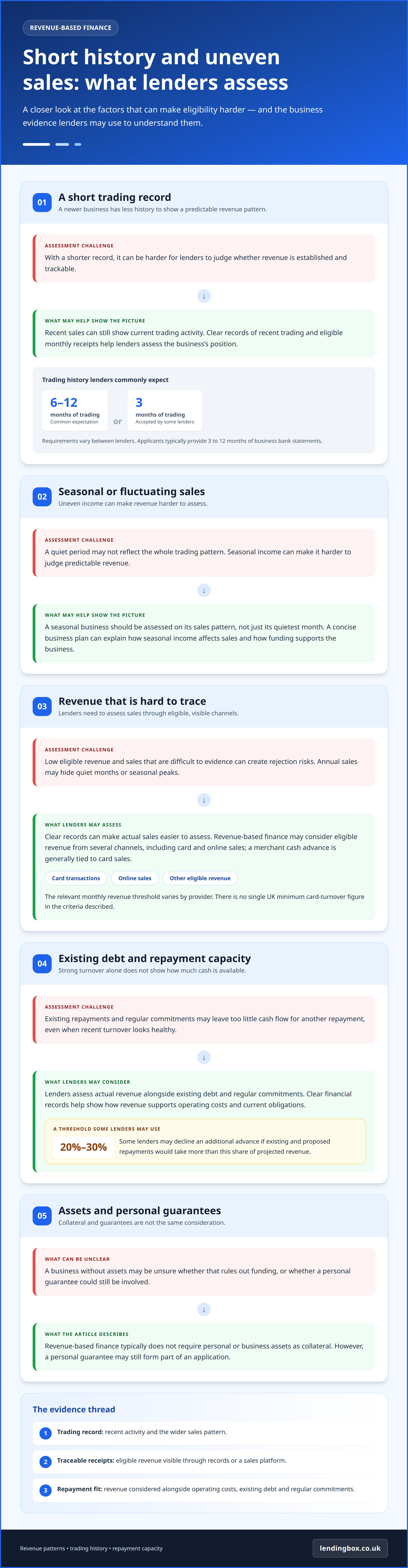
Seasonal sales and a short trading record can make revenue harder to assess. Common rejection risks include low eligible revenue, sales that are difficult to trace and existing repayments that leave too little cash flow.
Financial Health and Existing Debt
Financial health means lenders assess actual revenue alongside existing debt and regular commitments. This matters because strong sales may still leave limited capacity for another repayment.
Some lenders may decline an additional advance if existing and proposed repayments would take more than 20% to 30% of projected revenue. For example, a business with substantial debt repayments may appear less able to manage flexible funding, even when recent turnover looks healthy. Clear financial records help show how revenue supports operating costs and current obligations.
Seasonality and Business Age
Seasonality creates uneven income, while a newer business has less trading history to demonstrate a predictable pattern. Both can make qualification harder, but recent revenue can still help show the business’s actual trading position.
Revenue-based finance lenders commonly expect 6 to 12 months of trading, although some accept businesses as young as 3 months. A seasonal business should therefore be assessed on its sales pattern, not just its quietest month.
Collateral, Plans and Rejection Risks
Collateral is property or another asset pledged against borrowing. Revenue-based finance typically doesn’t require personal or business assets as collateral, which may suit businesses without assets to offer. However, a personal guarantee may still form part of an application.
A concise business plan can explain how funding supports the business and how seasonal income affects sales. Sector suitability also depends on whether revenue comes through a trackable channel: predictable card or online transactions are easier to assess than sales that cannot be clearly evidenced. UK businesses, including limited companies, sole traders and partnerships, are covered by the funding described. A broker can assess revenue-based finance options against those factors.
Minimum trading history
Trading history helps lenders judge whether a business’s revenue is established and trackable. Revenue-based finance lenders commonly expect 6 to 12 months of trading, although some accept businesses as young as 3 months. A shorter history can still be relevant if recent sales show consistent activity. Unlike a traditional loan, the assessment can give significant weight to current revenue patterns.
Monthly revenue thresholds vary between providers. These are not interchangeable qualification limits: the relevant threshold depends on the lender and programme. Annual revenue offers useful context, but it may hide quiet months or sharp seasonal peaks.
Monthly recurring revenue matters when customers pay regularly, but lenders also assess actual sales through eligible channels. For a retailer, monthly card turnover may help show transaction volume; for an online business, digital sales records may reveal a different pattern. Revenue that cannot be traced through statements or a sales platform is harder to use when lenders determine eligibility. Applicants typically provide 3 to 12 months of business bank statements.
There is no single UK minimum card-turnover figure in the criteria described. The key is whether revenue is eligible, visible and sufficient to support repayments. A business may report strong annual sales yet have limited qualifying monthly revenue if much of its income is irregular or difficult to track. A merchant cash advance is generally tied to card sales, whereas revenue-based finance can assess eligible revenue from multiple channels. This difference can affect which monthly figures lenders use.
For a newer company, the most useful evidence is a clear record of recent trading and eligible monthly receipts. This helps lenders assess the business’s current position rather than relying only on its age or annual total. Strong recent revenue can help offset a shorter trading history, while inconsistent records can make qualification harder.
How do UK providers assess recurring revenue, cash flow and business growth?
Providers look for revenue they can trace and use to judge repayment capacity. Regular card or online receipts create a clearer pattern than income that arrives through hard-to-track channels. Bank statements covering the previous three to six months can show payment frequency, quiet periods and changes in turnover.
Growth can strengthen an application when it reflects repeatable demand. Revenue increasing by 5% to 10% month over month can support the case, but lenders also consider what drives that rise. A short-term sales spike may tell a different story from recurring customer payments or a sustained increase in orders.
Cash flow analysis compares incoming revenue with operating costs and existing finance repayments. The key question is how much eligible revenue remains available after those commitments. Some lenders may decline an additional advance if existing and proposed repayments would consume more than 20% to 30% of projected revenue. That makes the forecast important, not just the latest sales figure.
Providers also assess how reliably future receipts can be estimated. A business with steady online sales may show a clearer pattern than one relying on irregular, untracked payments. Seasonal peaks and dips matter too: forecasts should reflect trading patterns rather than assume each month will match the strongest recent period. This helps show whether the proposed repayment share fits the business’s actual cash flow.
Useful evidence connects sales records, bank activity and forecasts into one consistent picture. Gaps between recorded sales and bank deposits can make revenue harder to assess. A broker can review these factors and match the application to suitable options. Assess your revenue-based finance fit with professional support.
Lending Box: Revenue-based finance
Lending Box matches UK limited companies and LLPs with revenue-based finance options. Its in-house lending model analyses company data and provides eligibility insights without impacting credit scores. A dedicated relationship manager guides the application and handles the paperwork.
This can help when sales are trackable but trading history, seasonal income or existing debt makes eligibility harder to assess. Lending Box can also consider a business loan, invoice finance or asset finance, depending on your circumstances. The aim is to identify a suitable route, not to assume revenue-based finance fits every case.
To discuss your business’s funding needs, contact Lending Box.
Choose funding that supports your next move
Use the revenue-based finance eligibility criteria as a starting point, then consider what the funding needs to achieve. Connect the amount sought to a clear business purpose, such as supporting stock, investment or working capital. This keeps the decision tied to an operational need, rather than focusing on eligibility alone.
The right structure should also fit your wider plans. Lending Box can help assess revenue-based finance and, where relevant, a business loan or invoice finance. Each option works differently, so the right fit depends on your income and funding requirements. The terms of any offer matter as much as the amount available.
If you’re ready to explore suitable routes for your business, contact Lending Box to discuss your options. A clear view of your goals is a practical place to begin.
Frequently Asked Questions
What documents are required?
Applications typically require active limited company registration, 3 to 6 months of business bank statements, latest filed accounts or management figures, director ID and credit checks. These records help lenders compare reported turnover with account activity and understand the company’s financial position. Credit checks may form part of a lender’s assessment, so check what the application involves before proceeding. Keep the figures consistent across the documents you provide.
What revenue level is required to access RBF in the UK?
There isn’t one revenue threshold used by every UK provider. These are different reference points, not a single market-wide rule. Lenders also consider whether revenue is eligible, traceable and sufficient after existing commitments.
Who can apply?
Businesses may be able to apply, depending on the provider and their circumstances. The applicant must be the business entity, not an individual seeking personal finance. For example, a director applying on behalf of an active limited company applies through that company. Sales records and financial information help lenders assess the application.
Will I need to provide a personal guarantee?
A personal guarantee may be required, depending on the application and lender’s terms. It is a commitment by a director or another individual to repay business borrowing if the company cannot meet its obligations. Before signing, understand the liability it creates and when it could be called. Personal guarantee insurance is a separate option and doesn’t remove the guarantee requirement.
What are the basic eligibility criteria for revenue-based finance in the UK?
Providers generally assess whether the applicant is an eligible UK business, has sufficient traceable revenue and can support repayments alongside existing commitments. They may also review trading history, revenue patterns and the records supplied with the application. A business with seasonal sales can present a different risk profile from one with steady receipts, so the timing and source of income matter.
What minimum monthly or annual revenue do UK revenue-based finance providers require?
Monthly thresholds differ by provider, and annual revenue alone may not show whether repayments fit current trading. A strong annual total may still mask weak or uneven recent sales, so providers examine the revenue pattern as well as the overall figure.
Frequently Asked Questions
Applications typically require active limited company registration, 3 to 6 months of business bank statements, latest filed accounts or management figures, director ID and credit checks. These records help lenders compare reported turnover with account activity and understand the company’s financial position. Credit checks may form part of a lender’s assessment, so check what the application involves before proceeding. Keep the figures consistent across the documents you provide.
There isn’t one revenue threshold used by every UK provider. These are different reference points, not a single market-wide rule. Lenders also consider whether revenue is eligible, traceable and sufficient after existing commitments.
Businesses may be able to apply, depending on the provider and their circumstances. The applicant must be the business entity, not an individual seeking personal finance. For example, a director applying on behalf of an active limited company applies through that company. Sales records and financial information help lenders assess the application.
A personal guarantee may be required, depending on the application and lender’s terms. It is a commitment by a director or another individual to repay business borrowing if the company cannot meet its obligations. Before signing, understand the liability it creates and when it could be called. Personal guarantee insurance is a separate option and doesn’t remove the guarantee requirement.
Providers generally assess whether the applicant is an eligible UK business, has sufficient traceable revenue and can support repayments alongside existing commitments. They may also review trading history, revenue patterns and the records supplied with the application. A business with seasonal sales can present a different risk profile from one with steady receipts, so the timing and source of income matter.
Monthly thresholds differ by provider, and annual revenue alone may not show whether repayments fit current trading. A strong annual total may still mask weak or uneven recent sales, so providers examine the revenue pattern as well as the overall figure.