
Bridge lending for property buyers and businesses
21 October 2026 · 17 min read

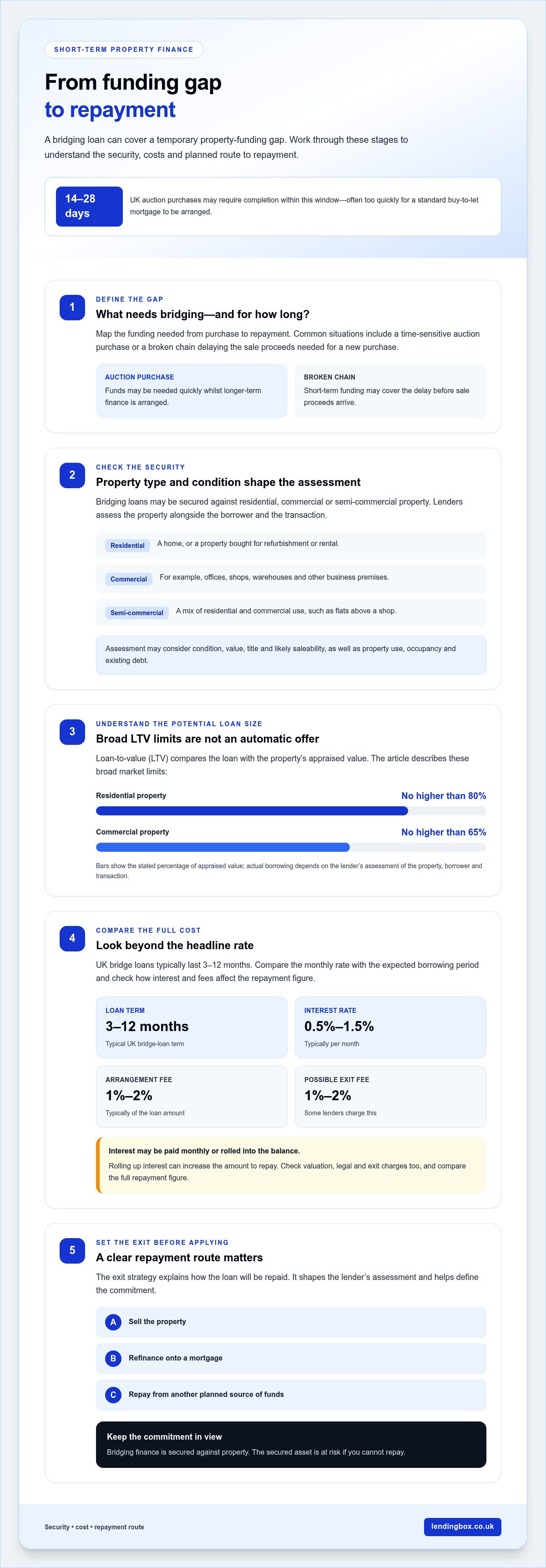
A property deal can hinge on the gap between buying and securing long-term finance. Bridge lending provides short-term funding to cover that gap, often until a property is sold or longer-term finance is arranged. UK auction purchases may require completion within 14-28 days, which can make a standard buy-to-let mortgage difficult to arrange in time.
That speed can be useful, but bridging finance is secured against property and requires a clear repayment plan. The exit route matters as much as the purchase: it shapes the application and helps you understand the commitment.
This guide explains what a bridging loan is, which properties may secure one, how repayment plans and interest work, and the differences between applying directly, using a broker or choosing a comparison platform. You’ll be better placed to decide which route suits your property purchase or business funding need.
Key Takeaways
- See when short-term property finance can help with an auction purchase or a broken chain, including the tight completion window auction buyers may face.
- Understand what lenders consider when assessing a property as security, from its type and condition to the overall transaction.
- Build a clear repayment route before applying, and learn why the exit plan can shape the lender’s decision.
- Compare how interest may accrue and be paid, so you can assess the full repayment commitment.
- Weigh the practical differences between applying directly, using a broker or a comparison platform, then choose a route that fits your funding need.
What is a bridging loan?
A bridging loan is short-term finance that covers the gap before a sale or longer-term funding. Whether it suits you depends on the security, repayment route and time required.
Common bridging loan uses
Auction buyers may need funds quickly: UK auction purchases can require completion within 14-28 days. A bridging loan can cover the purchase whilst longer-term finance is arranged. It can also help when a broken chain delays the sale proceeds needed for a new purchase.
For each use, map the funding gap from purchase to repayment. Lenders assess the property and your planned exit, not simply the urgency. Bridge lending is most relevant when you have a defined short-term need and a credible repayment route.
Loan size and loan-to-value limits
Loan-to-value, or LTV, compares the loan with the property’s appraised value. Commercial property bridge loans generally have LTVs no higher than 65% of appraised value; residential property loans generally have limits no higher than 80%. These are broad market limits, not an automatic offer.
The amount available depends on the lender’s assessment of the property, borrower and transaction. Compare the gross loan with the funds you need after fees. Ask how valuation, legal and exit charges affect the amount you receive and the balance due.
Terms and interest structures
UK bridge loans typically last 3-12 months. Interest rates typically range from 0.5%-1.5% per month, so compare the monthly rate alongside the expected period of borrowing. Some loans roll interest into the balance rather than requiring monthly payments; this can increase the amount to repay.
Arrangement fees are typically 1%-2% of the loan amount, and some lenders charge an exit fee of 1%-2%. Compare the full repayment figure, interest method and charges, not the headline rate alone.
Comparing short-term finance
A mortgage or remortgage is generally designed for longer-term property finance, while a bridging loan addresses a temporary funding gap. Unlike other short-term business finance, bridging is secured against property. Invoice finance uses invoices as security, while asset finance funds business assets.
For regulated borrowing, a first-charge bridge loan on a property where the borrower or a close family member will live is a regulated mortgage contract. The Financial Conduct Authority oversees regulated bridging loans under MCOB 11. For mixed-use properties, the Financial Conduct Authority’s final rules apply a 40% occupancy threshold for a regulated mortgage contract.
Across England, Wales, Scotland and Northern Ireland, compare the same essentials: security, rate, fees, repayment method and exit plan. Property and legal processes vary by nation, which can affect the work involved and completion timetable. Ask for a clear breakdown of charges and the steps for your specific property.
What types of properties can be used as security?
UK bridging loans may be secured against residential, commercial or semi-commercial property. The loan’s regulatory status depends on factors such as who will occupy the property and how it will be used.
Residential security may include a home or a property bought for refurbishment or rental. Commercial security may include offices, shops, warehouses and other business premises. Semi-commercial property combines residential and commercial use, such as flats above a shop. Lenders assess the property’s condition, value, title and likely saleability alongside your plans.
Auction purchases bring a specific timing challenge. UK auction buyers may need to complete within 14-28 days, so the security and legal work need to support that deadline. Before bidding, identify the property, the amount required and the intended repayment route. A specialist lender may consider a property that needs work, but its condition and the scope of the planned works affect the assessment.
Choose a lender whose criteria fit both the borrower and the property. A limited company buying a commercial unit presents a different case from an individual purchasing a home. Lenders may consider the property’s use, occupancy, condition, valuation, title and existing debt. Prepare the purchase details, ownership structure and repayment plan together, as gaps in any of these can complicate underwriting.
Regulated bridging loans generally relate to residential borrowing with an owner or close family member living in the property; other cases may be unregulated, depending on their circumstances. A first-charge loan on a property where the borrower or a close family member will reside is a regulated mortgage contract. For mixed-use properties, the Financial Conduct Authority’s final rules use a 40% occupancy threshold for a regulated mortgage contract. The protections and rules that apply therefore depend on the loan’s purpose and property occupancy.
Property security can support a personal purchase or business funding, but the secured asset is at risk if you cannot repay. For a business, compare property-backed borrowing with finance linked to invoices or assets. The right structure depends on what you need to fund and what security is available. Keep the loan purpose, borrower and property ownership aligned in the application.
If property security is part of a wider business funding decision, compare property-secured business finance options alongside the asset and repayment details.
What is an exit strategy, and why is it important?
An exit strategy explains how you’ll repay the bridging loan. It affects the lender’s assessment, affordability and the overall cost of borrowing.
Repayment routes and exit strategies
Start with a specific repayment route. Common exits include selling the property, refinancing onto a mortgage or repaying from another planned source of funds. Match the route to the loan term and show how the expected funds will cover the outstanding balance, interest and fees.
Test the plan against practical delays. A sale may take longer than expected, while refinancing may depend on the property meeting a new lender’s criteria. Set out the expected steps, such as completing works, obtaining a valuation and submitting a mortgage application. A clear sequence helps lenders assess whether the proposed exit is credible.
Some lenders may require a Decision in Principle if you plan to refinance onto a buy-to-let mortgage. For a rental property, the future rental income is assessed against the mortgage lender’s criteria. Include this assessment in your plan rather than treating refinancing as automatic.
Refinancing, development and sales exits
Refinancing replaces the bridging loan with longer-term borrowing. With a bridge-to-let purchase, you may plan to renovate and rent the property before applying for a buy-to-let mortgage. The property’s condition, rental income and mortgage eligibility all affect whether this route can repay the original loan.
A development exit uses completed works and the resulting property position to support refinancing or a sale. Set out the work still required, how you’ll evidence completion and what funds will repay the bridge. A sales bridge, by contrast, relies on selling the asset. Expected sale proceeds need to cover the debt and associated costs.
Each exit has different dependencies. A sale relies on finding a buyer and completing the transaction; refinancing depends on the property meeting a new lender’s criteria. Allow for delays by identifying the next step if your preferred route is held up. Your exit plan should explain the fallback, not just the best-case outcome.
Affordability and exit costs
Assess affordability against the full amount due at repayment, not just the original advance. Some lenders charge an exit fee of 1%-2%. Legal and monitoring fees may also affect the final balance.
Ask for every charge to be itemised and find out when it is payable. Check whether interest is paid monthly, retained or added to the balance. When interest accrues over a longer repayment period, the amount due can increase. Compare the projected balance at your planned exit date with expected sale proceeds or mortgage funds.
Stress-test the figures. Allow for a lower sale price, delayed completion or refinancing that does not cover the full bridge. If your exit depends on a rental mortgage, test the expected rent against the lender’s affordability criteria. This turns your exit strategy into a repayment calculation, with costs and fallback actions clear before you borrow.
Interest rates and interest payment options
The rate is only one part of a bridging loan’s cost. Compare how interest accrues, when you pay it and which fees add to the balance.
Interest payment options
UK bridging loan rates typically range from 0.5%-1.5% per month. Lenders may collect interest monthly, retain it from the advance or roll it up until repayment. With rolled-up interest, you avoid monthly interest payments, but the amount due at the end grows throughout the loan period.
Check how the lender calculates interest before signing. Some lenders charge a full month’s interest when you repay part-way through a month. Others calculate interest daily, which can affect the final bill if a sale or refinancing completes early. Ask whether the quoted rate is monthly and how repayment timing changes the amount charged.
That calculation assumes the full loan remains outstanding throughout the period. If refurbishment finishes early, whether repaying sooner reduces the interest charge depends on the exit date and the lender’s interest calculation.
The payment structure also affects cash flow. Monthly interest payments require funds to be available during the term; rolled-up interest postpones those payments but increases the balance due at repayment. Compare both options with the business’s expected income and credit commitments. For an auction or refurbishment, match the interest arrangement to the funds available before your planned exit.
Interest rates, costs and fees
Compare the full cost of borrowing, not just the advertised rate. A lender assesses the property, loan size, borrower profile and application when setting terms. A refurbishment project may also involve monitoring costs. Ask for each charge and its payment date alongside the interest calculation.
Arrangement fees for bridging loans are typically 1%-2% of the loan amount. Some lenders charge an exit fee of 1%-2% when the loan is repaid. Legal and monitoring fees can also affect the total, so include them in the repayment estimate.
A worked example makes comparisons clearer.
Compare offers using the same loan amount and period. List the interest method, arrangement fee, valuation and legal costs, monitoring charges and any exit fee. Then compare the projected repayment balance with the funds expected from a sale or refinancing. This gives you a clearer picture than comparing rates alone.
Applying directly, using a broker or using a comparison platform
For a UK bridging loan, choose an application route that fits the transaction’s size, property and complexity. Direct applications, brokers and comparison platforms differ in how they handle lender selection.
Applying directly gives you control over discussions with the lender. You’ll need to present the property, requested capital, borrower details and exit strategy clearly. This may suit a straightforward investment with familiar security and a clear repayment plan. The trade-off is managing the lender criteria, paperwork and follow-up yourself, then comparing each offer’s rate, fees and conditions.
A broker can assess your circumstances and approach lenders whose criteria fit the property and borrower. That can help when the transaction involves unusual security, multiple properties or a complex ownership structure. Brokers may also coordinate information and explain differences between offers. For loans of £3 million or above, arranging suitable terms directly can be difficult, so specialist broker support may be useful.
A comparison platform can help you review potential options in one place. Check what each result actually compares: headline rates alone won’t show the full cost, repayment structure or lender criteria. A platform may offer an initial view, but the lender still assesses the application, security and exit before approval. Compare like for like, including the loan period and fees.
To apply, prepare the purchase details, property information, amount required, borrower or company structure and repayment plan. Then provide documents requested for the lender’s review. Valuation and legal work form part of the transaction, so keep those steps moving alongside the application. UK bridge loans can complete in 3-14 days, depending on the transaction and its requirements. This is a possible completion timeframe, not a funding guarantee.
Regulated status matters too. The Financial Conduct Authority oversees regulated bridging loans under MCOB 11. The loan’s purpose, property occupancy and borrower circumstances affect which rules apply, so make those details clear from the start. A mismatch between the proposed use and the application can delay assessment or change the route required.
For a large or unusual transaction, weigh the benefit of tailored lender selection against the work of managing an application yourself. For a simpler case, direct contact or a comparison platform may be a practical starting point. Before proceeding, bring the property details, capital requirement and exit plan together in a concise brief. This makes it easier to assess the application route and compare the terms, not just the headline offer.
Lending Box: Business loan
Lending Box helps UK limited companies and LLPs compare business finance options when property bridging isn’t the right fit. It matches businesses with options including business loans, revenue-based finance, invoice finance and asset finance.
The platform analyses company data to provide eligibility insights without impacting credit scores. A dedicated relationship manager guides you through suitable options and handles the paperwork. This can help if you need working capital, want to release funds against invoices or assets, or are seeking finance for a business purpose rather than a short-term property purchase.
Explore your business finance options by visiting Lending Box.
Choose a funding route that fits your next move
Before committing to bridge lending, decide whether the funding is for a property transaction or a wider business need. Set out what the capital will achieve, how it fits your plans and what repayment means for cash flow. This gives you a practical basis for comparing options rather than choosing on urgency alone.
If you need business finance rather than property-backed borrowing, Lending Box offers business loans, revenue-based finance and invoice finance. These options serve different needs: a business loan provides borrowing for business purposes, revenue-based finance links funding to business revenue, and invoice finance uses unpaid invoices to access funds. Consider which structure best matches your intended use and repayment capacity.
Share your business funding requirement and explore a suitable next step with Contact Lending Box to discuss your options. A clear brief can help make the conversation focused and useful, so you can move ahead with greater confidence.
Frequently Asked Questions
What are bridging loans?
Bridging loans are short-term finance secured against property or another asset, with repayment planned from a later sale or longer-term borrowing. Bridge lending can suit a buyer who needs to complete before their existing property sells, or a business purchasing premises before arranging permanent finance. The security matters: if you cannot repay, the lender may take steps to recover the debt from the secured property.
Can I repay my loan early?
Early repayment may be possible, but the amount due depends on the loan’s interest method and terms. Some UK lenders charge a full month’s interest even if you repay part-way through that month; others calculate interest daily. Before repaying, obtain a redemption statement showing the outstanding balance, accrued interest and any exit charge. Compare that figure with the funds available from your sale or refinance.
How quickly can I receive funds?
UK bridging loans can complete in 3-14 days, depending on the loan and lender. The application moves through assessment, property valuation, legal work and completion, so delays in any step can affect the timetable. Prepare property and borrower information early, and keep solicitors and other parties aligned on deadlines. A target completion date is useful, but the valuation and legal process still need to finish.
What are the drawbacks of bridging finance?
The main drawbacks are the cost of short-term borrowing and the risk attached to property security. Monthly interest can build quickly, while arrangement, valuation, legal or exit fees increase the repayment amount. If a planned sale falls through or refinancing is declined, you still owe the debt. A missed repayment can put the secured asset at risk, so assess the exit and fallback plan before proceeding.
What is a bridging loan in the UK and how does it work?
A UK bridging loan provides temporary finance secured against property, with repayment due under the agreed loan terms. The lender assesses the borrower, security and intended repayment route, then sets the amount and conditions. You use the funds for the transaction and repay from an agreed source, such as a sale or refinance. A first-charge loan on a home where you or a close family member will live is a regulated mortgage contract.
What are typical UK bridging loan interest rates, fees and total costs in 2026?
In 2026, UK bridging loan rates typically range from 0.5%-1.5% per month. Legal and other charges also affect the total. Compare the full repayment amount, because the interest method and time outstanding change the final cost.
What loan-to-value ratios and borrowing amounts do UK bridging lenders offer?
Residential property bridge loans generally have loan-to-value ratios no higher than 80% of appraised value; commercial property loans generally have limits no higher than 65%. LTV is not the only limit: lenders also consider existing borrowing, security value and the proposed exit when assessing the amount.
What eligibility criteria and documents do UK bridging loan lenders require?
Lenders assess the borrower, property, requested amount and repayment plan. An application commonly requires property details, ownership information, a valuation, the borrower’s financial position and evidence supporting the planned exit. A company purchase may also require company accounts and details of its directors and ownership. For a rental refinance, expected rent matters to the mortgage lender’s assessment. Requirements vary with the property and transaction structure.
Frequently Asked Questions
Bridging loans are short-term finance secured against property or another asset, with repayment planned from a later sale or longer-term borrowing. Bridge lending can suit a buyer who needs to complete before their existing property sells, or a business purchasing premises before arranging permanent finance. The security matters: if you cannot repay, the lender may take steps to recover the debt from the secured property.
Early repayment may be possible, but the amount due depends on the loan’s interest method and terms. Some UK lenders charge a full month’s interest even if you repay part-way through that month; others calculate interest daily. Before repaying, obtain a redemption statement showing the outstanding balance, accrued interest and any exit charge. Compare that figure with the funds available from your sale or refinance.
UK bridging loans can complete in 3–14 days, depending on the loan and lender. The application moves through assessment, property valuation, legal work and completion, so delays in any step can affect the timetable. Prepare property and borrower information early, and keep solicitors and other parties aligned on deadlines. A target completion date is useful, but the valuation and legal process still need to finish.
The main drawbacks are the cost of short-term borrowing and the risk attached to property security. Monthly interest can build quickly, while arrangement, valuation, legal or exit fees increase the repayment amount. If a planned sale falls through or refinancing is declined, you still owe the debt. A missed repayment can put the secured asset at risk, so assess the exit and fallback plan before proceeding.
A UK bridging loan provides temporary finance secured against property, with repayment due under the agreed loan terms. The lender assesses the borrower, security and intended repayment route, then sets the amount and conditions. You use the funds for the transaction and repay from an agreed source, such as a sale or refinance. A first-charge loan on a home where you or a close family member will live is a regulated mortgage contract.
In 2026, UK bridging loan rates typically range from 0.5%–1.5% per month. Legal and other charges also affect the total. Compare the full repayment amount, because the interest method and time outstanding change the final cost.
Residential property bridge loans generally have loan-to-value ratios no higher than 80% of appraised value; commercial property loans generally have limits no higher than 65%. LTV is not the only limit: lenders also consider existing borrowing, security value and the proposed exit when assessing the amount.
Lenders assess the borrower, property, requested amount and repayment plan. An application commonly requires property details, ownership information, a valuation, the borrower’s financial position and evidence supporting the planned exit. A company purchase may also require company accounts and details of its directors and ownership. For a rental refinance, expected rent matters to the mortgage lender’s assessment. Requirements vary with the property and transaction structure.