
Bridging Finance: Eligibility, Loan Terms and Repayment
20 October 2026 · 17 min read

The repayment plan matters as much as the property itself. In the UK, bridging finance is usually a short-term loan of 24 months or less, used to cover a temporary funding gap involving property or land. The loan is repaid through a planned exit, such as selling a property or securing longer-term finance.
It’s reasonable to focus on whether you can qualify and what borrowing will involve. Credit history matters, but lenders also assess the property offered as security, available equity and your repayment plan. If you already have a mortgage, you may need to manage payments on both loans until the sale or refinancing completes.
This guide explains how bridging finance works, what can affect eligibility, and how the term, interest and repayment structure fit together. You’ll also learn the difference between open and closed loans, what lenders consider when setting terms, and why a clear exit plan matters. This gives you a practical basis for deciding whether short-term borrowing fits your situation.
Key Takeaways
- Assess the full borrowing cost, including how interest is charged and any arrangement or exit fees.
- Build a clear repayment plan around a realistic sale or refinancing route, especially if a mortgage will remain in place.
- Understand how the property’s value, available equity and lender’s loan-to-value limit shape the amount you can borrow.
- Compare open and closed arrangements by how firmly you can set the repayment date and exit plan.
- Credit history is one part of eligibility; lenders also weigh the security offered and the strength of the repayment plan.
What is a bridging loan?
A bridging loan is short-term borrowing used to cover a temporary funding gap, often involving property or land. The repayment plan, security and total cost all help determine whether it suits the transaction.
For example, a buyer might need funds to complete a property purchase before sale proceeds arrive. A business may use a short-term facility while arranging longer-term funding. In either case, the loan needs a clear exit plan, such as selling an asset or securing permanent finance.
Interest rates, fees and loan-to-value ratios
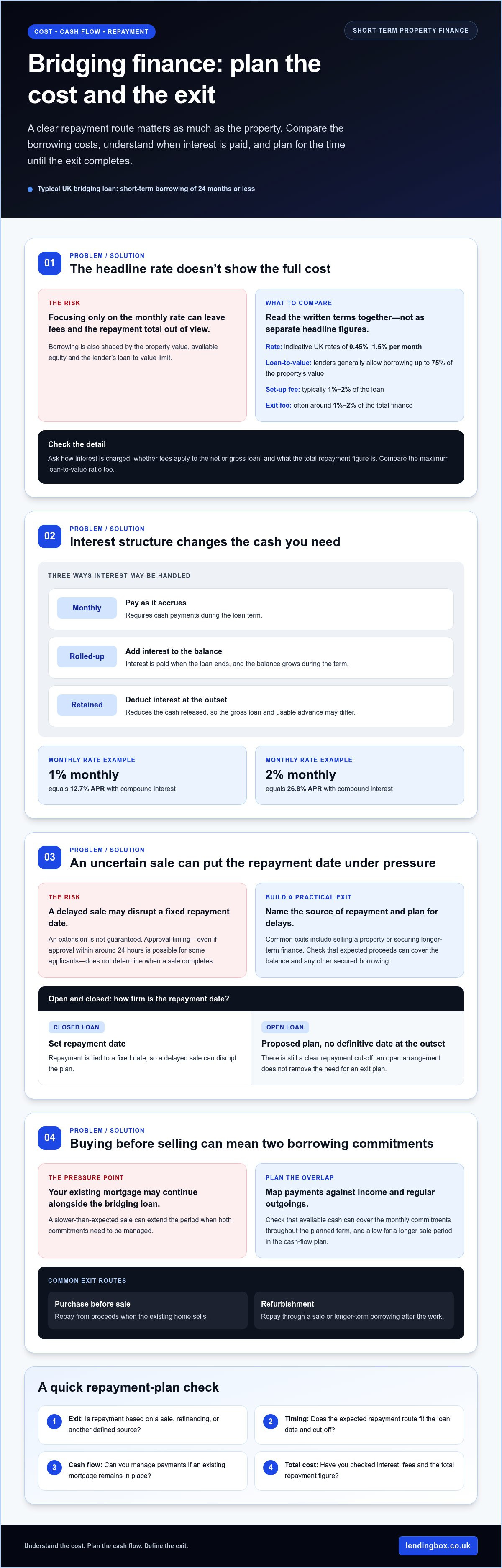
A loan-to-value ratio compares the amount borrowed with the property’s value, whilst the interest rate and fees determine borrowing costs. UK bridging loans typically have indicative rates of 0.45% to 1.5% per month, and lenders generally allow borrowing up to 75% of the property’s value. Set-up fees are typically 1% to 2% of the loan; exit fees are often around 1% to 2% of the total finance.
Compare written terms by checking the rate, how interest is charged, fees and the maximum loan-to-value ratio. Ask whether fees apply to the net or gross loan, then compare the total repayment figure. To check a broker’s authorisation, look for its status as authorised and regulated by the Financial Conduct Authority.
Monthly, rolled-up and retained interest
Monthly interest means paying interest as it accrues; rolled-up interest is added to the balance and paid when the loan ends; retained interest is deducted from the advance at the outset. These options change the cash needed during the loan and the amount available for the purchase. A 1% monthly rate equals 12.7% APR with compound interest; 2% monthly equals 26.8% APR.
Rates and payment arrangements affect the full cost, not just the amount received on completion. Monthly payments require funds during the term, while rolled-up interest increases the final balance. Retained interest reduces the cash released, so the gross loan and usable advance may differ.
Common uses in the UK
In the UK, buyers commonly use a bridging loan to buy before selling or to fund property refurbishment. A homeowner can use equity in their current property towards another purchase, then repay the loan after selling. Refurbishment borrowing can cover work before a property is sold or refinanced, with the exit plan based on the completed project.
International bridging finance can involve a UK borrower funding an overseas property, or using property abroad as security. The lender must assess the asset, its valuation and how security can be registered in the relevant country. Currency movements and cross-border legal processes can also affect the amount needed and the route to repayment.
Repayment while an existing mortgage remains
If you buy another property before selling your current one, you may temporarily carry two borrowing commitments. Plan for both payments and the bridging loan’s exit, not just the purchase date.
Loan amounts and repayment terms
A bridging loan is short-term borrowing secured against property, with the term and amount shaped by the security and repayment plan. Some lenders offer terms up to 24 months, but an extension isn’t guaranteed.
This short term differs from a conventional term loan and can create pressure if the sale takes longer than expected. For example, buying a new home before selling your existing one may mean paying the mortgage and bridging loan together. Check that your available cash can cover the monthly commitments throughout the planned term.
Exit strategies for repayment
An exit strategy is the defined source of funds used to repay the loan, such as selling a property or refinancing. It matters because the repayment date and expected proceeds need to align. A closed loan has a set repayment date; an open loan starts with a proposed plan and a clear cut-off, but no definitive date.
For a purchase before sale, the planned exit may be proceeds from selling the existing home. For refurbishment, it may be a sale or longer-term borrowing after the work. Set out what happens if the sale is delayed, and whether the expected proceeds will still cover the balance and any other secured borrowing.
Until the existing property sells, you may need to make payments on both the mortgage and bridging loan. Map those payments against income and regular outgoings, and allow for a longer sale period in your cash-flow plan. With rolled-up interest, the balance can grow during the term; monthly interest, by contrast, requires cash payments before the sale.
Open and closed terms affect how precisely you can schedule repayment. A closed loan ties repayment to a fixed date, so a delayed sale can disrupt the plan. An open loan allows a proposed exit without a fixed date at the outset, but still has a repayment cut-off. Neither removes the need to track the mortgage alongside the bridging balance.
Approval within around 24 hours may be possible for some applicants, but approval timing doesn’t determine when a sale completes. Keep the exit linked to a practical event, such as cleared sale proceeds or completed refinancing. This helps distinguish an expected repayment route from funds already available to repay the loan.
Bridging loan terms, security and loan-to-value
A bridging loan is short-term borrowing secured against property, also known as a bridge loan. The security and the lender’s valuation help determine the amount available and the terms offered.
Combined property value and loan limits
Combined property value means the total value of properties considered as security for one loan. It matters when a borrower offers more than one property, because lenders assess the security package rather than only the purchase property.
Some real-estate bridge lenders may lend up to 80% of the combined value of a borrower’s two properties. For example, a buyer using two properties as security needs to understand how the lender values both assets and calculates the borrowing limit. Existing borrowing secured against either property also affects the equity available.
Borrowing limits and loan-to-value
Loan-to-value, or LTV, compares the loan with the value of the property used as security. UK bridging lenders generally allow borrowing up to 75% of a property’s value, although the final amount depends on the security and the transaction.
That broad span reflects different property values and deal structures, not a single standard limit. Compare the requested amount with the lender’s valuation and any existing secured debt, as these determine the remaining equity supporting the loan.
The property’s condition and use can also shape how lenders assess security. A straightforward residential property differs from a partially completed refurbishment or a building with a complex ownership structure. These details can affect valuation, legal review and the lender’s view of the exit plan.
For an application, borrowers typically provide details of the property, its value, existing finance and the proposed repayment route. The lender assesses the security and application before issuing terms. Valuation and legal work then help establish whether the charge can be completed against the asset.
A UK bridging loan process usually takes between 7 and 28 days. The timetable depends on the valuation, legal work, title issues and the complexity of the property or ownership structure. An uncomplicated purchase can move differently from a case involving several properties or unusual security.
Compare offers on the same basis: loan amount, property valuation, LTV, security required and exit plan. A smaller requested amount may leave more equity in the property, while additional security can change the calculation. Understand what each lender includes in its valuation and how existing borrowing affects the available funds.
What are bridging loans and how do they work?
A bridging loan provides short-term funding until permanent finance is arranged or an existing obligation is met. UK borrowers may encounter regulated or unregulated loans; according to the Financial Conduct Authority, MCOB 11 covers responsible-lending rules for regulated mortgage contracts, including many residential bridging scenarios.
Open and closed bridging loans
A closed bridging loan has a set repayment date, while an open loan has a proposed repayment plan and clear cut-off without a definitive date at the outset. That distinction matters when a property purchase or sale has an uncertain completion date. A fixed sale contract may support a closed loan; a planned sale without a completion date may suit an open structure.
Both types still need an exit strategy. Some UK lenders expect repayment on an open loan within one year, so an uncertain date doesn’t mean an unlimited term. Link the proposed exit to a practical event, such as cleared sale proceeds or longer-term finance, and allow for delays that could affect repayment.
Bridging loans and traditional loans
Bridging loans are designed for a temporary funding gap, while a traditional mortgage usually spreads borrowing over a longer period. UK mortgages typically run for 15-35 years, and mortgage applications generally take at least 6-8 weeks to complete. A bridge can address a time-sensitive purchase, but its short term requires a defined repayment route.
Consider alternatives before borrowing. A business term loan may suit a longer repayment period, while invoice finance can release funds against unpaid invoices. Asset finance may fit an equipment purchase. The right comparison depends on the use of funds, timing and repayment source, not just application speed.
Benefits, costs and risks
The main benefit is access to short-term funding when a property transaction or other obligation cannot wait for longer-term finance. That speed comes with higher interest rates and larger origination fees than traditional loans. Compare the total amount repayable, interest payment method and fees, rather than judging the borrowing by its headline rate alone.
Security creates a material risk. A bridging loan secured against a property puts that asset at risk if repayment fails; Together warns that a borrower’s home may be repossessed if they don’t keep up mortgage repayments. Include existing mortgage payments in your budget, then test whether the exit still works if a planned sale or refinance is delayed.
Loan types and UK protections
UK bridging loans can be regulated or unregulated, depending on the transaction and the property’s use. Regulated residential cases fall within mortgage-contract rules where applicable; MCOB 11 is the Financial Conduct Authority’s responsible-lending rules reference for regulated mortgage contracts.
That classification matters because protections and lender obligations differ by loan type. For a home purchase, the borrower’s intended use of the property helps determine whether mortgage-contract rules apply. A business or investment purchase may follow a different route. Identify the loan purpose and security clearly before comparing terms, then assess the repayment plan against the loan’s stated cut-off.
Credit history and eligibility
Credit history matters, but it isn’t the only part of a bridging loan assessment. UK applicants generally need to be at least 18 years old, and property lenders typically prefer excellent credit and low debt-to-income ratios. They also consider the security offered, available equity and the proposed repayment route. The practical test is whether the full transaction supports repayment.
A lender may review a borrower’s record of managing credit alongside current commitments. Missed payments or existing debts can affect how the application is viewed, but lenders also consider property value and equity. For example, a borrower with a strong property position still needs a workable exit strategy. Credit alone doesn’t explain the whole borrowing decision.
Prepare a clear picture of the transaction before applying. Set out the amount required, the property offered as security, any borrowing already secured against it, and the expected repayment source. For a purchase before sale, show how sale proceeds will cover the loan. For refurbishment, explain how the completed property supports the intended sale or refinancing.
Timing can sharpen the assessment. A property auction typically requires completion within 28 days, so the application, valuation, legal work and exit plan need to align with that deadline. A short timetable doesn’t remove the need to show how repayment will happen. If the expected sale is delayed, the borrower still has to meet the loan terms and any existing mortgage payments.
Interest rates also reflect the lender’s view of the overall risk. Credit history, equity, property condition and repayment route all help shape that view. A higher loan-to-value request leaves less equity between the borrowing and the property’s value. Consider whether a smaller advance or additional security would make the structure more workable.
For a business owner with a poor credit history, separate the immediate funding need from the longer-term borrowing plan. A business credit card or bad credit options may suit different business needs, but they aren’t interchangeable with a property-secured bridging loan. Match the finance to its purpose, security and repayment source.
Before proceeding, compare the lender’s criteria with your circumstances: credit record, existing commitments, security, equity and exit strategy. That gives you a focused basis for discussing suitable business finance options. Explore business finance options if your company needs a route that fits its credit position and funding purpose.
Lending Box: Business loan
Lending Box helps UK limited companies and LLPs compare business finance options, including business loans, when a short-term property loan may not fit the business need. Its platform analyses company data to provide eligibility insights without impacting credit scores. A dedicated relationship manager guides applicants through suitable options and handles the paperwork.
If the funding need relates to cash flow rather than property, invoice finance can release funds against unpaid invoices, while revenue-based finance links repayments to business revenue. Asset finance may suit a business equipment purchase. The right route depends on the purpose of the funds, the company’s circumstances and its repayment plan.
Explore your business finance options with Lending Box at lendingbox.co.uk.
Choose the funding route that fits the next move
Before pursuing bridging finance, define whether the pressure point is a property transaction or your company’s working capital. That distinction helps align the borrowing purpose, repayment source and business priorities. If the need is outside a property purchase, compare business finance routes designed for operating needs instead.
Lending Box offers business loans, revenue-based finance and invoice finance for UK businesses. These options address different funding needs: a business loan can support a planned expense, revenue-based finance links funding to business revenue, and invoice finance can help unlock cash tied up in unpaid invoices.
Set out what the funds need to achieve and how the business expects to repay them. Then discuss which route fits that purpose. Contact Lending Box about bridging finance and explore the business funding options that may suit your next step.
Frequently Asked Questions
What is Bridging Finance?
Bridging finance is short-term borrowing used to cover a temporary funding gap, commonly involving property or land. For example, a buyer can use it to complete a purchase before sale proceeds arrive. The loan is repaid through a planned exit, such as selling the property or arranging longer-term finance. Before committing, compare the repayment route with the transaction timetable and the cost of holding the loan.
How much can I borrow, and how much deposit will I need?
The amount depends on the property value, existing borrowing, equity and the lender’s loan-to-value limit. UK applicants typically need a deposit or equity of 20% to 40% of the property value. For example, if a property already has a mortgage, that debt reduces the equity available to support further borrowing. Work out the funds needed for the transaction alongside the equity left after existing secured lending.
How do you decide my interest rate?
Lenders assess the property offered as security, the amount borrowed against its value, the proposed loan term and the repayment plan. Credit history and existing commitments also contribute to the overall assessment. For instance, a clear sale route and substantial equity present a different risk profile from a high loan-to-value request with an uncertain exit. Compare the rate alongside fees and how interest will be paid.
What is a bridging mortgage?
A bridging mortgage is a short-term loan secured against property, with the property acting as security for repayment. It can help fund a purchase before another property sells or cover a temporary gap during a property project. The borrower still needs a repayment route, such as sale proceeds or refinancing. Check how the new secured borrowing interacts with any mortgage already registered against the property.
What is the period of time I have to pay the loan back?
A typical UK bridging loan term is between 1 and 12 months. Some lenders offer terms of up to 24 months, but extending a loan is not guaranteed. The term available for a regulated bridging loan can depend on the lender and the borrower’s circumstances. Match the term to the expected sale, refinancing or other repayment event, and allow for the practical steps required to complete that exit.
What is bridging finance in the UK and how does it work?
In the UK, it is short-term property or land funding that bridges a temporary gap until longer-term finance arrives or an existing obligation is met. The lender assesses the security and the repayment plan before releasing funds. At a property auction, buyers commonly arrange bridging finance to meet the 28-day completion deadline. The sale or refinancing plan then provides the intended route to repay the loan.
What are typical UK bridging loan interest rates, fees and total costs?
UK bridging loans typically have indicative interest rates of 0.45% to 1.5% per month. Set-up fees are typically 1% to 2% of the loan amount, while exit fees are often around 1% to 2% of the total finance. Total cost also depends on the interest payment method and any other charges in the offer. Compare the full repayment amount, not just the monthly rate.
How much can you borrow with a UK bridging loan and what loan-to-value ratios apply?
Loan-to-value compares the loan with the property value used as security. Existing mortgages reduce the available equity, so the maximum headline ratio does not determine how much a borrower can raise. Lenders assess valuation, security and the proposed repayment route together.
Frequently Asked Questions
Bridging finance is short-term borrowing used to cover a temporary funding gap, commonly involving property or land. For example, a buyer can use it to complete a purchase before sale proceeds arrive. The loan is repaid through a planned exit, such as selling the property or arranging longer-term finance. Before committing, compare the repayment route with the transaction timetable and the cost of holding the loan.
The amount depends on the property value, existing borrowing, equity and the lender’s loan-to-value limit. UK applicants typically need a deposit or equity of 20% to 40% of the property value. For example, if a property already has a mortgage, that debt reduces the equity available to support further borrowing. Work out the funds needed for the transaction alongside the equity left after existing secured lending.
Lenders assess the property offered as security, the amount borrowed against its value, the proposed loan term and the repayment plan. Credit history and existing commitments also contribute to the overall assessment. For instance, a clear sale route and substantial equity present a different risk profile from a high loan-to-value request with an uncertain exit. Compare the rate alongside fees and how interest will be paid.
A bridging mortgage is a short-term loan secured against property, with the property acting as security for repayment. It can help fund a purchase before another property sells or cover a temporary gap during a property project. The borrower still needs a repayment route, such as sale proceeds or refinancing. Check how the new secured borrowing interacts with any mortgage already registered against the property.
A typical UK bridging loan term is between 1 and 12 months. Some lenders offer terms of up to 24 months, but extending a loan is not guaranteed. The term available for a regulated bridging loan can depend on the lender and the borrower’s circumstances. Match the term to the expected sale, refinancing or other repayment event, and allow for the practical steps required to complete that exit.
In the UK, it is short-term property or land funding that bridges a temporary gap until longer-term finance arrives or an existing obligation is met. The lender assesses the security and the repayment plan before releasing funds. At a property auction, buyers commonly arrange bridging finance to meet the 28-day completion deadline. The sale or refinancing plan then provides the intended route to repay the loan.
UK bridging loans typically have indicative interest rates of 0.45% to 1.5% per month. Set-up fees are typically 1% to 2% of the loan amount, while exit fees are often around 1% to 2% of the total finance. Total cost also depends on the interest payment method and any other charges in the offer. Compare the full repayment amount, not just the monthly rate.
Loan-to-value compares the loan with the property value used as security. Existing mortgages reduce the available equity, so the maximum headline ratio does not determine how much a borrower can raise. Lenders assess valuation, security and the proposed repayment route together.