
Growth Guarantee Scheme eligibility and facility limits for UK businesses
22 October 2026 · 15 min read

You can apply for finance through the growth guarantee scheme if your UK business meets the eligibility rules and applies through an accredited lender. The scheme guarantees 70% of the outstanding facility balance to the lender after its normal recovery process, but borrowers remain 100% liable for the debt. Facility limits depend on the type of finance and your business group.
It’s understandable to want clear answers before preparing an application. Government backing through the Growth Guarantee Scheme does not remove your repayment obligations, and funding depends on accredited lenders and the facilities they offer.
This guide explains who may qualify, how the guarantee works and what the facility limits mean in practice. You’ll also find out which documents to prepare and how the scheme’s availability affects your next steps, so you can assess whether it fits your business’s funding needs.
Key Takeaways
- Assess eligibility against the trading-income and business viability rules before preparing an application.
- Match the facility type to your funding need, then check the relevant minimum, maximum and repayment term.
- Prepare three years’ worth of historic accounts and allow for the lender’s standard credit and fraud checks.
- Apply through an accredited lender, bearing in mind that not every lender provides every type of finance.
- Compare suitable funding routes, including business loans, revenue-based finance, invoice finance and asset finance.
How does the government-backed guarantee work?
The Growth Guarantee Scheme launched in July 2024 as the successor to the Recovery Loan Scheme. It is designed to support UK businesses seeking finance through accredited lenders. The British Business Bank administers the scheme on behalf of the Secretary of State for Business and Trade. Businesses apply to a participating lender, not to the British Business Bank directly.
The guarantee covers 70% of the outstanding facility balance for the lender, after it completes its normal recovery process. It helps lenders manage part of their risk when providing eligible business finance. It does not mean the government lends directly to a business, nor does it remove the borrower’s repayment obligations. The facility must be used for business purposes.
To be eligible, a business must be trading in the UK and generate more than 50% of its turnover from trading activity. A business must also be viable. The lender assesses its circumstances and whether it can support the proposed borrowing.
In practical terms, review the following before applying:
- Trading income: check what share of turnover comes from trading activity. Charities and Further Education colleges are exempt from this criterion for facilities offered after 9 March 2023.
- Business type: banks, building societies, insurers and reinsurers, except insurance brokers, are ineligible. Public sector bodies and state-funded primary and secondary schools are also ineligible.
- Previous scheme conduct: a business that breached rules under previous Government Lending Schemes does not meet the application criteria.
- Viability: prepare to show the lender how the business operates and can meet its commitments. The guarantee does not replace this assessment.
Insolvency proceedings require careful consideration alongside the viability test. The scheme requires a viable business, so applicants should understand how their financial position affects the lender’s assessment. The guarantee does not replace a credible repayment case.
The lender also decides whether the requested finance suits the business’s purpose and circumstances. Facilities can include term loans, overdrafts, asset finance, invoice finance and asset-based lending, although not every accredited lender offers each type. Define the funding need first, then apply through a lender offering the relevant facility. This keeps the application focused on a clear business requirement.
Those organisations are excluded from the Growth Guarantee Scheme and cannot access its guaranteed business finance facilities through participating lenders.
Government guarantee and borrower liability
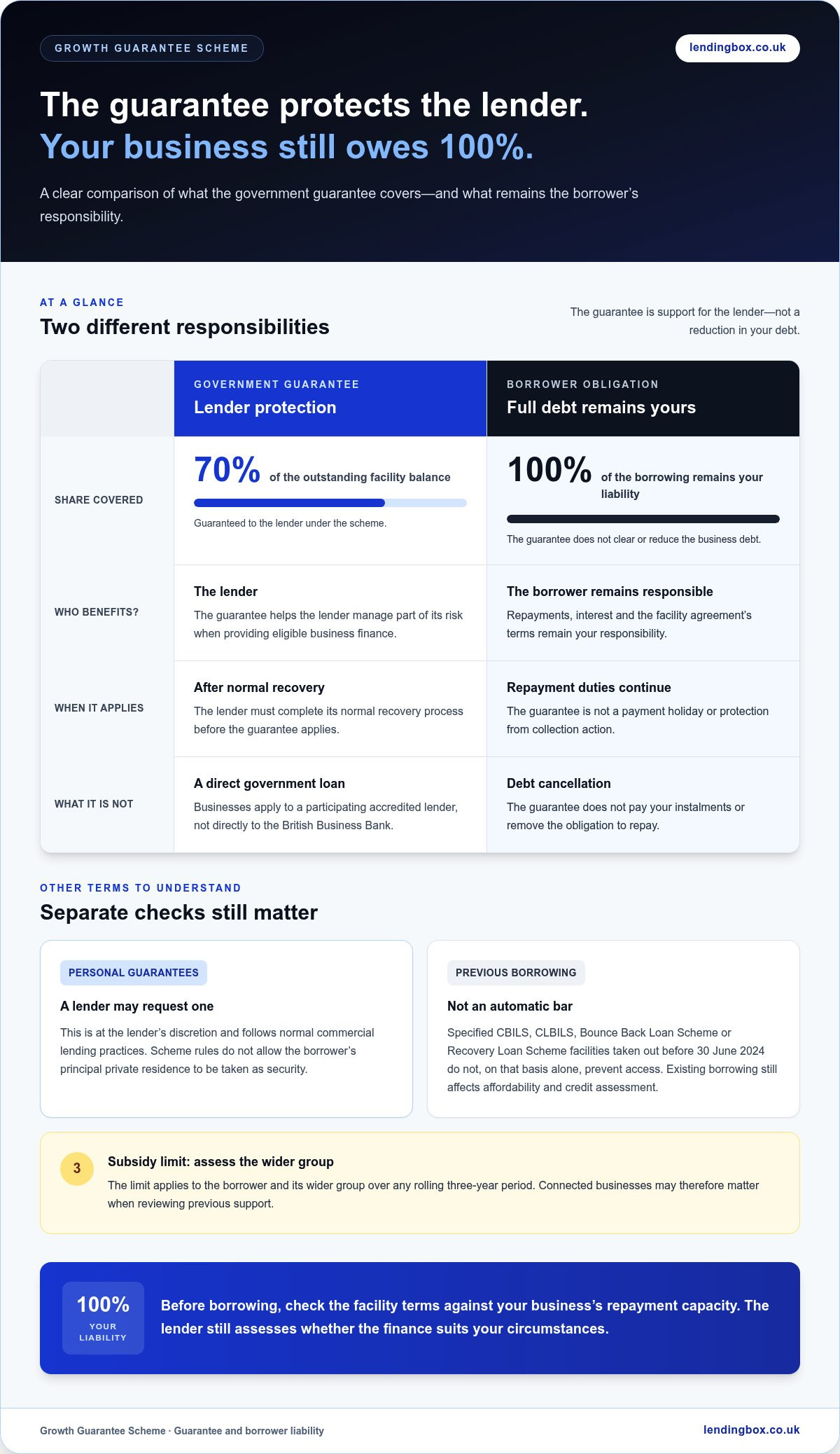
The government-backed guarantee protects the lender, not the borrower. For a Growth Guarantee Scheme facility, the government guarantees 70% of the outstanding balance after the lender completes its normal recovery process. That support may reduce some risk for the lender when making a lending decision. It does not pay your instalments or clear your business debt.
Your business remains 100% liable for the borrowing. Repayments, interest and the terms in your facility agreement remain your responsibility. If the business cannot meet repayments, the lender follows its usual recovery process. The government guarantee applies only after that process, so it is not a payment holiday, debt reduction or protection from collection action.
Personal guarantees are a separate consideration. A lender may request one at its discretion, in line with normal commercial lending practices. However, scheme rules do not allow the lender to take the borrower’s principal private residence as security. Read the facility and guarantee documents carefully to understand which obligations belong to the business and which, if any, apply personally.
Earlier government-backed borrowing does not automatically prevent a new application. Businesses that took out specified Coronavirus Business Interruption Loan Scheme, Coronavirus Large Business Interruption Loan Scheme, Bounce Back Loan Scheme or Recovery Loan Scheme facilities before 30 June 2024 are not barred from accessing this scheme on that basis alone. Existing borrowing still matters to affordability and the lender’s credit assessment.
A subsidy limit also applies. It covers the borrower and its wider group over any rolling three-year period. When reviewing previous support, consider connected businesses as well as the applicant company. This helps establish whether group-level subsidy use may affect the support available.
Before applying, organise your information into three parts:
- Existing facilities: list government-backed loans and other borrowing held by the business and wider group.
- Repayment position: record current commitments and explain how the proposed facility would be repaid.
- Security and guarantees: identify any existing security and read the proposed terms for personal obligations.
Previous support provides context, but it does not replace the lender’s assessment of a new application. The distinction is clear: the guarantee is given to the lender on the government’s behalf, while the borrower remains responsible for the full debt. Check the facility terms against your business’s repayment capacity before proceeding.
Facility limits
The amount available depends on the facility type and the borrower’s business group. Borrowers within the scope of the Northern Ireland Protocol face a maximum of £1m per business group, or another amount notified to the lender under the relevant legal agreements. These are group limits, not separate allowances for each company.
All listed facility types have a minimum term of three months. These thresholds help narrow down the finance options that suit the funding need and amount required.
Terms vary by facility. Asset finance facilities can also run for up to ten years under the announced enhancements. Earlier term limits differ, so focus on the current facility terms when comparing an offer.
Overdraft, invoice finance and asset-based lending facilities are available from three months up to three years. For invoice finance, this limit applies to the facility itself, while the amount advanced depends on eligible invoices and the lender’s assessment. A suitable facility amount should reflect the working capital gap, not simply the highest limit available.
Compare the main limits before choosing a facility:
- Working-capital facility duration: three months to three years for overdrafts, invoice finance and asset-based lending.
These limits are separate from the subsidy limit, which applies to the borrower and wider group over any rolling three-year period. A maximum facility amount does not mean a business will receive that amount. The lender assesses the application and proposed repayments. When planning finance, calculate the amount needed, identify the facility type, then compare its minimum and maximum amounts and repayment term. Don’t assume limits from the former Recovery Loan Scheme apply to a current application.
Application documents
Prepare the core financial evidence before approaching an accredited lender. The key documented requirement is three years’ worth of historic accounts.
Required application documents
Set aside the business’s historic accounts covering three years. Keep the records complete and organised by financial period so the lender can follow trading performance over time. Accounts are the stated document requirement; additional paperwork is not a universal scheme rule. The lender assesses the application and may explain what further information would support its review.
Make the application easy to follow by separating evidence from explanations. Keep the accounts together, for example, and prepare a short note describing the funding purpose and amount sought. This connects the figures to the business need, whether the company plans to manage cash flow or invest in growth.
- Historic accounts: arrange three years’ worth in chronological order.
- Funding purpose: write a clear explanation of how the business will use the facility.
- Amount requested: show how the requested finance relates to that purpose.
- Previous support: organise details of relevant government loan scheme support for the application discussion.
These steps help present a coherent case for finance. They are practical ways to organise information, not a separate fixed document list.
Application requirements and credit checks
Growth Guarantee Scheme lending is subject to the lender’s standard credit and fraud checks. The guarantee does not replace those checks or make approval automatic. The lender reviews the business and proposed borrowing through its usual assessment process, including whether the facility fits the company’s circumstances.
Use the three years of accounts to check that the figures tell a consistent story. If the business has received earlier government support, organise those details alongside its current borrowing. The scheme’s subsidy limit applies to the borrower and its wider group over a rolling three-year period, so relevant records help establish how much subsidy has already been used.
The British Business Bank administers the scheme on behalf of the Secretary of State for Business and Trade. That administration does not make the Secretary of State the applicant’s lender. Submit the application and its supporting information through an accredited lender, which conducts the checks and assesses the request.
Before submitting, use this simple sequence:
- Gather the three years of historic accounts.
- Set out the business purpose and requested amount clearly.
- Organise relevant information on existing borrowing and previous scheme support.
- Review the application for consistent figures and complete answers before the lender’s checks begin.
A clear file helps the lender assess the application efficiently. Keep the accounts, funding explanation and details of previous support aligned, so each part supports the same business case.
Growth Guarantee Scheme availability
Which lenders offer finance through the Growth Guarantee Scheme? UK businesses apply through accredited lenders. Not every accredited lender offers every facility type, so availability depends on both the lender and the finance required.
What can Growth Guarantee Scheme funding be used for? Borrowing must serve a business purpose. It can support an operational need or help a business invest and grow through a suitable facility, such as a term loan, overdraft, asset finance, invoice finance or asset-based lending.
Eligible UK businesses can access the scheme through its accredited lender network. This provides a route to government-backed finance, but it is not one standard product offered by every lender. One lender may offer invoice finance, for example, while another offers asset finance. Start by defining the business need, then identify an accredited lender offering a suitable facility.
Access depends on meeting the scheme criteria and the lender’s own assessment. The guarantee supports lending decisions, but does not require approval of every application. Consider the funding purpose, repayment structure and business group together. The right facility depends on how the business will use the finance and manage repayments.
Capacity is changing. On 12 July 2026, the Chancellor announced an increase intended to unlock £6.5bn of market lending over the next four years. The increase is expected to help an estimated 33,000 UK businesses. This expands the intended capacity of the Growth Guarantee Scheme, while applications still go through accredited lenders.
To assess availability for your business, work through these practical steps:
- Define the requirement: decide whether the business needs a term loan, overdraft, asset finance, invoice finance or asset-based lending.
- Identify the borrower: include the applicant and its wider business group when setting out the funding need.
- Match the lender: focus on accredited lenders that offer the facility type required.
- Explain the purpose: show how the finance will support business activity or planned investment.
This distinction separates eligibility for the scheme from access to a particular facility. An eligible borrower may find that an accredited lender does not offer the finance type it needs. Businesses planning to invest and grow should match their purpose to the lender’s available options, rather than assume every accredited lender offers the same facilities.
To compare finance routes for your business need, explore suitable finance options.
Finance is available through lenders accredited to the scheme, but their offerings vary by facility type.
Lending Box: Business loan
Lending Box helps UK limited companies and LLPs compare business finance options. If you’re assessing the Growth Guarantee Scheme, Lending Box can help you explore whether a business loan, revenue-based finance, invoice finance or asset finance fits your funding need.
The platform analyses company data to provide eligibility insights without impacting credit scores. A dedicated relationship manager guides you through the options and handles the paperwork. This support can help you compare the Growth Guarantee Scheme with other business finance routes and organise your application.
Lending Box is a broker, not a direct lender, and eligibility insights are not loan approval. Contact Lending Box to discuss your business finance options.
Make your next funding decision with clarity
Start with the outcome your business needs to achieve. Then decide whether the Growth Guarantee Scheme aligns with that plan or another type of finance better suits your priorities and cash flow.
Lending Box offers business loans, revenue-based finance and invoice finance. If you’re weighing the Growth Guarantee Scheme against other routes, compare how each option supports your intended use of funds and business plans.
Explore your business finance options with Lending Box. Take the next step when you’re ready, with a clearer view of the route that fits your needs.
Frequently Asked Questions
Can I apply?
You may apply if your UK business meets the scheme’s eligibility criteria and can present a viable borrowing case. For example, a trading company seeking finance for business activity may meet the trading-income test if more than 50% of its turnover comes from trading. Eligibility alone does not settle the application: the lender also assesses the business, its credit position and the proposed facility.
What is the Growth Guarantee Scheme?
The growth guarantee scheme is a government-backed programme that helps eligible UK businesses access finance through accredited lenders. It covers part of a lender’s outstanding facility balance after the lender completes its normal recovery process. Businesses still owe the full debt. Facilities can include term loans, overdrafts, asset finance, invoice finance and asset-based lending, depending on what the accredited lender offers.
What is the UK Growth Guarantee Scheme?
It is the UK government’s successor to the Recovery Loan Scheme, launched in July 2024. The British Business Bank administers the programme on behalf of the Secretary of State for Business and Trade. Businesses apply through accredited lenders rather than applying directly to the British Business Bank. The scheme supports access to business finance, while lenders assess applications and set facility terms.
Who is eligible for the Growth Guarantee Scheme?
Applicants must be UK businesses that meet the scheme’s trading and viability criteria. A business generally needs to generate more than 50% of its turnover from trading activity. Charities and Further Education colleges are exempt from the trading-income criterion for facilities offered after 9 March 2023.
Which types of businesses and sectors are excluded?
Banks, building societies, insurers and reinsurers are excluded, except insurance brokers. Public sector bodies and state-funded primary and secondary schools are also ineligible. A business that breached rules under previous Government Lending Schemes does not meet the application criteria. Check the applicant’s legal and trading structure, especially if it operates within a group, before preparing an application.
How much can a business borrow under the scheme?
Relevant borrowers within its scope face a maximum of £1m per group, or another amount notified to the lender under the relevant legal agreements.
What are the interest rates, fees and repayment terms?
Interest rates and fees depend on the lender’s offer and the application, so compare the full repayment cost and conditions before accepting a facility. Overdraft, invoice finance and asset-based lending can run from three months up to three years.
How do businesses apply for a Growth Guarantee Scheme loan?
Apply through an accredited lender offering the type of finance your business needs. Prepare three years’ worth of historic accounts, explain the business purpose and requested amount, then complete the lender’s application. The lender carries out its standard credit and fraud checks. For example, a business buying equipment should explain how the asset supports its operations and how repayments fit its finances.
Frequently Asked Questions
You may apply if your UK business meets the scheme’s eligibility criteria and can present a viable borrowing case. For example, a trading company seeking finance for business activity may meet the trading-income test if more than 50% of its turnover comes from trading. Eligibility alone does not settle the application: the lender also assesses the business, its credit position and the proposed facility.
The growth guarantee scheme is a government-backed programme that helps eligible UK businesses access finance through accredited lenders. It covers part of a lender’s outstanding facility balance after the lender completes its normal recovery process. Businesses still owe the full debt. Facilities can include term loans, overdrafts, asset finance, invoice finance and asset-based lending, depending on what the accredited lender offers.
It is the UK government’s successor to the Recovery Loan Scheme, launched in July 2024. The British Business Bank administers the programme on behalf of the Secretary of State for Business and Trade. Businesses apply through accredited lenders rather than applying directly to the British Business Bank. The scheme supports access to business finance, while lenders assess applications and set facility terms.
Applicants must be UK businesses that meet the scheme’s trading and viability criteria. A business generally needs to generate more than 50% of its turnover from trading activity. Charities and Further Education colleges are exempt from the trading-income criterion for facilities offered after 9 March 2023.
Banks, building societies, insurers and reinsurers are excluded, except insurance brokers. Public sector bodies and state-funded primary and secondary schools are also ineligible. A business that breached rules under previous Government Lending Schemes does not meet the application criteria. Check the applicant’s legal and trading structure, especially if it operates within a group, before preparing an application.
Relevant borrowers within its scope face a maximum of £1m per group, or another amount notified to the lender under the relevant legal agreements.
Interest rates and fees depend on the lender’s offer and the application, so compare the full repayment cost and conditions before accepting a facility. Overdraft, invoice finance and asset-based lending can run from three months up to three years.
Apply through an accredited lender offering the type of finance your business needs. Prepare three years’ worth of historic accounts, explain the business purpose and requested amount, then complete the lender’s application. The lender carries out its standard credit and fraud checks. For example, a business buying equipment should explain how the asset supports its operations and how repayments fit its finances.