Business funding application help for UK businesses
19 November 2026 · 11 min read

 Business funding
The best business finance option isn’t always the one with the lowest headline rate. The right choice depends on what the money is for, how your business earns revenue and what repayments it can manage. Good business funding application help makes these factors clear before you apply.
Applying online can feel straightforward, but choosing the wrong type of finance or submitting incomplete information can slow the process. You’ll want to understand what details lenders assess, how an application may affect credit scores and what can influence the time it takes to receive a decision and funding.
This guide explains how to prepare an online application, compare business loans with other funding options and assess affordability. It also covers credit searches and funding timelines, so you can approach the decision with a clearer view of the next steps.
Key Takeaways
- Understand how credit checks can affect your application, and why eligibility checks may work differently from a full loan application.
- See how professional support can help match an online application to your business’s funding needs and prepare the required paperwork.
- Learn what can shape a funding decision and timeline, including the finance type and the information needed to assess your application.
- Compare the role of business loans with other funding routes, and note that the European Commission lists 25 February 2027 as the European Innovation Council Pathfinder 2027 Open stage 1 deadline.
Will applying for a business loan affect my credit score?
For UK limited companies and LLPs, Lending Box’s initial matching process has no impact on your credit score. A credit search only happens at full application, and only with your agreement. Lenders may assess the business’s financial position and, where relevant, directors’ credit as part of their application process. Check that proposed repayments fit your business’s cash flow forecast.
UK businesses can consider business loans, revenue-based finance, invoice finance, asset finance, grants and equity finance. A business loan provides capital that must be repaid with interest; grants do not need repayment but usually restrict how funds are used. For example, equity investors provide money in return for a share of ownership.
A professional can assess the funding purpose, explain suitable options and prepare a loan or grant application. For a grant, local business support can help identify opportunities in the business’s area. The European Commission lists 25 February 2027 as the European Innovation Council Pathfinder 2027 Open stage 1 deadline. Grant applications may take time and attract competition, so application timing matters.
For a UK-based application, support can be handled by phone or email, depending on the service. The professional can guide the process, explain requests from funders and organise paperwork. Typical application documents may include company accounts, recent bank statements, management figures, identification and a clear funding plan. The exact documents depend on the finance type and the business’s circumstances.
Support can improve an application’s clarity by matching the funding request to the business’s purpose, presenting figures consistently and addressing likely lender questions. It cannot make a lender accept an application. Before using a broker or paying for application help, understand any fee, what work it covers and whether the broker explains how options are selected. Poorly matched applications can waste time; unclear charges can add avoidable cost.
Applying for business finance online with professional support
Professional support can organise an online application around its purpose, the business’s finances and the funding route. A relationship manager can also help keep requests and paperwork organised as the application progresses.
Government-backed finance
Government-backed finance may be one route for businesses seeking funds to support investment and growth. It remains borrowing, so the application needs to explain what the funds will support and how repayments fit the business’s plans. A professional can help present those details clearly and distinguish scheme-backed finance from grants, which have their own conditions and application process.
Grant and loan eligibility
Eligibility differs by scheme and lender. A grant may be restricted by location, business activity or the project it is intended to support. There are hundreds of government grants for small businesses across the UK, so support can help identify relevant opportunities and organise an application around each funder’s criteria. Loan providers assess the business against their own lending requirements.
Good business funding application help brings the application together in a clear sequence. A relationship manager can organise company information, clarify how the requested capital will be used and guide you through follow-up questions. For example, if forecast figures have changed, providing context helps a lender assess affordability. Clear, consistent answers keep the application focused without promising approval.
Other finance routes serve different purposes. Peer-to-peer finance connects businesses seeking funding with investors. Equity finance can involve sharing ownership with investors. Asset finance can support equipment or vehicle purchases, linking funding to the asset. Compare repayment commitments, ownership implications and how each option fits cash flow.
Choosing business funding application help can make the options and paperwork easier to assess; business finance application support can help clarify how a funding route fits your purpose.
Application decision and funding timelines
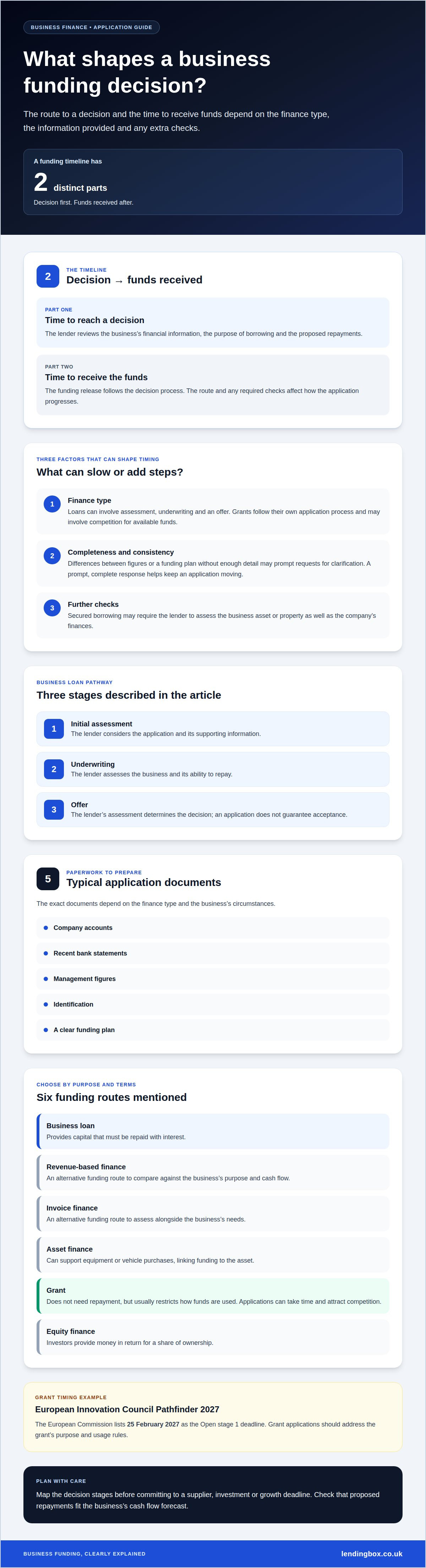
A funding timeline has two parts: the time to reach a decision and the time to receive funds. Both depend on the finance type, the completeness of the application and any further checks. A lender may review the business’s financial information, the purpose of borrowing and proposed repayments before deciding.
For a business loan, the process can involve an initial assessment, underwriting and an offer. The lender may request clarification if figures differ across documents or the funding plan lacks detail. A prompt, complete response helps keep the application moving, but the lender’s assessment still determines the decision.
Security can add steps. If a loan is secured against a business asset or property, the lender may need to assess that security before making an offer. For example, a property-backed application can involve checks on the property as well as the company’s finances. Those checks affect the route to a decision and release of funds.
The Growth Guarantee Scheme supports small UK businesses that want to invest and grow. A scheme-backed application still requires the lender to assess the business and its ability to repay. The scheme does not remove underwriting, so the finance purpose, financial position and proposed repayments remain relevant to the decision.
Grant applications follow a different timetable. Grant funding can involve a lengthy application process and competition for available funds. A complete submission must address the grant’s purpose and usage rules. Applicants may also need to report how they used the money, which adds work after a successful decision.
To plan responsibly, map the decision stages before committing to a supplier, investment or growth deadline. Identify which figures or documents may need updating, and allow time for questions about security or cash flow. Treat a preliminary indication as a step in the process, not as approval or confirmation that funds are ready to transfer.
Business loans
A business loan is debt finance: the business borrows capital and repays it over time with interest. Indicative only. Subject to lender assessment and approval. Loan amounts, terms, rates and fees vary by product and lender, so compare the total cost and repayment schedule rather than relying on a headline rate alone.
Start by matching the loan to a specific need. A business buying stock before a busy trading period may need a different repayment structure from one funding equipment for long-term use. Consider the amount, repayment frequency and term against expected cash flow, including quieter trading periods and existing commitments.
Before applying, review the offer’s full cost. Check whether it includes arrangement or administration fees, how interest is charged, when repayments begin and whether early repayment changes the cost. A lower headline rate may not mean lower total borrowing costs if fees or the repayment period differ.
Some business loans require security. If an asset is registered as security, it may be at risk if repayments aren’t maintained. For example, a lender could require a business asset to support borrowing. Consider the consequences alongside the loan’s purpose, repayment schedule and the company’s ability to meet payments from trading income.
Use a cash flow forecast to test affordability before accepting an offer. Include proposed repayments alongside wages, supplier invoices, tax obligations and other borrowing. If the forecast shows pressure in a particular month, consider whether a different amount or finance type better fits the business. A clear funding purpose also helps explain how the capital supports business activity or growth.
Compare offers on consistent terms: amount borrowed, total repayable, payment frequency, fees and any security requirement. This makes differences easier to see and helps you choose finance that works towards a defined business objective. Explore business loan options with support for comparing suitable finance routes.
Indicative only. Subject to lender assessment and approval. Loan rates, repayment periods and fees vary by lender and offer. Check how interest is charged, when repayments start and whether paying early affects the total cost.
Lending Box
Lending Box helps active UK limited companies and LLPs registered at Companies House explore business finance options and move through the application process. The initial matching process has no impact on your credit score. One named relationship manager guides you from shortlist to drawdown and handles the paperwork. There are no long forms before you see anything useful.
This support can help when you’re weighing different funding needs, such as an unsecured business loan, revenue-based finance, invoice finance or asset finance. The right route depends on how your business operates, what the capital is for and how repayments fit cash flow. Lending Box matches businesses with options from across the market; it does not lend directly or guarantee approval.
If you’d like professional support with your business finance application, contact Lending Box to discuss your requirements.
Choose your next funding step with confidence
Your next step is to turn a funding need into a clear decision. Set out what the money will support, how it fits your business plans and what repayment level your cash flow can carry. This gives an application a practical starting point and helps keep its purpose and affordability clear.
Professional business funding application help can make it easier to assess suitable routes and prepare for the next stage. Lending Box supports businesses exploring business loans, revenue-based finance, invoice finance and asset finance. The right option depends on your business’s circumstances and funding purpose.
Start a conversation when you’re ready to discuss your requirements and the application process. Contact Lending Box for application help, and take the next step with a clearer view of your funding choices.
Frequently Asked Questions
How long does it take?
Timing depends on whether you mean a decision, accepting an offer or receiving funds. These are separate stages. After a decision, review the offer and complete any remaining lender requirements before relying on the money. If funding supports a purchase or project, plan around the expected availability of funds, not simply the date you submit an application.
How long does a business funding application take in the UK?
There’s no single UK turnaround across loans, grants and other finance. A lender assesses the application and any required security; grant funders follow their own process, with applications facing competition for funds. Allow for preparation, assessment and transfer as distinct stages. For a purchase with a fixed deadline, build these stages into the plan rather than treating submission as confirmation that funding is ready.
How do business loans, grants, overdrafts and equity funding compare?
A loan provides capital that the business repays with interest. A grant doesn’t need repayment, but its rules can restrict how the money is used. An overdraft provides borrowing through a business bank account and can help manage short-term cash flow; its charges depend on the account terms. Equity brings investment in exchange for ownership, so consider the effect on control as well as funding.
Where can I get free business funding application support in the UK?
Local business support services can help you find grants in your area. For finance applications, Lending Box’s service is free to the business; it receives commission or a finder’s fee from lenders. Lending Box supports active UK limited companies and LLPs registered at Companies House. There’s no obligation at any stage, so you can explore the process before deciding whether to proceed.
Frequently Asked Questions
Timing depends on whether you mean a decision, accepting an offer or receiving funds. These are separate stages. After a decision, review the offer and complete any remaining lender requirements before relying on the money. If funding supports a purchase or project, plan around the expected availability of funds, not simply the date you submit an application.
There’s no single UK turnaround across loans, grants and other finance. A lender assesses the application and any required security; grant funders follow their own process, with applications facing competition for funds. Allow for preparation, assessment and transfer as distinct stages. For a purchase with a fixed deadline, build these stages into the plan rather than treating submission as confirmation that funding is ready.
A loan provides capital that the business repays with interest. A grant doesn’t need repayment, but its rules can restrict how the money is used. An overdraft provides borrowing through a business bank account and can help manage short-term cash flow; its charges depend on the account terms. Equity brings investment in exchange for ownership, so consider the effect on control as well as funding.
Local business support services can help you find grants in your area. For finance applications, Lending Box’s service is free to the business; it receives commission or a finder’s fee from lenders. Lending Box supports active UK limited companies and LLPs registered at Companies House. There’s no obligation at any stage, so you can explore the process before deciding whether to proceed.