Small business funding options in the UK and repayment risks
16 November 2026 · 10 min read

 Finance insights
Starting a business with little or no money doesn’t have to mean taking on a loan. Small business funding options in the UK include grants, self-funding, start-up loans and equity finance. Grants don’t have to be repaid, while borrowing may involve interest and regular repayments. The right route depends on what the business needs and can afford.
It’s sensible to weigh the risks. Personal savings and assets may be at risk if the business struggles, while equity finance means giving investors a share of ownership. Each option has different trade-offs, so understand the terms before committing.
This guide explains how common UK funding routes work, what repayments may involve and how to approach starting with little or no money. It also covers business loans, revenue-based finance, invoice finance and asset finance, so you can identify a practical next step for the business.
Key Takeaways
- Identify repayment and security risks to weigh before choosing a funding route.
- Explore practical ways to get a business started with little or no money, including grants and start-up finance.
- See how different funding options suit different needs, including routes to consider if your business has bad credit.
Growth Guarantee Scheme loans
UK businesses can consider loans, grants, start-up finance and equity investment.
Funding application documents and steps a broker can handle
A broker can organise application paperwork, explain funding routes and coordinate with a lender. Useful preparation includes a business plan, funding proposal and cashflow forecast. These should set out how much finance is needed, what it will fund and how repayments could fit expected income. Clear projections help lenders assess the application and the business’s plans.
Present the business’s finances and the purpose of the funding clearly and consistently. Link the proposed borrowing to the business plan, rather than treating the loan amount as a standalone figure.
Regional scheme availability
Some funding schemes are available nationally, while others are restricted by region, local authority or devolved nation. Eligibility may depend on where the business operates, its sector and the project it plans to fund. Check a scheme’s location rules and applicant criteria before spending time on an application.
Grant amounts and scheme sizes differ. These examples fund specific purposes, not unrestricted cash needs.
Grants don’t have to be repaid, but conditions can restrict spending and require reporting. A grant application typically needs a business plan, funding proposal and cashflow forecast. A Growth Guarantee Scheme loan is different: the guarantee supports the participating lender, while the business remains responsible for repaying the borrowing. Compare each scheme’s purpose, eligibility and repayment obligations before choosing a route.
Risks and repayment considerations
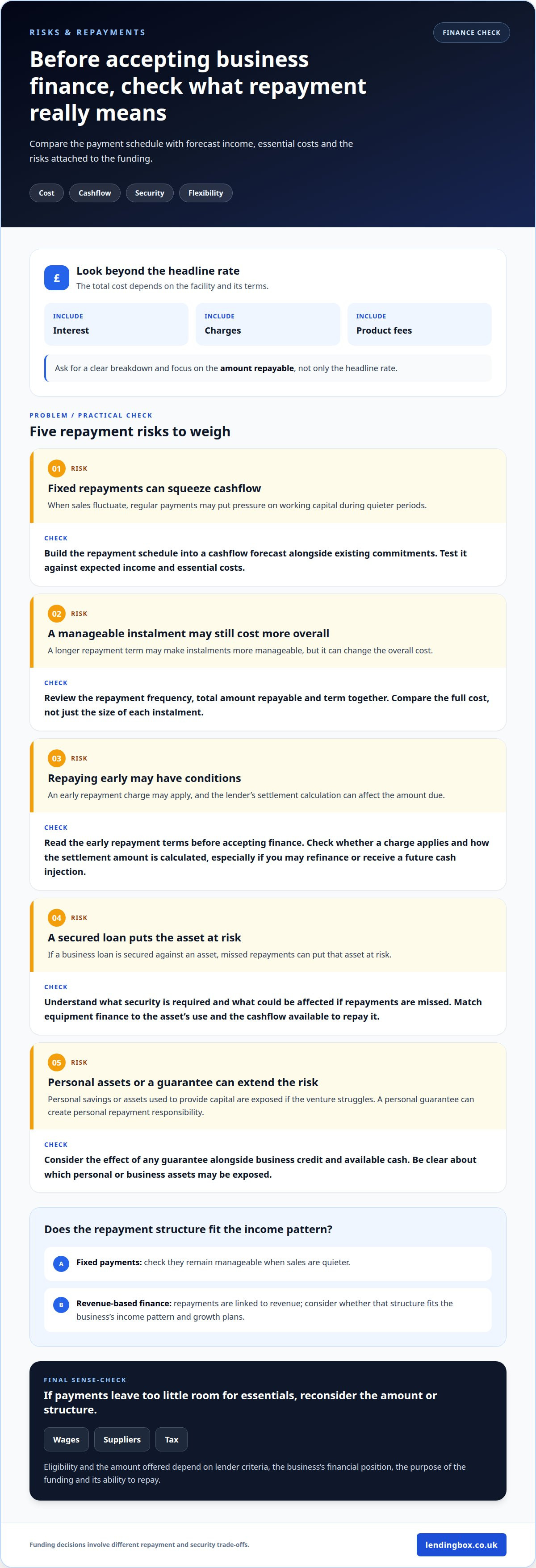
Business finance eligibility depends on lender criteria, the business’s financial position, the purpose of the funding and its ability to repay. Borrowing costs can include interest and charges, and product fees may also apply.
Loan amounts and repayment terms
The amount a lender offers depends on the business’s needs and its ability to manage repayments. For example, finance for equipment should match the asset’s use and the cashflow available to repay it. Review the repayment frequency, total amount repayable and term together.
Build repayments into a cashflow forecast alongside existing commitments. If sales fluctuate, fixed payments can put pressure on working capital during quieter periods. Revenue-based finance has repayments linked to revenue, so consider whether that structure fits the business’s income pattern and growth plans.
Fees and early repayment
Before accepting finance, ask for a clear breakdown of interest, charges and any product fees. The total cost depends on the facility and its terms, so focus on the amount repayable, not only the headline rate. A longer repayment term may make instalments more manageable but can change the overall cost.
If you may repay early, read the agreement’s early repayment terms. Check whether a charge applies and how the lender calculates the settlement amount. This matters if the business expects a future cash injection, such as a grant for a defined project, or plans to refinance.
Security changes the risk. If a business loan is secured against an asset, missed repayments can put that asset at risk. Personal savings or assets used to provide capital are also exposed if the venture struggles. A personal guarantee can create personal repayment responsibility, so consider its effect alongside business credit and available cash.
Before proceeding, compare the repayment schedule with forecast income and essential costs. If the proposed payments leave too little room for wages, suppliers or tax, reconsider the amount or structure. Explore business finance options that better fit the company’s cashflow.
Starting a business with little or no money
Starting with limited capital may mean using personal savings, launching in stages or seeking external finance. Grants, Start Up Loans and business support can help meet different needs, but each route has its own conditions.
A broker can organise financial information, prepare application paperwork and match a business with relevant funding routes. For a bank loan or overdraft application, clear forecasts and a business plan help explain the amount needed, its purpose and how repayments could fit expected cashflow.
Start Up Loans are government-backed loans for people starting or growing a business. Businesses can apply up to five years after starting, and first-time recipients receive 12 months of free business mentoring. The average loan amount is £10,264. Interest affects the overall cost, so assess the repayment terms alongside the amount borrowed.
The UK plans to make 69,000 Start Up Loans available over the next four years. A start-up may need a business plan and projections for a loan application. A business already trading can also seek finance: GOV.UK’s business finance support directory includes a start-up category for businesses with 1 to 2 years of trading.
Grants can support specific start-up costs without repayment, but eligibility and permitted use matter. Grant applications typically need a business plan, funding proposal and cashflow forecast.
Business-starting courses and guides can help founders develop a plan, understand cashflow and shape an innovation idea before seeking capital. Mentoring offers a practical way to discuss those decisions. For a small or medium-sized venture, staged spending can also help keep early commitments aligned with available income.
Alternative business funding options
Choose a funding route by weighing control, repayment obligations and the purpose of the capital. Self-funding lets owners retain control and avoid loan repayments and interest, but limits spending to available resources. External finance can support growth sooner, yet may involve debt or sharing ownership.
Equity finance exchanges a share of the company for investment. Crowdfunding, angel investment and venture capital are examples. An angel investor may also offer guidance and mentoring, while investors can expect a say in decisions and strong returns. Venture capital often involves more than £1 million, making it more relevant to ventures with substantial growth plans.
Crowdfunding can introduce a business to a wider pool of potential backers, and some businesses have raised millions through it. The structure matters: equity crowdfunding means sharing ownership, while peer-to-peer finance is a loan that must be repaid with interest. Match the approach to the amount required and the level of control owners want to retain.
Community development finance institutions, or CDFIs, provide another route for small businesses seeking to borrow.
Government-backed programmes and grants can suit specific projects, but eligibility and use conditions shape their value. This illustrates why funding needs to match the business’s industry and planned activity.
Decide first whether preserving ownership or avoiding repayments matters most. If borrowing fits your plans, explore business loan options alongside other finance routes.
Lending Box: Bad credit options
Lending Box helps UK limited companies and LLPs explore funding routes, including bad credit options. Its in-house lending model analyses company data to provide eligibility insights without impacting credit scores. An eligibility insight is not loan approval: lenders assess applications and the ability to repay.
If your business has a poor credit history, Lending Box can help explore suitable business loan, revenue-based finance and invoice finance options. One named relationship manager guides you through the available routes and handles the paperwork, helping clarify what each option involves before you proceed.
Contact Lending Box to discuss funding options for your business.
Make your next funding decision with clarity
Choosing between small business funding options in the UK starts with a clear view of what the business needs the money to achieve. Set out the purpose, timing and potential effect of repayments on day-to-day cashflow. This gives the funding conversation a practical starting point, whether you’re planning growth or managing a short-term gap.
Lending Box offers business loans, revenue-based finance and invoice finance. Each can suit a different business need. Discuss the company’s circumstances and explore which route may fit its plans and ability to repay. Focus on the funding purpose and terms, not just the amount offered.
For a considered conversation about your business’s funding needs, contact Lending Box to discuss funding. A clear starting point can help you move towards your next business decision with confidence.
Frequently Asked Questions
How can I start a business with no money in the UK?
Start by keeping initial costs low and testing whether customers will pay before taking on major commitments. A grant may help fund an eligible project, while self-funding avoids borrowing but puts personal resources at risk. The right small business funding options in the UK depend on launch costs, the project and the business’s ability to manage repayments. Grant conditions still apply.
What are small business grants?
Small business grants are funds awarded for a defined purpose, such as a project, equipment or business development. Unlike a loan, a grant does not need to be repaid, but it can come with restrictions on spending and reporting. Match your proposal to the grant’s criteria, then keep records showing how you used the funds. Grant income may affect taxable profit.
How do UK government start-up loans work, and what are the current loan limits and interest rates?
Start Up Loans are government-backed loans for people starting or growing a business, and they must be repaid with interest. Businesses can apply up to five years after starting; first-time recipients receive 12 months of free business mentoring. The average loan amount is £10,264. Check the interest rate and repayment schedule in an offer, as these terms determine the total commitment.
What UK grants are available to small businesses, and who is eligible?
Grant availability depends on the project, applicant and scheme criteria. Some schemes support defined activities, such as energy upgrades or innovation, rather than general business costs. Before applying, make sure the business meets the eligibility rules and planned spending matches the grant’s purpose. Applications commonly need a business plan, funding proposal and cashflow forecast.
How do alternative business finance options in the UK compare, including invoice finance, asset finance and merchant cash advances?
Invoice finance releases funds against unpaid business invoices. It may not suit businesses that sell mainly to consumers, and fees accrue while an advance remains outstanding. Asset finance is linked to acquiring or using an asset. A merchant cash advance, also called revenue-based finance, repays through a share of turnover. Its total cost is usually higher than a term loan, and repayments can squeeze working capital.
What are the risks and repayment obligations of different UK business funding options?
Loans must be repaid with interest and applicable charges, so missed payments can strain cashflow and put secured assets at risk. A personal guarantee can expose a director’s personal assets if the business cannot repay. Grants avoid loan repayments but restrict how funds can be used. Equity investment avoids scheduled debt repayments, but investors receive ownership and may influence decisions. Compare small business funding options in the UK against the business’s repayment capacity.
Frequently Asked Questions
Start by keeping initial costs low and testing whether customers will pay before taking on major commitments. A grant may help fund an eligible project, while self-funding avoids borrowing but puts personal resources at risk. The right small business funding options in the UK depend on launch costs, the project and the business’s ability to manage repayments. Grant conditions still apply.
Small business grants are funds awarded for a defined purpose, such as a project, equipment or business development. Unlike a loan, a grant does not need to be repaid, but it can come with restrictions on spending and reporting. Match your proposal to the grant’s criteria, then keep records showing how you used the funds. Grant income may affect taxable profit.
Start Up Loans are government-backed loans for people starting or growing a business, and they must be repaid with interest. Businesses can apply up to five years after starting; first-time recipients receive 12 months of free business mentoring. The average loan amount is £10,264. Check the interest rate and repayment schedule in an offer, as these terms determine the total commitment.
Grant availability depends on the project, applicant and scheme criteria. Some schemes support defined activities, such as energy upgrades or innovation, rather than general business costs. Before applying, make sure the business meets the eligibility rules and planned spending matches the grant’s purpose. Applications commonly need a business plan, funding proposal and cashflow forecast.
Invoice finance releases funds against unpaid business invoices. It may not suit businesses that sell mainly to consumers, and fees accrue while an advance remains outstanding. Asset finance is linked to acquiring or using an asset. A merchant cash advance, also called revenue-based finance, repays through a share of turnover. Its total cost is usually higher than a term loan, and repayments can squeeze working capital.
Loans must be repaid with interest and applicable charges, so missed payments can strain cashflow and put secured assets at risk. A personal guarantee can expose a director’s personal assets if the business cannot repay. Grants avoid loan repayments but restrict how funds can be used. Equity investment avoids scheduled debt repayments, but investors receive ownership and may influence decisions. Compare small business funding options in the UK against the business’s repayment capacity.