Business funding risks for directors and personal liability
18 November 2026 · 12 min read

 Business funding
A funding decision can become a personal risk when a company is in financial distress. The business funding risks for directors include personal liability for wrongful trading or misfeasance, and disqualification for up to 15 years, according to the Insolvency Service. A personal guarantee can also leave a director responsible for company borrowing if the business cannot repay it.
It’s understandable to focus on whether funding will keep the business moving. When insolvency is possible, directors may need to pay closer attention to creditors’ interests as financial difficulties deepen. Taking on more borrowing, repaying certain creditors or transferring assets can all raise questions about whether directors have met their duties.
This article explains when directors’ duties shift, what can happen if they’re breached, and how personal guarantees and funding choices may affect you. Understanding business funding risks for directors also means knowing which records and advice can support sound decisions. The aim is to help you weigh the risks before a funding decision creates consequences beyond the company.
Key Takeaways
- Keep current cash-flow forecasts and management records so funding decisions are based on the company’s position, not assumptions.
- As financial pressure grows, weigh creditors’ interests carefully before taking on more debt or repaying money owed to directors.
- Get professional advice before paying dividends, transferring assets or using customer deposits when the company is struggling.
- Understand how a personal guarantee could affect your own finances, and assess repayment capacity before committing to company borrowing.
Directors' Rising Financial Risk: What to Know
Financial distress changes the risks around borrowing, payments and company records. Directors need to monitor cash flow, protect creditors’ interests and act before insolvency worsens.
Duties during financial distress
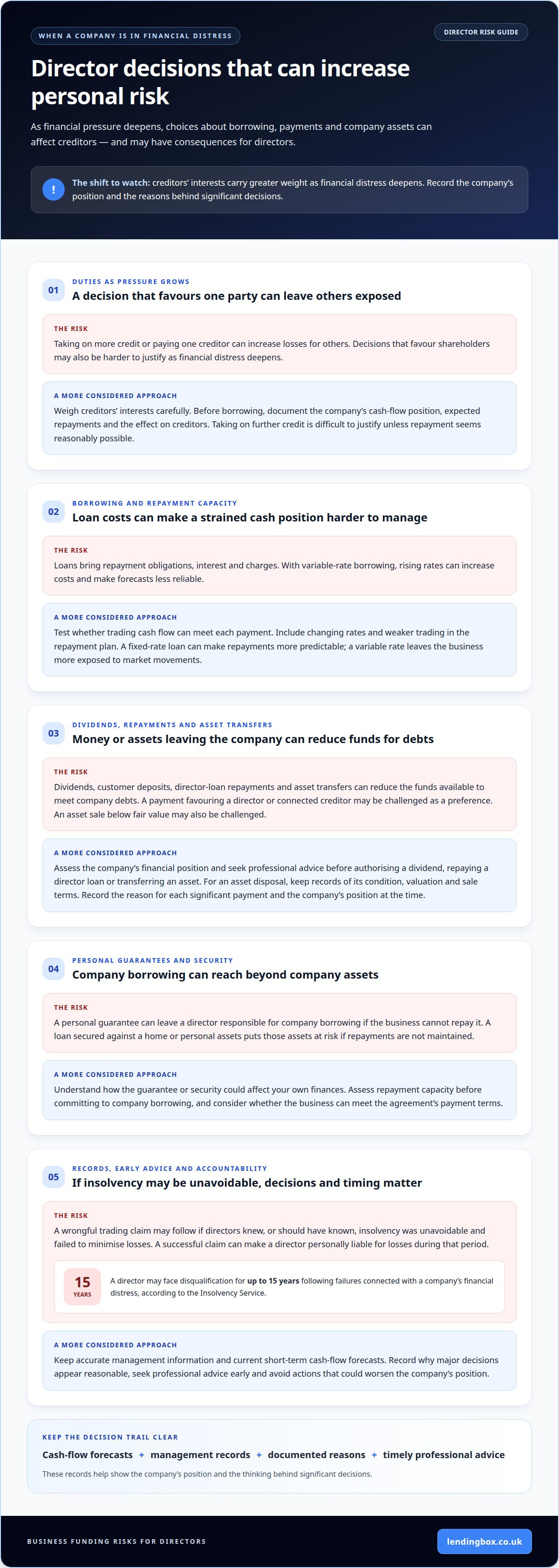
When a company is in financial difficulty, directors should take creditors’ interests into account. Decisions that favour shareholders or one creditor can increase losses for others. Keep accurate management information, prepare short-term cash-flow forecasts and record why major decisions appear reasonable. Seek professional advice early and avoid actions that could worsen the company’s position.
A wrongful trading claim may follow if directors knew, or should have known, insolvency was unavoidable and failed to minimise losses. A successful claim can make a director personally liable for losses during that period. A director may face disqualification for up to 15 years following failures connected with a company’s financial distress, according to the Insolvency Service.
Keep Companies House filings accurate and up to date, and consider the consequences before applying to dissolve a company with unresolved liabilities. Dissolution does not remove directors’ responsibility to deal properly with creditors and company affairs. If liquidation follows, restrictions may also apply to future company names.
Repeated insolvencies and tax liabilities
Repeated insolvencies can bring added scrutiny to directors’ conduct and company tax affairs. This matters when a new company continues similar activity, or tax liabilities remain unresolved after an earlier business closes. HMRC may assess company officers for deliberate inaccuracies in tax returns under Schedule 24 of the Finance Act 2007.
In the UK, section 216 of the Insolvency Act restricts directors from reusing the same or a similar company name for five years after liquidation, unless an exemption applies, according to The National Archives (legislation.gov.uk). Breaching the restriction may expose a director to personal liability for old debts or disqualification. From December 2020, HMRC regained secondary preferential creditor status in UK insolvencies, according to The National Archives (legislation.gov.uk). That status gives certain taxes priority over floating charge holders. Accurate tax records and timely advice can help directors understand the risks before restructuring or closing a company.
Creditor interests and shareholder interests
Directors ordinarily promote a company’s success for its members as a whole under the Companies Act 2006. But as financial distress deepens, creditors’ interests carry greater weight. This changes how directors should assess new borrowing, repayments and decisions that benefit shareholders. Taking on further credit is difficult to justify unless directors believe repayment is reasonably possible and can record why.
Loans create repayment obligations beyond the amount borrowed. Budget for interest and charges, then test whether trading cash flow can meet each payment. Variable-rate borrowing adds uncertainty: if rates rise, costs can increase and forecasts become less reliable. Build changing rates and weaker trading into the repayment plan, rather than relying only on the expected position.
Directors can consider available hedging arrangements, such as swaps, caps or collars, to manage interest-rate risk. Each works differently, so weigh its costs and terms against the company’s borrowing and exposure. A fixed-rate loan may make repayments more predictable, while a variable rate can leave the business more exposed to market movements.
If a director lends money to the company and charges interest, they must follow tax rules and record the loan in their director’s loan account. Keep clear records of the principal, interest charged and repayments. If the company later struggles, recovering a director loan may be harder if repayment would prejudice other creditors. The timing of repayment is therefore a governance decision, not just an accounting entry.
Before borrowing or repaying a director loan, document the company’s cash-flow position, expected repayments and effect on creditors. If the business needs funding, review business funding options alongside these obligations. The key test remains whether the company can reasonably meet its commitments without shifting avoidable losses onto creditors.
Dividends, asset transfers, deposits and loan repayments
A loan secured against your home or personal assets puts those assets at risk if repayments aren’t maintained. Asset finance, invoice finance and merchant cash advances can also create pressure if the business can’t meet the agreement’s payment terms or relies on assets or receivables needed for trading.
Dividends, asset transfers and repayments
Dividends, transfers, customer deposits and loan repayments can reduce the funds available to meet company debts. When a business is struggling, a payment that favours a director or connected creditor may be challenged as a preference. Before authorising a dividend, repaying a director loan or transferring an asset, assess the company’s financial position and seek professional advice.
A company asset disposal during insolvency should be for fair value; a sale below value may be challenged. Keep records of the asset’s condition, valuation and sale terms. Handle customer deposits carefully: spending them when the company may not fulfil orders can worsen losses and increase risks for directors. Record the reason for each significant payment and the company’s position at the time.
Security and exposure of personal assets
Security gives a lender rights over specified assets if agreed repayments aren’t maintained. For directors, that can extend beyond company property if a home or personal asset secures business borrowing. The consequence is personal: missed payments can put the secured asset at risk, even though the borrowing supported the company.
Asset finance and invoice finance have different structures, so review which assets or receivables support the agreement and what happens after missed payments. A merchant cash advance may link repayments to business income, making weaker sales a cash-flow pressure point. Understand those terms before committing, and consider whether repayments leave enough working capital for wages, suppliers and tax.
Distinguish commercial difficulty from deliberate wrongdoing. In extreme cases involving fraud or deliberate evasion, HMRC may prosecute under the Fraud Act or the Criminal Finances Act, and may use powers under the Proceeds of Crime Act to freeze UK assets. Keep payment, transfer and funding records clear, especially when the company is under financial strain.
Personal guarantees and director liability
A personal guarantee is a director’s commitment to meet specified company borrowing if the business fails to repay. It can create personal liability beyond the company’s own debts, so understand its scope before signing.
Read the agreement to understand the amount covered, when the lender can call on the guarantee, and whether it continues after changes to the borrowing. Check whether it covers principal, interest, charges or further advances. Depending on its terms and any security provided, a guarantee may put personal savings or assets at risk. Keep a signed copy and record the decision in board minutes.
If the company misses repayments, the lender may seek payment under the guarantee. Your exposure depends on its wording and circumstances, including any limits or release conditions. Don’t assume that closing the company, resigning as a director or changing its trading name ends the commitment. Get written confirmation before treating a guarantee as discharged.
Government-backed funding doesn’t remove directors’ ordinary responsibilities. For a UK government-backed business loan, directors must still consider whether the company can repay, use funds in line with the agreement and keep accurate financial records. A scheme’s backing does not itself make a director personally liable; liability may arise if they separately give a personal guarantee or breach their duties.
Keep company borrowing separate from a director’s personal commitment. Before signing, test repayments against realistic cash-flow forecasts, including weaker trading. Record why the company is borrowing, how it expects to use the funds and how it will meet repayments. If the business is already distressed, seek professional advice before taking on more debt or giving a personal guarantee.
Personal guarantee insurance may be worth considering as a separate way to address guarantee exposure. Review what protection it provides and its limits before relying on it. To explore personal guarantee insurance options, consider how the cover relates to the specific guarantee and borrowing.
Lending Box
Lending Box helps UK limited companies and LLPs assess business funding options against cash flow and repayment capacity. As a whole-of-market broker, it matches businesses with options including business loans, revenue-based finance, invoice finance and asset finance.
Lending Box’s in-house lending model analyses company data to provide instant eligibility insights with no impact on your credit score. One named relationship manager guides the process and handles the paperwork. This can help directors understand potential finance routes before deciding whether funding fits the company’s position and obligations. Funding does not replace directors’ duties or remove the need to assess repayment risks, especially during financial distress.
Contact Lending Box to discuss funding options for your business.
Make your next funding decision with a clear plan
Before committing to a funding route, set a clear decision point: what change in trading, cash flow or repayment capacity would make the proposal unsafe? Agreeing that threshold with fellow directors gives the board a practical basis for pausing, revising the plan or seeking advice. It keeps the decision focused on the company’s needs, not urgency alone.
Business funding risks for directors don’t end when funds arrive. They also depend on how the company monitors its position afterwards. Build review dates into board discussions, compare actual performance with forecasts and record when assumptions change. This gives directors a sound basis for adjusting decisions as circumstances develop.
Funding can support a well-defined business plan when the repayment implications fit the company’s outlook. Lending Box can help you consider suitable finance options for your business. Discuss funding with Lending Box and take your next step with a clearer view of the options.
Frequently Asked Questions
What happens if directors fail to comply with their duties?
Failure can lead to claims against directors, financial consequences and disqualification. For example, a liquidator may pursue a wrongful trading claim if directors continued trading when insolvency was unavoidable and failed to take steps to minimise losses. A misfeasance claim may also seek compensation for a breach of duty. The facts, timing and effects on the company and its creditors all matter.
What practical steps should directors take?
Keep a current cash-flow forecast and management records, updating them as trading changes. Use board meetings to record key decisions, the information considered and the reasons for each choice. For example, if a major customer pays late, minute the effect on supplier payments and borrowing. Consult relevant stakeholders early and get professional advice before committing to decisions that could affect creditors.
What should directors do when a company is in financial distress?
Act promptly: review near-term cash needs, identify obligations at risk and seek professional advice before making significant payments or taking on further credit. Speak to key stakeholders, such as lenders, HMRC, landlords and suppliers, when their position affects the company’s options. Avoid decisions that worsen losses or favour one creditor without considering the wider impact on creditors as a whole.
What personal financial risks do UK company directors face when arranging business funding?
Directors may put personal savings or assets at risk by self-funding, offering personal assets as security or signing a personal guarantee. These exposures differ: security relates to specified assets, while a guarantee creates a personal commitment under its terms. Before arranging finance, identify what you are personally committing and assess how repayment difficulties could affect your household finances.
When can a UK director be personally liable for company debts or loans?
A director isn’t automatically responsible for every debt of a limited company. Personal liability may arise if the director has signed a guarantee or if a successful claim follows misconduct such as wrongful trading or breach of duty. The route to liability depends on the agreement or the director’s conduct. Keep company borrowing distinct from personal commitments and retain the relevant documents.
What are the risks of giving a personal guarantee for UK business finance?
A guarantee can make a director personally responsible for covered company borrowing if the business doesn’t repay. The lender may then seek payment under the guarantee, putting personal finances at risk. Read its scope and conditions carefully before signing, including which borrowing it covers and when it can be called. Personal guarantee insurance can cover part of what you would owe if a lender calls on your guarantee.
Frequently Asked Questions
Failure can lead to claims against directors, financial consequences and disqualification. For example, a liquidator may pursue a wrongful trading claim if directors continued trading when insolvency was unavoidable and failed to take steps to minimise losses. A misfeasance claim may also seek compensation for a breach of duty. The facts, timing and effects on the company and its creditors all matter.
Keep a current cash-flow forecast and management records, updating them as trading changes. Use board meetings to record key decisions, the information considered and the reasons for each choice. For example, if a major customer pays late, minute the effect on supplier payments and borrowing. Consult relevant stakeholders early and get professional advice before committing to decisions that could affect creditors.
Act promptly: review near-term cash needs, identify obligations at risk and seek professional advice before making significant payments or taking on further credit. Speak to key stakeholders, such as lenders, HMRC, landlords and suppliers, when their position affects the company’s options. Avoid decisions that worsen losses or favour one creditor without considering the wider impact on creditors as a whole.
Directors may put personal savings or assets at risk by self-funding, offering personal assets as security or signing a personal guarantee. These exposures differ: security relates to specified assets, while a guarantee creates a personal commitment under its terms. Before arranging finance, identify what you are personally committing and assess how repayment difficulties could affect your household finances.
A director isn’t automatically responsible for every debt of a limited company. Personal liability may arise if the director has signed a guarantee or if a successful claim follows misconduct such as wrongful trading or breach of duty. The route to liability depends on the agreement or the director’s conduct. Keep company borrowing distinct from personal commitments and retain the relevant documents.
A guarantee can make a director personally responsible for covered company borrowing if the business doesn’t repay. The lender may then seek payment under the guarantee, putting personal finances at risk. Read its scope and conditions carefully before signing, including which borrowing it covers and when it can be called. Personal guarantee insurance can cover part of what you would owe if a lender calls on your guarantee.