Business loans for growth: eligibility and repayments
17 November 2026 · 11 min read

 Business funding
A government guarantee doesn’t remove your business’s repayment responsibility. A business loan for growth may be available through the UK Growth Guarantee Scheme if your business is viable and meets the lender’s eligibility checks. The scheme guarantees lenders for 70% of a facility’s outstanding balance after the lender completes its normal recovery process, but the borrower remains liable for the full debt.
It’s sensible to look beyond eligibility. The amount you borrow, the repayment period and any personal guarantee can all affect your decision and your business’s risk.
This guide explains key eligibility criteria, what a personal guarantee means for your liability and how repayments work. It also covers documents you may need, including three years of historic accounts for a Growth Guarantee Scheme application. Use it to understand what to prepare and what to weigh before choosing finance for your next stage of growth.
Key Takeaways
- Use your group turnover, UK trading activity and business type to assess whether the scheme’s eligibility rules may fit.
- Understand how lender guarantees and personal guarantees affect your business and personal exposure before accepting an offer.
- Compare repayment periods and facility types against your cash flow, including whether early repayments could suit your plans.
- Prepare financial records and key-principal details early to help keep an application moving.
Business eligibility and turnover threshold
Growth Guarantee Scheme eligibility depends on business viability, UK trading activity, turnover and sector. A broker can compare business loans, overdrafts and other growth finance against lender criteria, facility type and your funding purpose.
Borrower eligibility criteria
The business must be viable and use the finance for business purposes. Start-ups with 1 to 2 years of trading and established businesses can apply. The scheme covers businesses with 0 to 9 employees and those with 10 to 249 employees. Public sector bodies are ineligible. Banks, building societies, insurers and reinsurers are also excluded, except insurance brokers.
For most applicants, more than 50% of income must come from UK trading activity. These tests apply alongside the lender’s assessment, so meeting scheme criteria doesn’t by itself determine the lending decision.
Business turnover limits
Turnover may be assessed across a group where relevant, rather than only at the individual applicant level. The structure of connected businesses can therefore matter when eligibility is assessed.
For Northern Ireland Protocol borrowers, the maximum is £1m per group. The amount of subsidy available to a borrower and its wider group is also subject to a limit over any rolling three-year period.
The scheme may be an option alongside other forms of business finance. The facility that suits you depends on your funding purpose and the lender’s assessment.
The British Business Bank manages the scheme on behalf of the Secretary of State for Business & Trade. A business bank or other accredited lender assesses the application and its proposed use. Match the facility to the need: an overdraft may suit working-capital fluctuations, while asset finance is linked to an asset purchase.
Government guarantee and borrower liability
The Growth Guarantee Scheme supports UK businesses seeking finance to invest and grow. Its government guarantee protects lenders against part of a loss, not borrowers from repaying.
Repayment responsibility
The government guarantees lenders for 70% of a facility’s outstanding balance after the lender completes its normal recovery process. The borrower remains liable for 100% of the debt under the lending agreement, including applicable interest and fees. The guarantee therefore doesn’t reduce the balance owed or replace agreed repayments. A broker can match start-ups and established companies with lenders by comparing eligibility, proposed use and suitable finance types, including term loans.
Are repayments and interest tax-deductible in the UK? There isn’t one tax answer for every business. Treatment depends on how borrowed funds are used and the business’s circumstances. Distinguish interest from repayments of loan capital when considering the tax position.
Personal guarantees and borrowing risks
A lender may ask for a personal guarantee at its discretion. This creates potential personal exposure if the business can’t meet its obligations, so understand the guarantee’s terms and scope before signing. The scheme does not allow a principal private residence to be taken as security. That restriction doesn’t remove the borrower’s responsibility for the full debt.
The key risk is taking on repayments that your business’s cash flow can’t support. If expected growth doesn’t generate enough income, the debt remains due. Test the borrowing against its purpose and your business’s ability to meet the agreed repayment schedule.
Previous government-backed borrowing doesn’t automatically prevent an application. Businesses that took out a CBILS, CLBILS, BBLS or Recovery Loan Scheme facility before 30 June 2024 aren’t automatically barred from applying. The Growth Guarantee Scheme launched in July 2024 as the Recovery Loan Scheme’s successor. Existing borrowing still matters when assessing overall liabilities and the subsidy limit.
For a clearer view of suitable lender routes, compare business finance options against your plans and repayment capacity.
Repayment terms
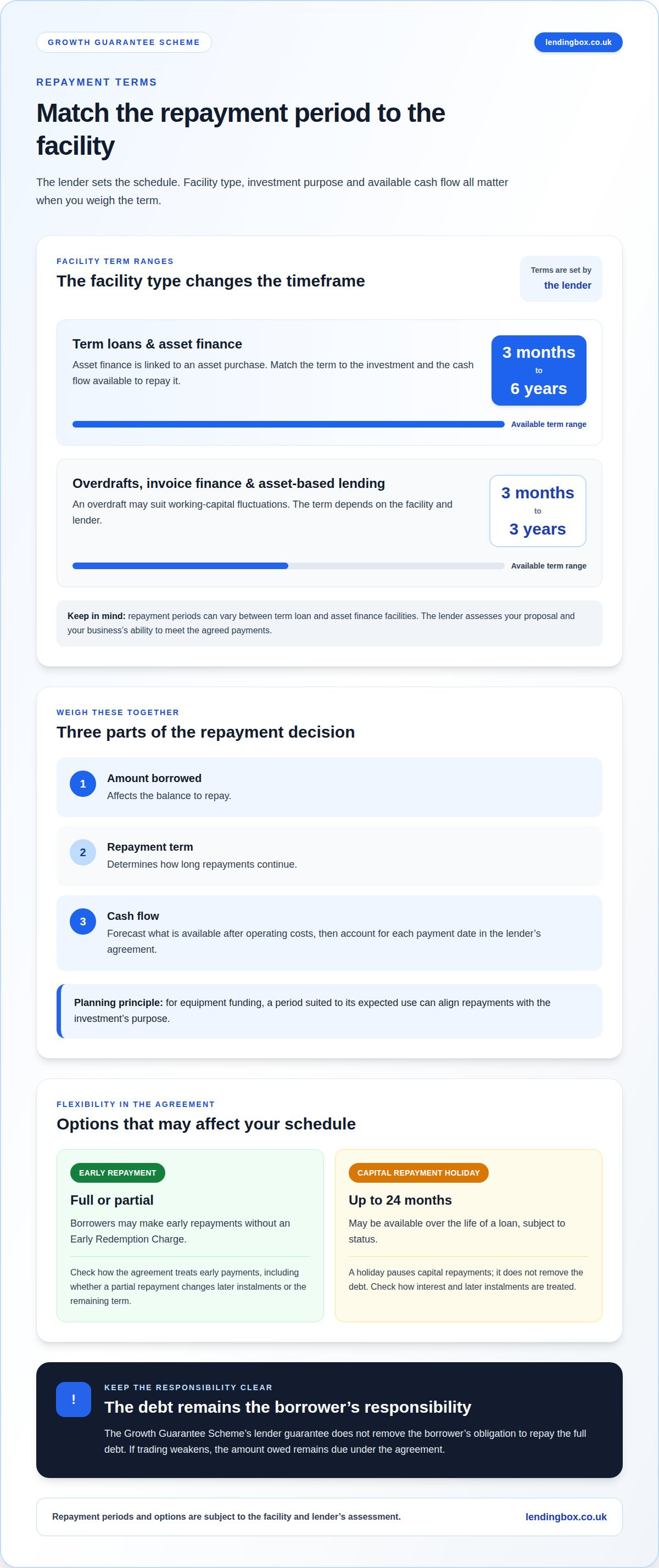
The repayment period depends on the facility type and lender. Match the term to the investment and the cash flow available to repay it.
Loan amounts and repayment periods
Under the Growth Guarantee Scheme, term loans and asset finance facilities generally run from three months to six years. Repayment terms can vary between term loan and asset finance facilities. Overdrafts, invoice finance and asset-based lending facilities run from three months to three years. The lender sets the repayment schedule for the eligible facility.
The amount borrowed affects the balance to repay, while the term determines how long repayments continue. Consider them together. For example, funding equipment over a period suited to its expected use can align repayments with the investment’s purpose. The lender assesses your proposal and your business’s ability to meet the agreed payments. Indicative only. Subject to lender assessment and approval.
Early repayment options
Growth Guarantee Scheme borrowers may make full or partial early repayments without an Early Redemption Charge. This can give a business room to reduce its outstanding balance when cash flow allows. Check how the lending agreement applies early payments, including whether a partial repayment changes later instalments or the remaining term.
Capital repayment holidays of up to 24 months may be available over the life of a loan, subject to status. A holiday pauses capital repayments, but it doesn’t remove the debt. Understand how interest and later instalments are treated in the agreement before relying on a holiday to manage a cash-flow gap.
Build the repayment schedule into your investment plan before accepting credit. Forecast cash available after operating costs, then account for each payment date in the lender’s agreement. If trading weakens and repayment becomes difficult, the amount owed remains due. A longer term may spread payments over more time, but the agreement still sets your obligations. An accredited lender assesses the facility and its terms under the scheme.
Application documents
A British Business Bank-backed application combines financial records with details of the funding request. Three years of historic accounts are required for a Growth Guarantee Scheme facility.
Key business principals may also need to provide address history covering the past 3 years. These records help lenders review the people behind the application alongside the business’s financial position.
Organise the accounts and address history before submitting an application. Keep figures consistent across documents and explain changes in trading or group structure clearly. For example, a recent shift in business activity should align with the figures and funding purpose described in the application.
Lending Box brings application information together, matches it with finance options and helps manage the paperwork. One named relationship manager guides you through the process, from reviewing options to completing your application. No long forms before you see anything useful, and no obligation at any stage. You can start with your company name.
Explain what the business will fund, how much finance it needs and how the facility supports growth. Lenders assess the application and your business’s ability to repay. Accurate information about existing borrowing, trading and any insolvency proceedings or recovery arrangements helps present the full picture.
Funding times depend on how quickly the application is complete, how promptly questions are answered and the lender’s assessment process. A business can’t rely on a fixed turnaround. Accredited lenders make their own decisions, so the timing and conditions depend on the facility and application.
Before submitting, the broker can check that the accounts cover the required three-year period and that each principal’s address history covers the past 3 years. Then the lender reviews the information and decides whether to offer a facility and on what terms.
Prepare your business loan application with your accounts and principal address history ready.
Lending Box: Business loan
Lending Box helps UK limited companies and LLPs compare business loan options for planned growth. Its in-house lending model provides instant eligibility insights without affecting credit scores, helping clarify potential routes before a formal application.
One named relationship manager guides you through suitable options, including a business loan, Growth Guarantee Scheme, revenue-based finance and invoice finance, and handles the application paperwork. Lending Box shows you products and fit, not a directory: no lender names, no pressure. The service is free to the business, with Lending Box receiving commission or a finder’s fee from lenders.
Contact Lending Box to discuss finance for your business.
Shape the next stage of your growth
Set the funding decision against the outcome you want to achieve. A business loan for growth should support a clear priority, with repayments that fit the way income reaches your business. That might mean funding a specific investment or choosing finance that reflects how your customers pay.
Lending Box offers business loans, revenue-based finance and invoice finance. The right route depends on what you’re funding and how your business earns and receives revenue. A named relationship manager can help match your needs with available options, without treating one type of finance as right for every business.
Share your plans and funding needs with Lending Box to discuss the options available for your business. Contact Lending Box about your options and take a practical next step towards your growth plans.
Frequently Asked Questions
Can I apply?
You can apply for a business loan for growth if your business is an active UK limited company or LLP registered at Companies House. Explain what the funding will support and how it fits your plans. Set out the intended use clearly, such as expanding capacity or funding a defined investment, so the lender can assess the request in context.
Can I make additional repayments to my loan?
Additional repayments may be possible, but the facility agreement sets the process. Before sending extra funds, understand how the lender will identify and allocate the payment. Keep enough working capital for commitments such as payroll and suppliers rather than using all available cash to reduce borrowing. Balance debt reduction with maintaining funds for normal trading needs.
Can I take a capital repayment holiday?
A capital repayment holiday depends on the facility and its terms. Before relying on one, understand how the payment schedule changes and what payments follow the pause. Build those later payments into your cash forecast alongside expected income and operating costs. This helps you judge whether temporary breathing space supports the business plan or shifts pressure to a later point.
How does the government-backed guarantee work?
The Growth Guarantee Scheme is an option involving the government and participating lenders. Review the written facility terms to understand whether the offer uses the scheme and what conditions apply. Consider any personal guarantee as a separate commitment. Base your decision on the agreement and your obligations under it.
How long does this take?
There’s no standard turnaround for every application. Separate the process into initial matching, full lender assessment, offer and completion, then establish which stage your application has reached. An eligibility indication isn’t a formal offer. If progress pauses, find out whether the lender needs further information or has completed its assessment. Each stage has a different outcome.
What does this cost?
Lending Box’s brokerage service is free to the business; it receives commission or a finder’s fee from lenders. The cost of a business loan for growth depends on the lender’s offer. Read the agreement for the interest, fees and total amount repayable, and consider how those commitments fit your expected cash flow before accepting the facility.
Frequently Asked Questions
You can apply for a business loan for growth if your business is an active UK limited company or LLP registered at Companies House. Explain what the funding will support and how it fits your plans. Set out the intended use clearly, such as expanding capacity or funding a defined investment, so the lender can assess the request in context.
Additional repayments may be possible, but the facility agreement sets the process. Before sending extra funds, understand how the lender will identify and allocate the payment. Keep enough working capital for commitments such as payroll and suppliers rather than using all available cash to reduce borrowing. Balance debt reduction with maintaining funds for normal trading needs.
A capital repayment holiday depends on the facility and its terms. Before relying on one, understand how the payment schedule changes and what payments follow the pause. Build those later payments into your cash forecast alongside expected income and operating costs. This helps you judge whether temporary breathing space supports the business plan or shifts pressure to a later point.
The Growth Guarantee Scheme is an option involving the government and participating lenders. Review the written facility terms to understand whether the offer uses the scheme and what conditions apply. Consider any personal guarantee as a separate commitment. Base your decision on the agreement and your obligations under it.
There’s no standard turnaround for every application. Separate the process into initial matching, full lender assessment, offer and completion, then establish which stage your application has reached. An eligibility indication isn’t a formal offer. If progress pauses, find out whether the lender needs further information or has completed its assessment. Each stage has a different outcome.
Lending Box’s brokerage service is free to the business; it receives commission or a finder’s fee from lenders. The cost of a business loan for growth depends on the lender’s offer. Read the agreement for the interest, fees and total amount repayable, and consider how those commitments fit your expected cash flow before accepting the facility.