Business Loan Application Mistakes: What to Fix Next
23 November 2026 · 11 min read

 Business funding
A rejection is a reason to review the application, not simply resubmit it unchanged. The most common business loan application mistakes to address are unclear plans for using the funds, incomplete or inconsistent documents, unsuitable collateral and a loan amount that the business can’t support. Different lenders use different criteria, so fixing the underlying issues can help you prepare a stronger application.
Facing another round of paperwork after a rejection is frustrating. To avoid business loan application mistakes, first understand why the application fell short, then focus on the points that matter to a lender.
This guide explains what to do after a rejection and how to strengthen a fresh application. It covers the documents lenders may assess, how security affects the decision, and how to link the amount requested to a clear business need and a realistic repayment plan.
Key Takeaways
- After a rejection, pinpoint what needs to change and make the intended use of funds clear.
- Organised, consistent financial records can help a broker present your application clearly.
- Review what assets could support borrowing and understand the risks attached to secured finance.
- Build your loan request around specific business costs and repayments the business can manage.
1. What if your business loan application has already been rejected?
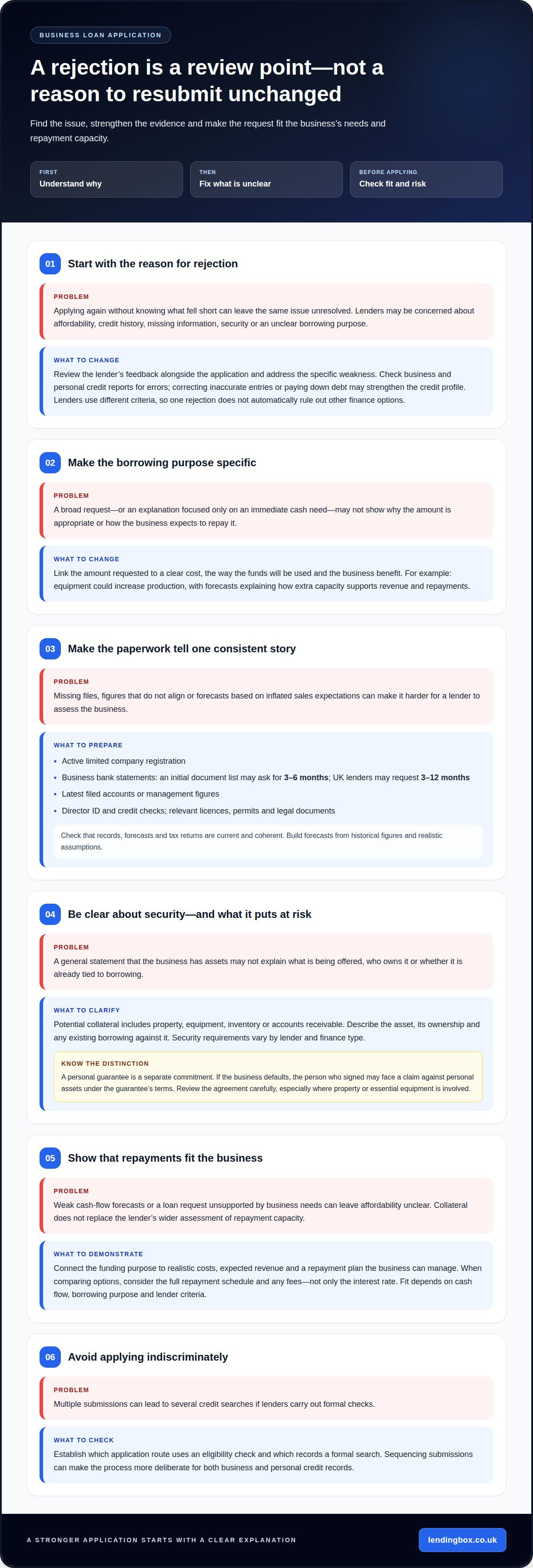
Start by understanding the reason for rejection. Lending Box can review lender feedback alongside your application and identify whether the issue involved affordability, credit history, missing information, security or an unclear borrowing purpose. Lenders use different criteria, so one rejection does not automatically rule out other business finance options.
The next application needs a clear link between the amount requested, how the funds will be used and the business benefit. A broker can turn a broad request into a specific explanation: for example, funding new equipment to increase production, with forecasts showing how the extra capacity supports revenue and repayments. Explain the borrowing purpose, not just the immediate cash need.
When comparing finance options, look at the full repayment schedule and any fees, not just the interest rate. The right fit depends on your business’s cash flow, borrowing purpose and the lender’s criteria. Lending Box compares options across the market and explains how they fit your needs.
A broker can help review business and personal credit reports, identify errors and explain how existing debts or missed payments may affect a lender’s assessment. Paying down debt and correcting inaccurate entries can strengthen the credit profile before applying. Lenders may assess the business credit rating and the histories of key directors.
Multiple submissions can result in several credit searches if lenders carry out formal checks. A broker can establish which application route uses an eligibility check and which records a formal search, then sequence submissions to avoid applying indiscriminately. That makes the process more deliberate for both business and personal credit records.
Common reasons for rejection include weak cash-flow forecasts, inconsistent financial records, poor credit history, insufficient security or a request that is not supported by the business’s needs. Address the specific issue before applying again. Explain how you will use the funds and how the business expects to repay them.
1. Getting application documents ready with a broker
Prepare the documents lenders may ask for: active limited company registration, three to six months of business bank statements, latest filed accounts or management figures, and director ID and credit checks. Requirements can vary by lender and finance type. Lending Box’s relationship manager can guide you through the application paperwork.
UK lenders may request business bank statements covering 3-12 months. They may also consider account history, cash-flow records and financial projections. A broker can review these documents for gaps or figures that do not align, then help resolve discrepancies before submitting. Accurate records demonstrate how income arrives, where payments go and whether the business can manage repayments.
A business plan should connect the company’s operations to its revenue plan. A broker can help present the business model, target market, growth strategy and forecasts in a practical order. For example, a plan for expansion should explain the expected costs, the source of additional revenue and how that revenue supports repayment. Forecasts should draw on historical figures and realistic assumptions, not inflated sales expectations.
Licences and permits can also form part of an application where they apply to the business. The broker can identify relevant paperwork alongside legal documents and financial records, helping business owners avoid missing items. Consistency matters: a forecast, bank statement and tax return should tell a coherent story about the same business.
Before submitting, the broker can assemble the requested documents, check that each file is current and flag anything that needs clarification. This reduces avoidable delays caused by incomplete or inconsistent paperwork. For practical business loan application support, a broker can help prepare the documents and present the business’s revenue plan clearly.
3. Reviewing collateral with a finance broker
Collateral can support a lending application, but it also changes what the business risks if it cannot repay. A finance broker can review the assets available and explain how each relates to the funding purpose. Potential collateral can include property, equipment, inventory or accounts receivable.
Give a clear account of any asset offered as security, including its ownership and description, and whether it is already tied to borrowing. This helps the lender understand the security proposed rather than relying on a general statement that the business has assets.
There is no single security arrangement for every UK business loan. Lenders may request collateral depending on the finance type and their assessment. A personal guarantee is a separate commitment: if the business defaults, the person who signed may face a claim against personal assets under the guarantee’s terms. Review the agreement carefully before signing.
A broker can explain the difference between offering a business asset as security and signing a personal guarantee. They can help identify what the agreement makes available to the lender following default, and whether the proposed security fits the business’s circumstances. That matters particularly where a property or essential equipment supports daily operations.
Collateral does not replace the lender’s wider assessment. Statements, cash flow and repayment capacity still help demonstrate whether the business can meet payments. A broker can connect those records with the asset details and the loan’s purpose, then consider how the lender’s requirements affect the application.
Before submitting, make sure the security offered is relevant to the funding need and that its risks are understood. For example, equipment may suit funding for machinery, while property security could put a significant business asset at risk. A finance broker can help review available security alongside the business’s credit history and funding options, so the application presents a coherent picture without overlooking potential consequences.
4. Calculating an appropriate loan amount with professional support
A broker can help calculate a request from the business’s specific costs, rather than choosing a figure without a clear basis. Start with supplier quotes, planned spending and cash-flow forecasts. Separate equipment, marketing and expansion costs, then connect each amount to the business outcome it should support. This makes the funding purpose easier for lenders to assess.
For example, a £75,000 request to buy two machines has a defined use. If the investment could increase production capacity by approximately 30%, the broker can help explain the operational benefit and show how forecasts support the expected revenue. The projections still need realistic assumptions. Unsupported growth estimates can weaken the application, even when the purchase itself is clear.
A £50,000 expansion request needs the same discipline. A broker can help build a cost breakdown and forecasts showing how the expansion affects income, operating costs and repayments. The amount should meet the business need without adding borrowing that the plan cannot justify. This is one way to avoid common mistakes, such as requesting a round figure without linking it to actual spending.
Choosing the wrong amount or loan type can lead to rejection if the request does not fit the business’s needs or repayment capacity. A request that is too low may not fund the intended purpose; an excessive amount can raise concerns about affordability. Different finance types also suit different needs, so the structure should match how the business will use and repay the funds.
Test the repayment plan against lower-than-expected sales for the first six months. Would the business still meet payments from available cash flow? A broker can compare that scenario with the forecast and explain how the requested amount, interest rate and repayment schedule fit together. Revenue-based finance may also be relevant where repayments need to reflect business revenue. Review funding options with Lending Box to shape a request around the business’s costs and repayment capacity.
Lending Box: Business loan
Lending Box helps UK limited companies and LLPs explore business finance after a rejection or when preparing a fresh application. As a whole-of-market broker, it matches businesses with suitable options and provides instant eligibility insights without impacting credit scores.
A dedicated relationship manager guides you through the process and handles the paperwork. Alongside business loans, options include revenue-based finance, invoice finance and asset finance. The right route depends on your funding purpose, financial records and repayment needs, so clear documents and realistic forecasts remain important.
If you’re ready to discuss your funding needs and next steps, contact Lending Box.
Make your next funding decision with clarity
A rejection can be a reason to review your approach. Before applying again, decide what the funding needs to achieve and which repayment structure fits the business’s cash flow. Avoiding business loan application mistakes means presenting a credible case and choosing finance that fits the business’s plans.
Lending Box helps eligible UK limited companies and LLPs consider business loans, revenue-based finance and invoice finance against their funding needs. One named relationship manager guides you through the options and handles the paperwork, providing practical support as you consider your next step.
Take the next step when you’re ready to discuss the funding purpose and possible routes. Contact Lending Box to discuss your options. A clear plan can help you move forward with greater confidence.
Frequently Asked Questions
What if your business loan application has already been rejected?
Pause before submitting another application and identify the reason for the rejection. If the feedback is unclear, ask the lender for an explanation, then address the specific issue rather than changing unrelated parts of the application. If affordability was the concern, for example, review the repayment plan against current commitments. One lender’s rejection does not automatically prevent another from assessing the business.
What information and documents should you provide to a finance broker?
For an initial assessment, prepare evidence of active limited company registration, business bank statements covering 3-6 months, the latest filed accounts or management figures, and director ID and credit checks. Give the broker a clear account of the funding purpose and any existing borrowing. This context helps them understand the request and identify which information may need clarification before an application is submitted.
What are the most common business loan application mistakes in the UK?
Common problems include requesting an amount without a defined use, presenting forecasts that do not match the business’s trading record, and providing incomplete or inconsistent information. Choosing finance that does not suit how the business earns income or repays borrowing can also create difficulties. For example, seasonal revenue may make fixed repayments harder to manage, so consider how the repayment structure fits cash flow.
How do lenders assess affordability, cash flow and debt service coverage for UK business loans?
Lenders consider whether the business’s available cash can cover operating costs, existing commitments and the proposed repayments. Debt service coverage compares cash available for debt payments with the debt payments due. They may examine account history, revenue patterns and forecasts to understand how the business would manage quieter trading periods. The assessment focuses on the full repayment picture, not revenue alone.
What financial information and forecasts should a UK business provide for its loan application?
Provide current financial figures that show trading performance, cash movement, existing commitments and the expected effect of borrowing. Forecast how sales, costs and repayments may change after funding. Base assumptions on trading history and explain planned changes, such as a new contract or expansion. Lenders may compare projections with accounts and management figures for consistency.
How can a broker help a UK business respond to a loan rejection or improve a future application?
Lending Box can interpret lender feedback, distinguish issues you can address from those tied to lending criteria, and help shape a fresh application. For example, the team can clarify how the funds support trading plans or identify a mismatch between repayment timing and cash flow. Lending Box matches businesses with lenders across the market and supports applications through to completion.
Frequently Asked Questions
Pause before submitting another application and identify the reason for the rejection. If the feedback is unclear, ask the lender for an explanation, then address the specific issue rather than changing unrelated parts of the application. If affordability was the concern, for example, review the repayment plan against current commitments. One lender’s rejection does not automatically prevent another from assessing the business.
For an initial assessment, prepare evidence of active limited company registration, business bank statements covering 3–6 months, the latest filed accounts or management figures, and director ID and credit checks. Give the broker a clear account of the funding purpose and any existing borrowing. This context helps them understand the request and identify which information may need clarification before an application is submitted.
Common problems include requesting an amount without a defined use, presenting forecasts that do not match the business’s trading record, and providing incomplete or inconsistent information. Choosing finance that does not suit how the business earns income or repays borrowing can also create difficulties. For example, seasonal revenue may make fixed repayments harder to manage, so consider how the repayment structure fits cash flow.
Lenders consider whether the business’s available cash can cover operating costs, existing commitments and the proposed repayments. Debt service coverage compares cash available for debt payments with the debt payments due. They may examine account history, revenue patterns and forecasts to understand how the business would manage quieter trading periods. The assessment focuses on the full repayment picture, not revenue alone.
Provide current financial figures that show trading performance, cash movement, existing commitments and the expected effect of borrowing. Forecast how sales, costs and repayments may change after funding. Base assumptions on trading history and explain planned changes, such as a new contract or expansion. Lenders may compare projections with accounts and management figures for consistency.
Lending Box can interpret lender feedback, distinguish issues you can address from those tied to lending criteria, and help shape a fresh application. For example, the team can clarify how the funds support trading plans or identify a mismatch between repayment timing and cash flow. Lending Box matches businesses with lenders across the market and supports applications through to completion.