Business loan application support for UK businesses
22 November 2026 · 12 min read

 Business funding
A loan application is only as clear as the evidence behind it. Business loan paperwork support helps organise the financial records, business plan and forecasts a lender may review, including details of existing finance and assets. Lenders use this information to understand how the funds will be used and whether the business can manage repayments.
Business loan paperwork support can help make an application clearer, especially when several documents need to tell a consistent story. A focused review can identify gaps and help present the business’s position without promising a particular lending decision.
This article explains how business loans work, which documents may support an application and how plans, existing finance and asset records can help a lender assess the case. It also explains how professional preparation fits in, so you can see what to get ready before applying.
Key Takeaways
- A well-prepared application connects the requested funding to its purpose and the business’s ability to repay.
- Business bank statements and tax returns help lenders assess trading activity, cash flow and financial position.
- A reviewed business plan and realistic forecasts can make the case for borrowing clearer and more consistent.
- Clear evidence of existing finance and business assets helps present the company’s wider financial commitments and resources.
Professional support preparing and presenting a loan application
A professional review can organise an application and present the business’s financial position clearly. The focus is on the funding purpose, supporting evidence and realistic repayment capacity.
Preparing the application
Support can bring the key figures and explanations together in a consistent application. Accounts may include a profit and loss statement and balance sheet. Missing or incomplete records can delay an application or lead to rejection. Preparation also clarifies how the funds will be used and how the business expects to repay the loan.
For example, a forecast might show how new equipment could increase production and generate revenue to support repayments. A professional can review this link, identify gaps in the evidence and help explain existing business debts or payments due to the company. An accountant can prepare or interpret financial records, while an application specialist can organise them alongside the business case.
Secured and unsecured applications
A secured application uses an asset as security, so the paperwork needs to identify the asset and explain its role in the proposal. An unsecured application does not use that security, but lenders still assess the business’s finances and ability to make payments throughout the loan term. Most lenders on our panel ask directors for a personal guarantee, and a personal guarantee from directors is common.
Professional support can explain how security or a personal guarantee affects an application and bring related evidence together. This distinction matters when considering the potential consequences of missed repayments, not just the loan amount or start date.
Before submission, a reviewer can compare the proposed repayment schedule with cash flow and flag pressure points. They can also consider whether settling existing business debts or collecting overdue payments would improve the picture presented to a lender. These steps help show both current commitments and the capacity to repay.
Review any application and early repayment fees alongside the interest rate, repayment schedule and loan term. A professional can identify charges stated in an offer and explain how they affect the overall cost if the business repays early. This gives decision-makers a clearer basis for assessing the proposed finance.
How do business loans work?
A lender provides funds for a business purpose, then collects repayments through scheduled instalments. Payments usually cover the borrowed amount and accrued interest. The interest rate may be fixed or variable: a fixed rate keeps repayments consistent, while a variable rate can change the amount due. Lenders assess financial records, trading activity and affordability. A clear funding purpose links the requested amount to plans such as buying equipment or supporting growth.
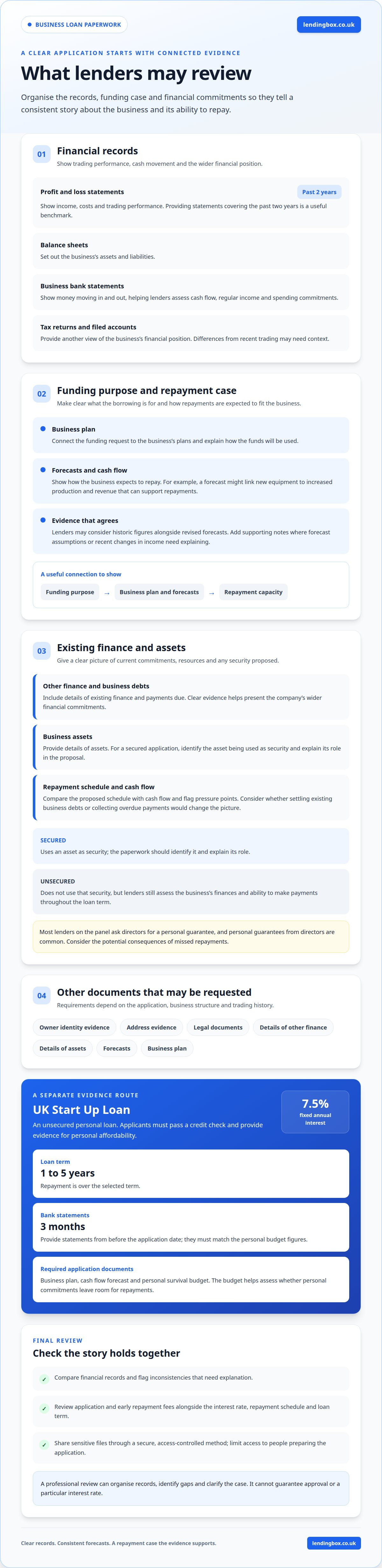
Business bank statements show money moving into and out of the company. They help lenders assess cash flow, regular income and spending commitments. Tax returns and filed accounts provide another view of the financial position. Business loan paperwork support can help organise these records and explain differences between them. For example, a recent change in income may need context if it differs from historic figures.
Profit and loss statements show income, costs and trading performance. A useful benchmark is to provide statements covering the past two years. Balance sheets show assets and liabilities, while bank statements capture day-to-day cash movement. Together, these records help a lender assess whether projected repayments fit the business’s finances. Business loan paperwork support can also clarify how revised forecasts relate to historic trading.
A Start Up Loan is an unsecured personal loan, and applicants must pass a credit check. It has a fixed annual interest rate of 7.5%, with repayment over 1 to 5 years. Applicants must provide 3 months of bank statements before the application date, matching their personal budget figures. The budget helps assess whether personal commitments leave room for repayments. This route has different evidence requirements from a business loan.
Business plan and supporting-document review
A document review checks whether the business plan, forecasts and financial evidence support the same case. Professional business loan paperwork support can connect each document to the funding purpose and repayment plan, while highlighting gaps that need explanation.
Documents lenders may request
Depending on the application, lenders may ask for business bank statements, accounts, tax returns, legal documents, owner identity and address evidence, details of other finance and assets, forecasts, and a business plan. UK Start Up Loan applicants must submit a business plan, cash flow forecast and personal survival budget. These documents explain how borrowing supports the business and fits personal affordability.
Protect sensitive files by sharing them through a secure, access-controlled method. Limit access to people preparing the application, and avoid sending records through unsecured channels.
Required financial documents
Financial statements should be accurate and up to date. A reviewer can compare profit and loss statements, balance sheets, tax returns and bank records, then flag inconsistencies that need explanation. If revised forecasts differ from historic trading figures, supporting notes can explain the assumptions. Lenders may consider historic figures alongside revised forecasts when assessing creditworthiness.
A lender considers a credit score alongside financial evidence and affordability. Business loan paperwork support can help make the records coherent, but no document guarantees approval or a particular fixed interest rate.
Requirements by business type
Paperwork depends on the business structure and trading history. A start-up may rely more on a plan, cash flow forecast and personal survival budget. A sole trader’s records may combine business activity with personal finances. A limited company or partnership presents records that reflect its structure, ownership and trading position.
The application should identify the borrower clearly and explain any gaps in trading history. This gives the lender context for the figures and proposed use of funds.
Paperwork delays and rejections
Missing or incomplete documents can delay an application and may lead to rejection. Common problems include absent records, conflicting figures, outdated statements or forecasts that do not explain how repayments will be covered. Reviewing the documents before submission can identify gaps and clarify what supporting evidence is needed.
For a Start Up Loan, the business plan, cash flow forecast and personal survival budget should align. A final business loan paperwork support review can help ensure those materials present a consistent funding case.
Evidence of existing finance and assets
Existing borrowing and owned assets shape what a lender sees when assessing a new application. A clear schedule links each finance commitment to its balance, payment pattern and remaining term. It also shows how new borrowing would sit alongside obligations already affecting cash flow. The aim is transparency, not simply presenting a low-debt snapshot.
Evidence can include statements for current finance, repayment schedules, asset details and business bank statements showing payments leaving the account. For example, regular equipment finance instalments should match the figures in the cash flow forecast. If a facility has been repaid, a settlement record can explain why those outgoing payments no longer appear. This helps distinguish active commitments from historic ones.
Assets need context too. A vehicle, machine or property may support trading, secure existing finance or be available for a proposed loan. Relevant documents can show ownership, current finance attached to the asset and its business use. This matters for secured applications, where the lender considers security alongside repayment capacity. Listing an asset alone does not show whether it is already encumbered.
When applying, a reviewer can compare the finance schedule with bank statements and forecasts. This may reveal a payment missing from the forecast or an expected reduction in commitments that needs evidence. Settling existing business debts and collecting payments due to the business may strengthen the financial picture. Explain these changes with records, rather than relying on an unsupported forecast.
Start Up Loan borrowers can receive free support and mentoring during the first 12 months of the loan term. For a new business, that support can help keep forecasts and finance records aligned as trading develops. Whether a proposal is backed by existing assets or relies on projected cash flow, the takeaway is the same: show what the business owes, owns and expects to repay, with evidence that matches the figures.
Lending Box: Business loan
Lending Box helps active UK limited companies and LLPs registered at Companies House prepare finance applications and find suitable options. Its in-house lending model analyses company data to provide initial eligibility insights with no impact on your credit score.
One named relationship manager guides applicants through the paperwork and available finance routes, including business loans, revenue-based finance, invoice finance and asset finance. The right option depends on the funding purpose, trading position, cash flow and existing commitments. For example, a business seeking to fund equipment can discuss asset finance, while a company managing unpaid invoices can consider invoice finance.
Turn to Lending Box when you need help organising an application, reviewing finance options or presenting your business’s evidence. Start with your company name to discuss your business finance requirements, with no obligation at any stage.
Move your finance application forward
The next step is to turn your funding requirement into a clear proposal. Decide what the business needs the funds to achieve, then consider how repayments fit its plans. A focused conversation can help connect those priorities with a suitable finance route.
Business loan paperwork support can bring structure to that conversation, especially when your trading position or existing commitments need context. Lending Box offers business loans, revenue-based finance and invoice finance, with one named relationship manager to guide the application and paperwork. The aim is to make your options and next steps easier to understand, not to promise a particular lending decision.
Share your finance requirements and take the next step with Contact Lending Box. A clearer application starts with a practical discussion about what your business needs.
Frequently Asked Questions
How long does this take?
Initial eligibility insights can be available in minutes, while a full application takes longer. Timing depends on how quickly the required information is provided and how the lender assesses the application. To reduce avoidable back-and-forth, have your company details and relevant records ready before moving from initial matching to a full application.
What does this cost?
The service is free to the business. Lending Box receives a commission or finder’s fee from lenders when finance is arranged, rather than charging the business a direct brokerage fee. This is separate from any costs set by a lender for a finance product. Review the lender’s offer carefully so you understand its terms before deciding whether to proceed.
What does this involve?
The process matches business information with potential finance options, then supports the application and paperwork. You can start with your company name, with no long forms before you see anything useful and no obligation at any stage. Initial matching has no impact on your credit score. A credit search only happens at full application, and only with your agreement.
Who is this for?
This service is for UK limited companies and LLPs that are active and registered at Companies House. It can suit a business seeking funding for a defined need, such as managing a cash-flow gap or investing in growth. Sole traders and partnerships do not meet the stated eligibility criteria. The business structure matters, so the application must relate to an eligible company or LLP.
What documents do UK lenders require for a business loan application?
Typical application documents include active limited company registration, three to six months of business bank statements, latest filed accounts or management figures, director ID and credit checks. The lender uses these to assess the company and its application. A credit search only happens at full application, and only with your agreement. Keep the figures consistent across the submitted records to reduce questions about the company’s position.
How many months of business bank statements are needed for a UK business loan?
Business loan applications typically require three to six months of business bank statements. The statements help show account activity and give context to the figures in the latest filed accounts or management figures. Make sure the records cover the period requested for the application and relate to the borrowing company. Start-up applicants may face different lender requirements depending on their trading history and available financial records.
Frequently Asked Questions
Initial eligibility insights can be available in minutes, while a full application takes longer. Timing depends on how quickly the required information is provided and how the lender assesses the application. To reduce avoidable back-and-forth, have your company details and relevant records ready before moving from initial matching to a full application.
The service is free to the business. Lending Box receives a commission or finder’s fee from lenders when finance is arranged, rather than charging the business a direct brokerage fee. This is separate from any costs set by a lender for a finance product. Review the lender’s offer carefully so you understand its terms before deciding whether to proceed.
The process matches business information with potential finance options, then supports the application and paperwork. You can start with your company name, with no long forms before you see anything useful and no obligation at any stage. Initial matching has no impact on your credit score. A credit search only happens at full application, and only with your agreement.
This service is for UK limited companies and LLPs that are active and registered at Companies House. It can suit a business seeking funding for a defined need, such as managing a cash-flow gap or investing in growth. Sole traders and partnerships do not meet the stated eligibility criteria. The business structure matters, so the application must relate to an eligible company or LLP.
Typical application documents include active limited company registration, three to six months of business bank statements, latest filed accounts or management figures, director ID and credit checks. The lender uses these to assess the company and its application. A credit search only happens at full application, and only with your agreement. Keep the figures consistent across the submitted records to reduce questions about the company’s position.
Business loan applications typically require three to six months of business bank statements. The statements help show account activity and give context to the figures in the latest filed accounts or management figures. Make sure the records cover the period requested for the application and relate to the borrowing company. Start-up applicants may face different lender requirements depending on their trading history and available financial records.