Invoice finance for UK limited companies
20 November 2026 · 11 min read

 Invoice finance
An unpaid invoice can provide working capital before your customer pays. Invoice finance for limited companies lets a business access an advance against eligible unpaid invoices, with providers typically advancing 80% to 90% of an invoice’s value. It’s generally designed for business-to-business sales made on credit terms.
That can help bridge the gap when customers have 30 to 90 days to pay. The amount available depends on the invoices and the facility, so the advance isn’t the same as the total funding limit.
This guide explains invoice finance for limited companies, including how advances and facility limits work and how factoring fits into the UK market. It also compares factoring with invoice discounting and highlights what to consider when choosing a facility.
Key Takeaways
- Assess whether your sales ledger and customer payment patterns are a fit, then consider how your industry and business structure may affect eligibility.
- Separate the advance on an invoice from the overall facility limit to understand how much funding could be available as sales change.
- Choose between factoring, where the provider collects customer payments, and discounting, where your business keeps control of collections.
- See how invoice finance sits within the wider UK asset-based lending market and what that means when weighing funding options.
What is invoice finance?
Invoice finance for limited companies lets a business seek working capital against unpaid invoices. UK banks and specialist providers assess whether the company invoices business customers on credit terms, alongside its turnover and customers’ payment records.
Instead of waiting 30 to 90 days for a customer to pay, a business can seek funding against eligible invoices. That can help cover operating costs or support growth while money remains tied up in sales. The facility relies on invoices for completed goods or services, rather than consumer purchases.
Limited companies are common applicants, but eligibility can also include LLPs and sole traders invoicing businesses. Consumer sales, cash transactions and card payments generally don’t provide the unpaid B2B invoices this type of credit relies on. Eligibility for invoice finance for limited companies therefore rests on the company’s trading and invoice profile.
Sector alone doesn’t determine suitability. A manufacturer, wholesaler or professional services firm may each issue business invoices on credit terms. The practical test is whether the business has a regular sales ledger, creditworthy customers and invoices for completed work. Customers who take longer than 90 days to pay can make approval harder.
Turnover thresholds vary by facility and lender. A traditional invoice finance facility may not suit a UK business with annual turnover below £300,000. These are suitability indicators, not universal cut-offs; providers also assess invoice volume, customer concentration and payment patterns.
For a smaller company, match its trading profile to the facility. Factoring is generally easier for smaller businesses to secure and is usually available to businesses with annual sales up to £2 million. Lower turnover, irregular invoices or mainly consumer sales may make invoice finance less suitable than funding assessed on different business information.
Invoice advance percentages and funding limits
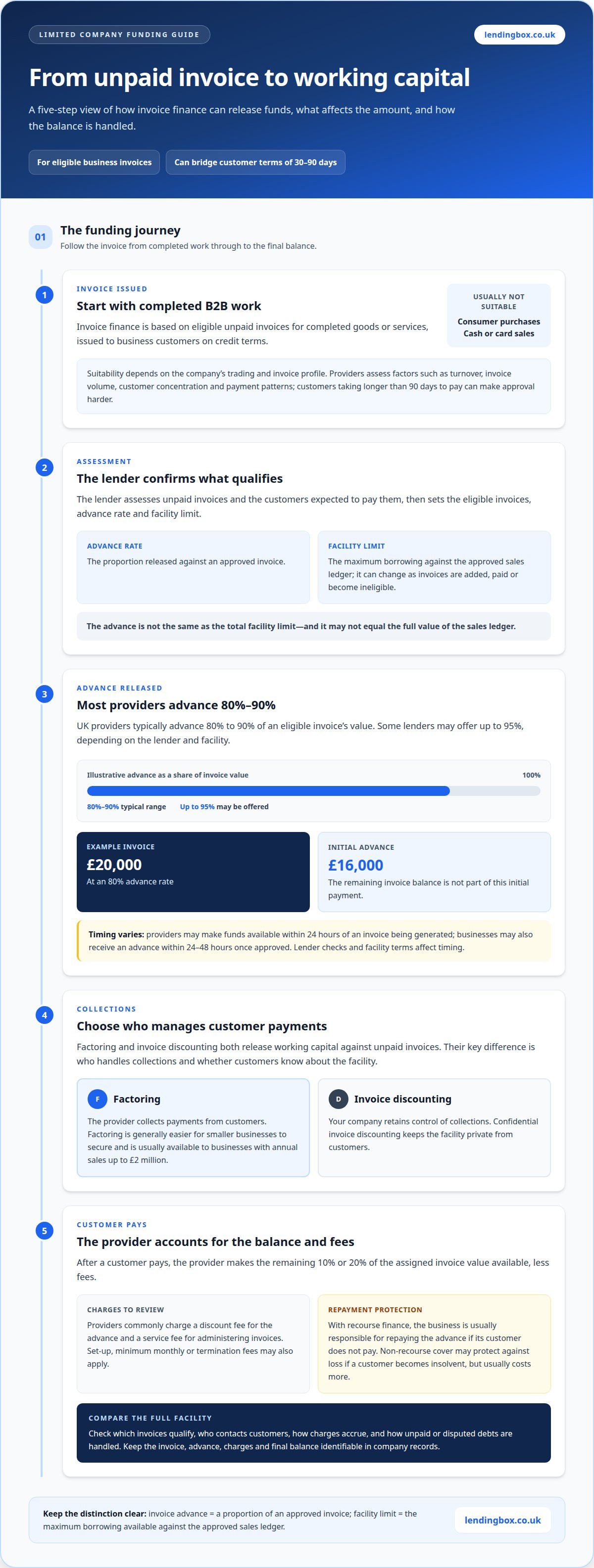
UK providers typically advance 80% to 90% of an eligible invoice’s value. Some lenders may offer up to 95%, depending on the lender and facility. The advance rate is the proportion released against an approved invoice, not the total limit available to the company.
For example, an invoice worth £20,000 could produce a £16,000 advance at an 80% rate. The remaining balance isn’t part of that initial payment. The customer still pays the invoice according to its agreed credit terms, while the facility applies its fees and release process.
A funding limit sets the maximum borrowing available against the approved sales ledger. It can change as invoices are added, paid or become ineligible. The amount a business can access depends on the lender’s assessment of the business and its debtor book.
How quickly can a UK limited company receive funds? Providers may make funds available within 24 hours of an invoice being generated. UK businesses can also receive an advance within 24 to 48 hours once approved. The timing depends on completing the lender’s checks and the invoice meeting the facility’s terms.
The lender assesses unpaid invoices and the customers expected to pay them, then confirms which invoices qualify, the advance rate and the facility limit. The amount advanced is not necessarily the full value of the sales ledger, so check how much working capital your company could access after the assessment.
Confidential facilities can preserve the company’s role in managing customer relationships, while selective options may offer flexibility over which invoices to fund. The right structure depends on the business’s cash-flow needs and how it handles collections. A considered invoice funding assessment can help clarify how an advance fits the company’s payment cycle.
What is invoice factoring?
Invoice factoring and invoice discounting both release working capital against unpaid invoices. The main differences are who manages customer collections and whether customers know about the facility.
Factoring and invoice discounting
With factoring, the provider collects payments from customers. With invoice discounting, your company retains control of collections, which may suit businesses that want to manage customer accounts themselves. Confidential invoice discounting keeps the facility private from customers. Compare collection responsibilities and confidentiality with your customer relationships and internal processes.
Fees and accounting treatment
Providers commonly charge a discount fee for the advance and a service fee for administering invoices. Set-up, minimum monthly or termination fees may also apply, so review the full facility terms rather than focusing on one charge. Invoice discounting is priced with interest and an administration fee; factoring charges are called a factor rate and reflect factors such as risk, invoice volume and credit duration.
For company accounts, keep the invoice, advance, charges and final balance identifiable. The entries depend on the facility’s structure and terms. Tax treatment also depends on the transaction and the company’s accounting position, so keep sales distinct from finance charges and repayments. Clear records make each movement of capital easier to trace.
After a customer pays, the provider makes the remaining 10 or 20 per cent of the assigned invoice value available, less fees. With recourse finance, the business is usually responsible for repaying the advance if its customer does not pay. Non-recourse cover may protect against loss if a customer becomes insolvent, but usually costs more.
Look beyond the headline advance when comparing facilities: consider who contacts customers, which invoices qualify, how charges accrue and how unpaid or disputed debts are handled. These terms affect both day-to-day operations and the balance ultimately returned to the company.
UK invoice finance and asset-based lending market
Invoice finance forms part of a wider UK market for working capital and asset-based lending. UK Finance represents more than 300 UK credit providers, including invoice finance companies. Its members provide well over £20 billion to UK client businesses at any one time. That scale shows how established these facilities are, but it doesn’t mean every company receives the same terms.
During 2024, invoice finance funded £21.5 billion to businesses across the UK, and more than 33,000 UK SMEs used it to help with growth. For a limited company, the practical value is managing cash flow while customer payments remain outstanding. The facility’s usefulness depends on the quality and spread of its sales ledger, not just the total invoice value.
One factor is customer concentration. UK invoice finance lenders commonly apply limits of 25% to 40% of the sales ledger for a single customer. If one debtor accounts for a large share, that cap can restrict how much of its invoices support the facility. A broad customer base can therefore affect available working capital, even when the total ledger is substantial.
Asset-based lending provides a wider funding context than invoices alone. Consider how invoice finance fits your cash-flow cycle alongside other business funding needs, rather than treating every facility as interchangeable. Understand which assets and sales support each arrangement, how credit control works and what happens to the remaining invoice balance after the customer pays.
For a business assessing its next step, map the funding need to the asset or receivable that supports it. Explore invoice finance options to consider how a facility could fit your company’s working capital needs.
Lending Box: Invoice finance
Lending Box matches UK limited companies and LLPs with business finance options, including invoice finance. The initial matching process has no impact on your credit score. There are no long forms before you see anything useful, and you can start with your company name with no obligation at any stage. One named relationship manager guides you through the options and application paperwork.
Invoice finance may suit your company when unpaid business invoices are holding up working capital. It is not suitable if you sell mainly to consumers, and concentration on one large customer can limit what is available. Other options include business loans, revenue-based finance and asset finance. The right fit depends on what you need to fund and how your business earns revenue.
Contact Lending Box to discuss invoice finance for your company.
Choose the next funding step with confidence
Start by identifying what your company needs to fund and how it trades. Consider whether you want to release cash against invoices, meet a broader business need or align repayments with revenue. This gives you a practical starting point for exploring invoice finance for limited companies and other suitable funding routes.
Lending Box can help you explore invoice finance alongside business loans and revenue-based finance. The service is free to the business, with Lending Box receiving a commission or finder’s fee from lenders. You’ll see products and fit, not a directory, with no lender names, no pressure.
There’s no need to settle on a facility before understanding how it could work for your business. Set out what you need the funding to support, then discuss the routes available with a relationship manager.
Contact Lending Box to discuss funding and take a clear next step for your company.
Frequently Asked Questions
Am I tied into a lengthy contract?
Contract length depends on the facility: whole-ledger factoring and discounting commonly run for six to twelve months. Some providers offer selective invoice finance on a pay-as-you-go basis, letting a business fund chosen invoices instead. Before agreeing, look at the minimum term, notice period, renewal arrangements and any exit charges. These terms affect how easily the facility can adapt if your cash-flow needs change.
Are there things I should be aware of or consider?
Invoice finance is not suitable if you sell mainly to consumers. Concentration on one large customer can limit what is available. Customer payment times can affect the overall cost of invoice finance, so consider how quickly your customers usually pay. Also consider who manages credit control, which invoices qualify and how the agreement handles disputed invoices. These details affect both daily operations and the funding available.
How am I protected if my customer won’t pay?
With recourse finance, your company is usually responsible for repaying the advance if its customer does not pay. Non-recourse arrangements may cover losses if a customer becomes insolvent, but that protection usually costs more and does not automatically cover every reason for non-payment. Check how the agreement defines covered losses, what evidence is needed and how it handles disputes or overdue invoices.
What is invoice finance for UK limited companies?
Invoice finance lets an eligible company access working capital against unpaid invoices for business sales made on credit. It can help bridge the gap between delivering work and receiving customer payment. To apply through Lending Box, a company must be a UK limited company or LLP that is active and registered at Companies House. The facility terms determine which invoices qualify and how customer payments are managed.
What is the difference between invoice factoring and invoice discounting?
With factoring, the finance provider collects customer payments; with discounting, your company keeps that responsibility. A business that wants its own team to manage customer accounts may prefer discounting. Confidential invoice discounting also keeps the facility private from customers. Compare collection arrangements and customer contact processes, not just the advance amount, when deciding what suits your operations.
How much does invoice finance cost in the UK, including fees and interest?
Costs depend on the facility and the time each advance remains outstanding. Indicative only. Subject to lender assessment and approval. Its pay-as-you-go model has no set-up or ongoing fees. Ask how the charges apply to your invoices and payment timings before accepting an offer.
Frequently Asked Questions
Contract length depends on the facility: whole-ledger factoring and discounting commonly run for six to twelve months. Some providers offer selective invoice finance on a pay-as-you-go basis, letting a business fund chosen invoices instead. Before agreeing, look at the minimum term, notice period, renewal arrangements and any exit charges. These terms affect how easily the facility can adapt if your cash-flow needs change.
Invoice finance is not suitable if you sell mainly to consumers. Concentration on one large customer can limit what is available. Customer payment times can affect the overall cost of invoice finance, so consider how quickly your customers usually pay. Also consider who manages credit control, which invoices qualify and how the agreement handles disputed invoices. These details affect both daily operations and the funding available.
With recourse finance, your company is usually responsible for repaying the advance if its customer does not pay. Non-recourse arrangements may cover losses if a customer becomes insolvent, but that protection usually costs more and does not automatically cover every reason for non-payment. Check how the agreement defines covered losses, what evidence is needed and how it handles disputes or overdue invoices.
Invoice finance lets an eligible company access working capital against unpaid invoices for business sales made on credit. It can help bridge the gap between delivering work and receiving customer payment. To apply through Lending Box, a company must be a UK limited company or LLP that is active and registered at Companies House. The facility terms determine which invoices qualify and how customer payments are managed.
With factoring, the finance provider collects customer payments; with discounting, your company keeps that responsibility. A business that wants its own team to manage customer accounts may prefer discounting. Confidential invoice discounting also keeps the facility private from customers. Compare collection arrangements and customer contact processes, not just the advance amount, when deciding what suits your operations.
Costs depend on the facility and the time each advance remains outstanding. Indicative only. Subject to lender assessment and approval. Its pay-as-you-go model has no set-up or ongoing fees. Ask how the charges apply to your invoices and payment timings before accepting an offer.