Revenue based funding for UK limited companies
21 November 2026 · 12 min read

 Business funding
A funding model that flexes with sales can still be the wrong fit. Revenue based funding for limited companies links repayments to an agreed share of business revenue, so payments vary with sales. It may suit a company with regular card takings, but businesses with little or no revenue may not qualify.
It’s understandable to want funding that supports growth without adding unnecessary pressure to cash flow. Look beyond the headline amount: understand how repayments are calculated, what the agreement requires and whether the business can manage the payments alongside its other costs.
This guide explains how revenue-based finance works for UK limited companies, which businesses may suit it and when another funding route could be a better fit. You’ll learn what shapes repayments and what to consider when comparing options, so you can assess the structure against your company’s cash flow.
Key Takeaways
- Understand how repayments linked to revenue can change with your sales, and which terms to examine before agreeing.
- Assess whether your trading pattern and recurring income make this type of finance a practical fit.
- Look beyond the repayment percentage to the total amount repayable and how the agreement handles slower sales.
- Recognise when limited or no revenue could make another funding route more suitable for your company.
What is Revenue-Based Finance?
Revenue-based finance gives a UK limited company an advance that is repaid through an agreed share of revenue, often from card takings. Payments are linked to turnover rather than being only fixed monthly instalments. The agreement sets the repayment share and term, so check how collections could affect cash flow across busy and quiet periods.
Unlike equity finance, this arrangement lets owners retain their shares. Unlike a traditional business loan, repayments can reflect sales; however, a bank loan may suit a company with a profitable trading record. Revenue-based financing can support growth, marketing or short-term cash-flow needs, but the total repayment and terms matter as much as flexibility.
Eligibility depends on the company’s trading and revenue pattern. Businesses with strong recurring income, such as SaaS, e-commerce and subscription companies, are often better suited than firms with irregular or limited sales. Revenue-based finance usually doesn’t require collateral or personal guarantees. UK lenders offering it assess business revenue and financial information, rather than using one universal eligibility rule.
Interest on a UK company’s commercial loan is generally deductible for corporation tax purposes under the loan relationship rules, according to HM Revenue & Customs. For FRS 102 accounting, funding proceeds are recorded as a liability, with payments allocated between principal and interest using the effective interest method. A company’s accountant can apply the relevant treatment to its accounts.
Applications usually involve connecting the business bank account through open banking. A broker can assess company data, provide eligibility insights without affecting credit scores, guide the company through available finance options and handle paperwork. The company should be ready to share relevant business and revenue information; the lender’s assessment determines the supporting documents required.
Suitability for seasonal businesses, startups and subscription businesses
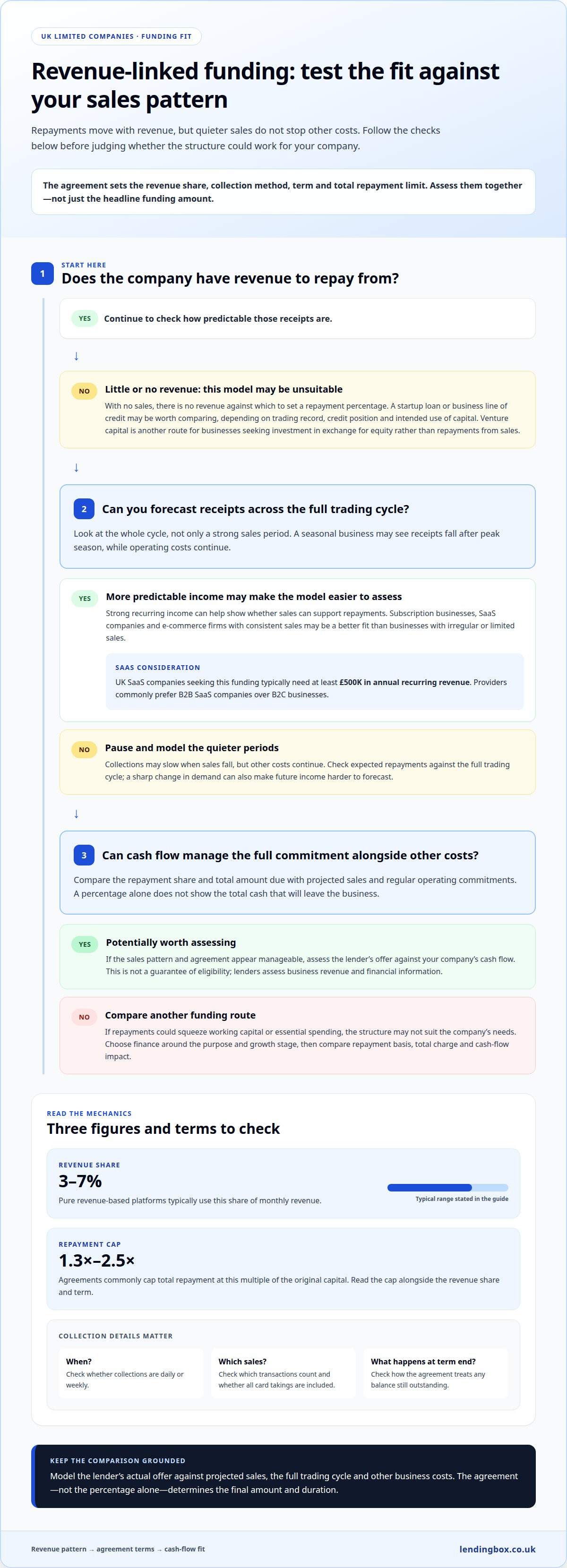
Revenue-based finance is easier to assess when a company can forecast income from its trading history. A seasonal business may earn most of its revenue during a short selling period, then see receipts fall. Repayments linked to sales can move with that pattern, but other costs continue during quieter months. Compare expected collections with the full trading cycle, not just peak-season income.
Subscription businesses can offer a clearer view of future receipts. UK SaaS companies seeking this funding typically need at least £500K in annual recurring revenue, and providers commonly prefer B2B SaaS companies over B2C businesses. Recurring contracts, customer retention and monthly revenue all help show whether income can support repayments. E-commerce firms with consistent sales may also fit, while a sharp change in demand can make future income harder to forecast.
Startups without revenue may find this model unsuitable because there are no sales against which to set a repayment percentage. A company still building its customer base might consider a startup loan or business line of credit instead, depending on its trading record, credit position and intended use of capital. Venture capital is another route for businesses seeking investment in exchange for equity, rather than repayments from sales.
For small and medium-sized businesses, choose finance around the need and growth stage. A company buying equipment has a different requirement from one funding marketing or managing a seasonal stock build-up. Compare the repayment basis, total charge and impact on working capital. A broker can assess how a company’s trading pattern aligns with available options; explore suitable funding routes when you’re ready to consider the next step.
Revenue-based funding mechanics and repayment structure
The agreement sets a revenue share, how payments are collected and the total repayment limit. The amount a UK limited company can borrow depends on its revenue, trading data and the terms offered.
Revenue Share and Repayment Multiples
A revenue share is the agreed percentage of turnover collected for repayment. Pure revenue-based platforms typically use a share of 3-7% of monthly revenue. The repayment multiple helps define the total amount due relative to the original funding. Consider both figures together: a smaller share may ease monthly cash flow, but the multiple defines the overall commitment.
The agreement sets the repayment share, how payments are collected and the total amount due. Before applying, check whether collections are taken daily or weekly, which transactions count and whether the share applies to all card takings. These details affect working capital and the company’s ability to meet other costs while funding growth.
Royalty Multipliers and Repayment Caps
A royalty multiplier converts the funding amount into the repayment target. Revenue-based agreements commonly cap total repayment at 1.3x-2.5x the original capital. The cap helps define the cost of success, but it should be read alongside the revenue share and agreement term.
Compare the total repayment with projected sales, not just the repayment share. A percentage alone does not show how much cash will leave the business over the full term. Check how the agreement handles the end of the term and any balance still outstanding. Make sure the company can meet the commitment without cutting essential spending.
Revenue-Linked Repayments
Consider a repayment sweep of 5% of turnover. This illustrates how collections can vary with sales. If repayments are linked to daily card sales, quieter trading periods can mean slower collections, although the agreement’s terms still determine the final amount and duration.
For a business with card takings, check which transactions count and when collections are taken. The actual repayment depends on the agreed share and contract terms, so use the lender’s offer to model the effect on cash flow. Compare it with regular operating commitments before proceeding.
Borrowing Amounts
There isn’t one borrowing amount that applies to every UK limited company. Providers assess revenue, trading performance and the company’s capacity to repay; a larger or less predictable income stream can change the amount and structure considered. The offer should be assessed against the funding purpose and the business’s forecast cash flow.
For a practical assessment, match the requested capital to a defined use, such as stock, marketing or expansion. Then review the proposed share, repayment multiple and collection method together. A company weighing revenue-based funding against a business loan should compare total repayments and payment timing, not just the headline amount or the chance of business success.
When revenue-based funding may be unsuitable
Revenue-linked repayments depend on sales. A company with no revenue may not suit this structure because there are no incoming sales from which to collect repayments. A pre-revenue business planning a launch should consider whether payments could start before trading income arrives. Without predictable receipts, the funding obligation may add pressure rather than support growth.
Thin profit margins create another difficulty. Repayments are based on turnover, not the profit left after wages, stock and rent. A retailer with strong sales but tight margins could therefore feel each collection more sharply than a higher-margin business. Check whether cash flow can cover repayments alongside essential operating costs throughout the trading cycle. Total cost is usually higher than a term loan. A high repayment share can squeeze working capital.
Seasonal companies should map quiet periods as carefully as peak months. A 5% share of turnover still removes cash when sales come in, even if monthly income is lower than forecast. Businesses with irregular contracts face a similar challenge: collections can move with revenue, but rent, payroll and supplier bills may remain due on schedule. Build those fixed commitments into the assessment before taking on funding.
Compare the agreement’s total repayment with the company’s expected cash generation. Revenue-based finance can cost more over the long run than traditional loans, so a profitable company with predictable income should compare both structures, including repayment timing and interest. It may also be a poor fit if the funding need centres on equipment: asset finance is designed around funding assets, while revenue-based repayments draw on business income.
Ownership is a separate consideration. Revenue-based finance lets owners retain shares, but that benefit doesn’t make the repayment burden suitable for every business. If sales are absent, margins are narrow or income fluctuates sharply, explore a different funding structure. Review revenue-based finance options alongside the company’s cash-flow needs before deciding.
Lending Box: Revenue-based finance
Lending Box helps active UK limited companies and LLPs registered at Companies House compare revenue-based finance with other business funding options. The initial matching process has no impact on your credit score, and there is no obligation at any stage. It is free to the business, with Lending Box receiving a commission or finder’s fee from lenders. One named relationship manager guides you through the options and paperwork.
If sales-linked repayments do not fit your cash flow, a business loan, invoice finance or asset finance may better match the need. The right option depends on what the company needs the capital for and how it expects to repay.
Contact Lending Box to discuss revenue-based finance for your company.
Choose a funding route that supports your next move
Before moving forward, connect the funding decision to a clear business objective. Decide what the capital needs to achieve, how repayments fit alongside planned spending and which terms matter most. This gives you a practical basis for assessing revenue based funding for limited companies, rather than focusing on the headline amount alone. If sales-linked repayments do not suit the company’s plans, compare a different funding structure.
Lending Box offers revenue-based finance, business loans and invoice finance, giving limited companies routes to consider around different funding needs. Its team can help you assess the options and guide you through the process. Take the next step when you’re ready: Contact Lending Box about funding. A clear view of your plans is a useful place to begin.
Frequently Asked Questions
What Are the Main Ways to Fund a Limited Company?
Common options include business loans, revenue-based finance, invoice finance and asset finance. Each addresses a different cash need: invoice finance releases funds against unpaid invoices, while asset finance supports an equipment purchase. Equity investment brings capital in exchange for shares. A company can narrow its choice by identifying whether it needs working capital, help with a specific asset or investment for expansion.
What is revenue-based funding for limited companies in the UK?
In the UK, revenue-based funding for limited companies is an advance repaid through an agreed share of business revenue, rather than by giving investors ownership shares. It is also known as merchant cash advance when repayments are linked to card takings. Only active UK limited companies and LLPs registered at Companies House may apply to Lending Box. The initial matching process has no impact on your credit score.
What are the eligibility requirements for revenue-based funding in the UK?
Providers assess trading activity, income patterns and the company’s ability to support repayments. SaaS businesses seeking this type of finance typically need at least £500K in annual recurring revenue. Lending Box accepts applications only from active UK limited companies and LLPs registered at Companies House. Stated documents include business bank statements covering 3-6 months, filed accounts or management figures, director ID and credit checks.
What are typical UK revenue-based funding fees, rates and repayment caps?
There isn’t one standard fee or repayment cap across UK agreements. Compare the total amount repayable, collection share and any stated charges in the written offer. Indicative only. Subject to lender assessment and approval. Lending Box’s revenue-based finance information gives a factor rate of 1.15-1.30 and a repayment share of 10%-15% of daily or weekly card takings. A factor rate is not an annual interest rate.
How are repayments calculated and collected for revenue-based finance?
Repayments are calculated as an agreed share of revenue, then collected according to the contract. For Lending Box’s revenue-based finance, the stated basis is daily or weekly card takings. Indicative only. Subject to lender assessment and approval. The repayment share is 10%-15%. Since collections follow card sales, businesses should account for the effect on cash available for stock, wages and other bills.
How does revenue-based funding compare with business loans, merchant cash advances and equity finance?
A business loan typically follows a defined repayment schedule, while revenue-based finance links collections to revenue. Merchant cash advance usually refers to funding repaid from card takings, so the term can overlap with revenue-based finance. Equity finance brings investment in return for shares and changes ownership. Compare the repayment basis, total amount payable and effect on future cash flow before choosing.
Frequently Asked Questions
Common options include business loans, revenue-based finance, invoice finance and asset finance. Each addresses a different cash need: invoice finance releases funds against unpaid invoices, while asset finance supports an equipment purchase. Equity investment brings capital in exchange for shares. A company can narrow its choice by identifying whether it needs working capital, help with a specific asset or investment for expansion.
In the UK, revenue-based funding for limited companies is an advance repaid through an agreed share of business revenue, rather than by giving investors ownership shares. It is also known as merchant cash advance when repayments are linked to card takings. Only active UK limited companies and LLPs registered at Companies House may apply to Lending Box. The initial matching process has no impact on your credit score.
Providers assess trading activity, income patterns and the company’s ability to support repayments. SaaS businesses seeking this type of finance typically need at least £500K in annual recurring revenue. Lending Box accepts applications only from active UK limited companies and LLPs registered at Companies House. Stated documents include business bank statements covering 3-6 months, filed accounts or management figures, director ID and credit checks.
There isn’t one standard fee or repayment cap across UK agreements. Compare the total amount repayable, collection share and any stated charges in the written offer. Indicative only. Subject to lender assessment and approval. Lending Box’s revenue-based finance information gives a factor rate of 1.15-1.30 and a repayment share of 10%-15% of daily or weekly card takings. A factor rate is not an annual interest rate.
Repayments are calculated as an agreed share of revenue, then collected according to the contract. For Lending Box’s revenue-based finance, the stated basis is daily or weekly card takings. Indicative only. Subject to lender assessment and approval. The repayment share is 10%-15%. Since collections follow card sales, businesses should account for the effect on cash available for stock, wages and other bills.
A business loan typically follows a defined repayment schedule, while revenue-based finance links collections to revenue. Merchant cash advance usually refers to funding repaid from card takings, so the term can overlap with revenue-based finance. Equity finance brings investment in return for shares and changes ownership. Compare the repayment basis, total amount payable and effect on future cash flow before choosing.