Business Loan Eligibility and Application Steps for New Borrowers
5 November 2026 · 11 min read

 Business funding
A first business loan application starts with a clear purpose and a realistic repayment plan. To understand how to apply for a business loan for the first time, work out how much the business needs, what the money will fund and how repayments could fit its cash flow. Lenders may assess credit history, time in business, revenue and any assets offered as security.
It’s sensible to feel cautious: a new business may have little trading or credit history to show, and that can make borrowing harder. It’s an unsecured personal loan, rather than a business loan.
This guide explains how to apply for a business loan for the first time, what lenders may consider and what information to prepare. You’ll learn how to define the amount and purpose, assess repayment affordability and move through an application with a clearer idea of what to expect.
Key Takeaways
- Map repayments against the business’s cash flow and understand the schedule and terms before borrowing.
- Review the factors lenders assess, including trading history, revenue, credit record and available security.
- Match the funding amount and type to the business’s needs, then account for borrowing costs and any applicable fees.
- Prepare a clear business plan that explains how the funds will be used and repaid before starting an application.
Am I eligible for a business loan?
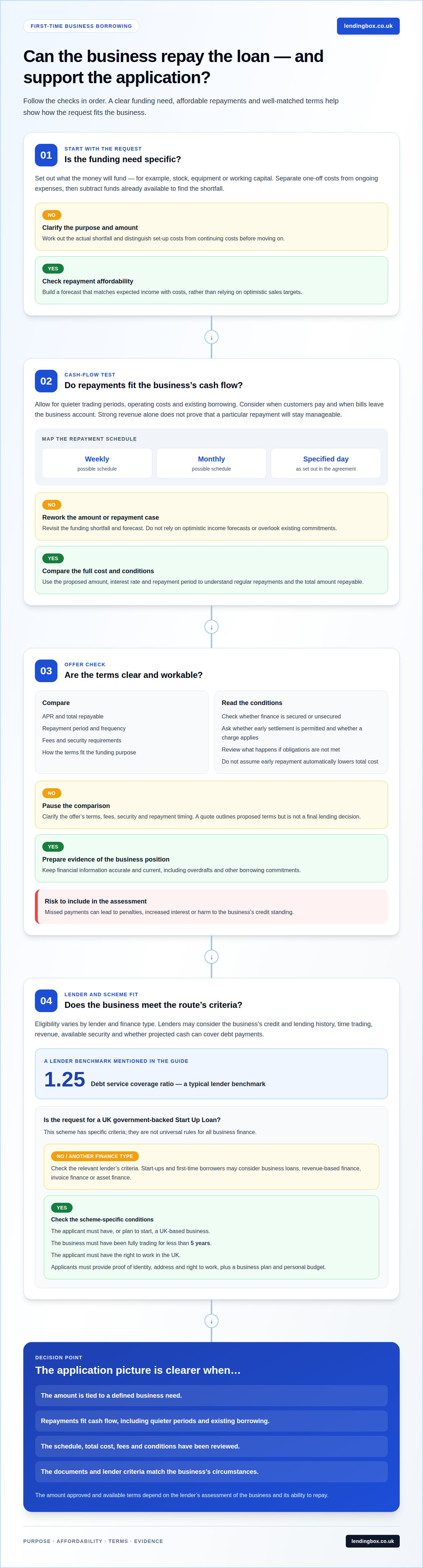
Eligibility depends partly on whether the business can afford repayments alongside its operating costs. Start by defining the amount required and what it will fund, then assess how repayments fit the business’s cash flow. Allow for quieter trading periods and existing borrowing. Lenders may also assess trading history, revenue, credit information and, for some finance, security. Strong revenue alone does not prove that a particular repayment will remain manageable.
Use a loan calculator to compare the amount borrowed, interest rate and repayment period. These examples show why it matters to check the total cost as well as the regular repayment. Actual repayments depend on the lender’s offer and agreement.
Check the schedule before accepting an offer. Repayments may fall weekly, monthly or on a specified day, as set out in the agreement. Match that timing to when customers pay and bills leave the business account. Review the full repayment period and how interest affects the total owed. Ask whether the agreement permits early settlement and whether a charge applies; product fees may also apply. Don’t assume paying early automatically reduces the total cost.
Read the conditions alongside the figures. An agreement may set out consequences if the business fails to meet its obligations. Missed payments can lead to penalties, increased interest or harm to the business’s credit standing. Include these risks in your affordability assessment, and avoid relying on optimistic income forecasts.
Eligibility requirements
Eligibility varies by lender and finance type. A clear application links the funding request to the business’s trading position and supporting documents.
Eligibility documents
For a UK government-backed Start Up Loan, applicants must provide proof of identity, address and their right to work in the UK. They also need a business plan and personal budget showing how they manage income and expenses. Prepare these details together so the application gives a consistent picture of the business’s plans and finances.
Other applications may be assessed against factors such as business credit, lending history, revenue, time trading and assets offered as security. Keep financial information accurate and current. Include any overdraft when setting out existing borrowing and commitments. Lenders need a clear view of the business’s finances, not just the amount requested.
Eligibility checks and loan quotes
An eligibility check helps assess whether your business and funding request fit a lender’s criteria. A quote can then outline the proposed amount, interest rate and repayment terms. Use a calculator to see how those terms affect the regular repayments, then compare the total cost and any fees before deciding.
A quote can help you understand a potential offer, but it is not a final lending decision. Read its conditions carefully. Check whether the finance is secured or unsecured, what information is needed for the full application, and whether the proposed repayments fit the business’s cash flow.
Trading history also matters. A new business may find borrowing harder because it has limited credit history and can appear higher risk. For a Start Up Loan, the applicant must have or plan to start a UK-based business that has been fully trading for less than 5 years, and must have the right to work in the UK. These criteria are specific to that government-backed scheme, rather than a universal rule for business finance.
Use the business finance options available to assess which funding route fits your company’s circumstances.
How do business loans work?
A business receives funding under agreed terms and repays it as set out in the agreement. The amount, cost and assessment depend on the finance type and the business’s circumstances.
Assessing borrowing needs
Separate start-up costs from ongoing costs before deciding how much to borrow. Account for equipment, premises, stock and working cash while customers’ invoices remain unpaid. Subtract funds already available to identify the shortfall. Then consider whether the business can manage its costs as it builds. A forecast that matches expected income with costs helps set a practical borrowing amount instead of relying on optimistic sales targets.
Borrowing limits and lender assessments
Smaller UK businesses are typically offered loans up to £500,000, while loans over £1 million are generally more accessible to businesses with higher turnover. Lenders may assess business credit, lending history, time trading, annual revenue and assets offered as security. They may also consider whether projected cash can cover debt payments. A debt service coverage ratio of at least 1.25 is a typical lender benchmark.
APR and loan terms
Compare the total amount repayable, repayment period and fees, not just the regular payment. This illustrates how interest adds to the amount borrowed. There is no single standard repayment period for new businesses: the lender’s agreement sets the term and schedule.
Loan types and lender comparisons
Start-ups and first-time borrowers may consider business loans, revenue-based finance, invoice finance or asset finance. A UK government-backed Start Up Loan is another option for eligible applicants. To compare lenders, review APR, total repayable, fees, security requirements and repayment frequency. Check each offer’s terms against the funding purpose and projected cash flow. The amount approved and available terms depend on the lender’s assessment of the business and its ability to repay.
Steps for applying for a business loan
A strong application connects the amount requested to a clear business need and repayment plan. Use these steps to present the business’s trading position, funding purpose and supporting information clearly.
- Define the funding need. Set out what the money will pay for, such as stock, equipment or working capital. Separate one-off costs from ongoing expenses, then calculate the shortfall after available funds. A specific request is easier to assess than a rounded figure without a stated purpose.
- Build the repayment case. Prepare a business plan explaining how the loan will be used and repaid. Include realistic income and cost projections, and show how repayments fit alongside existing commitments. For a UK Start Up Loan, applicants must also provide a personal budget showing how they manage personal income and expenses.
- Gather accurate application details. Have the company’s registered information and trading details ready, alongside relevant financial records. Lenders may assess annual revenue, lending history, business credit score, time trading and any assets offered as security. Check that the figures agree across the application and supporting documents. Gaps or inconsistent totals can make the business’s position harder to assess.
- Review the offer before accepting. Read the proposed amount, interest rate, repayment schedule, total cost and any applicable charge. Confirm whether the finance requires security or a guarantee, and review the conditions for repayment. Choose terms that fit the business’s cash flow, not simply the largest amount offered.
Be deliberate about applications. A poor business credit score is a common reason for rejection, and making several new applications immediately after a refusal could negatively affect the score. If an application is declined, applicants can ask the lender for its reasons within 30-60 days of the result. Use that feedback to address gaps before applying again.
Considering a business loan? Start a business loan application with a clear purpose and repayment plan.
Lending Box: Business loan
Lending Box helps UK limited companies and LLPs explore business funding options. Its in-house lending model analyses company data to provide eligibility insights without affecting credit scores. A dedicated relationship manager guides you through suitable options and handles the paperwork.
This support can be useful once you’ve defined the funding need but want help understanding the available routes. Alongside unsecured business loans, options include revenue-based finance, invoice finance and asset finance. The right fit depends on the business’s circumstances, funding purpose and ability to meet repayments.
Use the eligibility insights as a starting point, then review the terms and repayment obligations before proceeding. Lending Box matches businesses with finance options; it does not provide guaranteed approval. Contact Lending Box to discuss your business funding needs.
Take the next step with a clear funding goal
Before moving forward, define what success would look like after funding. It might mean completing a planned purchase, managing a cash-flow gap or supporting a new stage of growth. A clear outcome keeps the borrowing decision connected to the business, rather than making funding a goal in itself.
Knowing how to apply for a business loan for the first time also means knowing when practical support could help. Lending Box helps eligible UK limited companies and LLPs compare business funding options and understand possible routes. To take the next step, enter your company name online for an indicative quote, then decide whether to proceed.
Share your funding aims and business circumstances to start a focused conversation. Contact Lending Box to discuss funding. A considered decision can help you move ahead with greater clarity and confidence.
Frequently Asked Questions
How much can I borrow?
The amount depends on the finance type and lender assessment. These figures are indicative, not guaranteed offers. Indicative only. Subject to lender assessment and approval.
What are the eligibility requirements for a UK business loan?
To explore Lending Box’s business finance options, the business must be an active, registered UK limited company or LLP. A lender assesses the application, including factors such as trading activity, revenue, credit history and existing commitments. Requirements vary by finance type. If the business has little trading history, explain its operating model and expected income clearly.
What documents and financial information do UK lenders require?
To prepare for how to apply for a business loan for the first time, gather an active limited company registration, 3-6 months of bank statements, the latest filed accounts and director identification for credit checks. These records show how money moves through the business and help explain its trading position. Keep company details consistent across documents, and clarify unusual transactions for the lender.
How do I apply for a business loan in the UK step by step?
To understand how to apply for a business loan for the first time, begin by entering your company name on the Lending Box website for an indicative match. Review the options, then decide whether to proceed with a full application. Initial matching does not affect your credit score; a full credit search occurs only at full application with your agreement. A relationship manager guides you through the application and paperwork. There’s no obligation at any stage.
Can I get a business loan with no trading history or poor credit?
Limited trading history or poor credit can narrow the options, but bad-credit finance options are available. A lender assesses the wider business picture, including current trading, revenue, existing commitments and the funding purpose. For a new venture, a clear plan and realistic projections help explain how it expects to generate income. No single factor tells the whole story.
What risks should I consider before taking out a business loan?
Consider how repayments could affect working capital, especially if sales fall or customers pay late. Missed payments can lead to penalties, increased interest and damage to business credit. An unsecured business loan has no asset pledged as security, but a personal guarantee from directors is common and may put personal assets at risk if the business cannot repay. Check early settlement terms and all agreement conditions before signing.
Frequently Asked Questions
The amount depends on the finance type and lender assessment. These figures are indicative, not guaranteed offers. Indicative only. Subject to lender assessment and approval.
To explore Lending Box’s business finance options, the business must be an active, registered UK limited company or LLP. A lender assesses the application, including factors such as trading activity, revenue, credit history and existing commitments. Requirements vary by finance type. If the business has little trading history, explain its operating model and expected income clearly.
To prepare for how to apply for a business loan for the first time, gather an active limited company registration, 3-6 months of bank statements, the latest filed accounts and director identification for credit checks. These records show how money moves through the business and help explain its trading position. Keep company details consistent across documents, and clarify unusual transactions for the lender.
To understand how to apply for a business loan for the first time, begin by entering your company name on the Lending Box website for an indicative match. Review the options, then decide whether to proceed with a full application. Initial matching does not affect your credit score; a full credit search occurs only at full application with your agreement. A relationship manager guides you through the application and paperwork. There’s no obligation at any stage.
Limited trading history or poor credit can narrow the options, but bad-credit finance options are available. A lender assesses the wider business picture, including current trading, revenue, existing commitments and the funding purpose. For a new venture, a clear plan and realistic projections help explain how it expects to generate income. No single factor tells the whole story.
Consider how repayments could affect working capital, especially if sales fall or customers pay late. Missed payments can lead to penalties, increased interest and damage to business credit. An unsecured business loan has no asset pledged as security, but a personal guarantee from directors is common and may put personal assets at risk if the business cannot repay. Check early settlement terms and all agreement conditions before signing.