How to protect personal assets from business debt in the UK
2 November 2026 · 12 min read

 Business funding
A limited company can help separate business debts from your personal assets, but it is not a complete shield. A personal guarantee or property used as security can put your home and other assets at risk if the business cannot repay what it owes. Understanding how to protect personal assets from business debt in the UK starts with knowing exactly what you have agreed to secure.
It is reasonable to expect a company structure to create a clear boundary. The key is to understand where that boundary can be weakened, particularly when borrowing involves personal guarantees, ownership arrangements or property security.
This article explains how these protections work, what to review before signing finance documents and which steps can help manage your exposure. It covers when business debt can reach personal assets and how the family home may be affected.
Key Takeaways
- A limited company can separate business debts from your personal assets, but a personal guarantee may create a direct route to your finances.
- Keep business and personal finances clearly separate, and review borrowing terms before signing.
- Trusts change who owns and controls assets, but transfers made to frustrate creditors may be challenged.
- Before using your home as security, understand what the lender could claim if the business cannot repay.
1. Personal Guarantees and Business Debt: Could Your Family Home Be at Risk?
A UK private limited company is a separate legal entity. It can enter contracts, sue and be sued in its own name. The Companies Act 2006 establishes limited liability for shareholders, generally limiting their legal responsibility to the capital invested. If the company cannot pay, creditors can generally pursue company assets, not shareholders’ personal belongings. This separation makes the business structure an important choice for business owners.
Sole traders and partners do not have the same separation. A sole trader’s business and personal finances are not legally distinct, so business debts can expose personal assets. Partners may also face personal liability for partnership obligations. For limited-company directors, ordinary company debts do not automatically become personal debts. However, continuing to trade while insolvent can expose directors to personal liability for wrongful trading. During winding up, a court may, on a liquidator’s application, make a director contribute to company assets, according to the UK Government. Fraudulent conduct or abuse of limited liability can also put this protection at risk.
A personal guarantee creates another route to personal liability. If the company defaults, the lender can seek repayment from the guarantor under the guarantee’s terms. Before signing, identify the amount covered, how long the guarantee lasts and what circumstances trigger repayment. Setting up a limited company also brings formation and ongoing administration costs, including record-keeping and filings. Weigh those costs against the separation it provides: the structure does not cancel guarantees or directors’ responsibilities.
Insurance can help cover specified claims and losses, such as public liability claims or damage to business property. It does not replace a business’s loan repayment obligations. Read the policy scope, exclusions and limits, then match the cover to the risks your business faces.
UK business owners can seek free debt and insolvency advice from debt-advice charities and business support organisations. Ask specifically about company debts, personal guarantees and directors’ responsibilities. Early guidance can clarify your obligations before financial pressure escalates.
2. How do you protect assets?
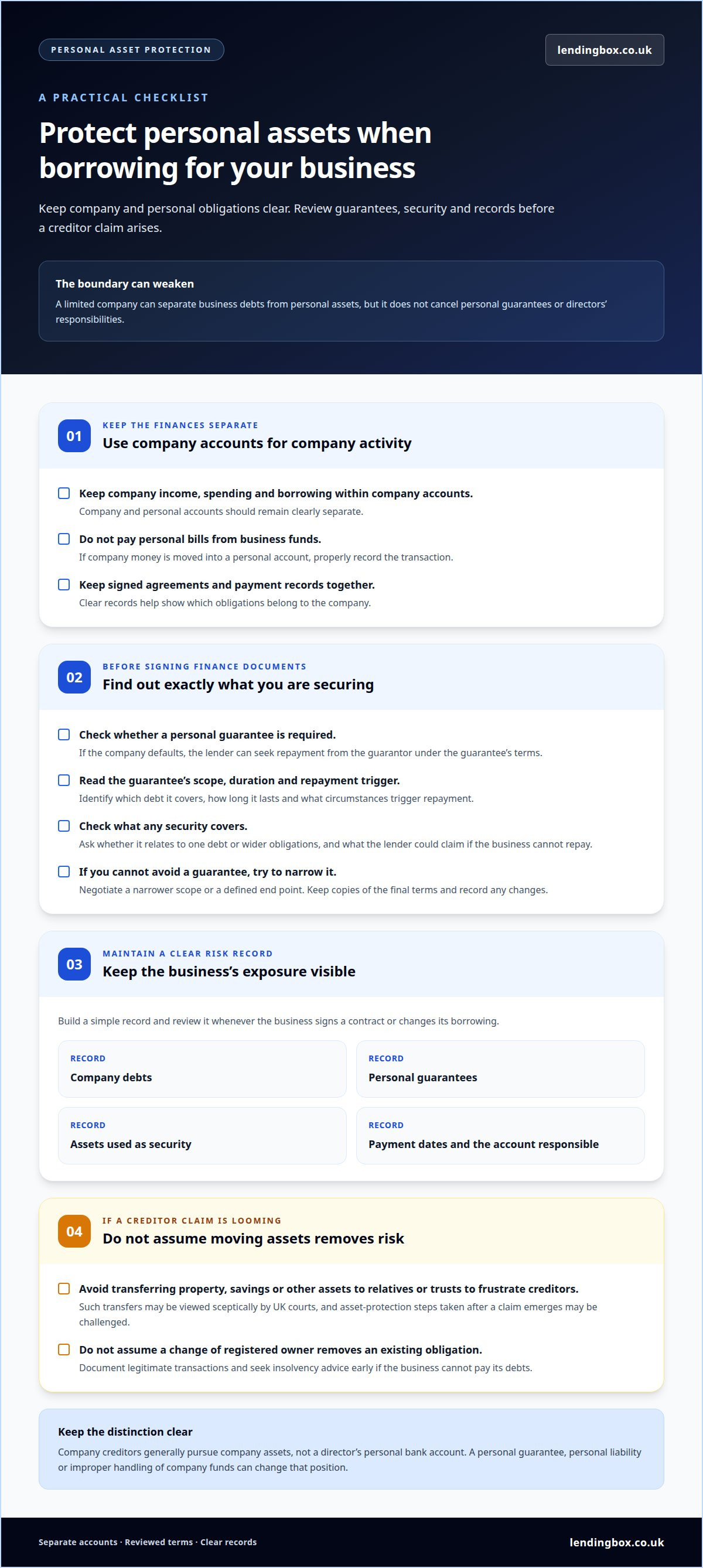
To reduce personal liability when borrowing or signing contracts, keep company and personal accounts separate, read every guarantee and negotiate its scope. A guarantee can make you personally responsible if the company defaults, so review the debt it covers, its duration and its trigger before signing. Keep signed agreements and payment records together to help show which obligations belong to the company.
Start with a practical safeguard: keep company income, spending and borrowing within company accounts. Do not pay personal bills from business funds or move company money into personal accounts without properly recording the transaction. Company creditors generally pursue company assets, not a director’s personal bank account. A personal guarantee, personal liability or improper handling of company funds can change that position. During winding up, a court may, on a liquidator’s application, make a director contribute to company assets, according to the UK Government and legislation.gov.uk.
Review contracts and credit terms before committing. Ask whether the facility requires a personal guarantee, whether security covers one debt or wider obligations, and which events trigger repayment. If you cannot avoid a guarantee, negotiate a narrower scope or a defined end point. Keep copies of the final terms and record any changes. This helps you understand your exposure before a creditor makes a claim.
Avoid transferring property, savings or other assets to relatives or trusts when a creditor claim is looming. Transfers made to frustrate creditors may be viewed sceptically by UK courts, and asset-protection steps taken after a claim emerges may be challenged. Do not assume that changing an asset’s registered owner removes an existing obligation. Instead, document legitimate transactions and seek insolvency advice early if the business cannot pay its debts.
Build a simple record of risk: list company debts, guarantees, secured assets, payment dates and the account responsible for each payment. Review it whenever the business signs a contract or changes its borrowing. Sound financial and administrative policies cannot erase existing liabilities, but they can help you act responsibly and spot mounting pressure before missed payments lead to creditor action.
3. Trusts and separation of ownership from control
A trust separates legal ownership from the right to benefit from an asset. A trustee holds and manages the property under the trust’s terms, while beneficiaries receive the rights set out in its agreements. For example, a business owner who transfers an investment into a trust gives up direct ownership and control. The trustee then has legal duties, and liabilities can fall on them depending on the type of trust. This is a significant change, not a simple shield that leaves the owner’s position untouched.
The trust’s structure shapes how assets are managed. A discretionary trust gives trustees flexibility over distributions between beneficiaries. A bare trust offers a more direct arrangement, often used for a child, with the beneficiary entitled to the asset. The Trustee Act 2000 forms part of the UK framework governing trustees’ duties. Before transferring property, document its value, ownership, purpose and the beneficiaries’ rights. Review how the trust contract interacts with existing loan or security agreements.
Trusts can help separate personal and business assets, but they don’t erase existing creditor claims. The Insolvency Act 1986 is identified as a basis for setting aside trusts established solely to frustrate creditors. Timing and purpose matter: creating a trust after a claim arises is not a reliable way to shield assets. Keep records showing the genuine reason for any transfer, and consider the impact on tax and control before acting.
Offshore asset-protection trusts may be established in places such as the Cook Islands or Nevis. A foreign location does not remove UK obligations or make a trust immune to legal claims. Cross-border ownership can also add complexity around enforcement, administration and tax. Compare this route with UK options, such as holding property as tenants in common, where owners have defined shares. Each approach changes rights differently. Before signing trust documents or transferring ownership, take advice on the asset, existing contracts, creditor position and intended beneficiaries.
4. Personal assets and the family home as security
Limited liability separates company debts from your personal wealth, but it does not cancel security you have agreed to provide. If a lender takes a charge over your home, the property itself may secure business borrowing. If the company defaults, the lender can use the rights set out in the agreement to seek repayment. The risk depends on the signed terms, the property covered and the outstanding debt.
Before signing, identify whether the document creates a personal guarantee, a charge over property or both. Check which debts are covered, whether the security extends to future borrowing, and what counts as a default under the contract. Ask how the lender may enforce the charge and whether another owner must consent. Keep the signed documents with your company’s borrowing records. Forming a limited company alone will not remove security you have personally agreed to give.
Ownership matters too. In England and Wales, tenants in common hold defined shares in a property, rather than owning it jointly in equal, undivided interests. A charge may affect the property or an owner’s interest according to its terms. Review the title and ownership arrangements before using a home as security. Do not assume that transferring a share after borrowing will undo an existing lender’s rights.
The family home can also matter after death. Depending on the guarantee’s wording, a lender may claim against a guarantor’s estate. In the Scottish Widows and YouGov 2026 survey, 14% of UK business owners with debt expected personal security to be used if they died; 9% expected a charge against personal assets. These findings underline why owners should record guarantees, charges and repayment obligations as part of estate planning.
For business borrowing secured against property, compare the proposed security with the repayment plan and the assets exposed. Explore property-secured business finance as one financing route, and weigh its security terms against unsecured alternatives before committing.
Lending Box: Business loan
Lending Box helps UK limited companies and LLPs compare business finance options, including business loans, revenue-based finance, invoice finance and asset finance. Its in-house lending model analyses company data to provide eligibility insights in minutes without impacting credit scores.
Consider finance when you need working capital, want to fund equipment or need to manage cash flow. The right structure depends on your business needs and ability to repay. Before proceeding, review whether an option involves a personal guarantee or security over personal property. Finance can support business plans, but it does not remove existing liabilities or automatically protect personal assets.
A dedicated relationship manager guides you through suitable options and paperwork. Share your funding need and discuss the terms, including any personal exposure, before making a decision. Contact Lending Box to discuss business finance for your company.
Make your next funding decision with clarity
Protecting personal wealth starts before your next borrowing decision. Set a clear boundary for what the business can repay, what security you are willing to offer and which terms need closer review. Record those limits alongside your cash-flow forecast, then use them to assess each proposed facility. This gives you a practical basis for discussing finance without losing sight of your personal exposure.
Understanding how to protect personal assets from business debt in the UK is not about avoiding every business risk. It is about making deliberate choices, documenting commitments and acting early when repayment pressure changes. If you are weighing finance options, Lending Box can help you compare whole-of-market funding options for your business and understand the paperwork involved.
Contact Lending Box to discuss your options. Take the next step with a clearer view of the commitments involved and a plan that fits your business.
Frequently Asked Questions
How do you protect assets?
Start by listing each personal asset, its legal owner and any security already attached. Then compare that list with company borrowing documents and contracts, especially the wording of any guarantee. This practical review helps you understand how to protect personal assets from business debt in the UK before signing further commitments. Keep copies of signed documents and update the record whenever ownership or borrowing changes.
What is a Private Limited Company?
A private limited company is a business incorporated as a legal entity separate from its shareholders. It can hold assets and enter contracts in its own name. The same person may be both director and shareholder, but those roles carry different responsibilities. Check the company’s articles of association and Companies House record to understand its governance and identify who can make decisions or sign agreements.
Personal Guarantees and Business Debt: Could Your Family Home Be at Risk?
Yes, if you personally guarantee a company debt or give the lender security over your home. These are separate commitments: a guarantee makes you responsible under its terms, while property security gives the lender rights over the property. Read the signed documents to identify the debt covered, enforcement triggers and any limits. A company’s limited liability does not cancel a personal commitment you have made.
Can a business creditor take money from a director’s personal bank account?
Not simply because the person is a director. A company creditor needs a basis to pursue that director personally, such as an applicable personal guarantee or a court order establishing personal liability. Keep personal and company transactions clearly recorded, particularly where a director pays a company bill personally or receives a company payment. If a creditor makes a personal demand, compare it with the relevant contract and evidence.
Is a director’s spouse responsible for the company’s debts?
No, marriage alone does not make a spouse liable for company borrowing. A spouse may take on a separate obligation by signing a guarantee or agreeing to property security. If a home has joint owners, check who signed the finance and security documents and which property interests they cover. Keep each person’s signed agreements available so any lender claim can be assessed against the actual commitments.
What About Trust Structures?
A trust changes who legally holds an asset and who benefits from it. The trust deed sets out the trustee’s powers, beneficiaries’ rights and how assets may be distributed. Before transferring property, review existing lending agreements, tax implications and the trustee’s duties. A trust created to defeat creditor claims may be challenged, so it should reflect a genuine purpose and be properly documented, not treated as a last-minute shield.
Frequently Asked Questions
Start by listing each personal asset, its legal owner and any security already attached. Then compare that list with company borrowing documents and contracts, especially the wording of any guarantee. This practical review helps you understand how to protect personal assets from business debt in the UK before signing further commitments. Keep copies of signed documents and update the record whenever ownership or borrowing changes.
A private limited company is a business incorporated as a legal entity separate from its shareholders. It can hold assets and enter contracts in its own name. The same person may be both director and shareholder, but those roles carry different responsibilities. Check the company’s articles of association and Companies House record to understand its governance and identify who can make decisions or sign agreements.
Yes, if you personally guarantee a company debt or give the lender security over your home. These are separate commitments: a guarantee makes you responsible under its terms, while property security gives the lender rights over the property. Read the signed documents to identify the debt covered, enforcement triggers and any limits. A company’s limited liability does not cancel a personal commitment you have made.
Not simply because the person is a director. A company creditor needs a basis to pursue that director personally, such as an applicable personal guarantee or a court order establishing personal liability. Keep personal and company transactions clearly recorded, particularly where a director pays a company bill personally or receives a company payment. If a creditor makes a personal demand, compare it with the relevant contract and evidence.
No, marriage alone does not make a spouse liable for company borrowing. A spouse may take on a separate obligation by signing a guarantee or agreeing to property security. If a home has joint owners, check who signed the finance and security documents and which property interests they cover. Keep each person’s signed agreements available so any lender claim can be assessed against the actual commitments.
A trust changes who legally holds an asset and who benefits from it. The trust deed sets out the trustee’s powers, beneficiaries’ rights and how assets may be distributed. Before transferring property, review existing lending agreements, tax implications and the trustee’s duties. A trust created to defeat creditor claims may be challenged, so it should reflect a genuine purpose and be properly documented, not treated as a last-minute shield.