Invoice finance options for construction firms
3 November 2026 · 12 min read

 Invoice finance
Completed work doesn’t always mean cash in the bank. Invoice finance for a small construction company can release working capital against unpaid business invoices, while clients may take 30, 60 or even 90 days to pay. The advance is an agreed percentage of the invoice value, with the balance, less fees, available when the customer pays.
Payment delays can make it harder to cover wages, materials and other costs as a project progresses. Invoice finance can bridge the gap between completing work and receiving payment, but the details depend on the facility.
This guide explains construction invoice finance, the difference between factoring and discounting, and what to consider when comparing costs and terms. It also covers how invoice funding can support working capital and when another type of finance may fit better.
Key Takeaways
- Learn how funding against unpaid invoices can help bridge the gap between completing work and receiving payment.
- Compare factoring and discounting to understand the differences in customer visibility and day-to-day control.
- Assess how payment terms, invoice types and facility fees can affect whether this funding suits your business.
- See how to weigh invoice finance against other options when planning working capital for projects.
What is construction invoice finance?
Construction invoice finance advances funds against eligible unpaid invoices before customers settle them. The agreement defines the advance, eligible invoices and repayment process. For invoice finance for small construction company owners, the key question is whether the firm’s invoices meet the facility’s criteria.
Funding limits and customer credit terms
A finance provider assesses turnover, invoice values and how reliably customers pay. A traditional invoice finance facility would generally not suit businesses with annual turnover below £300,000. The customer’s creditworthiness also matters, particularly with factoring, where advances are based on clients’ creditworthiness rather than the construction company’s. Business-to-business credit terms are usually required; customers paying beyond 90 days may affect approval. This shapes the funding available to invoice finance for small construction company contractors.
Staged invoices and payment applications
Construction contracts often bill by project stage rather than after the whole job is complete. Some UK providers fund sales invoices or, in some cases, applications for payment. An application requests payment for completed work, but may need approval before it becomes an invoice. Check how the agreement treats each stage, certification requirements and disputed amounts. This clarifies which project documents can support funding.
Fees, interest rates and risks
Providers typically charge a service fee for managing the facility and a discount fee on funds accessed. The rate and total cost depend on the agreement, how the facility is used and customer payment behaviour. Compare the charges with the cash-flow benefit, not just the initial advance. Fees may reduce the balance released when the customer pays, while delayed or disputed invoices can disrupt expected cash flow. Check how the agreement handles these situations.
Main contractors and subcontractors should expect an assessment of turnover, contract terms, invoice records and customers’ ability to pay. Prepare business accounts, a debtor list, sample invoices and relevant contracts or payment applications. Submit them for assessment, review the proposed facility terms and agree which receivables can be assigned.
Rules, contracts and application steps
Construction tax and VAT processes affect invoice paperwork, but invoice finance does not replace tax obligations. Under the Construction Industry Scheme, contractors send a 20% tax deposit to HM Revenue & Customs instead of 30%. The UK VAT domestic reverse charge was introduced on 1 March 2021, according to HM Revenue & Customs. Make sure contract terms and invoices reflect the relevant treatment.
To apply, organise financial records, contracts and outstanding invoices, then submit them for assessment. Before accepting an advance, review the agreement’s eligible-invoice rules, fees and responsibilities.
Invoice factoring and invoice discounting
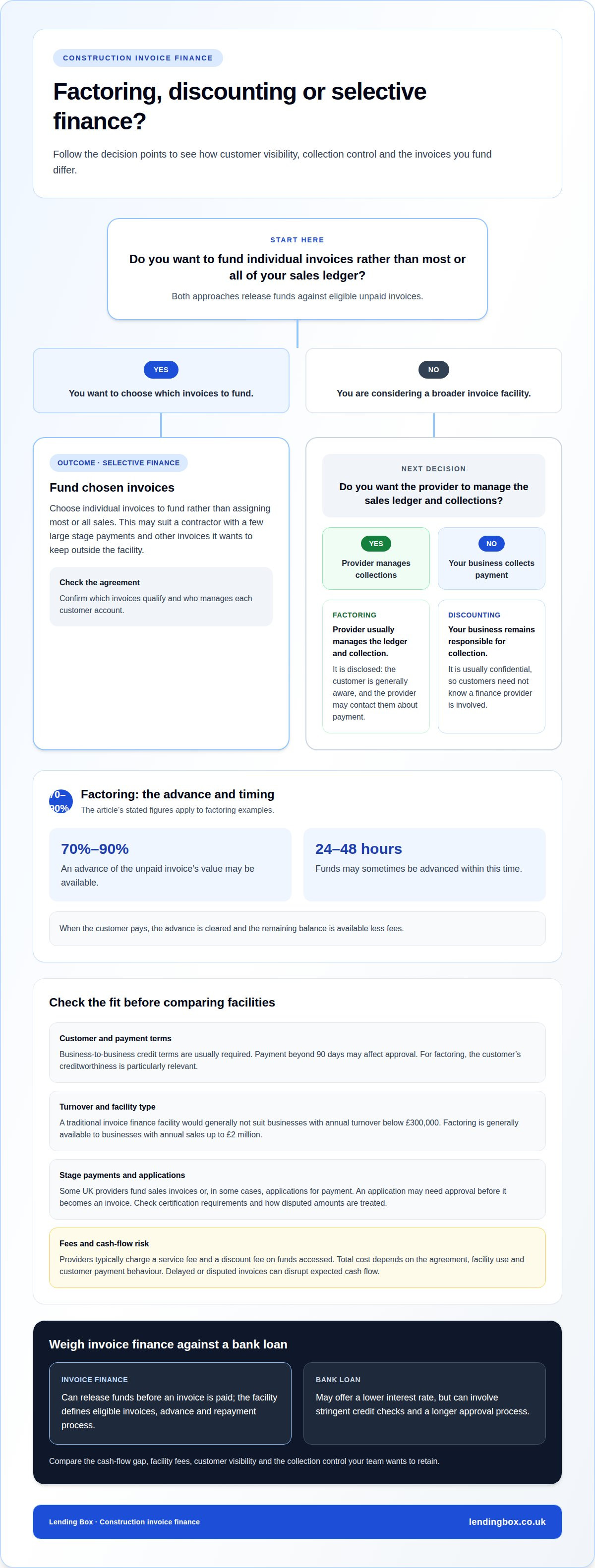
Both options release cash against unpaid invoices, but differ in customer visibility and who manages collections. Selective finance adds flexibility by funding chosen invoices instead of the whole sales ledger.
Factoring, discounting and selective finance
With invoice factoring, the finance provider advances funds and usually manages the sales ledger and collection. It’s also called disclosed invoice finance, because the client is generally aware of the arrangement. Construction firms may receive an advance of 70% to 90% of an unpaid invoice’s value, sometimes within 24 to 48 hours.
Invoice discounting advances funds while the business remains responsible for collecting payment. Selective invoice finance lets a firm choose individual invoices to fund rather than assigning most or all sales. This may suit a contractor with a few large stage payments and other invoices it wants to keep outside the facility. Compare which invoices qualify and who manages each customer account.
Factoring compared with invoice discounting
The key choice is control versus customer visibility. Factoring is disclosed, and the provider may contact customers about payment. Discounting is usually confidential, so customers need not know a finance provider is involved. Both can release funds before an invoice is paid; the advance is cleared when the customer settles the invoice.
Factoring can suit smaller firms that want support managing collections. It is generally available to businesses with annual sales up to £2 million. Discounting may suit firms with the capacity to manage their own ledger and customer relationships. Selective funding can narrow the facility to particular transactions. Check the agreement for eligible invoices, collection responsibilities and what happens if payment is delayed beyond 90 days.
Compared with invoice factoring, a bank loan may offer a lower interest rate, but can involve stringent credit checks and a longer approval process. The right finance solution depends on the cash-flow gap and the control your team wants to retain. Explore construction invoice finance options as one way to compare suitable approaches.
What is construction invoice finance?
Construction invoice finance releases an agreed advance against eligible unpaid invoices, with the balance settled after the customer pays. For invoice finance for small construction company owners, it can bridge the gap between completing work and receiving cash. The agreement defines which invoices qualify, the advance and how repayment works.
Funding limits and customer credit terms
A finance provider considers turnover, invoice values and customer payment records when assessing a facility. A traditional invoice finance facility would generally not suit businesses with annual turnover below £300,000. A provider may consider a construction company’s customers’ creditworthiness when assessing a factoring facility. Business-to-business credit terms are usually needed, and payment delays beyond 90 days may affect approval. These criteria shape funding for invoice finance for small construction company contractors.
Staged invoices and payment applications
Construction contracts often bill by project stage instead of after the whole job is complete. Some UK providers fund sales invoices or, in some cases, applications for payment. An application requests payment for completed work, but may need approval before becoming an invoice. Review how the agreement treats stage claims, certification and disputed amounts. This clarifies which project records support an advance and whether payment timing fits the facility.
Fees, interest rates and risks
Providers typically charge a service fee for managing a facility and a discount fee on funds accessed. Total costs depend on the agreement, facility use and customer payment behaviour. Compare the charges with the cash-flow benefit, not just the advance. Fees reduce the balance released when the customer pays, while delayed or disputed invoices can disrupt expected cash flow. Review how the agreement handles these situations.
Main contractors and subcontractors are assessed on turnover, contract terms, invoice records and customers’ ability to pay. Prepare business accounts, a debtor list, sample invoices and relevant contracts or payment applications. Submit these for assessment, review the proposed terms, then agree which receivables can be assigned.
Rules, contracts and application steps
Construction tax and VAT processes affect invoice paperwork, but finance does not replace tax obligations. Under the Construction Industry Scheme, contractors send a 20% tax deposit to HM Revenue & Customs instead of 30%. The UK VAT domestic reverse charge was introduced on 1 March 2021, according to HM Revenue & Customs. Ensure contracts and invoices reflect the relevant treatment.
To apply, organise financial records, contracts and outstanding invoices, then submit them for assessment. Compare invoice finance with a business loan or asset finance by matching the funding to its purpose: unpaid customer bills, general business costs or equipment. Review eligible-invoice rules and responsibilities before accepting an advance.
Construction invoice finance and working capital
Working capital is the cash available for current operating costs, not simply the value of work booked. Construction firms can have completed work and strong order books whilst cash remains tied up in outstanding invoices. Late payments caused 28% of insolvencies in the UK construction sector in 2023. The practical issue is timing: suppliers, payroll and project costs still need funding before the client pays.
Invoice finance can bring part of an invoice’s value forward, giving the firm cash to manage the gap. The remaining amount is released after the customer pays, less fees and charges. This can make funds available for materials on the next job rather than waiting for payment from the previous project.
Use the facility alongside a cash-flow forecast, not as a substitute for one. Map expected invoice payments against wages, supplier bills, tax liabilities and project milestones. Then identify which outstanding invoices could cover the largest near-term costs. A finance provider can assess eligible invoices and facility terms; include fees when estimating the net cash released.
Invoice finance can support growth when new contracts require spending before customer payments arrive. It can also create repayment dependency: if a client pays late, expected funds may arrive later while costs continue. Track payment dates and debtor concentration alongside the sales ledger. If one main contractor accounts for much of the balance, factor that exposure into working-capital planning.
Build a project-by-project forecast before choosing how much capital to draw. Compare the timing of each advance with the costs it must cover, then review the facility as work and payment patterns change. Explore invoice finance options to consider how funding could fit your construction cash-flow plan.
Lending Box: Business loan
Lending Box helps construction firms compare invoice finance with business loans and other funding options. It matches UK limited companies and LLPs with finance across the market, using company data to provide instant eligibility insights without impacting credit scores for the initial match.
Consider Lending Box when weighing a longer-term borrowing need against cash tied up in unpaid invoices. A dedicated relationship manager guides you through business loan, invoice finance, revenue-based finance and asset finance options, and handles the paperwork. This can help you assess which route best fits your cash-flow needs and business plans.
Visit Lending Box to discuss finance options for your construction business.
Choose funding that fits your next project
Before choosing a facility, map upcoming project costs against expected customer receipts. Consider whether the main pressure comes from waiting on invoices, investing in equipment or funding broader growth. This can help you decide whether invoice finance, a business loan or revenue-based finance best matches the need.
For a small construction company, invoice finance can be one part of a wider funding plan. The right structure should fit the firm’s contracts, payment patterns and cash-flow priorities. Lending Box offers invoice finance, business loans and revenue-based finance, giving you options to consider alongside your project plans.
Discuss your funding needs and explore the available routes. Contact Lending Box about invoice finance and take a considered next step for your business.
Frequently Asked Questions
Who can get a facility?
UK contractors and subcontractors selling work to business customers on credit terms may qualify. A provider looks at the invoices, customer payment record, turnover and contract structure. A traditional facility would generally not suit a business with annual turnover below £300,000. Firms should also consider whether their customers pay within the facility’s accepted terms and whether the receivables are clear and supported by project records.
How does invoice finance work for a small construction company in the UK?
A firm submits eligible invoices to a finance provider, which advances an agreed share before the customer pays. The business can use the cash for operating costs while the invoice remains due from its customer. When payment arrives, the advance is cleared and the remaining balance, less fees, is released. For a staged project, match each invoice to its work records and payment approval.
What types of invoice finance are available to UK construction firms?
The main options are factoring, invoice discounting and selective invoice finance. Factoring usually involves disclosed customer contact and provider-managed collections; discounting is generally confidential, with the business managing its own ledger. Selective finance lets a firm choose particular invoices rather than funding most or all transactions. The practical choice depends on how much collection control the contractor wants to retain and which receivables need funding.
How much funding can a small construction company get against its invoices?
Construction businesses may receive an invoice factoring advance of 70% to 90% of an unpaid invoice’s value. The precise advance depends on invoice eligibility, customer creditworthiness and the facility agreement. The balance becomes available after the customer pays, less applicable charges, so plan using the net amount.
Can construction firms finance applications for payment, retentions, or disputed invoices?
Some construction finance providers may fund applications for payment, but these are not automatically treated like approved invoices. Retentions and disputed amounts also need separate consideration: payment timing, contract wording and whether the amount is accepted all affect eligibility. Keep application records, certification and correspondence together. A clear audit trail helps distinguish payment due for completed work from an amount still under review or withheld under contract terms.
How does invoice finance compare with a business loan or asset finance for a UK builder?
Invoice finance links funding to eligible unpaid customer invoices, so available cash follows the sales ledger. A business loan provides borrowing for broader needs, with repayments set by the loan agreement. Asset finance is geared towards equipment and other business assets. A builder planning to buy machinery may compare asset finance, while a firm bridging delayed customer receipts may consider invoice finance alongside its cash-flow forecast.
Frequently Asked Questions
UK contractors and subcontractors selling work to business customers on credit terms may qualify. A provider looks at the invoices, customer payment record, turnover and contract structure. A traditional facility would generally not suit a business with annual turnover below £300,000. Firms should also consider whether their customers pay within the facility’s accepted terms and whether the receivables are clear and supported by project records.
A firm submits eligible invoices to a finance provider, which advances an agreed share before the customer pays. The business can use the cash for operating costs while the invoice remains due from its customer. When payment arrives, the advance is cleared and the remaining balance, less fees, is released. For a staged project, match each invoice to its work records and payment approval.
The main options are factoring, invoice discounting and selective invoice finance. Factoring usually involves disclosed customer contact and provider-managed collections; discounting is generally confidential, with the business managing its own ledger. Selective finance lets a firm choose particular invoices rather than funding most or all transactions. The practical choice depends on how much collection control the contractor wants to retain and which receivables need funding.
Construction businesses may receive an invoice factoring advance of 70% to 90% of an unpaid invoice’s value. The precise advance depends on invoice eligibility, customer creditworthiness and the facility agreement. The balance becomes available after the customer pays, less applicable charges, so plan using the net amount.
Some construction finance providers may fund applications for payment, but these are not automatically treated like approved invoices. Retentions and disputed amounts also need separate consideration: payment timing, contract wording and whether the amount is accepted all affect eligibility. Keep application records, certification and correspondence together. A clear audit trail helps distinguish payment due for completed work from an amount still under review or withheld under contract terms.
Invoice finance links funding to eligible unpaid customer invoices, so available cash follows the sales ledger. A business loan provides borrowing for broader needs, with repayments set by the loan agreement. Asset finance is geared towards equipment and other business assets. A builder planning to buy machinery may compare asset finance, while a firm bridging delayed customer receipts may consider invoice finance alongside its cash-flow forecast.