Business loan with a new CCJ: which options could you get
4 November 2026 · 11 min read

 Business funding
A new CCJ does not automatically rule out a UK business loan. You may still be able to borrow, although some lenders decline applications with a recent, unpaid judgment and your options may be narrower. A CCJ can stay on your UK credit file for six years from registration; paying it in full within 30 days means it is removed from the register.
If you’re wondering whether you can get a business loan with a new CCJ, the answer is yes, in some cases. Lenders may consider whether the judgment is satisfied, how recently it was registered, and your business’s cash flow and assets. A recent unpaid CCJ can make borrowing harder, but it does not tell the whole story.
This guide explains how a new CCJ can affect eligibility, which types of finance may fit different circumstances, and why the judgment’s status and age matter. It also covers how long a CCJ can remain on your credit file, helping you understand the next steps before considering an application.
Key Takeaways
- A CCJ doesn’t automatically close off business borrowing, but an unpaid judgment can narrow your options.
- Asset finance and invoice finance may be worth considering when standard lending is harder to access.
- Lenders may weigh your trading performance, cash flow and available assets alongside the CCJ.
- Understand how unsecured specialist lending differs before deciding which type of finance best fits your business.
How long does a CCJ stay on your credit file?
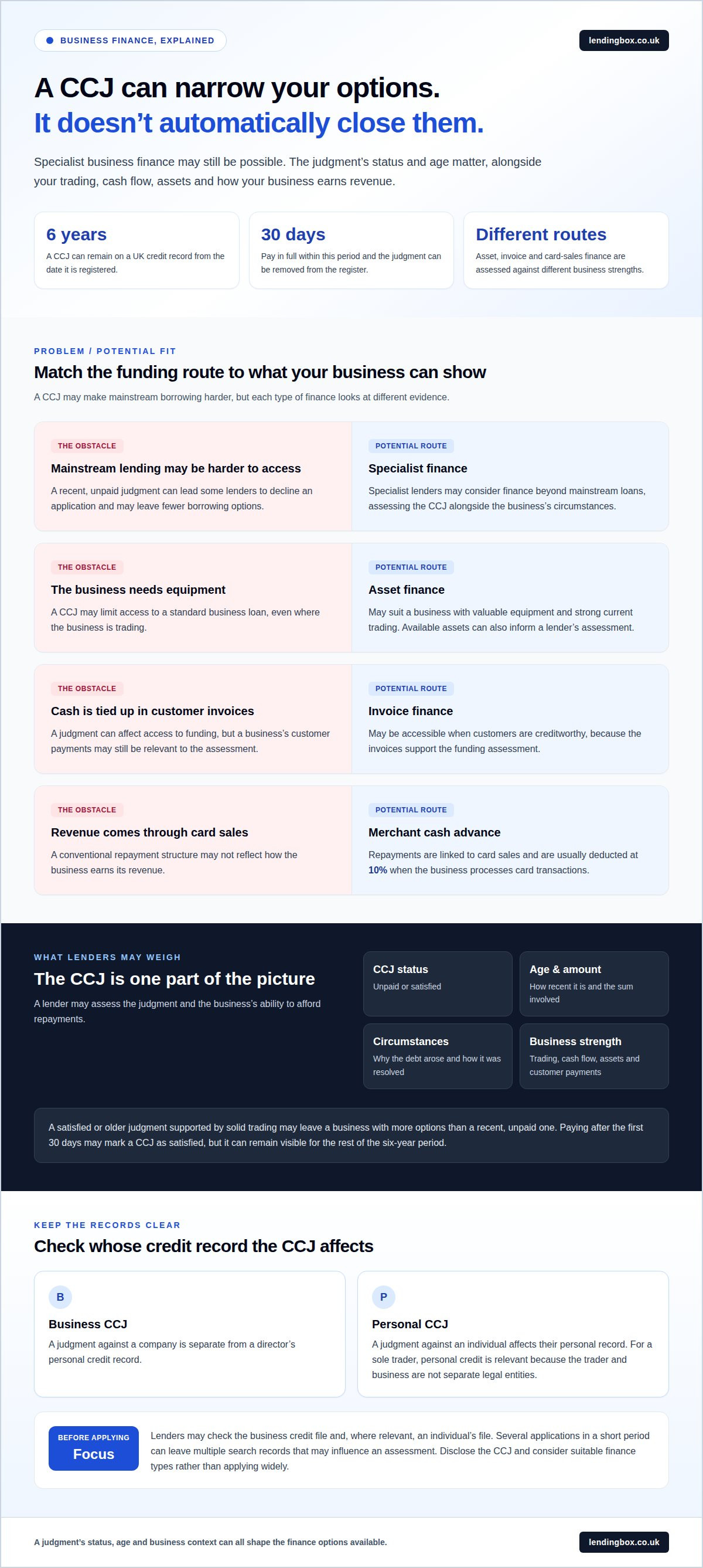
A County Court Judgment (CCJ) can remain on a UK credit record for six years from registration. If it’s paid in full within 30 days, it can be removed from the register and credit file. Paying after that period can mark the judgment as satisfied, but it may remain visible for the rest of the six years.
A CCJ is a court order relating to an unpaid debt. It may be registered against an individual or a business, so establish whose record it affects. A company’s CCJ and a director’s personal credit record are separate. A director is affected personally when a judgment is made against them.
Credit searches also matter when applying for funding. Lenders may review the business credit file and, where relevant, an individual’s file. Several applications in a short period can leave multiple search records, which may influence a lender’s assessment. Focus on suitable options rather than applying widely, to avoid unnecessary searches.
Repayment status is only one part of an assessment. Lenders may also consider the CCJ’s age and amount, the reason for the debt, current trading, cash flow and available assets. For example, a recent judgment arising from a disputed invoice may prompt questions about what happened. Strong trading can still be relevant, but it does not remove the CCJ from the file.
The borrowing structure can affect the rules, too. For a sole trader, borrowing of £25,000 or less can be regulated consumer credit. That threshold is relevant when considering a business loan, and a lender may assess the applicant’s personal credit alongside business performance. A limited company’s application is assessed in relation to the company, with directors’ circumstances also potentially relevant. A new CCJ doesn’t automatically prevent funding, but its status and the rest of the credit picture can shape the options available.
What business loans can I get with a CCJ?
A CCJ can limit access to mainstream business loans, but it does not automatically rule out finance. The funding type, repayment record and business performance all matter.
Business finance beyond mainstream lenders
Specialist finance can provide an alternative when mainstream lenders decline an application because of a CCJ. Options may include asset finance, invoice finance and merchant cash advances, each assessed against different business strengths.
Asset finance may suit a business with valuable equipment and strong current trading. Invoice finance may be accessible where customers are creditworthy, because the invoices support the funding assessment. A merchant cash advance links repayments to card sales, with repayments usually deducted at 10% when the business processes card transactions. The right structure depends on the business’s circumstances and how it earns revenue.
How a CCJ affects finance applications
A lender may consider whether the judgment is unpaid or satisfied, its age and amount, and the circumstances behind it. Strong cash flow, assets or reliable customer payments may also inform the assessment.
Disclose the CCJ in an application. Lenders are likely to check the business credit file, and applying widely can create multiple credit searches. A satisfied or older judgment, supported by solid trading, may give a business more options than a recent, unpaid one. If invoice finance fits the business’s sales pattern, explore business finance options that use invoices to support funding.
Resolving outstanding CCJs before applying
Paying an outstanding judgment may help present your application, but it does not necessarily remove the entry from a credit file.
A CCJ may be set aside if there are grounds to challenge it, such as not receiving the claim or having a valid defence. Act promptly in those circumstances. If the judgment is correct, resolving it before seeking finance can help clarify the business’s liabilities and repayment position.
What Is a CCJ and How Does It Affect Business Loan Eligibility?
A County Court Judgment is a court order relating to an unpaid debt, against an individual or a business. For business loan eligibility, lenders consider who the judgment affects and whether the business can afford the repayments.
Personal CCJs and company CCJs
A personal CCJ is registered against an individual, while a company CCJ is registered against the business. The distinction matters because a lender may assess the company’s credit file, a director’s personal record, or both.
For example, a supplier debt recorded against a limited company is different from a court order against its director personally. Explain the judgment’s circumstances, including whether it arose from an unpaid invoice or another debt. Lenders may also consider the company’s trading, assets and available capital when assessing unsecured borrowing.
Satisfied, older and unpaid CCJs
A satisfied CCJ has been paid; an unpaid one remains outstanding. Lenders may view a paid judgment as less concerning, but satisfaction does not immediately erase the entry from the credit file.
Age and context matter, too. A satisfied CCJ registered three or more years ago may be easier for a lender to assess, particularly if the business has traded strongly recently. By contrast, a recent, large, unpaid judgment can raise concerns about cash flow and repayment capacity. A disputed invoice or a customer’s insolvency may be viewed differently from general non-payment, so explain the cause and how it was resolved.
CCJs and sole trader borrowing
A sole trader may seek a business loan despite having a CCJ. Lenders may consider whether it is satisfied, how long ago it was registered, and whether trading income can cover repayments.
Because a sole trader and the business are not separate legal entities, the applicant’s personal credit record is relevant to the assessment. For borrowing of £25,000 or less, sole trader finance can be regulated consumer credit. A lender may therefore consider both the judgment and the income available to meet repayments. Strong trading helps explain the business’s position, but the CCJ’s status and age remain important eligibility factors.
Unsecured business loans from specialist lenders
Some lenders may consider unsecured borrowing where a recent CCJ makes mainstream lending harder. They assess the business’s current trading and repayment record alongside the judgment.
Factors lenders consider with a CCJ
Lenders weigh the CCJ’s status, age, amount and cause, then assess whether the business can afford repayments. A satisfied judgment and strong trading record can support an application, while an active, unpaid CCJ registered in the last 12 months is difficult for most lenders to consider.
Prepare at least six months of business bank statements; 12 months is useful if available. For borrowing above £50,000, have recent filed accounts and management accounts ready. These records help show income, outgoings and trading performance, giving lenders a fuller view than the credit file alone.
Personal guarantees and lender checks
A personal guarantee makes a director or another guarantor personally responsible for the borrowing if the business cannot repay. It can put personal finances at risk, so understand the commitment before agreeing. With secured borrowing, the asset used as security is also at risk if repayments are not met.
Specialist lending can cost more than borrowing for businesses with clean credit, and a satisfied CCJ may still attract a rate premium. Compare the repayment obligation with realistic cash flow, not just the amount offered. This matters especially where a business already has other debts or uneven trading income.
Use a broker to consider specialist and alternative lending routes against the business’s circumstances. Explore specialist business finance options and the records needed to support an application.
Lending Box: Business loan
Lending Box helps UK limited companies and LLPs explore business loan options after a CCJ. As a whole-of-market broker, it matches businesses with potential finance options, including revenue-based finance, invoice finance and asset finance.
Its in-house lending model analyses company data to provide eligibility insights in minutes, without affecting credit scores. A dedicated relationship manager guides you through the options and handles the paperwork. This can help when a recent judgment makes it harder to identify suitable funding routes or prepare an application.
Share your business details and the CCJ’s status to start exploring finance options. Contact Lending Box to discuss your business’s funding needs.
Plan your next funding move
If you’re asking whether you can get a business loan with a new CCJ, focus on your funding need, timing and the repayments your business can manage. A clear purpose for borrowing helps frame the decision. So does an honest view of cash flow, existing commitments and the circumstances behind the judgment.
Before taking on finance, consider what the funding needs to achieve and how it supports your business plans. The right option should fit your trading position, not just provide access to capital. A discussion about your circumstances can help identify suitable options without treating the CCJ as the only factor.
Contact Lending Box about your options and take the next step towards a clearer funding decision.
Frequently Asked Questions
How to get a loan with a CCJ?
Match the finance type to your business need, then explain the CCJ and current trading clearly. Equipment purchases may suit asset finance, while eligible unpaid invoices could support invoice finance. Prepare business bank statements, accounts and details of existing commitments so lenders can assess repayment capacity and understand the judgment’s circumstances.
Can a business get finance with a CCJ?
Yes, a business may still access finance with a CCJ. The judgment affects which options may be suitable, rather than automatically stopping every application. A business with regular card sales, for example, could consider finance repaid as a share of card takings; one buying machinery may consider asset finance. Match the funding structure to the business’s income and borrowing purpose.
Is borrowing with bad credit the right move?
Borrowing with bad credit is worth considering only when the funding supports a clear business need and repayments fit expected cash flow. Map repayments against quieter trading periods, tax bills and existing debts before committing. If the loan would cover ongoing losses rather than a defined requirement, more debt can add pressure. Consider whether resolving an outstanding liability or delaying a purchase is more workable.
Can a limited company get a business loan with a CCJ?
Yes, a limited company can apply for finance with a CCJ recorded against the company. A lender assesses the company’s accounts, trading and liabilities, and may also consider directors if a personal guarantee is part of the borrowing. Keep company records distinct from a director’s personal credit history, and explain which entity owes the debt and how it affects current operations.
Can a sole trader get a business loan with a CCJ?
A sole trader may apply despite having a CCJ. Since the trader and business are not separate legal entities, lenders can consider personal credit alongside trading income and existing commitments. Regular customer payments, for example, can help show how repayments would be managed. Set out business income clearly and account for personal outgoings when assessing what repayments are affordable.
Can a UK business get a loan with a recent CCJ?
Yes, a UK business can sometimes get a loan with a new CCJ, although an unpaid judgment can restrict access to mainstream lending. Lending Box matches active UK limited companies and LLPs with funding options across the market. Lenders may assess the judgment’s status, its circumstances and the business’s recent performance. A clear explanation and evidence of stable trading can help show how the business plans to meet repayments. Indicative only. Subject to lender assessment and approval.
Frequently Asked Questions
Match the finance type to your business need, then explain the CCJ and current trading clearly. Equipment purchases may suit asset finance, while eligible unpaid invoices could support invoice finance. Prepare business bank statements, accounts and details of existing commitments so lenders can assess repayment capacity and understand the judgment’s circumstances.
Yes, a business may still access finance with a CCJ. The judgment affects which options may be suitable, rather than automatically stopping every application. A business with regular card sales, for example, could consider finance repaid as a share of card takings; one buying machinery may consider asset finance. Match the funding structure to the business’s income and borrowing purpose.
Borrowing with bad credit is worth considering only when the funding supports a clear business need and repayments fit expected cash flow. Map repayments against quieter trading periods, tax bills and existing debts before committing. If the loan would cover ongoing losses rather than a defined requirement, more debt can add pressure. Consider whether resolving an outstanding liability or delaying a purchase is more workable.
Yes, a limited company can apply for finance with a CCJ recorded against the company. A lender assesses the company’s accounts, trading and liabilities, and may also consider directors if a personal guarantee is part of the borrowing. Keep company records distinct from a director’s personal credit history, and explain which entity owes the debt and how it affects current operations.
A sole trader may apply despite having a CCJ. Since the trader and business are not separate legal entities, lenders can consider personal credit alongside trading income and existing commitments. Regular customer payments, for example, can help show how repayments would be managed. Set out business income clearly and account for personal outgoings when assessing what repayments are affordable.
Yes, a UK business can sometimes get a loan with a new CCJ, although an unpaid judgment can restrict access to mainstream lending. Lending Box matches active UK limited companies and LLPs with funding options across the market. Lenders may assess the judgment’s status, its circumstances and the business’s recent performance. A clear explanation and evidence of stable trading can help show how the business plans to meet repayments. Indicative only. Subject to lender assessment and approval.