Business loan options for UK small businesses
14 November 2026 · 12 min read

 Business funding
The right finance isn’t always a standard business loan. A small business loan provides a lump sum that the business repays over time with interest, and business loan options also include different ways to fund cash flow, equipment or growth.
It’s understandable to focus on how much you can borrow. But when comparing business loan options, the repayment schedule, cost and funding purpose matter just as much as the amount.
This guide explains how small business loans work, what can affect interest rates and repayments, and how the Growth Guarantee Scheme may support businesses looking to invest and grow. The scheme launched with accredited lenders on 1 July 2024.
This guide explains how finance types differ, what lenders may consider when assessing an application, and how a broker can help you understand the routes available.
Key Takeaways
- Weigh the flexibility of a business loan against the commitment to regular repayments, and factor them into your cash flow planning.
- Understand which parts of your business finances and funding plan lenders may assess, and why application times can vary.
- See how credit profile, loan type and term can affect interest, borrowing amounts and repayment predictability.
- Explore whether the Growth Guarantee Scheme could support your business’s investment and growth plans.
How do business loans work?
A business loan provides capital as a lump sum, repaid over an agreed term with interest. It can fund working capital, equipment or cash-flow needs, but repayments must fit the business’s budget.
Advantages and disadvantages
A loan gives a business access to capital without selling ownership, and a set repayment schedule can make costs easier to plan. The trade-off is a firm repayment commitment, even when cash flow tightens. If an asset secures the borrowing, it may be at risk if repayments aren’t maintained. Match the amount and term to the investment’s likely benefit.
Compare a loan with finance designed for a specific need. Asset finance can fund equipment, while invoice finance can release funds tied up in unpaid invoices. A business credit card may suit smaller, short-term purchases. The right route depends on the purpose, repayment capacity and when the funds are needed.
UK businesses can apply through business banks or alternative finance providers. Banks assess applications using factors such as trading history, credit profile, profitability and the business plan; alternative lenders may assess the same business information through different processes.
Government-backed finance schemes
A Start Up Loan is an unsecured personal loan, not a business loan. It is available to new businesses and businesses trading for less than five years. Successful applicants can receive up to 12 months of free mentoring.
The Growth Guarantee Scheme supports small businesses seeking finance to invest and grow. It launched with accredited lenders on 1 July 2024. These schemes serve different needs: Start Up Loans target newer businesses, while the Growth Guarantee Scheme supports business investment and growth. Check eligibility against the scheme’s purpose before choosing a route.
Business loans for start-ups
A finance broker can help a start-up identify suitable funding routes and match its needs with lender criteria. The broker can also help present the business plan, funding requirement and repayment case clearly. This is useful when a lender needs evidence that planned repayments are affordable.
For a start-up, compare a government-backed Start Up Loan with business lending and alternative finance. A broker can explain the difference between a personal loan and borrowing in the business’s name, then guide the application and paperwork. The right route depends on the start-up’s trading position, purpose and ability to repay.
What is a Small Business Loan?
A small business loan provides a lump sum for a defined purpose, such as buying equipment or investing in stock. Lenders may assess trading history, turnover, profitability, cash flow, existing debt, the planned use of funds and whether repayments appear affordable. An unsecured loan does not use an asset as security, while an asset used to secure borrowing may be at risk if repayments fall behind.
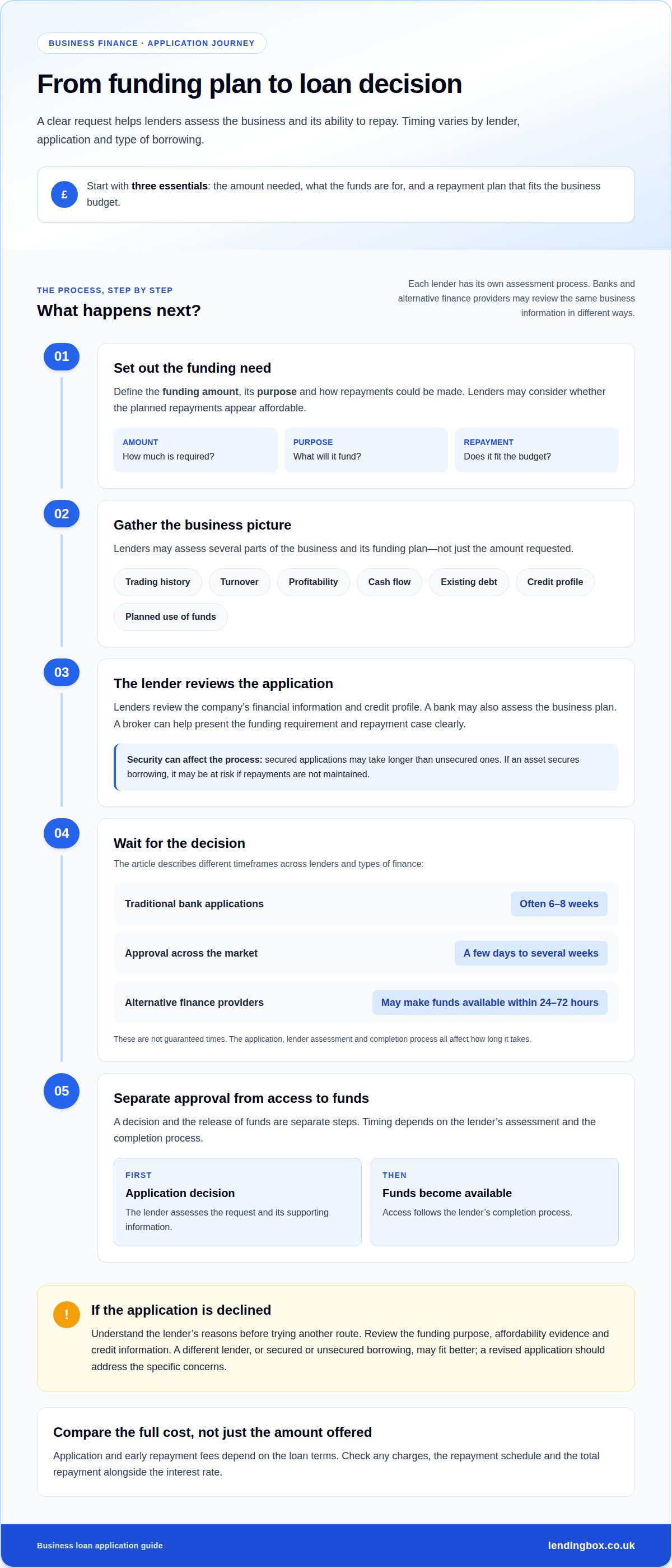
The application process starts with the funding amount, purpose and repayment plan. A broker can assess business loan options against lender criteria and help present the request clearly. Lenders review the company’s financial information and credit profile. A bank may also assess its business plan. Alternative finance providers may offer eligibility checks that don’t affect the business’s credit score.
Decision times vary by lender and application. Traditional bank loan applications often take 6-8 weeks to process, while approval across the market can take from a few days to several weeks. Secured applications may take longer than unsecured ones. Alternative finance providers may make funding available within 24-72 hours. Approval and access to funds are separate steps, so timing depends on the assessment and completion process.
Application and early repayment fees depend on the loan terms. A broker can help compare business loan options by looking at charges, when they apply and how they affect the total repayment. Consider the full cost alongside the interest rate and repayment schedule, not just the initial amount offered.
If an application is declined, understand the lender’s reasons before pursuing another route. A broker can review the funding purpose, affordability evidence and credit information, then identify whether a different lender or secured or unsecured borrowing better fits the business. A revised application should address the specific concerns rather than repeat the same case.
For support shaping an application around the business’s circumstances, explore business finance application support.
How is the interest rate calculated?
A lender sets a business loan interest rate using the application’s risk and terms. Factors include the business’s credit score, loan type, repayment period and economic conditions. A stronger credit profile can influence the assessment, but the lender also weighs profitability, existing commitments and cash flow. The rate may be fixed or variable, so understand which applies before accepting an offer.
The amount a business may be offered depends on its financial position, the type of finance and the lender’s assessment. Factors can include turnover, profitability, cash flow, trading history, existing debt, funding purpose and repayment capacity. A request for equipment finance, for example, may be assessed differently from a request to support cash flow. Indicative only. Subject to lender assessment and approval.
Repayment term changes the shape of the borrowing. Long-term business loan terms in the UK may range from around five years to 30 years. A longer period spreads repayments over more time; the total interest cost also depends on the rate and loan terms. A fixed repayment schedule makes monthly payments and the term predictable, helping a business plan its outgoing cash.
Look beyond the headline interest rate. Check the repayment schedule, total amount payable and any charges stated in the agreement. If the rate is variable, payments may change as the rate changes. Compare the full cost and timing against the business’s cash flow forecast, rather than judging affordability from the initial payment alone.
Early repayment or overpayments can reduce the outstanding balance, but the loan agreement determines how they are handled. Review whether charges apply, how extra payments affect the term, and whether the lender recalculates interest. For example, a business expecting a seasonal cash surplus should understand the agreement before relying on that surplus to clear borrowing early.
For a specific equipment purchase, asset finance may be another route to consider alongside a business loan. The comparison should account for the asset, repayment structure and the business’s wider funding needs.
Growth Guarantee Scheme
The Growth Guarantee Scheme (GGS) is a government-backed route to business finance for small businesses planning investment and growth. It launched with accredited lenders on 1st July 2024. For owners, its practical value is access to lending through participating lenders, with the finance still assessed as borrowing the business must repay.
The Growth Guarantee Scheme is one option to consider, not a grant or a way to avoid interest. A lender assesses the application and sets the loan terms, and the business remains responsible for meeting its repayments. Consider the planned investment, cash flow and repayment capacity before deciding whether this option fits.
Eligibility matters. Applicants must have or plan to start a UK-based business that has been fully trading for less than 5 years. The GGS is aimed at small businesses seeking finance to invest and grow. It differs from a Start Up Loan, which is an unsecured personal loan rather than a business loan. That distinction affects who borrows and who carries the repayment obligation.
A government guarantee under the scheme does not guarantee approval for an applicant. The lender still assesses the business and its ability to repay. The scheme is also separate from personal guarantee insurance, and does not remove any personal guarantee requirement. Read the proposed loan terms carefully, including any security or personal guarantee requirements.
To assess whether the Growth Guarantee Scheme suits a growth plan, connect the requested funding to a clear business purpose. For example, an equipment investment should have a repayment plan that fits the business’s cash flow. Compare the offered terms and obligations with the expected benefit, rather than choosing finance on the scheme name alone. Indicative only. Subject to lender assessment and approval.
Explore Growth Guarantee Scheme finance to consider this route alongside other suitable borrowing.
Lending Box: Business loan
Lending Box helps active UK limited companies and LLPs registered at Companies House compare business finance options. Consider using the broker when weighing a business loan against revenue-based finance or invoice finance, or exploring bad credit options.
Lending Box analyses company data to provide initial eligibility insights with no impact on your credit score. One named relationship manager guides you through the options and handles the paperwork, helping you understand how each route fits your funding purpose and repayment plans.
This can be useful when you want professional support rather than approaching lenders alone. The right route depends on your company’s circumstances, funding need and ability to repay.
Contact Lending Box to discuss business finance for your company.
Choose finance that fits your next move
Before taking the next step, connect the funding to a clear business outcome. Decide what the money needs to achieve, how repayments fit alongside existing commitments, and which finance structure suits the way your business earns and spends. This gives you a practical starting point for comparing options.
The most suitable business loan options are those that support your plans while keeping repayments within the business’s means. Lending Box matches active UK limited companies and LLPs with business loans, revenue-based finance and invoice finance, helping you compare routes against your funding need.
A focused conversation can help clarify which route to explore and what information will support an application. Discuss your funding needs with Lending Box and take the next step with a clearer view of the choices ahead.
Frequently Asked Questions
How can a finance broker help improve a business’s chances of being approved?
A finance broker can match the funding purpose to lender criteria and organise the application information clearly. Lending Box’s initial matching uses company data and has no impact on your credit score. There are no long forms before you see anything useful. You can start with your company name, with no obligation at any stage. The lender assesses the application and makes the approval decision.
How much can I borrow?
Indicative only. Subject to lender assessment and approval. The amount offered depends on factors such as turnover, profitability, cash flow, trading history, existing debt, funding purpose and repayment capacity. A lender considers these together, so your request should reflect both the business need and its ability to meet repayments.
What information should I provide to a finance broker when applying for a business loan?
Prepare your active limited company registration, 3-6 months of business bank statements, latest filed accounts or management figures, director ID and credit checks. These details help the broker understand the company’s financial position and present its funding request clearly. Lending Box manages the paperwork with a named relationship manager, so you can focus on explaining the purpose of the funding and the outcome it needs to support.
What is the application criteria?
To apply through Lending Box, your business must be an active UK limited company or LLP registered at Companies House. Lenders then assess factors such as trading history, affordability, profitability, existing financial commitments and the funding purpose. They may also consider the business plan and repayment capacity. The exact assessment depends on the finance being requested and the lender’s criteria.
Will my credit score be affected?
The initial matching process has no impact on your credit score. A credit search only happens at full application, and only with your agreement. Initial eligibility insights are separate from a lender’s full application, so you can review the proposed route before deciding whether to continue.
What types of business loans are available in the UK?
UK limited companies and LLPs can explore unsecured business loans, revenue-based finance, invoice finance, asset finance, property and secured finance, business credit cards, bad credit options and the Growth Guarantee Scheme. Each route serves a different need: asset finance is linked to equipment, while invoice finance relates to unpaid customer invoices. The suitable option depends on the business’s purpose and finances. Indicative only. Subject to lender assessment and approval.
Frequently Asked Questions
A finance broker can match the funding purpose to lender criteria and organise the application information clearly. Lending Box’s initial matching uses company data and has no impact on your credit score. There are no long forms before you see anything useful. You can start with your company name, with no obligation at any stage. The lender assesses the application and makes the approval decision.
Indicative only. Subject to lender assessment and approval. The amount offered depends on factors such as turnover, profitability, cash flow, trading history, existing debt, funding purpose and repayment capacity. A lender considers these together, so your request should reflect both the business need and its ability to meet repayments.
Prepare your active limited company registration, 3–6 months of business bank statements, latest filed accounts or management figures, director ID and credit checks. These details help the broker understand the company’s financial position and present its funding request clearly. Lending Box manages the paperwork with a named relationship manager, so you can focus on explaining the purpose of the funding and the outcome it needs to support.
To apply through Lending Box, your business must be an active UK limited company or LLP registered at Companies House. Lenders then assess factors such as trading history, affordability, profitability, existing financial commitments and the funding purpose. They may also consider the business plan and repayment capacity. The exact assessment depends on the finance being requested and the lender’s criteria.
The initial matching process has no impact on your credit score. A credit search only happens at full application, and only with your agreement. Initial eligibility insights are separate from a lender’s full application, so you can review the proposed route before deciding whether to continue.
UK limited companies and LLPs can explore unsecured business loans, revenue-based finance, invoice finance, asset finance, property and secured finance, business credit cards, bad credit options and the Growth Guarantee Scheme. Each route serves a different need: asset finance is linked to equipment, while invoice finance relates to unpaid customer invoices. The suitable option depends on the business’s purpose and finances. Indicative only. Subject to lender assessment and approval.