Personal Guarantee Insurance for UK Business Directors
12 November 2026 · 12 min read

 Business funding
A personal guarantee can put a director’s personal assets at risk if a company cannot repay its debt. Personal guarantee insurance can cover a defined share of that liability, typically 60% to 80%, depending on the policy. It doesn’t remove the guarantee or cover the full amount, so the uninsured balance remains the director’s responsibility.
It’s reasonable to want a clear picture of what you could still owe before relying on this cover. To understand how personal guarantee insurance works, look beyond the headline percentage: the policy terms and claim conditions matter too. This article explains what the cover may protect and where its limits remain.
You’ll also learn how a personal guarantee can affect your assets, what can shape the level of cover, and what to consider before taking out a policy. The aim is to give you a practical view of the protection so you can weigh it alongside the finance your business needs.
Key Takeaways
- Personal guarantee insurance can cover a defined share of a guarantee, but the policyholder remains responsible for the uninsured portion.
- The lender does not normally need to be involved in arranging the policy, though the cover must match the guarantee and its terms.
- Understand how a guarantee could affect your personal credit and assets if the company cannot repay its debt.
- Consider how Lending Box’s personal guarantee insurance and business finance options may fit your funding plans.
What is Personal Guarantee Insurance?
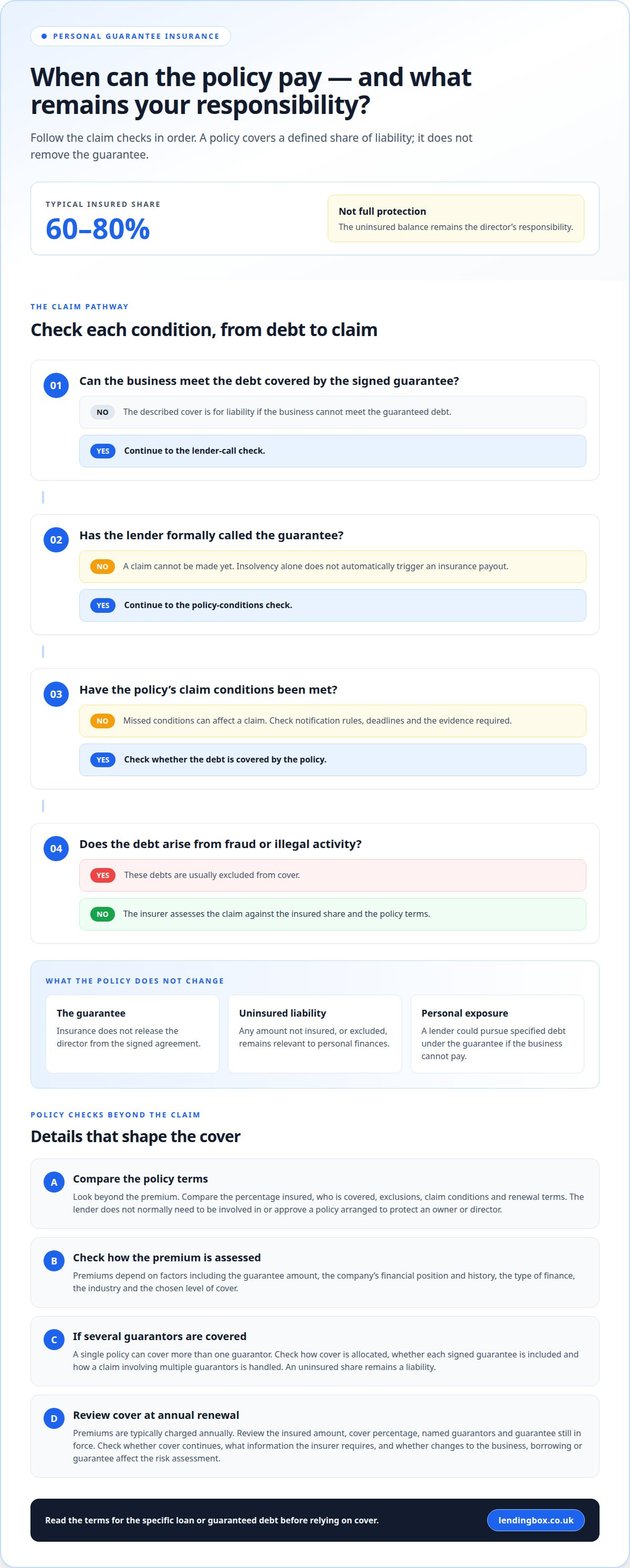
Personal guarantee insurance covers a defined share of a director’s liability if the business cannot meet the debt covered by a signed guarantee. Policies typically cover 60% to 80% of the guaranteed amount, and cannot insure the full 100%.
Specialist insurers and brokers arrange this cover in the UK. Compare the percentage insured, who is covered, exclusions, claim conditions and renewal terms, rather than focusing only on the premium. The lender does not normally need to be involved in or approve a policy arranged to protect an owner or director.
Premiums depend on factors such as the guarantee amount, the company’s financial position and history, the type of finance, the industry and the chosen level of cover. These details also help the insurer assess the risk.
Covering multiple guarantors
A single policy can cover more than one guarantor, which may suit a finance agreement backed by several owners or directors. Check how the policy allocates cover between them, whether each signed guarantee is included, and how the insurer handles a claim involving multiple guarantors. Cover does not remove liability for any uninsured share.
Policy duration and annual renewal
Premiums are typically charged annually, so renewal terms matter throughout the guarantee’s life. At each renewal, review the insured amount, cover percentage, named guarantors and the guarantee that remains in force. Check the policy term and renewal conditions to understand whether cover continues and what information the insurer requires.
A business’s circumstances can change between renewals. Changes to its financial position, borrowing or guarantee may affect the risk assessment, so ensure any renewal information reflects the current arrangement.
Exclusions and policy conditions
Policies usually exclude debts arising from fraud or illegal activity. A claim can be made only after the lender formally calls the guarantee and the policy conditions are met. Some policies also require prompt notification when the business shows signs of financial trouble, making the notification rules and deadlines important.
Read the terms for the specific loan or other guaranteed debt before relying on the cover. Check what evidence a claim requires, when the insurer must be notified, and which part of the liability remains yours. These steps show how personal guarantee insurance works in practice.
What a personal guarantee means for business owners and directors
A personal guarantee makes an owner or director personally responsible for specified company debt if the business cannot pay. Its terms define the extent of that liability.
Guarantees in loan applications
A lender may request a personal guarantee as part of a business loan application, particularly when the company has limited trading history, few assets or a higher perceived risk. The guarantee may cover all or part of the borrowing, and several business owners may share it. Before signing, understand the amount covered and whether the agreement is secured, unsecured or joint and several.
A guarantee can help a company access business finance it might otherwise struggle to secure, including funding for a start-up with little credit history. It may also help a lender offer better terms, such as a lower interest rate. However, it does not improve the director’s credit score or remove personal exposure. Consider the proposed borrowing against the assets and savings that could be at risk.
Personal guarantee insurance is arranged to protect the guarantor, not to release the director from the signed agreement. A business may pay the premium as a business expense. Record the payment appropriately in the company accounts and keep the policy documents with the loan and guarantee paperwork.
Claims after business insolvency
Insolvency alone does not settle a personal guarantee or automatically trigger an insurance payout. The lender must formally call the guarantee, and the policy’s claim conditions must be met. The insurer assesses the claim against the insured share and policy terms. The guarantor remains responsible for any liability the cover excludes or does not insure.
Keep the loan agreement, signed guarantee and insurance policy together. If a business shows signs of financial trouble, follow the policy’s notification requirements promptly; missed conditions can affect a claim. If a guarantee forms part of a proposed loan, review business finance options alongside the personal commitment.
Potential effects on personal credit and assets
A personal guarantee links a director’s finances to company borrowing. The main risks are missed payments, enforcement against personal assets and pressure on household finances.
Potential personal credit effects
Signing a guarantee does not generally affect your credit score by itself. The risk changes if you fail to make payments on time or at all. A lender’s enforcement action can add financial pressure and make future borrowing harder. Keep payment records and respond promptly to lender correspondence. A broker can help explain how a guarantee and insurance fit your borrowing plans.
Exposure of personal assets
If the company cannot pay, a lender could pursue the debt under the guarantee. A director’s home, car, savings and investments could be used to settle it. A lender typically has to take legal action before seizing personal assets. The specific guarantee matters: it may be secured against an asset, unsecured or shared with other guarantors. Read the signed terms to understand your exposure.
Insurance can protect a director’s personal assets against the insured share of a covered claim. It does not remove the guarantee or cover the full liability. The uninsured amount and any money owed to the company remain relevant to your personal finances.
Protecting family finances
Consider the effect on household finances before signing. For example, if your family relies on a home or savings account, enforcement could disrupt those plans. Map out essential commitments, available savings and the borrowing secured by the guarantee. This gives you a clearer view of what could be affected if the business cannot meet its obligations.
Personal guarantee insurance can reduce exposure for the portion covered by the policy, but it cannot protect every asset or remove all financial risk. Review the policy conditions alongside the guarantee, including what counts as a claim and what remains your responsibility. This helps you assess the potential effect on family finances before committing.
How personal guarantee insurance protects company owners and directors
Personal guarantee insurance reduces a guarantor’s financial exposure if the business cannot meet its obligations. It covers an agreed percentage of a qualifying claim, subject to the policy terms. The guarantee remains in place, and the owner or director is responsible for the uninsured share.
The remaining liability can still affect personal finances. A policy may apply to guarantees linked to unsecured borrowing or secured loans, but the circumstances and exclusions determine what qualifies.
Protection follows a defined process. The lender must formally call the guarantee, and the policy conditions must be met before a claim can be made. The insurer then assesses the claim against the insured amount and policy terms. Any amount outside the cover remains the guarantor’s responsibility.
Compare this with negotiating a limited guarantee. A lender-agreed cap reduces the liability set out in the guarantee itself. Insurance covers an agreed share of a qualifying claim but leaves the remaining exposure in place. Other practical steps include limiting the borrowing, clarifying each guarantor’s share and understanding whether specific assets secure the debt.
That distinction matters when making funding decisions. A negotiated limit changes the guarantee; insurance adds a separate layer of protection. Neither removes the need to understand the full commitment. Review the guarantee and policy together, including the insured percentage, claim conditions, exclusions and any secured assets.
Insurance may help safeguard personal assets against the covered portion, but it cannot protect every asset or cover every circumstance. Decide before relying on the cover, and account for the remaining liability in your business and personal planning.
Explore personal guarantee insurance to consider how cover could fit alongside your funding plans.
Lending Box: Personal guarantee insurance
Lending Box can help business owners consider personal guarantee insurance alongside the funding their company needs. Its whole-of-market brokerage matches UK limited companies and LLPs with finance options, including business loans, revenue-based finance and invoice finance.
If a proposed guarantee is part of your borrowing decision, consider how insurance may fit with the wider finance arrangement. Lending Box analyses company data through its in-house lending model to provide eligibility insights with no impact on your credit score. One named relationship manager guides you through suitable options and handles the paperwork.
Personal guarantee insurance is not a substitute for understanding the guarantee or the policy terms. Use the finance discussion to consider both the borrowing requirement and the personal exposure. Contact Lending Box to discuss your business finance needs.
Plan your next funding decision
Before committing to borrowing, map the funding need against the guarantee and the business’s expected cash flow. Understanding how personal guarantee insurance works can help you identify questions to resolve before signing, including how much personal exposure remains and how the policy fits the proposed finance.
The right funding structure matters too. Lending Box offers business loans, revenue-based finance and invoice finance, giving businesses different routes to consider alongside personal guarantee insurance. Each option interacts differently with business income and repayment commitments, so focus on the structure that fits your plans, not just the amount available.
Use your next conversation to set out the funding purpose, repayment expectations and any guarantee attached. Clear priorities make it easier to discuss the trade-offs and choose a practical way forward. Discuss your options with Lending Box and take the next step with a clearer view of your business finance choices.
Frequently Asked Questions
How does it work?
Personal guarantee insurance pays the insured share of a covered liability after the lender formally calls the guarantee and the policy conditions are met. The insurer assesses the claim against the policy terms. Cover can relate to guaranteed business loans, leases or trade credit. The policy does not pay simply because a business struggles: the guarantee must be called and the claim must meet the policy conditions.
Can I get PGI if my company is already in financial difficulty?
Personal guarantee insurance may be available for an existing guarantee, but that does not mean every claim or business will qualify. The insurer’s risk assessment considers the company’s financial position and outlook. Existing policies may require you to notify the insurer as soon as the business shows signs of financial trouble. Read those notification terms carefully, as timing can affect how cover applies.
Can I take out PGI for a guarantee my spouse signed?
A policy can cover more than one personal guarantor, so a spouse’s guarantee may be included if the policy covers them and their liability. Do not assume your partner is automatically covered because you hold the policy. Check that your spouse is identified as an insured guarantor and that their signed guarantee falls within the policy terms and covered debts.
Can Standard PGI be taken out after a loan has been agreed?
Yes. Personal guarantee insurance may be arranged for an existing personal guarantee, including one connected to an agreed loan. The policy still has its own acceptance conditions and cover terms. It is arranged to protect the guarantor and does not normally require lender involvement or approval. Check that the policy relates to the specific guarantee and finance facility already in place.
Does PGI cover 100% of the guarantee?
No. Personal guarantee insurance cannot cover the full guarantee. Policies commonly cover 70% to 80% of the liability, although the available proportion depends on the policy and risk. For example, with 70% cover, the guarantor remains exposed to the uninsured 30%, alongside any other amounts excluded by the policy. Work out the uncovered share before relying on the protection.
How much does PG insurance cost?
There is no single premium: the annual cost depends on the guarantee amount, business finances, borrowing type, industry and cover level. The insurer’s risk assessment also affects the premium. Stronger liquidity and a more favourable financial outlook may influence the cost. Compare the premium with the insured share and remaining liability, and read the policy terms before deciding whether the cover suits your circumstances.
Frequently Asked Questions
Personal guarantee insurance pays the insured share of a covered liability after the lender formally calls the guarantee and the policy conditions are met. The insurer assesses the claim against the policy terms. Cover can relate to guaranteed business loans, leases or trade credit. The policy does not pay simply because a business struggles: the guarantee must be called and the claim must meet the policy conditions.
Personal guarantee insurance may be available for an existing guarantee, but that does not mean every claim or business will qualify. The insurer’s risk assessment considers the company’s financial position and outlook. Existing policies may require you to notify the insurer as soon as the business shows signs of financial trouble. Read those notification terms carefully, as timing can affect how cover applies.
A policy can cover more than one personal guarantor, so a spouse’s guarantee may be included if the policy covers them and their liability. Do not assume your partner is automatically covered because you hold the policy. Check that your spouse is identified as an insured guarantor and that their signed guarantee falls within the policy terms and covered debts.
Yes. Personal guarantee insurance may be arranged for an existing personal guarantee, including one connected to an agreed loan. The policy still has its own acceptance conditions and cover terms. It is arranged to protect the guarantor and does not normally require lender involvement or approval. Check that the policy relates to the specific guarantee and finance facility already in place.
No. Personal guarantee insurance cannot cover the full guarantee. Policies commonly cover 70% to 80% of the liability, although the available proportion depends on the policy and risk. For example, with 70% cover, the guarantor remains exposed to the uninsured 30%, alongside any other amounts excluded by the policy. Work out the uncovered share before relying on the protection.
There is no single premium: the annual cost depends on the guarantee amount, business finances, borrowing type, industry and cover level. The insurer’s risk assessment also affects the premium. Stronger liquidity and a more favourable financial outlook may influence the cost. Compare the premium with the insured share and remaining liability, and read the policy terms before deciding whether the cover suits your circumstances.