Business loan rejections: why lenders say no and next steps
13 November 2026 · 11 min read

 Business funding
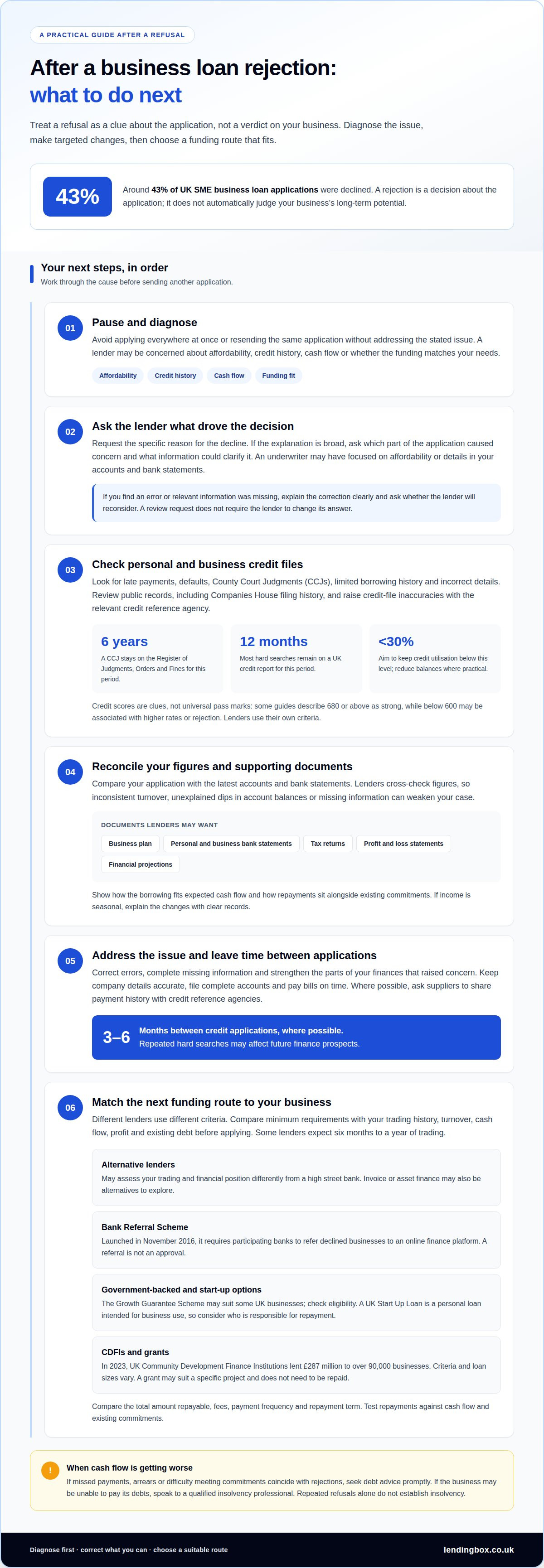
A loan rejection is a reason to pause and diagnose, not to apply everywhere at once. If you’re deciding what to do after multiple business loan rejections, ask each lender why it declined your application, review your personal and business credit files, and address the issues before trying again. Where possible, leave three to six months between credit applications.
Repeated refusals can feel like a verdict on your business. Treat them as clues instead: lenders may have concerns about affordability, credit history, cash flow or whether the funding matches your needs.
This article explains common reasons lenders say no and how to assess your credit and business performance. You’ll also learn practical steps to strengthen a future application and explore alternative or government-backed funding routes. Start with the reasons behind the decisions, then choose a next step that fits your business.
Key Takeaways
- Ask the lender for its reason for declining your application, then identify what needs to change before you apply again.
- Review personal and business credit files alongside cash flow, existing commitments and the figures in your accounts.
- Avoid sending the same application to multiple lenders. Match the funding route to your business’s circumstances and the lender’s criteria.
- Explore alternatives such as invoice or asset finance, and consider whether a government-backed scheme could suit your needs.
1. Why do lenders decline business loan applications?
A lender may reject an application because of weak credit history, limited security, a poor business plan or uncertain forecasts. Sector risk can also matter: construction, hospitality and transport businesses may face closer scrutiny when income fluctuates. Around 43% of UK SME business loan applications were declined. A refusal is a decision about the application, not automatically a judgement on the business’s long-term potential.
Start by asking the lender for its reason. If an underwriter reviewed the application, affordability or details in your accounts and bank statements may have influenced the decision. Lenders cross-check figures across documents, so inconsistent turnover, unexplained dips in account balances or missing information can weaken your case. Compare the application with your latest accounts and statements, then correct any errors before applying again.
For a stronger application, lenders may want a business plan, personal and business bank statements, tax returns, profit and loss statements, and financial projections. Show how the requested borrowing fits expected cash flow and how repayments sit alongside existing commitments. If the lender gives a broad reason, ask which part of the application caused concern and what information could clarify it.
A UK business can ask the lender to reconsider, particularly if it finds an error or has relevant information that was missing. Explain the correction clearly and ask whether the lender will review its decision. A request does not require the lender to change its answer. Avoid resending the same application without addressing the stated issue.
If rejections coincide with missed payments, arrears or difficulty meeting existing commitments, seek debt advice promptly. If the business may be unable to pay its debts, speak to a qualified insolvency professional about the situation and possible next steps. Repeated refusals alone do not establish insolvency, but worsening cash flow is a practical warning to act early.
2. Assessing credit history alongside business performance
Review the business and director’s personal credit files before another application. UK lenders may consider both, especially where the company has a thin credit history. Look for late payments, defaults, County Court Judgments (CCJs), limited borrowing history and incorrect details. A CCJ stays on the Register of Judgments, Orders and Fines for six years, according to the Ministry of Justice.
Credit scores offer clues, not universal pass marks. Some guides describe 680 or above as a strong score, while a score below 600 may be associated with higher rates or rejection. Lenders use their own criteria, so assess the whole profile alongside cash flow, existing debt, affordability and trading history. Aim to keep credit utilisation below 30%, and reduce balances where practical.
Several applications can leave multiple hard searches on personal or business credit files. Most hard searches remain on a UK credit report for 12 months, and repeated searches may affect future finance prospects. Before you borrow again, review both profiles for errors and raise inaccuracies with the relevant credit reference agency. Also check public records, including the Companies House filing history and any listed CCJ.
Business performance needs to support the credit picture. Compare recent accounts with bank activity: turnover, regular income, overdraft use and payment patterns should tell a consistent story. If cash flow is uneven, explain seasonal changes with clear records. File complete company accounts, pay bills on time and, where possible, ask suppliers to share payment history with credit reference agencies.
Credibility also comes from a clear, current business presence. Keep Companies House details accurate, maintain a professional website and ensure contact and service information matches your application. These details won’t replace sound finances, but inconsistencies can create questions. For a clearer view of suitable borrowing routes, explore business finance options alongside your credit and trading position.
3. Exploring alternative lenders and government-backed schemes
A rejection from one bank doesn’t mean every lender will reach the same decision. UK high street banks use different criteria, and alternative lenders may assess trading history, turnover, cash flow, profit and existing debt differently. Before applying, compare each lender’s minimum requirements with your business record. Some lenders expect six months to a year of trading, so newer businesses may have fewer suitable routes.
The Bank Referral Scheme offers another route after a participating bank declines a business funding request. Launched in November 2016, it requires participating banks to refer rejected businesses to an online finance platform. A referral isn’t an approval; it can help identify other funding options without sending the same application indiscriminately.
Consider whether the Growth Guarantee Scheme fits your business. It may be an option for some UK businesses. Check the scheme’s eligibility criteria before applying. For start-ups, a UK Start Up Loan is a personal loan intended for business use, rather than a traditional bank loan. That distinction matters when assessing who is responsible for repayment.
Community Development Finance Institutions (CDFIs) can be another alternative. In 2023, UK CDFIs lent £287 million to over 90,000 businesses. Their criteria and loan sizes vary, so assess whether the funding purpose, repayment schedule and affordability fit your plans. A grant may also suit a specific project, as grants don’t need to be repaid.
How do interest rates, fees and repayment costs compare? They depend on the lender’s criteria, the business’s financial position and the funding structure. Compare the total amount repayable, any fees, payment frequency and repayment term, then test payments against cash flow and existing commitments. Choose a route that fits the business’s needs and ability to repay, not simply the one with the quickest decision.
4. Common reasons for business loan rejections
Look beyond the credit score: lenders also assess whether borrowing fits the business’s structure and trading stage. Many UK high street banks want at least two years of trading and filed accounts. A newer company may therefore be declined despite having a credible plan, particularly if it requests a large unsecured loan before establishing steady income.
Affordability can be a concern even when turnover looks healthy. High monthly repayments on existing borrowing may leave too little room for another repayment. Lenders may also question irregular income, unexplained dips in bank statements or frequent overdraft use. Compare expected repayments with regular outgoings, not just projected profit. A forecast that depends on optimistic sales can weaken an application.
Security is another factor. A secured loan requires an asset, such as property or equipment, as collateral. For start-ups, collateral typically needs to equal or exceed the loan value, although requirements vary between lenders. If suitable security isn’t available, the requested amount or loan structure may not fit the business’s position.
Sector and repayment fit matter too. Construction, hospitality and transport businesses can face stricter risk criteria because income may fluctuate or overheads may be high. A seasonal retailer seeking fixed repayments, for example, may be declined because sales rise and fall through the year. Evidence of contracts, repeat customers and margin control can help explain how the business manages those risks.
Debt levels can signal strain, so assess existing repayments alongside the business’s income and other commitments. Treat those figures as a prompt to review affordability, not a universal lender rule. Pinpoint the reason behind each refusal, then change the amount, evidence or repayment structure before applying again. Review business loan options against your funding needs and current commitments.
Lending Box: Business loan
Lending Box is a whole-of-market broker that matches UK limited companies and LLPs with business finance options. If repeated rejections have left you unsure which route fits, its in-house lending model analyses company data and provides eligibility insights in minutes, without impacting credit scores. A dedicated relationship manager can guide you through business loans, revenue-based finance, invoice finance and asset finance, and handle the paperwork. The right option depends on your funding need and business position, so use the assessment to understand possible routes rather than assume approval. If you’re ready to discuss your next step, contact Lending Box.
Make your next funding decision with a clear plan
Repeated refusals can make the next application feel like a test of persistence. Treat it instead as a decision about timing and fit. Before moving forward, decide what the funding needs to achieve, what repayments the business can manage and what evidence supports the case. That gives you a practical basis for choosing whether to apply again or consider another route.
If you’re weighing what to do after multiple business loan rejections, focus on the change that would make your next step better informed. It might be clearer forecasts, a different funding structure or waiting until the business’s position has strengthened. A measured decision can help you avoid another application that doesn’t match your needs.
Contact Lending Box to discuss funding and consider the next route for your business. A clear plan puts you in a stronger position to move forward with confidence.
Frequently Asked Questions
Why do lenders decline business loan applications?
Lenders decline applications when their assessment suggests the business may struggle to repay or when the evidence doesn’t meet their criteria. For example, a company with rising sales but frequent overdraft use may still raise affordability concerns. A lender may also consider unsecured borrowing unsuitable if the business has limited trading history. Ask which factor carried the most weight before deciding what to change.
Which decline reasons can you fix quickly?
Missing documents, outdated figures, incorrect company details or mismatches between an application and its accounts can often be corrected promptly. For a business deciding what to do after multiple business loan rejections, fixing these errors can make a future application more accurate. If a bank statement contains a transaction that needs context, prepare a clear explanation. Arrears, affordability concerns or limited trading history usually take longer to address.
Why Business Finance Applications Get Rejected in the UK?
In the UK, an application can fail an automated eligibility check before detailed underwriting. A lender may use minimum turnover, credit or trading-history criteria to screen applications. A later refusal may instead follow a review of affordability and financial records. This difference matters: if the decision arrived quickly, ask whether you failed to meet a threshold; if it followed a review, ask which part of the financial case needs attention.
Why are UK business loan applications rejected, and how can I find out the reason?
UK applications may be declined because of credit concerns, affordability, security, sector risk or information that doesn’t align across records. Ask the lender for its reason and whether it can explain the concern in more detail. If you spot a factual error, identify the specific entry and provide corrected information. This helps distinguish a fixable mistake from a broader issue with the lending decision.
How can I check and improve my business and personal credit reports in the UK?
Review both credit files for missed-payment records, defaults, CCJs and accounts you don’t recognise. If an entry is wrong, raise it with the credit reference agency and the organisation that supplied it. Keep payments consistent, reduce outstanding balances where possible and ensure suppliers report payment history. Credit utilisation below 30% is an aim some guidance recommends, but lenders assess the full profile.
How long should I wait before reapplying for a business loan after rejection?
Where possible, leave three to six months before applying again. A sensible next step when considering what to do after multiple business loan rejections is to use that time to address the lender’s concerns and show what has changed. Avoid submitting several applications at once or repeating the same request with unchanged evidence. Hard searches can remain on a UK credit report for 12 months.
Frequently Asked Questions
Lenders decline applications when their assessment suggests the business may struggle to repay or when the evidence doesn’t meet their criteria. For example, a company with rising sales but frequent overdraft use may still raise affordability concerns. A lender may also consider unsecured borrowing unsuitable if the business has limited trading history. Ask which factor carried the most weight before deciding what to change.
Missing documents, outdated figures, incorrect company details or mismatches between an application and its accounts can often be corrected promptly. For a business deciding what to do after multiple business loan rejections, fixing these errors can make a future application more accurate. If a bank statement contains a transaction that needs context, prepare a clear explanation. Arrears, affordability concerns or limited trading history usually take longer to address.
In the UK, an application can fail an automated eligibility check before detailed underwriting. A lender may use minimum turnover, credit or trading-history criteria to screen applications. A later refusal may instead follow a review of affordability and financial records. This difference matters: if the decision arrived quickly, ask whether you failed to meet a threshold; if it followed a review, ask which part of the financial case needs attention.
UK applications may be declined because of credit concerns, affordability, security, sector risk or information that doesn’t align across records. Ask the lender for its reason and whether it can explain the concern in more detail. If you spot a factual error, identify the specific entry and provide corrected information. This helps distinguish a fixable mistake from a broader issue with the lending decision.
Review both credit files for missed-payment records, defaults, CCJs and accounts you don’t recognise. If an entry is wrong, raise it with the credit reference agency and the organisation that supplied it. Keep payments consistent, reduce outstanding balances where possible and ensure suppliers report payment history. Credit utilisation below 30% is an aim some guidance recommends, but lenders assess the full profile.
Where possible, leave three to six months before applying again. A sensible next step when considering what to do after multiple business loan rejections is to use that time to address the lender’s concerns and show what has changed. Avoid submitting several applications at once or repeating the same request with unchanged evidence. Hard searches can remain on a UK credit report for 12 months.