Revenue Based Finance vs Equity for Startups: Compare Your Options
11 November 2026 · 12 min read

 Finance insights
Giving up equity isn’t the only way to fund growth, and it isn’t always the better fit. With revenue-based finance, a startup repays an agreed share of monthly gross revenue, commonly 2% to 10%, until it reaches a repayment cap that commonly ranges from 1.2x to 3x the original investment. Choosing between revenue-based finance and equity depends on how you want to fund growth, manage repayments and retain ownership.
Revenue based finance vs equity for startups comes down to how each route affects cash flow and ownership. Revenue-based finance ties repayments to revenue without giving the funder an ownership stake. Equity brings investment without immediate repayments, but founders give up a share of the company and may share decision-making. Comparing these trade-offs helps clarify which option fits your priorities.
If you’re weighing up funding options, consider how each fits your business stage, revenue pattern and growth plans. This guide explains how revenue-based finance works, compares it with equity and traditional debt, and outlines the business characteristics that may suit it. You’ll have a clearer basis for choosing a funding route aligned with your plans.
Key Takeaways
- Understand how revenue-based repayments and repayment caps work, so you can assess their effect on cash flow.
- Weigh the trade-off between keeping ownership, taking on repayments and sharing decision-making.
- Use your revenue pattern and growth plans to judge whether this funding approach fits your startup’s stage.
- See how revenue-based finance, business loans, invoice finance and asset finance can meet different funding needs.
What is Revenue Based Finance?
Revenue-based finance provides capital in exchange for a share of future revenue, with repayments usually continuing until an agreed cap is met. The percentage, cap and payment schedule shape the total cost and effect on cash flow.
Revenue-based financing mechanics
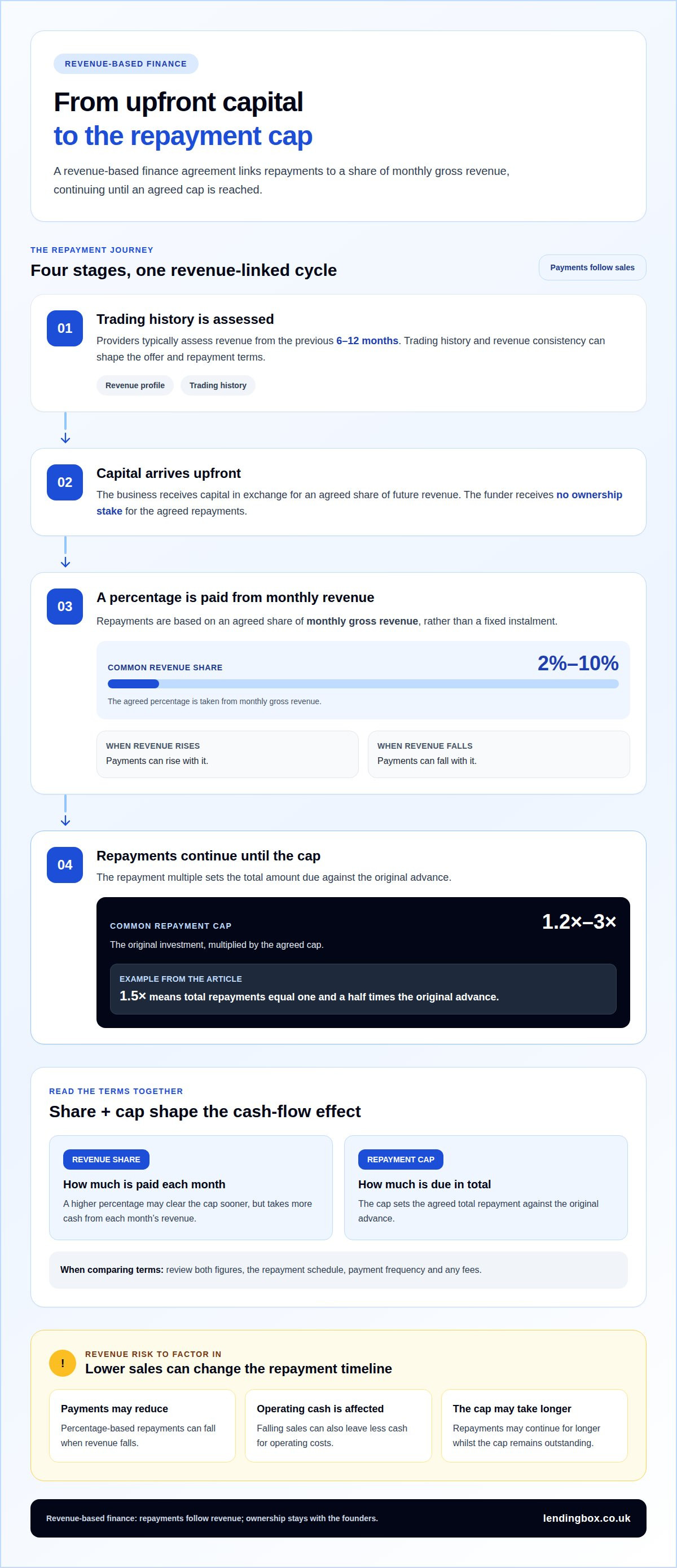
A business receives capital upfront and repays it through an agreed percentage of revenue, rather than a fixed instalment. Because the payment follows sales, it can rise or fall with revenue. Providers typically assess revenue from the previous 6-12 months, making trading history relevant to the offer and repayment terms.
Revenue-linked repayments and caps
The revenue share sets the percentage paid, whilst the repayment multiple sets the total amount due against the original advance. Agreements commonly allocate 2% to 10% of monthly gross revenue, with repayment caps commonly ranging from 1.2x to 3x the original investment. A higher percentage may clear the cap sooner, but takes more cash from each month’s revenue. Compare both figures, the repayment schedule and any fees when assessing the total cost of capital. Unlike equity, the funder receives no ownership stake in exchange for the agreed repayments.
Lender terms and revenue risks
UK startups can access revenue-based finance through specialist providers and platforms; terms vary by business and its revenue profile. Common terms include a monthly revenue share of 2% to 10% and a repayment cap of 1.2x to 3x the advance. Compare the percentage, cap and payment frequency, since each affects the business’s ability to manage cash during growth.
If revenue fluctuates, percentage-based repayments can rise or fall with it. Falling sales may reduce payments, but can also leave less cash for operating costs; repayments may take longer while the cap remains outstanding.
Revenue-based finance compared with equity and traditional debt
Revenue-based finance, equity and traditional debt fund growth in different ways. Compare repayment obligations, ownership and the potential effect each option could have on the company’s future value.
Revenue finance compared with equity
Revenue-based finance is repaid from revenue, while equity funding gives investors an ownership share. That difference matters if founders want to retain control or avoid scheduled repayments. Equity brings no immediate repayment obligation, leaving cash available for growth, but investors may gain decision-making influence. Revenue finance avoids dilution, but repayments draw on trading income. The better fit depends on whether the business prioritises cash-flow capacity or retained ownership.
Cost of revenue shares and equity
A revenue share has a capped repayment total; equity’s eventual cost depends on the company’s value and the stake sold. For example, a 1.5x repayment multiple means total repayments equal one and a half times the original advance. Equity has no equivalent fixed cap on investor returns. If the company grows substantially, the shares sold at an early valuation may become more valuable. Compare the capped obligation with the potential value of the ownership offered.
Equity venture capital commonly dilutes founders by 15-25%. A 20% stake, for instance, means investors own one-fifth of the company. Revenue-based finance has no ownership dilution, but repayment still reduces cash available for hiring, stock or marketing. Map both effects against the funding’s intended use and the company’s growth plans.
Dilution and exit value
At an exit, equity investors share in the company’s value according to their ownership, while revenue-based repayments are tied to the agreed cap. A rising valuation can make an equity stake more costly to founders than its initial percentage suggests. By contrast, a fixed repayment cap remains the agreed total, even if company value rises. This distinction matters most when founders expect substantial long-term growth.
Traditional loans use interest-bearing terms, fixed repayment schedules and defined end dates. Those regular payments can make budgeting clearer, but they don’t flex with revenue in the same way. Compare the payment structure with likely cash flow before choosing. A review of business finance options can help frame that comparison.
Funding choices by business stage and growth ambitions
A startup’s stage, revenue pattern and use for capital shape its funding options. For UK SaaS companies, revenue-based finance may suit businesses with established recurring income, while venture capital can support plans that need larger investment before revenue matures.
Match the funding model to your stage
Those figures are reference points, not universal approval thresholds: trading history, revenue consistency and the planned use of funds also matter. A younger venture without dependable sales may find equity better aligned with its growth plans, since it does not require scheduled repayments.
Revenue finance can fund a defined growth step, such as customer acquisition or stock, when sales can support repayments. Venture capital may better suit founders pursuing rapid expansion that requires substantial cash before returns arrive. The choice depends on how much capital the plan needs, when it can produce income and how much ownership founders are prepared to exchange.
Combine funding where it fits
Startups can use different funding models at different stages. A business might raise equity for early product development, then consider revenue-based finance once recurring income can support repayments. Combining sources can match funding to different purposes, but overlapping repayment commitments can strain cash flow. Forecast revenue alongside existing obligations before taking on another facility.
Allow for timing and agreement terms
Approval and funding speed vary with the application, financial records and assessment process. Equity rounds can involve extensive due diligence and legal work; revenue finance assessments focus on revenue and trading data. Agreement terms matter too: understand repayment triggers, caps, early repayment provisions and any security or guarantees before signing. Tax treatment depends on the structure, so include the expected accounting treatment in financial forecasts and discuss the agreement with a qualified adviser. This helps align the funding’s timing and obligations with the growth plan.
What is revenue-based finance for startups and how does it work?
Revenue-based finance gives a startup capital in return for an agreed share of future revenue. Repayments continue until the startup reaches a set total, rather than exchanging capital for company ownership. This structure can suit businesses with recurring sales and a clear use for funds. Repayments remain an obligation under the agreement, even when founders would prefer to preserve cash for another priority.
Providers assess trading performance before making an offer. The guide’s typical assessment looks at revenue over the previous 6-12 months. That history helps show whether sales are consistent enough to support repayments. Most providers don’t ask for personal guarantees or collateral, but the agreement’s own conditions still matter. Review what triggers payment, how revenue is measured and when repayments are collected.
Payment schedules can be weekly, monthly or yearly. A schedule that follows revenue may ease pressure during a quieter period, but regular payments still affect working capital. For a subscription business, recurring customer receipts may help support a predictable repayment plan. A business with seasonal or uneven sales should consider how payment dates align with income and essential costs.
Before accepting an offer, map the funding to a specific use, such as customer acquisition, product development or stock. Then compare the expected benefit with the total repayment cap and payment frequency. Revenue-based finance is commonly described as having no compounding interest, but the agreed cap still determines the total amount owed. The agreement sets the actual repayment obligation.
Use the figures in your forecast to test the impact of repayments across stronger and weaker trading periods. If the planned growth depends on income arriving much later, a revenue-linked commitment may not match the timing of the project. Explore funding options for your business to consider how different structures fit your startup’s revenue and plans.
Lending Box: Revenue-based finance
Lending Box helps UK limited companies and LLPs assess revenue-based finance alongside other funding routes. Its initial matching process has no impact on your credit score and provides eligibility insights based on company data, helping founders consider options that may fit their revenue and growth plans.
One named relationship manager guides applicants through available options and handles the paperwork. Revenue-based finance may suit a business with established revenue that wants capital without giving up equity. If income timing or funding needs point elsewhere, Lending Box can also discuss a business loan, invoice finance or asset finance.
Consider Lending Box when you want support comparing funding structures and understanding the application process. Contact Lending Box to discuss your business’s funding needs.
Make the next funding decision with confidence
The choice between revenue-based finance and equity should support the business you’re building, not just its immediate cash needs. Start with a defined growth objective, then consider how your funding choice could shape the company beyond the current round.
Lending Box can help you consider revenue-based finance alongside a business loan or invoice finance. The right option depends on what the capital will fund and how the business expects to generate returns. A clear discussion of those priorities can turn a broad comparison into a practical funding decision.
Contact Lending Box about startup funding to discuss your options and decide what to explore next. Take the next step when you’re ready to move forward with a funding plan that fits your business.
Frequently Asked Questions
What is equity financing for startups?
Equity financing raises capital by giving investors shares in a startup. The shares represent part ownership, so founders’ proportion of the company falls when new shares are issued. For example, a founder can use an equity round to fund product development before sales can support repayments. The trade-off is that investors may also have a say in decisions, depending on the agreement and rights attached to their shares.
How do repayment caps and duration work in RBF?
A repayment cap sets the maximum total a startup must repay, while the duration depends on how quickly revenue-linked payments reach that limit. If sales rise, repayments may clear the cap sooner; if sales fall, the schedule can extend. A seasonal business should model quieter trading periods as well as busy ones, since slower repayments can keep the funding commitment in place for longer.
What does RBF mean in business?
RBF means revenue-based financing, a form of business funding repaid from a share of revenue. A subscription software startup, for example, might use it to fund customer acquisition and make repayments from incoming subscription sales. The arrangement links payments to trading activity rather than giving the funder shares. Its practical fit depends on whether revenue arrives consistently enough to meet the agreed payment arrangement.
How does equity financing work for UK startups?
A UK startup seeking equity investment agrees how much capital to raise and what proportion of the company investors will receive. The process commonly involves presenting the business plan, discussing valuation and completing due diligence before finalising investment documents. Founders should consider how new shares affect ownership and which decisions investors may influence. This funding can suit a business with ambitious plans but limited income for repayments.
What are typical revenue-based finance fees, repayment caps and repayment rates in the UK?
Terms vary, but agreements commonly take 2% to 10% of monthly gross revenue, with caps commonly set at 1.2x to 3x the original investment. The cap determines the total repayment, while the revenue share affects each payment. Fees and other charges depend on the agreement’s structure, so assess the total amount payable rather than treating the revenue percentage alone as the cost.
How do revenue-based finance and equity compare on costs, dilution, control and repayment?
Revenue-based finance creates a repayment obligation without selling company ownership; equity brings investment in exchange for shares, with no immediate repayments. For a startup expecting rapid growth, the value of shares sold can become substantial as the company grows. A business with predictable income may prefer a capped repayment commitment, while one funding long-term development before sales may favour equity’s lack of scheduled repayments.
Frequently Asked Questions
Equity financing raises capital by giving investors shares in a startup. The shares represent part ownership, so founders’ proportion of the company falls when new shares are issued. For example, a founder can use an equity round to fund product development before sales can support repayments. The trade-off is that investors may also have a say in decisions, depending on the agreement and rights attached to their shares.
A repayment cap sets the maximum total a startup must repay, while the duration depends on how quickly revenue-linked payments reach that limit. If sales rise, repayments may clear the cap sooner; if sales fall, the schedule can extend. A seasonal business should model quieter trading periods as well as busy ones, since slower repayments can keep the funding commitment in place for longer.
RBF means revenue-based financing, a form of business funding repaid from a share of revenue. A subscription software startup, for example, might use it to fund customer acquisition and make repayments from incoming subscription sales. The arrangement links payments to trading activity rather than giving the funder shares. Its practical fit depends on whether revenue arrives consistently enough to meet the agreed payment arrangement.
A UK startup seeking equity investment agrees how much capital to raise and what proportion of the company investors will receive. The process commonly involves presenting the business plan, discussing valuation and completing due diligence before finalising investment documents. Founders should consider how new shares affect ownership and which decisions investors may influence. This funding can suit a business with ambitious plans but limited income for repayments.
Terms vary, but agreements commonly take 2% to 10% of monthly gross revenue, with caps commonly set at 1.2x to 3x the original investment. The cap determines the total repayment, while the revenue share affects each payment. Fees and other charges depend on the agreement’s structure, so assess the total amount payable rather than treating the revenue percentage alone as the cost.
Revenue-based finance creates a repayment obligation without selling company ownership; equity brings investment in exchange for shares, with no immediate repayments. For a startup expecting rapid growth, the value of shares sold can become substantial as the company grows. A business with predictable income may prefer a capped repayment commitment, while one funding long-term development before sales may favour equity’s lack of scheduled repayments.