How to Improve Your Chances of Getting a Business Loan
10 November 2026 · 11 min read

 Business funding
A strong credit score is only one part of a business loan application. UK lenders also assess your business’s finances, trading position and ability to repay. To improve your chances, present a clear borrowing request supported by accurate, up-to-date information.
If you’re working out how to improve your chances of getting a business loan, focus first on what you can prepare: your borrowing request, financial information and credit record. There is no guaranteed yes or no before assessment, because eligibility depends on how these factors fit together.
This guide explains how personal and business credit can affect an application, which documents to prepare, how to estimate an affordable borrowing amount and what UK lenders may look for in an eligible business. You’ll have a clearer basis for deciding what to address before you apply.
Key Takeaways
- Review personal and business credit records before applying, and address errors or missed payments that could weaken an application.
- Prepare clear financial statements, cash-flow forecasts and a practical explanation of how the borrowing will support the business.
- Base your borrowing request on what the business can repay, not just the amount a lender might offer.
- Check how your business’s trading history, finances and existing borrowing fit lender criteria before choosing a finance route.
1. How does my credit score affect my chances of getting a loan?
UK lenders may assess both personal and business credit when reviewing a business loan application. Your credit score helps indicate how reliably you’ve managed payments, but it isn’t the only factor. A weaker record can reduce the amount offered or lead to a higher interest rate. Some lenders automatically reject applicants with scores below 500, while others weigh wider business finances.
Score scales differ, so don’t compare figures without considering the provider. Equifax classifies scores under 580 as poor, while Experian classifies scores under 780 as poor. One missed payment can negatively affect a personal credit score. Check credit reports for mistakes, then dispute any inaccurate entries. Pay bills on time and keep credit card balances low to support a stronger payment history. For a limited company, filing full rather than abbreviated accounts with Companies House can help build business creditworthiness.
Apply for credit only when it’s needed. Several applications in a short period can affect your credit score and suggest difficulty securing finance. Before submitting a loan application, address errors, bring overdue payments up to date and make sure the requested borrowing fits the business’s finances.
A whole-of-market broker can compare finance options across lenders rather than relying on a single lender’s criteria. Lending Box shows you products and fit, not a directory, with no lender names, no pressure. The service is free to the business; Lending Box receives a commission or finder’s fee from lenders.
Common rejection reasons include poor credit, missed payments, existing debt or an application that doesn’t fit the lender’s criteria. Address what you can: correct report errors, show reliable payments, disclose borrowing and request an affordable amount. Directors’ personal credit can affect an application, particularly when a business has a short credit history. A personal guarantee is a legally binding agreement to repay if the borrower defaults; applicants relying on one typically need a credit score of 680 or higher.
Preparing financial statements and application documents
A clear application connects your figures to the funding request. Lenders commonly ask small businesses for their last 3 to 6 months of bank statements. Prepare these alongside a projected profit-and-loss account, cash-flow forecasts and balance-sheet projections. Make sure the figures tell a consistent story about income, costs, debts and available cash. Owners should also include a detailed strategy explaining how they’ll invest the funds and what the money will achieve. For example, link a request for equipment funding to the equipment’s role in production, capacity or revenue.
Economic uncertainty makes a realistic plan especially useful. Show how the business expects to manage cash flow if sales slow, costs rise or customers pay late. Use the forecasts to explain the assumptions behind expected income and spending, rather than relying on a single optimistic projection. A lender can then assess how the proposed borrowing fits the business’s trading position and intended purposes. Keep the application consistent: explain any major change from recent bank statements in the accompanying strategy.
Disclose existing borrowing fully. Include each lender’s name, outstanding balance, repayment schedule and expiry date. Omissions can leave lenders with an incomplete view of commitments. Collateral can support a secured application, particularly when the business has limited credit history. Identify the asset offered and explain its connection to the borrowing request. Security adds risk if repayments aren’t made, so weigh that exposure against the funding need.
Decision times vary by route. Most mainstream lenders aim to respond to applications within ten working days; traditional-bank approval typically takes 1-3 weeks, while online lenders may approve within a few days. Build those timings into your plans, rather than assuming funding will arrive immediately. If unpaid invoices are central to your cash-flow gap, invoice finance options can be relevant to consider alongside a conventional loan.
3. Calculating an affordable borrowing amount
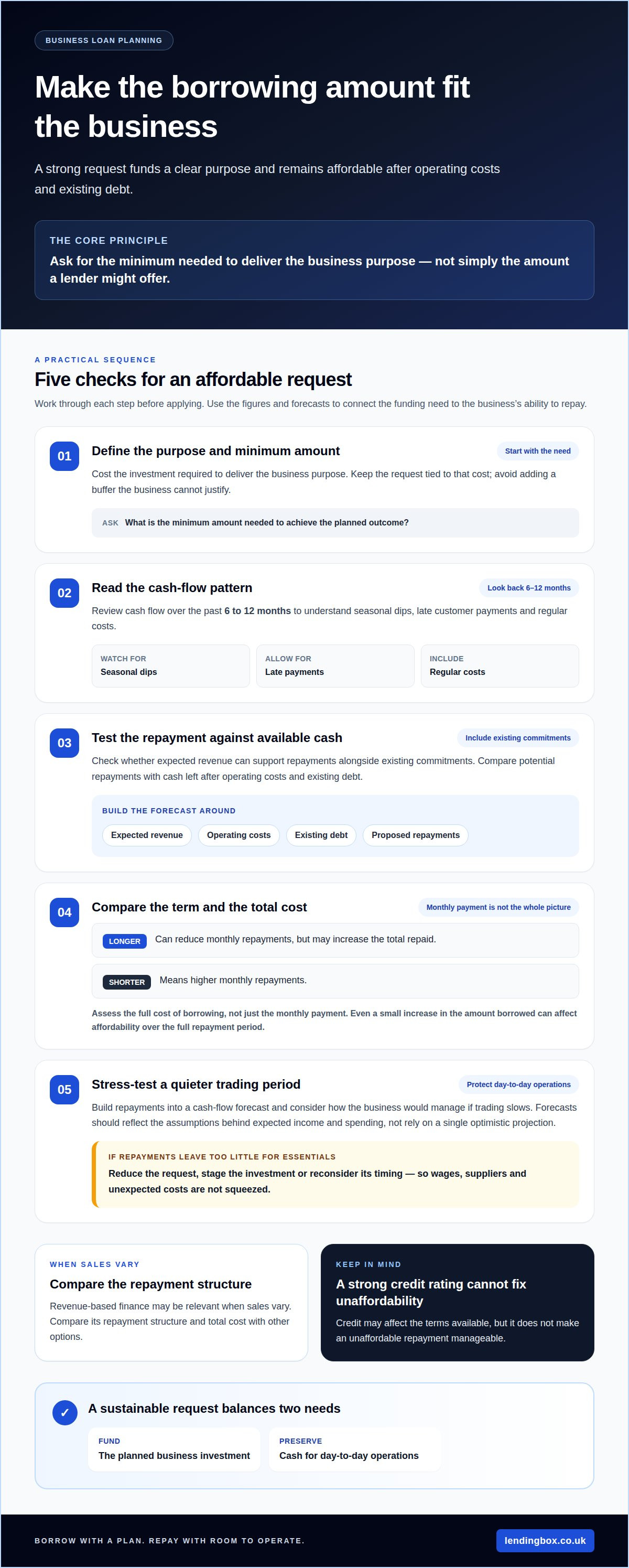
Start with the purpose, then cost the borrowing needed to deliver it. A request should cover the investment without adding a buffer that the business cannot justify. Review cash flow over the past 6 to 12 months to understand seasonal dips, late customer payments and regular costs. Then test whether expected revenue can support repayments alongside existing commitments. A strong credit rating may affect the terms available, but it doesn’t make an unaffordable repayment manageable.
Compare repayment terms as well as the amount borrowed. A longer term can reduce monthly repayments but may increase the total repaid. A shorter term means higher monthly repayments. Build repayments into a cash-flow forecast and consider how the business would manage a quieter trading period. If sales vary, revenue-based finance may be relevant, but compare its repayment structure and total cost with other options.
These examples show why even a small increase in borrowing can affect affordability over the full repayment period.
Before applying, calculate the minimum amount needed to achieve the business purpose. Compare potential repayments with cash available after operating costs and existing debt, and assess the full cost of borrowing, not just the monthly payment. If repayments would leave too little for wages, suppliers or unexpected costs, reduce the request, stage the investment or reconsider its timing. Sustainable borrowing should protect day-to-day operations as well as fund the planned investment.
4. UK business loan eligibility requirements
Lenders assess more than a business credit score. They may consider trading history, cash flow, existing borrowing, financial information and the purpose of the loan. Criteria vary, so a request that does not fit one lender’s requirements may suit another funding route. Match the finance type to your business’s stage, circumstances and needs.
There’s no single credit score or trading history that guarantees eligibility across the UK market. Lenders weigh credit alongside the company’s ability to make repayments. Start-ups with less than 2 years of business history are typically viewed as riskier. Most UK banks expect at least three years of accounts, while some fast-funding providers require 6-12 months of consistent trading. A shorter history makes clear forecasts and evidence of revenue particularly important.
Revenue and debt also shape the assessment. One guide gives £10,000 as a minimum revenue figure for an application, but lender requirements differ. A lower debt-to-income ratio can signal that the business isn’t taking on more borrowing than it can manage. Show how cash flow supports repayments, and explain how funding will help the business operate or expand. A coherent business plan, balance sheet and cash-flow statement help lenders assess the request as a whole.
Government-backed options have their own eligibility tests. Government-backed finance options may have different eligibility criteria, so consider the business’s stage and funding purpose when assessing which route fits. Neither name replaces the lender’s assessment of the application.
To improve your chances of getting a business loan, match the funding route to your trading history, cash flow and plans. Organise the relevant financial information and details of existing borrowing, then explain clearly how you will use the funds and repay them.
Lending Box: Business loan
Lending Box helps active UK limited companies and LLPs registered at Companies House explore business finance options. Its initial matching process analyses company data to provide eligibility insights with no impact on your credit score. There are no long forms before you see anything useful, no obligation at any stage, and you can start with your company name.
A business loan may suit a defined investment or cash-flow need. Revenue-Based Finance may be relevant when repayments linked to turnover suit the business; Invoice Finance can release cash tied up in unpaid invoices, while Asset Finance can help fund equipment. One named relationship manager guides you through the options and supports your application through to completion.
If you’re ready to discuss your funding needs and possible finance routes, contact Lending Box.
Make your next funding decision with clarity
Before moving ahead, decide what a useful funding outcome looks like for your business. Set out the purpose, the timing and the repayment level your cash flow can support. Agree who will make the final decision, and what information they need. This keeps the funding decision tied to a business priority, rather than pressure to secure finance quickly.
A practical step in how to improve your chances of getting a business loan is to match the finance route to the need. Lending Box helps businesses compare business loans, Revenue-Based Finance and Invoice Finance. The right option depends on how you will use the funds and how the business can repay them. If the borrowing does not support a clear business outcome, pause and reassess the plan.
Ready to talk through the options? Contact Lending Box to discuss your options and take a considered next step for your business.
Frequently Asked Questions
Am I eligible for a business loan?
To apply through Lending Box, your business must be an active UK limited company or LLP registered at Companies House. Lenders assess the business’s finances and ability to repay, and may consider its trading history, credit information, existing commitments and reason for borrowing. If the business has a short trading history, explain its current position and the purpose of the funding clearly.
How do business loans work?
Business finance can take different forms, including a fixed loan, funding linked to revenue or finance against unpaid invoices. Each works differently, so compare how repayments are calculated, what they depend on and whether the arrangement suits the way your business earns and manages cash. All options are indicative only and subject to lender assessment and approval.
How does my credit score affect my chances of getting a loan?
Your credit history can influence a lender’s view of repayment risk, but it is not the only factor. Lending Box’s initial matching process has no impact on your credit score. Lenders may carry out credit searches as part of an application, so check what this involves before deciding whether to proceed.
How much can I borrow?
The amount available depends on the funding purpose, the business’s finances and the lender’s assessment. The amount requested may differ from any offer. Start with the cost of the business need, then assess whether repayments leave enough room for normal trading costs. Borrowing should support a clear plan, not create avoidable pressure.
What do loan providers look for before approving a loan?
Providers assess financial and non-financial information to judge whether a business can repay and how much risk the application presents. They may consider credit grading, probability-of-default measures and pricing models alongside the business’s trading position. A clear purpose matters too: explain what the funds will enable, how that supports the company, and how repayment fits its expected finances.
Where can I apply for funding if I have been declined by the bank?
A bank decline does not rule out every funding route. Lending Box matches eligible UK limited companies and LLPs with finance options across the market, including Bad Credit Options. The initial matching process has no impact on your credit score, and there is no obligation at any stage. You can start with your company name and consider the options before deciding whether to apply.
Frequently Asked Questions
To apply through Lending Box, your business must be an active UK limited company or LLP registered at Companies House. Lenders assess the business’s finances and ability to repay, and may consider its trading history, credit information, existing commitments and reason for borrowing. If the business has a short trading history, explain its current position and the purpose of the funding clearly.
Business finance can take different forms, including a fixed loan, funding linked to revenue or finance against unpaid invoices. Each works differently, so compare how repayments are calculated, what they depend on and whether the arrangement suits the way your business earns and manages cash. All options are indicative only and subject to lender assessment and approval.
Your credit history can influence a lender’s view of repayment risk, but it is not the only factor. Lending Box’s initial matching process has no impact on your credit score. Lenders may carry out credit searches as part of an application, so check what this involves before deciding whether to proceed.
The amount available depends on the funding purpose, the business’s finances and the lender’s assessment. The amount requested may differ from any offer. Start with the cost of the business need, then assess whether repayments leave enough room for normal trading costs. Borrowing should support a clear plan, not create avoidable pressure.
Providers assess financial and non-financial information to judge whether a business can repay and how much risk the application presents. They may consider credit grading, probability-of-default measures and pricing models alongside the business’s trading position. A clear purpose matters too: explain what the funds will enable, how that supports the company, and how repayment fits its expected finances.
A bank decline does not rule out every funding route. Lending Box matches eligible UK limited companies and LLPs with finance options across the market, including Bad Credit Options. The initial matching process has no impact on your credit score, and there is no obligation at any stage. You can start with your company name and consider the options before deciding whether to apply.