Personal guarantee insurance tax relief and payment rules in the UK
25 November 2026 · 11 min read

 Business funding
A personal guarantee insurance premium paid by a company may be deductible for UK Corporation Tax, while a director who pays personally generally cannot deduct it. So, whether personal guarantee insurance is tax deductible in the UK depends first on who pays the premium. A payment made after a guarantee is called may qualify for relief only if the guarantee was wholly and exclusively for the guarantor’s trade and did not secure a capital advantage.
A personal guarantee can make a director personally responsible for business borrowing, and insurance does not prevent a lender from calling on it. Subject to the policy terms, insurance can compensate the guarantor for covered losses after a claim. Tax treatment is therefore only one part of the decision.
This guide explains how guarantees and personal guarantee insurance work, when a company-paid premium may receive tax relief, and what conditions may apply to a payment made under a guarantee. It also explains the difference between revenue and capital treatment, and the factors to consider when assessing the cost.
Key Takeaways
- Understand how guarantee limits and joint liability can affect your personal exposure before signing.
- See why the tax treatment of insurance premiums can differ depending on whether the company or a director pays.
- Learn what can make a guarantee payment revenue or capital, and which conditions may affect relief.
- Find out how insurance may reduce covered losses without preventing a lender from calling the guarantee.
What is a Personal Guarantee?
A personal guarantee makes a business owner responsible for specified company borrowing if the business cannot repay. A limited guarantee caps liability at an agreed amount; an unlimited guarantee can include the outstanding debt, interest and costs. Under a joint and several guarantee, each guarantor may be pursued for the full amount, not just their share.
Personal guarantee insurance is an annual policy for directors of limited companies who support business loan facilities. It can cover a new or existing guarantee, provided no claim event has occurred and no likely claim circumstances are known. The policy compensates covered net loss after a lender calls on the guarantee. It does not stop the lender pursuing the guarantor.
Cover varies by loan security and policy year. For an unsecured business loan, cover can reach 60% in year one, 70% in year two, then 80% in year three and thereafter. Neither structure insures the full guarantee.
Each director who gives a guarantee generally needs a separate policy, unless one policy specifically covers all guarantors. Secured and unsecured loans may both qualify, subject to policy terms and insurer acceptance.
UK personal guarantee insurance premiums are subject to Insurance Premium Tax, which is added to the quoted premium. This is not VAT, so there is no VAT to reclaim on the premium.
For a company tax deduction, retain the policy schedule, premium invoice, proof of payment and company accounting entry. These records show what the policy covers, the amount paid and whether the company bore the cost.
Common exclusions include fraud, deliberate default, known claim circumstances, pre-existing financial difficulties and losses arising from the guarantor’s own actions. Read the policy terms before relying on cover for a particular claim.
Revenue versus capital treatment
Tax treatment depends on why the guarantee was given and the business purpose it served. A payment may be revenue expenditure if a short-term guarantee helped secure or retain income-producing contracts. The key test is whether the expense was wholly and exclusively for the trade, rather than protecting an investment or creating an enduring advantage.
Three UK cases illustrate the revenue argument: Morley v Lawford and Company (14TC229), Jennings v Barfield (40TC365) and Lunt v Wellesley (27TC78). Each concerned a short-term guarantee linked to obtaining or retaining income-producing contracts. For a director, the commercial purpose matters more than the label attached to the liability.
Capital treatment is more likely where a guarantee supports acquiring, improving or modifying a capital asset or investment. It may also apply when the guarantee secures an enduring business advantage over a lengthy period. In Milnes v J Beam Group Ltd (50TC675), guarantees involving grouped, subsidiary or associated companies could fail the wholly and exclusively test or be capital because they protected a capital interest.
Apply this distinction to the transaction. A guarantee supporting a short-term commercial contract differs from one supporting an investment that continues to benefit the business. Using a facility for invoice finance does not determine the tax outcome by itself; the guarantee’s purpose and the advantage it secures remain central. Classify the payment based on those facts, then keep the guarantee and transaction records together for the accounts.
An insurance payout is classified by what it compensates: revenue-related and capital-related amounts follow the treatment of their underlying purpose. For example, compensation linked to a deductible trading expense differs from compensation connected to a capital asset. If the borrowing structure is still being considered, business finance options can help frame the decision alongside the guarantee’s purpose.
Tax relief for payments made under a personal guarantee
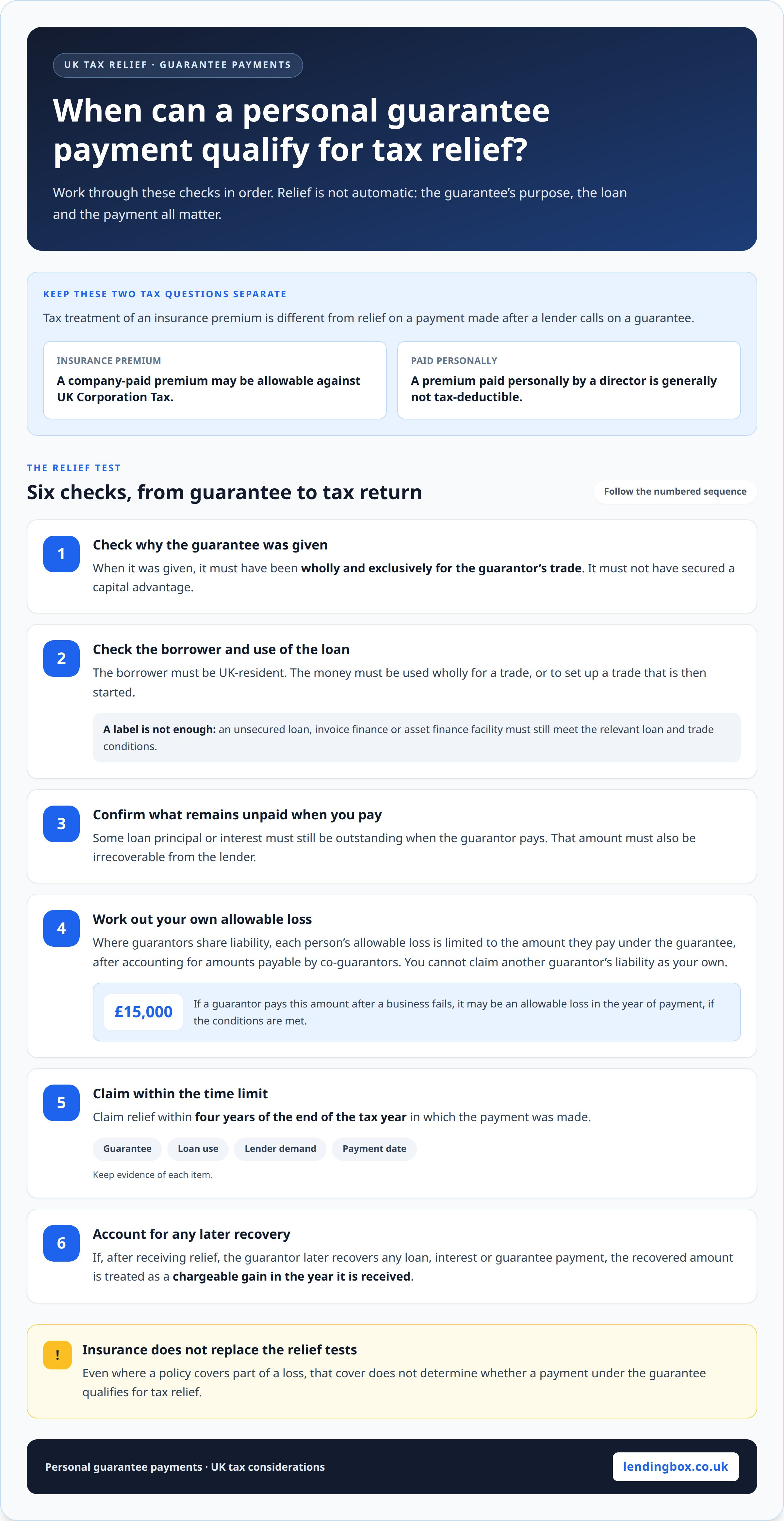
A payment made after a lender calls on a guarantee may qualify as an allowable loss, but relief is not automatic. The guarantee must have been wholly and exclusively for the guarantor’s trade when given and must not have secured a capital advantage. The loan must meet the relevant conditions for relief. Whether personal guarantee insurance is tax deductible in the UK is a separate question from whether a guarantee payment qualifies for relief.
The qualifying loan must be made to a borrower resident in the UK. The borrower must use the money wholly for a trade, or to set up a trade that is then started. An unsecured label alone does not establish eligibility. Nor does a facility’s name: invoice finance or asset finance must still meet the relevant loan and trade conditions.
Timing matters too. Some loan principal or interest must remain outstanding when the guarantor pays, and that amount must be irrecoverable from the lender. For example, if a guarantor pays £15,000 after a business fails, the allowable loss may be £15,000 in the year of payment, if the conditions are met.
Where several guarantors share liability, each person’s allowable loss is limited to the amount they pay under the guarantee, after accounting for amounts payable by co-guarantors. A director who pays more than their own qualifying share cannot claim another guarantor’s liability as their own loss.
Claim relief within four years of the end of the tax year in which payment was made. Keep evidence of the guarantee, loan use, lender demand and payment date. If the guarantor later recovers any loan, interest or guarantee payment after receiving relief, the recovered amount is treated as a chargeable gain in the year received.
To assess whether personal guarantee insurance premiums are tax deductible in the UK, distinguish who pays. Company-paid premiums are allowable against UK Corporation Tax; premiums paid personally by a director are generally not tax-deductible. Even where cover reaches 80%, insurance doesn’t replace the separate tests for relief on a guarantee payment.
Benefits of personal guarantee insurance
A personal guarantee can put a director’s personal finances at risk if a business cannot repay commercial borrowing. Insurance can reduce the covered portion of that exposure, but it does not remove the guarantee or prevent a lender from calling on it. It provides a defined layer of financial protection, subject to the policy limit and exclusions.
Consider a £100,000 business loan backed by a £100,000 personal guarantee. That difference can help business owners understand the maximum remaining liability before a claim. The insurer pays only covered losses, so the policy schedule matters as much as the headline cover percentage.
For an insured unsecured loan, a specialist can negotiate the outstanding amount with the lender after the business becomes insolvent. This support can help clarify the amount claimed and how the policy responds. It does not guarantee that the lender will accept a lower settlement, and the director remains responsible for any amount outside the cover.
An annual policy can also make guarantee exposure easier to plan alongside finance commitments. For example, a business using asset finance should consider how a guarantee relates to its borrowing and personal assets. Insurance may help manage the consequences of a claim, while keeping the funding decision separate from the tax treatment of the premium.
Cover has limits. Policies commonly exclude fraud, deliberate default, known claim circumstances, pre-existing financial difficulties and losses caused by the guarantor’s own actions. A claim can therefore fall outside the protection even when the guarantee itself is covered. Before relying on a policy, read the wording for covered events, excesses, claim requirements and the insurer’s payment limits.
The clearest benefit is reduced exposure, not complete protection. If a personal guarantee forms part of your business borrowing, explore personal guarantee insurance to consider how cover could fit the finance decision.
Lending Box: Personal guarantee insurance
Lending Box helps UK limited companies and LLPs consider personal guarantee insurance alongside their borrowing plans. This can be useful when a director is weighing the personal exposure created by a business loan and wants to understand how insurance could fit.
If funding is also under review, Lending Box matches businesses with business loans, revenue-based finance and invoice finance. Its in-house lending model provides eligibility insights with no impact on your credit score, and one named relationship manager guides clients through options and paperwork.
Tax treatment still depends on who pays the premium and the purpose of any guarantee payment. Keep these questions separate from the funding decision, then bring the relevant details into the discussion. Contact Lending Box to discuss personal guarantee insurance and business finance options.
Make your next funding decision with a clear view
When discussing funding, consider the borrowing and guarantee together. A finance structure affects the obligations a business takes on, while insurance is a separate decision about managing personal exposure. Assessing these decisions together can help you weigh the trade-offs before committing.
Whether personal guarantee insurance is tax deductible in the UK is only one part of the assessment. Your records and the guarantee’s purpose matter too. Set out who pays the premium, what the borrowing supports and how the guarantee fits the business plan. This gives your accountant and finance adviser a clearer basis for reviewing the tax treatment and funding structure.
If you’re considering how a guarantee fits your business borrowing, take the next step at your pace. Contact Lending Box to discuss your options and explore a practical route forward.
Frequently Asked Questions
Is PGI tax-deductible?
A premium paid by a company for personal guarantee insurance may be allowable against UK Corporation Tax. If a director pays personally, it is generally not tax-deductible. Keep the policy paperwork and payment records with the company accounts so the payer and business purpose are clear. Tax relief on a separate payment under a guarantee has different conditions and should not be treated as the same claim.
Is personal guarantee insurance premium tax deductible for UK individuals?
Generally, no. A director who personally pays a personal guarantee insurance premium usually cannot deduct it for UK tax purposes. For example, paying from a personal bank account rather than the company account changes who bears the cost. Keep the receipt and policy details, but do not assume the premium qualifies as an individual business expense simply because the guarantee supports company borrowing.
Can a limited company deduct the cost of a director's personal guarantee insurance in the UK?
Yes. A company-paid premium for a director’s personal guarantee insurance is allowable against UK Corporation Tax. The company should record the expense and retain the policy schedule, invoice and proof of payment. If the director is covered personally, the company’s accountant should also consider whether the payment creates a benefit in kind. That treatment depends on the circumstances surrounding the cover.
How does HMRC treat personal guarantee insurance premiums for corporation tax?
For Corporation Tax, company-paid personal guarantee insurance premiums are allowable expenses. The company should record the premium in its accounts and retain documents showing the policy relates to a director’s business guarantee. Insurance Premium Tax may form part of the cost, but it isn’t VAT. This distinction matters when recording the payment, as VAT recovery rules don’t apply to Insurance Premium Tax.
Does tax treatment differ when the company pays for a director's personal guarantee insurance?
Yes. If the company pays, the premium is allowable against Corporation Tax; if the director pays personally, it’s generally not tax-deductible for that individual. A company-paid policy may also be treated as a benefit in kind, depending on the circumstances. Keep the payer, payment route and policyholder details clear in the records, then account for the company expense and any relevant director treatment separately.
Frequently Asked Questions
A premium paid by a company for personal guarantee insurance may be allowable against UK Corporation Tax. If a director pays personally, it is generally not tax-deductible. Keep the policy paperwork and payment records with the company accounts so the payer and business purpose are clear. Tax relief on a separate payment under a guarantee has different conditions and should not be treated as the same claim.
Generally, no. A director who personally pays a personal guarantee insurance premium usually cannot deduct it for UK tax purposes. For example, paying from a personal bank account rather than the company account changes who bears the cost. Keep the receipt and policy details, but do not assume the premium qualifies as an individual business expense simply because the guarantee supports company borrowing.
Yes. A company-paid premium for a director’s personal guarantee insurance is allowable against UK Corporation Tax. The company should record the expense and retain the policy schedule, invoice and proof of payment. If the director is covered personally, the company’s accountant should also consider whether the payment creates a benefit in kind. That treatment depends on the circumstances surrounding the cover.
For Corporation Tax, company-paid personal guarantee insurance premiums are allowable expenses. The company should record the premium in its accounts and retain documents showing the policy relates to a director’s business guarantee. Insurance Premium Tax may form part of the cost, but it isn’t VAT. This distinction matters when recording the payment, as VAT recovery rules don’t apply to Insurance Premium Tax.
Yes. If the company pays, the premium is allowable against Corporation Tax; if the director pays personally, it’s generally not tax-deductible for that individual. A company-paid policy may also be treated as a benefit in kind, depending on the circumstances. Keep the payer, payment route and policyholder details clear in the records, then account for the company expense and any relevant director treatment separately.