Management buyout funding: how valuation, debt and investors shape the deal
24 November 2026 · 11 min read

 Business funding
A large loan is not always the answer to an MBO. To understand how to get funding for a management buyout (MBO), consider the whole package: it may combine debt, equity and deferred payment to the seller. The right mix depends on the business’s valuation and its ability to repay.
The funding structure matters, but lenders and investors also assess the management team and the business’s prospects. A strong case should explain how the team will run the company, support its forecasts with evidence and respond to market conditions.
This article explains how valuation, debt capacity and working capital shape the amount and type of funding available. It also covers how lenders and investors assess management, forecasts and market opportunity, so you can prepare for discussions and understand where specialist finance support may help.
Key Takeaways
- Build the funding package around the purchase price, management’s contribution and any amount the seller agrees to defer.
- Use a fair valuation grounded in the company’s profits, recurring income, industry trends and EBITDA.
- Test debt repayments against cash flow and working capital needs to see whether the business can keep operating comfortably.
- Show lenders and investors a capable management team, credible forecasts and a clear market opportunity.
What is a management buyout (MBO), and how can a finance broker help secure funding for one?
A management buyout is when the existing management team acquires the business it runs. UK MBO funding can combine debt, equity and vendor finance. For managers, understanding how to get funding for a management buyout (MBO) starts with matching these sources to the purchase price, business earnings and available security. A finance broker can help shape the package and present the case to potential lenders.
Management Team Equity Contribution
The management team’s equity contribution is the share of the purchase price it funds itself. UK management teams typically contribute 10-30% through personal savings, director loans or family funding. This contribution shows commitment and can help bridge the gap between the purchase price and available borrowing. The MBO team may also consider deferred seller payments, reducing the cash required upfront. The balance depends on the deal structure and funding available.
Private Equity and Bank Debt
Private equity provides capital in return for an ownership stake, while debt adds borrowing that the business must repay. Combining them can provide both risk capital and repayable finance, reducing reliance on either source alone. The trade-off is control: an external investor may seek a shareholding and influence over strategic decisions. Management should weigh that involvement against the value of extra capital and investor support.
Debt, Equity and Vendor Financing
Debt is repaid from the business’s earnings; equity is capital exchanged for ownership; vendor finance means the seller defers part of the purchase price. Together, these sources can fund a purchase when management has limited cash available. A lender assesses repayment capacity and may require security over business assets. Vendor finance can bridge a funding gap, but its repayment terms must fit alongside senior debt and the company’s operating cash needs.
Seller Equity Paid Down Over Time
Seller equity paid down over time lets the seller retain an interest while management acquires ownership gradually. The seller’s stake can diminish as agreed payments are made, easing the MBO team’s upfront funding requirement. Clear terms should set payment timing, the seller’s remaining rights and how future earnings affect the arrangement. A finance broker can help clarify how to get funding for a management buyout (MBO) by assessing how this structure fits the wider package.
Business valuation
A defensible valuation gives the MBO a basis for its purchase price and helps determine the funding requirement. Professional valuers may assess profits, recurring income, industry trends and EBITDA, which measures earnings before interest, tax, depreciation and amortisation. Each offers a different perspective: recurring income indicates revenue consistency, while industry trends put current performance in context. Considering several factors gives the management team a sounder basis for negotiations and lender discussions.
Due diligence tests whether the valuation reflects how the business actually operates. It may cover financial records, customer and supplier contracts, legal responsibilities, suppliers and staffing. These checks can uncover obligations or operational issues that affect earnings and future cash flow. For example, reliance on a particular contract or a change in staffing costs may alter the forecasts supporting the proposed price. The evidence helps both sides assess the transaction on a consistent basis.
Funding suitability also depends on whether the existing management team can run the business and service its borrowing after completion. Lenders assess the company’s cash flow, existing debt and ability to meet repayments without weakening day-to-day operations. UK MBO senior debt is typically serviced from business cash flow over a 5-7 year term. Forecasts therefore need to show how earnings support repayments throughout that period, not just at the point of sale.
Business planning connects the valuation to the funding case. A clear plan explains how the management team will maintain operations, protect income and pursue strategic opportunities after ownership changes. Lenders consider whether the forecast supports the proposed debt; investors also examine the target’s prospects and the team’s ability to deliver. If a business loan forms part of the proposed funding, business loan options can be considered alongside the transaction’s valuation and cash-flow needs.
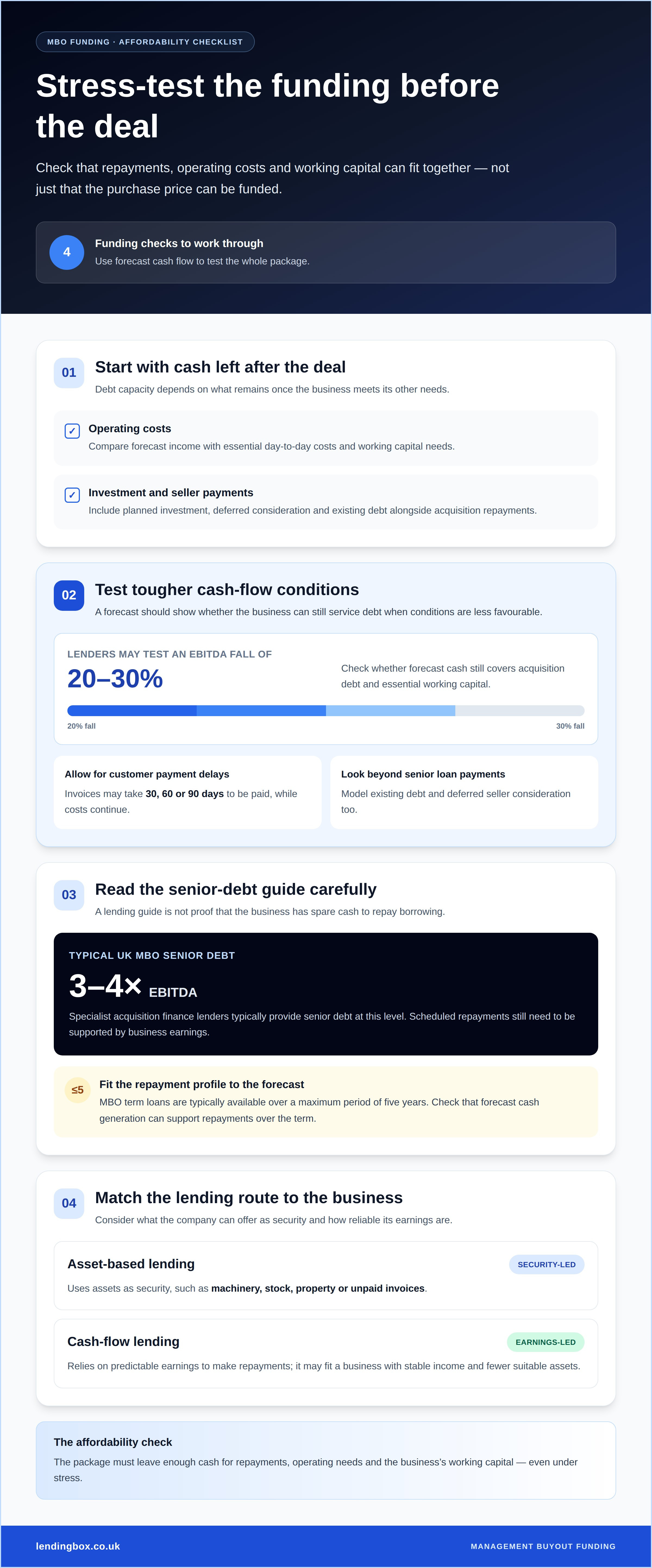
Assessing debt affordability and working capital needs
Debt capacity depends on cash available after operating costs, planned investment and seller payments. Stress-testing shows whether the proposed structure leaves enough capital for daily operations and growth.
Cash-Flow Analysis and Debt Stress-Testing
Cash-flow analysis compares forecast income with repayments and essential working capital needs. Lenders may test whether the business can still service acquisition debt if EBITDA falls by 20-30%. The management team should also account for deferred consideration and existing debt, not just senior loan payments. This matters because customers may take 30, 60 or 90 days to pay invoices, leaving cash tied up while costs continue.
Senior Debt and EBITDA-Based Lending
Senior debt is borrowing that ranks ahead of other finance for repayment. Specialist acquisition finance lenders typically provide UK MBO senior debt at 3-4 times EBITDA. That is a lending guide, not a measure of spare cash: the business still needs to meet scheduled payments from earnings. MBO term loans are typically available over a maximum period of five years, so the repayment profile must fit forecast cash generation.
Asset-Based and Cash-Flow Lending
Asset-based lending uses assets such as machinery, stock, property or unpaid invoices as security. Cash-flow lending instead relies on the business generating predictable earnings to make repayments. Asset finance may suit a company acquiring equipment, while cash-flow finance may fit a business with stable income and fewer suitable assets. If repayments are missed, assets pledged as security may be at risk.
MBO Interest Rates, Fees and Repayment Terms
Interest rates and fees depend on the lender’s assessment of risk, security, leverage and repayment structure. Compare the full payment schedule, including seller instalments, with forecast cash available after operating costs. The repayment term affects both regular payments and the total financing cost. For an MBO term loan, the typical maximum term is five years, so assess how much debt the business can support from its cash flow.
Investor assessment of management, forecasts and markets
An MBO can support continuity because the existing management team already understands the company’s operations, culture and strategy. That knowledge can matter to investors, but familiarity alone does not prove the acquisition is viable. Investors assess the team’s integrity and capability alongside the business case. Lenders need evidence that sustainable cash flow can support repayments.
Private equity investors compare the business plan and forecasts with the market opportunity for the company’s products or services. Forecasts should link planned growth to clear commercial drivers, such as customer demand, sales performance and operating capacity. If projected revenue rises, explain how the business will win and deliver that work. This helps investors judge whether the purchase price reflects the company’s prospects.
Investors test management’s credibility by examining the assumptions behind the forecasts. They look for a team that can explain its reasoning, identify risks and show who will lead each part of the plan after completion. For example, a forecast for stronger sales should account for the resources needed to serve customers. Clear roles also matter: uncertainty about responsibilities or decision-making can weaken confidence in the team’s ability to deliver.
Market conditions shape the financing structure. Investors consider whether demand can support earnings, while lenders focus on cash flow available for repayments. If repayments are missed, assets pledged for a secured loan may be at risk. The plan should show how the company will manage debt alongside investment and working capital. A strong case connects market evidence, management capability and repayment capacity.
Prepare a funding case that connects the team’s experience with credible forecasts and market demand. Discuss your MBO funding structure with a finance specialist.
Lending Box
Lending Box helps UK limited companies and LLPs explore funding options for an MBO. As a whole-of-market broker, it matches businesses with options including business loans, revenue-based finance, invoice finance and asset finance. The right fit depends on the transaction, the company’s cash flow and its available assets.
Lending Box’s initial matching process has no impact on your credit score. A named relationship manager guides you through relevant options and supports the application paperwork, helping keep the process organised while lenders assess the business and proposed deal.
If you’re considering an MBO, contact Lending Box to discuss your funding needs.
Set your MBO funding plan in motion
Turn the deal’s assumptions into a funding plan that lenders and investors can assess. Set out the proposed transaction, the management team’s role after completion and the evidence behind the business plan. Keep the seller’s expectations aligned with the funding structure so negotiations can proceed on realistic terms.
Getting funding for a management buyout means connecting the purchase proposal to a credible plan for ownership and future performance. A finance specialist can help assess funding routes and present the business’s case to potential lenders. Lending Box matches UK limited companies and LLPs with options across the market, with one named relationship manager to guide the process.
Discuss MBO funding with Lending Box and take a considered next step towards the deal.
Frequently Asked Questions
How does a management buy-out work?
An MBO transfers ownership of a business to its existing management team. The seller and management agree the purchase terms, arrange funding and complete the legal transfer. The deal may use a share purchase or an asset purchase, which determines what changes hands. A share sale transfers ownership of the company; an asset sale transfers specified business assets.
What are the tax implications of an MBO?
Tax implications depend on the transaction structure and each party’s circumstances. Share sales and asset sales can have different tax consequences for the seller and buyer. Deferred payments or an earn-out may also affect when proceeds are received and how the deal is treated. Before agreeing terms, both sides should get tax advice based on the proposed structure and payment arrangements.
What is the best way to fund an MBO?
The right funding mix depends on the purchase price, cash flow, available assets and how much ownership management wants to retain. A deal might combine senior borrowing with management equity and deferred seller consideration. Private equity can add capital, but means sharing ownership. Compare each source’s repayment demands and effect on control against the business plan before settling on a structure.
How much equity do managers need to contribute to an MBO in the UK?
UK management teams typically contribute 10-30% of the purchase price through personal savings, director loans or family funding. The amount needed depends on the purchase price and how much lenders or investors will fund. If the team cannot cover the gap, deferred consideration from the seller may form part of the package. Agree how contributions relate to each manager’s ownership and decision-making rights.
How do UK banks assess and finance management buyouts?
Banks assess whether the business can repay borrowing from cash flow and whether the management team can deliver its plan. They may review financial performance, forecasts, existing debt and available security. The structure may include senior debt secured against assets from the business, management team or both. The lender’s assessment determines the amount, repayment terms and conditions offered.
How does private equity funding for a UK MBO work?
A private equity firm invests capital in return for an ownership stake in the business. It may fund some or all of the equity element, often alongside senior debt. Investors may seek a board seat, dividends and regular reporting against agreed growth targets. This can bring expertise or contacts, but management shares ownership and some influence over strategic decisions.
Frequently Asked Questions
An MBO transfers ownership of a business to its existing management team. The seller and management agree the purchase terms, arrange funding and complete the legal transfer. The deal may use a share purchase or an asset purchase, which determines what changes hands. A share sale transfers ownership of the company; an asset sale transfers specified business assets.
Tax implications depend on the transaction structure and each party’s circumstances. Share sales and asset sales can have different tax consequences for the seller and buyer. Deferred payments or an earn-out may also affect when proceeds are received and how the deal is treated. Before agreeing terms, both sides should get tax advice based on the proposed structure and payment arrangements.
The right funding mix depends on the purchase price, cash flow, available assets and how much ownership management wants to retain. A deal might combine senior borrowing with management equity and deferred seller consideration. Private equity can add capital, but means sharing ownership. Compare each source’s repayment demands and effect on control against the business plan before settling on a structure.
UK management teams typically contribute 10-30% of the purchase price through personal savings, director loans or family funding. The amount needed depends on the purchase price and how much lenders or investors will fund. If the team cannot cover the gap, deferred consideration from the seller may form part of the package. Agree how contributions relate to each manager’s ownership and decision-making rights.
Banks assess whether the business can repay borrowing from cash flow and whether the management team can deliver its plan. They may review financial performance, forecasts, existing debt and available security. The structure may include senior debt secured against assets from the business, management team or both. The lender’s assessment determines the amount, repayment terms and conditions offered.
A private equity firm invests capital in return for an ownership stake in the business. It may fund some or all of the equity element, often alongside senior debt. Investors may seek a board seat, dividends and regular reporting against agreed growth targets. This can bring expertise or contacts, but management shares ownership and some influence over strategic decisions.