Business loans to cover a VAT bill: costs and repayments
9 November 2026 · 12 min read

 Business funding
A VAT bill can be paid in full without taking the whole amount from working capital at once. A business loan to cover a VAT bill can be paid directly to HMRC, then repaid by the business in monthly instalments over an agreed period, typically three to 12 months.
This can ease cash-flow pressure, but it adds borrowing costs and regular repayments. The right option depends on when money is due in, the finance costs and whether the repayments fit the business’s budget.
This guide explains how VAT finance works, what affects its cost and how repayments are structured. It compares invoice finance, which can release funds tied up in unpaid invoices, and asset finance, which is linked to equipment or other business assets. Understanding what each option is designed to fund can help you choose an approach that fits the VAT bill and the business’s wider cash-flow needs.
Key Takeaways
- A VAT loan can cover a bill due to HMRC, with the business repaying the lender in instalments.
- Assess the total borrowing cost and whether repayments fit your cash flow before choosing a term.
- Invoice finance may suit a business waiting for customers to pay; asset finance is linked to funding business assets.
- Match the finance type to the cash-flow gap, the purpose of the borrowing and the repayments the business can manage.
What are the costs and repayment terms associated with VAT loans?
VAT loan costs depend on the amount borrowed, the lender’s interest rate and any arrangement fee. Repayments are usually monthly, with terms commonly set for 3, 6, 9 or 12 months.
HM Revenue & Customs says you must register for VAT if you expect your taxable turnover to go over £90,000 in the next 30 days. It also says the deadline for submitting your return online is usually one calendar month and 7 days after the end of an accounting period.
Borrowing costs and affordability
Affordability means being able to meet each repayment alongside the business’s other costs. Spreading the VAT bill can preserve cash now, but it also creates regular commitments later.
Compare the total amount repayable, including interest and fees, with the instalments and expected cash coming in. For example, if customer payments are due after the VAT deadline, check whether they are expected before loan repayments fall due. A shorter term may mean larger instalments; a longer term spreads repayments out but can increase the total borrowing cost.
Interest, fees and repayment terms
Interest is the lender’s charge for borrowing, while some VAT finance may also include an arrangement fee. Both affect the total cost, so compare the full repayment amount rather than the interest rate alone.
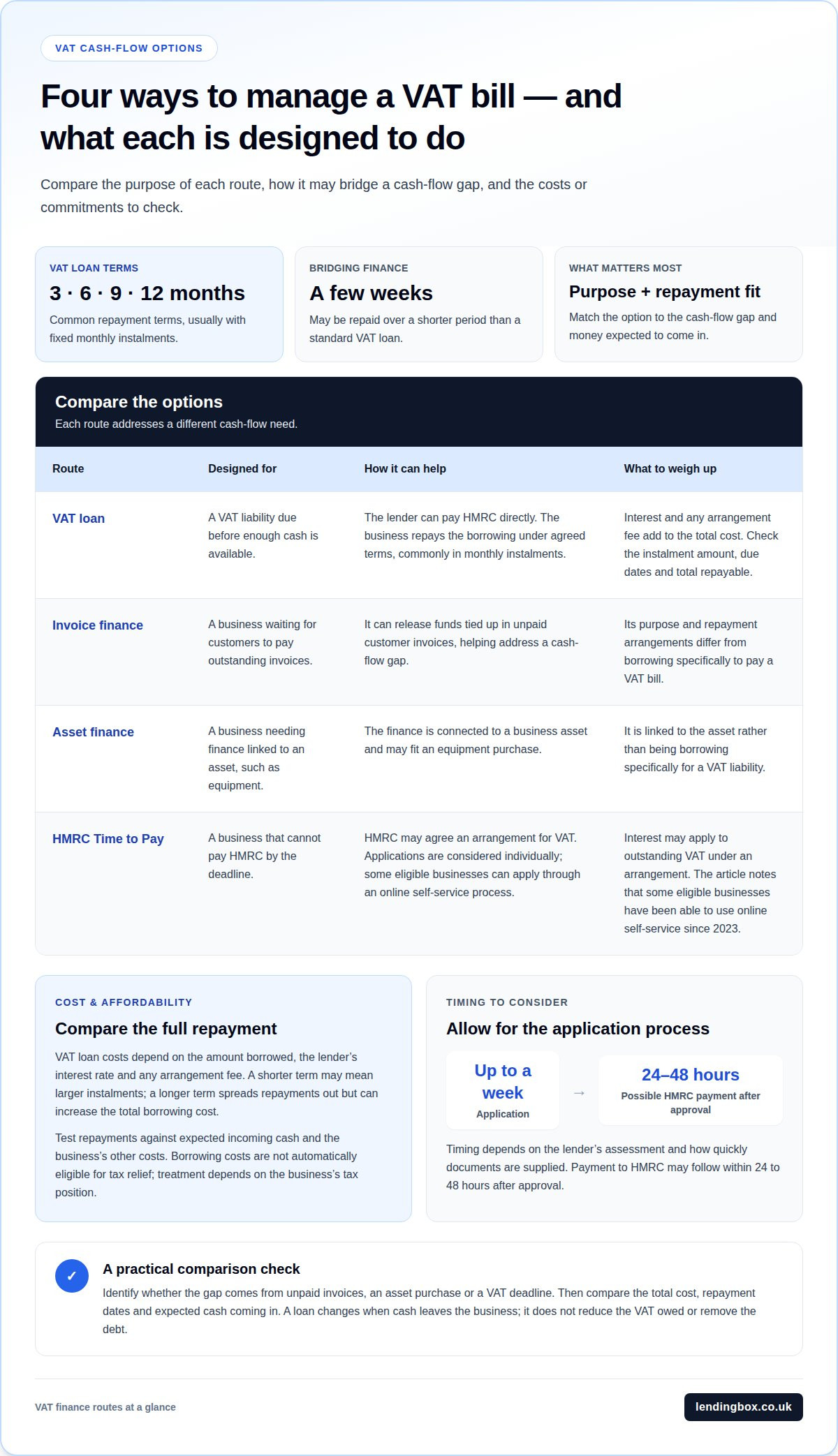
VAT loan terms commonly run for 3, 6, 9 or 12 months, with fixed monthly repayments. Bridging finance may instead be repaid within a few weeks. Check the instalment amount, due dates and total payable before agreeing to borrow, then test the schedule against the business’s cash-flow forecast.
A VAT loan does not automatically make its interest or fees eligible for tax relief. Their treatment depends on the business’s tax position, so discuss any claim with an accountant before deducting borrowing costs.
HMRC may agree a Time to Pay arrangement for VAT, and considers each application individually. Since 2023, some eligible businesses have been able to apply through an online self-service process; interest may apply to outstanding VAT under an arrangement.
How do VAT loans work?
A VAT loan is short-term credit that helps a business pay its VAT liability before cash is available. A business loan to cover a VAT bill may be arranged for the lender to pay HMRC directly, leaving the business to repay the borrowed amount under agreed terms.
VAT loans and business cash flow
This type of finance bridges the gap between a VAT payment deadline and incoming business cash. It may be relevant when paying HMRC in full would leave too little available for wages, suppliers or other operating costs.
For example, a company may have issued invoices but still be waiting for customers to pay when its VAT bill falls due. Finance can meet the immediate liability while later receipts contribute to repayments. A business loan to cover a VAT bill changes the timing of the cash outflow, but it does not reduce the tax owed or remove the debt.
Benefits and drawbacks of VAT loans
The main benefit is meeting the VAT obligation without using all available working capital at once. The trade-off is taking on credit that must be repaid, with interest and possibly fees adding to the total cost.
This option may suit a business with a clear cash-flow gap and a realistic repayment plan. It may be less suitable if income is uncertain or existing commitments already stretch available cash. The key question is whether the business can make repayments without creating another shortfall.
A lender typically assesses trading history, creditworthiness and the business’s ability to repay. Applicants commonly undergo a credit check and may need to provide financial information. Most VAT loan lenders require at least one year of trading, although requirements vary.
Once approved, the lender can pay HMRC directly. The amount available depends on the business’s financial history, credit position and borrowing needs. Applications can take up to a week, depending on the lender and how quickly documents are supplied. After approval, payment to HMRC may follow within 24 to 48 hours.
Standard VAT loans commonly spread repayments over a few months to a year. Bridging VAT loans can provide a short-term borrowing option. For a business loan to cover a VAT bill, match the repayment schedule to expected cash rather than relying on a future receipt without a workable plan.
Alternatives such as invoice finance and asset finance
Invoice finance and asset finance can address different needs from a business loan. The right fit depends on whether cash is tied up in unpaid invoices or the business needs finance linked to an asset.
Using finance to pay a VAT bill
Businesses can use finance to meet a VAT payment and then repay the borrowing under its agreed terms. This can be useful when a VAT liability falls due before the cash needed to pay it arrives.
Invoice finance releases funds tied to unpaid customer invoices, so it may suit a business waiting for payment. Asset finance is linked to a business asset and may fit an equipment purchase. Either can support cash flow, but their purpose and repayment arrangements differ from borrowing specifically for a VAT bill. A business loan is another option for a defined shortfall.
VAT rules also distinguish financial services from other supplies. The Value Added Tax Act 1994 sets out the finance exemption in Schedule 9, Group 5. For the intermediary-services exemption, the financial service must be listed in items 1 to 4 and 6. This exemption concerns qualifying services; it doesn’t mean every form of business finance is exempt.
Finance when a VAT bill is due
If a business cannot pay HMRC by the deadline, it should act early and discuss a Time to Pay arrangement. HMRC considers applications individually, and interest may apply to outstanding VAT under an arrangement.
Finance timing depends on the lender’s assessment and how quickly the business supplies its documents. An application can take up to a week; after approval, payment to HMRC may follow within 24 to 48 hours. These timings matter when comparing finance with an approaching due date, but they leave little room for delay if paperwork is incomplete.
Before choosing invoice finance, asset finance or a business loan, match the funding purpose to the cash-flow gap. A business waiting for a customer invoice may consider invoice finance; one planning an equipment purchase may consider asset finance. If the immediate need is paying HMRC, compare repayment obligations and the total borrowing cost with expected cash coming in.
Matching businesses with VAT loan providers
A suitable finance option should match the funding amount, timing and repayments to the business’s finances. Start with the VAT liability and payment deadline, then compare the available options with expected cash flow. Indicative only. Subject to lender assessment and approval.
Lenders commonly assess trading history, creditworthiness and the ability to meet repayments. Most require at least one year of trading, and applicants typically undergo a credit check. A stable financial record and up-to-date VAT returns can strengthen an application, while existing borrowing affects affordability.
Prepare the information a lender may request: recent bank statements, filed accounts, VAT returns, tax position and proof of income. Complete records help show how the business earns revenue and manages obligations. If a VAT deadline is close, missing documents can delay assessment and funding, so organise them before applying.
Match the repayment period to the cash expected, not just the deadline. A term of up to 12 months spreads repayments further, while a shorter term clears the borrowing sooner. Compare the total cost and instalment against forecast receipts, including any seasonal changes. Keep enough working capital for payroll, suppliers or a planned purchase after paying HMRC.
Some VAT loan providers may approve and pay funds within 48 hours. That timing can help where the application is complete and the VAT payment is urgent, but it should not replace early planning. Applying ahead of the deadline gives more room to review the offer, repayment schedule and total borrowing cost before committing.
Choose finance for the actual cash-flow gap: VAT funding can cover the bill, while other business finance may suit a wider capital need. Explore business finance options to assess a route that fits your funding purpose and repayment capacity.
Lending Box: Business loan
Lending Box helps UK limited companies and LLPs explore finance options when a VAT bill puts pressure on cash flow. Its in-house lending model analyses company data to provide instant eligibility insights without impacting credit scores.
A business loan may suit a defined funding gap. If unpaid invoices are delaying cash, invoice finance may be more relevant; asset finance can support an eligible asset purchase. Lending Box also offers revenue-based finance. One named relationship manager guides you through the options and handles the paperwork.
This can help when you need to understand which type of funding fits the VAT bill, repayment capacity and wider business needs. The aim is to clarify the options, not to assume one form of finance suits every situation. Contact Lending Box to discuss your business’s funding needs.
Make your next funding decision with a clear view
Before choosing finance, consider whether the VAT shortfall is a one-off timing issue or part of a wider working-capital need. That distinction can shape the type of funding and repayment pattern that makes sense for the business. A business loan to cover a VAT bill may address a specific payment, while other finance types can meet different cash-flow needs.
Lending Box offers business loans, revenue-based finance and invoice finance. Its team can help you consider the options in relation to your business’s circumstances, rather than treating the VAT payment in isolation.
Bring your funding need and expected cash-flow position into the conversation. Contact Lending Box about VAT finance to discuss a suitable next step. A clear view of the need makes it easier to move forward with purpose.
Frequently Asked Questions
What is a VAT loan?
A VAT loan is business borrowing used to settle a VAT liability. In some arrangements, the lender pays HMRC on the company’s behalf, and the company then owes the lender the financed amount. This can bridge the gap between a tax payment and customer receipts, but it creates a separate credit commitment for the business to manage.
How do you apply for a VAT loan, and what are the eligibility criteria?
To apply through Lending Box, a business must be an active UK limited company or LLP registered at Companies House. Start with your company name: there are no long forms before you see anything useful and no obligation at any stage. The initial matching process has no impact on your credit score. A credit search only happens at full application, and only with your agreement.
How much can a business borrow?
There is no standard amount for every VAT loan. The funding available depends on lender assessment and approval. Consider the VAT liability alongside the business’s cash flow and ability to meet repayments. A sensible application reflects the bill being funded and the cash available for repayments; borrowing beyond the tax shortfall can add debt without addressing the immediate need. Indicative only. Subject to lender assessment and approval.
What should businesses consider before taking out a VAT loan?
Check that the VAT return reflects the business’s sales and recoverable VAT, then map expected customer receipts against existing commitments. Consider whether delayed invoices, seasonal trading or a planned purchase could affect repayment capacity. A forecast should show how the business will meet repayments without missing supplier or payroll payments. This gives a clearer view of the effect on working capital.
Can a UK business take out a loan to pay a VAT bill?
Yes. A UK business can use business borrowing to fund a VAT payment. Depending on the arrangement, the lender may pay HMRC directly or the business may receive funds to make the payment. Either way, the loan creates a separate obligation to the lender. Keep the VAT payment and loan repayments clear in the business’s cash-flow records.
What types of business finance can cover a VAT bill in the UK?
A business loan can fund a specific VAT shortfall. Revenue-based finance links repayments to business turnover, while invoice finance releases funds against eligible unpaid invoices. Asset finance is linked to an asset purchase, so it may suit equipment funding rather than a VAT-only need. Match the finance type to the cash-flow problem and purpose of the borrowing.
Frequently Asked Questions
A VAT loan is business borrowing used to settle a VAT liability. In some arrangements, the lender pays HMRC on the company’s behalf, and the company then owes the lender the financed amount. This can bridge the gap between a tax payment and customer receipts, but it creates a separate credit commitment for the business to manage.
To apply through Lending Box, a business must be an active UK limited company or LLP registered at Companies House. Start with your company name: there are no long forms before you see anything useful and no obligation at any stage. The initial matching process has no impact on your credit score. A credit search only happens at full application, and only with your agreement.
There is no standard amount for every VAT loan. The funding available depends on lender assessment and approval. Consider the VAT liability alongside the business’s cash flow and ability to meet repayments. A sensible application reflects the bill being funded and the cash available for repayments; borrowing beyond the tax shortfall can add debt without addressing the immediate need. Indicative only. Subject to lender assessment and approval.
Check that the VAT return reflects the business’s sales and recoverable VAT, then map expected customer receipts against existing commitments. Consider whether delayed invoices, seasonal trading or a planned purchase could affect repayment capacity. A forecast should show how the business will meet repayments without missing supplier or payroll payments. This gives a clearer view of the effect on working capital.
Yes. A UK business can use business borrowing to fund a VAT payment. Depending on the arrangement, the lender may pay HMRC directly or the business may receive funds to make the payment. Either way, the loan creates a separate obligation to the lender. Keep the VAT payment and loan repayments clear in the business’s cash-flow records.
A business loan can fund a specific VAT shortfall. Revenue-based finance links repayments to business turnover, while invoice finance releases funds against eligible unpaid invoices. Asset finance is linked to an asset purchase, so it may suit equipment funding rather than a VAT-only need. Match the finance type to the cash-flow problem and purpose of the borrowing.