Personal Guarantee Insurance Cost and the Risks for Directors
8 November 2026 · 11 min read

 Business funding
A personal guarantee can put your home and other personal assets at risk. Whether personal guarantee insurance is worth it for directors depends on the exposure and the policy’s cost: policies typically cover 70 to 80% of the guaranteed amount, rather than removing the risk entirely.
It’s sensible to weigh the premium against the amount you could owe, how long the guarantee may remain in place and what the policy covers. Whether personal guarantee insurance is worth it for directors depends on the company’s borrowing and each director’s personal financial position.
This article explains how guarantees can affect directors’ personal assets, how insurance responds and what can affect its cost. Use these points to assess whether the cover suits your circumstances.
Key Takeaways
- Estimate the premium against the guarantee amount and the cover offered to judge whether insurance fits your financial exposure.
- Read the guarantee’s limits and terms carefully, as personal liability can put assets such as your home at risk.
- If several directors sign, understand whether each could be responsible for the full debt, not just an agreed share.
- Consider how insurance may reduce your exposure, then explore suitable business finance options if a personal guarantee is a concern.
How Much Does Personal Guarantee Insurance Cost (2025)?
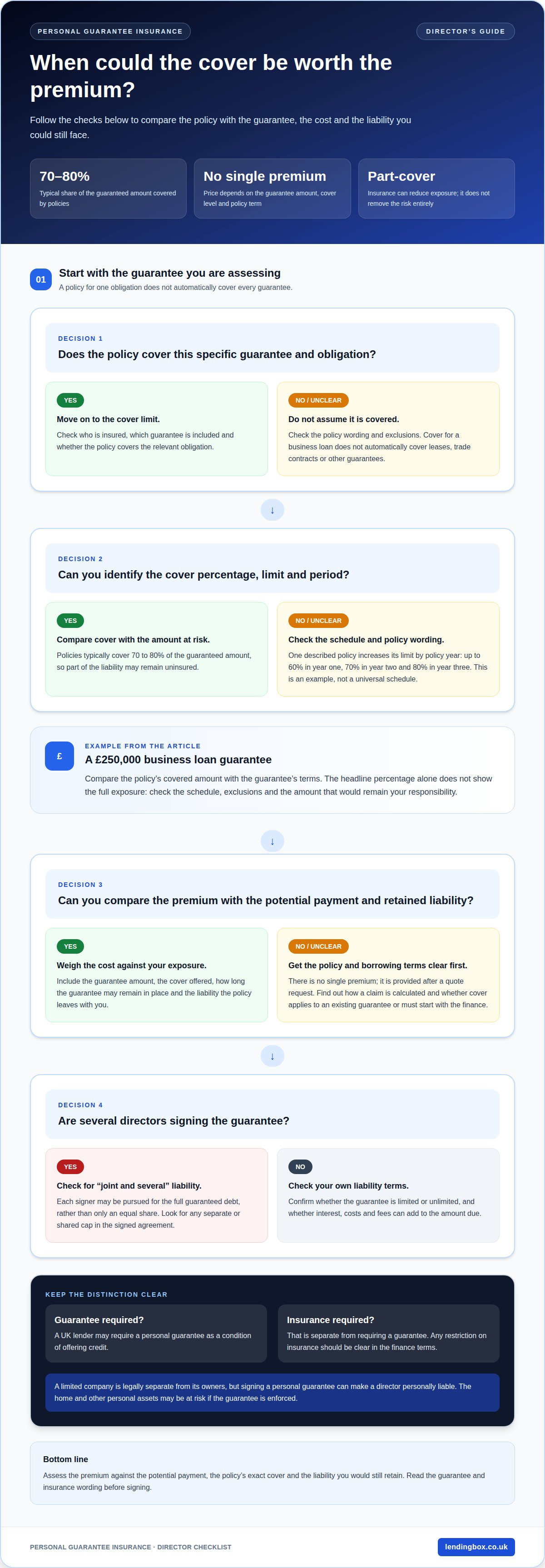
There is no single premium for personal guarantee insurance. The price depends on the guarantee amount, cover level and policy term, and is provided after a quote request. Premiums generally reflect a percentage of the guaranteed amount, so a larger exposure can mean a higher cost.
Personal guarantee insurance can cover part of what you would owe if a lender calls on your guarantee. A guarantee may support finance or banking commitments, commercial leases, or trade and consultancy contracts. Check which obligations the policy includes: cover for a business loan does not automatically cover every other guarantee.
For example, a director signing a £250,000 business loan guarantee should compare the policy’s covered amount with the guarantee’s terms. Policies typically cover 70 to 80% of the guaranteed amount. One described policy increases its limit by policy year: up to 60% in year one, 70% in year two and 80% in year three. These figures show why the schedule and exclusions matter as much as the headline percentage.
A specialist broker can help explain policy wording, limits and exclusions alongside the borrowing terms. Before buying, check who is insured, which guarantee and obligations are covered, the cover period and how a claim is calculated. Also find out whether the policy covers an existing guarantee or must start when you take out finance.
A UK lender may require a personal guarantee as a condition of offering credit; that is separate from requiring insurance. Any restriction on insurance should be clear in the finance terms. UK legislation identifies the Unfair Terms in Consumer Contract Regulations (1999) as a potential basis for challenging unfair personal guarantee terms.
To decide whether cover is worthwhile, compare its premium with the potential payment and the liability you would retain. A policy limit may leave part of the guarantee uninsured, so assess your remaining exposure before signing.
How personal guarantees expose directors’ personal assets
A UK limited company is legally separate from its owners, so personal assets are not usually at risk if the company fails. Signing a personal guarantee changes that. If the company cannot pay, the director becomes personally liable for the obligations covered by the guarantee. It is a separate contract with the creditor, not simply another company debt.
Your home can be exposed if the creditor enforces the guarantee and you cannot meet the payment. A limited guarantee caps liability at a stated amount. An unlimited guarantee can cover the full outstanding balance, plus interest, costs and fees. Even a capped guarantee can therefore leave you owing more than the original figure. Check what the document includes before signing.
Personal assets may face enforcement after a creditor takes legal action. If a court order is made and the guarantor cannot pay, a charging order may be registered against their home. According to the Insolvency Service, a creditor may issue a statutory demand for a personal guarantee debt, giving the director 21 days to pay before the creditor can petition for personal bankruptcy. A demand is a serious step, not an automatic seizure of property.
Company insolvency does not end a director’s separate guarantee contract. Liquidation, dissolution or starting a new company does not release the signer from the old company’s guarantee. The creditor may pursue the guarantor even after the company’s borrowing has been dealt with through insolvency. A director who leaves the company also remains tied to the guarantee unless the creditor releases them.
Before accepting borrowing, identify the liability cap, covered debt and any added interest or costs. If a guarantee is already in place, understand its terms before changing roles or company arrangements. Reviewing business borrowing options can help frame the financing decision alongside the personal exposure.
Joint and several liability where multiple directors guarantee a debt
When several directors sign a joint and several personal guarantee, each signer can be liable for the entire guaranteed debt. The creditor may pursue one director for the full amount, rather than limiting each business owner to an equal share. The wording matters: signing alongside colleagues does not necessarily divide personal exposure between you.
Consider a business loan guaranteed by three directors. If the company stops trading and cannot meet its obligations, the creditor may pursue one guarantor for the full amount covered by the guarantee. That director’s liability does not automatically shrink because two others also signed. A personal understanding between directors about sharing payments may not change the creditor’s rights under the guarantee.
Before signing, read the liability clauses and look for terms such as “joint and several”. Identify whether the guarantee covers one facility or wider obligations, and whether interest, costs or fees can increase the sum due. Check whether the document limits each signer’s liability separately or applies a shared cap. Any cap should be clear in the signed agreement; don’t assume an informal agreement between directors changes it.
Directors can negotiate a cap to limit potential financial exposure. Ask for it to be written into the guarantee, and establish whether it applies to each guarantor or the group. An overall cap may still leave one signer exposed to a larger share if the agreement allows the creditor to pursue them for the full capped amount.
Also consider how the guarantee could affect decisions during difficult trading. A director with personal exposure may feel pressure to prioritise guaranteed borrowing, even when the company has competing creditor obligations. Before agreeing, weigh the business need for the loan against your ability to meet the liability. Make sure every director understands the same terms and consequences of signing, rather than assuming responsibility is shared equally.
How personal guarantee insurance works
Personal guarantee insurance is a separate policy linked to a director’s guarantee. The director remains liable to the lender under the guarantee. If the company cannot pay and the guarantee is called, the policy may pay the insured director part of the amount due. It does not cancel the guarantee or prevent the lender from enforcing it.
Cover depends on the policy wording, not simply on whether a company is struggling. A guarantee may be called in circumstances other than liquidation, so the trigger, eligible debt and claim conditions matter. For example, a policy covering a specific finance agreement may not respond to a separate commercial lease guarantee. Match the insured agreement to the guarantee you signed.
The policy generally covers the guarantor who takes it out in their own name. If a spouse or business partner also signed the guarantee, they may need to be included on the policy. This matters when several business owners share exposure: one director’s cover does not automatically insure every other signer.
Cover can be arranged for an existing guarantee or alongside new finance. Policies may run annually or for several years, so compare the premium period with the guarantee’s duration. Check the insured amount, exclusions, claim trigger, payment basis and what happens if the borrowing changes. These details help you assess whether personal guarantee insurance is worth it for directors with your level of exposure.
Most lenders require prospective guarantors to obtain independent legal advice before signing. Use that advice to understand the guarantee, then read the insurance terms separately. Legal advice explains the obligation; insurance may reimburse part of the resulting liability under its conditions. Whether personal guarantee insurance is worth it for directors depends on how the cover, premiums and remaining exposure fit together.
For a practical decision, map the guarantee to the policy: identify each signer, the covered borrowing, the event that triggers a claim and any uninsured balance. Then compare that remaining exposure with the premiums over the policy term. Explore personal guarantee cover options as part of assessing your borrowing and protection needs.
Lending Box: Personal guarantee insurance
Lending Box helps UK limited companies and LLPs explore personal guarantee insurance alongside their borrowing needs. If a guarantee forms part of proposed or existing finance, Lending Box can help you consider cover and understand how it relates to your exposure.
When arranging funding, Lending Box can also match your business with options such as a business loan, revenue-based finance or invoice finance. Each has a different structure, so the right comparison depends on your company’s needs and the guarantee involved. Considering funding and cover together can help you assess the overall commitment before proceeding.
Contact Lending Box to discuss personal guarantee insurance or suitable business finance options.
Make your next funding decision with clarity
Before borrowing, consider how the repayment plan fits your company’s trading outlook and your tolerance for personal exposure. Whether personal guarantee insurance is worth it for directors depends on how the cover aligns with the guarantee and the risks you’re prepared to carry. Review funding and protection together rather than treating the guarantee as a standalone clause.
Lending Box can help you explore a business loan, revenue-based finance or invoice finance for your company’s funding needs. Each option has a different structure, so understanding the borrowing alongside any personal guarantee can help you make a considered choice.
Talk through your financing options with Lending Box. A clear view of the commitment can help you move forward with confidence.
Frequently Asked Questions
Does PGI cover 100% of the guarantee?
Usually, no. Personal guarantee insurance generally covers only part of the liability, and the policy sets the maximum payment. Check whether the limit applies to the original guarantee or the amount due when a claim arises. Look for exclusions, waiting periods and claim conditions too. Before relying on the policy, understand the uninsured balance, including any interest or costs.
How much does PGI cost?
The premium depends on the guaranteed amount, cover level and policy term. Insurers also assess the guarantee and the borrowing it supports. Compare the total premiums over the expected period with the amount the policy could pay, not just the initial payment. The policy schedule and wording set out the price and protection offered for your circumstances.
What are the risks of signing a personal guarantee?
Signing can make you personally responsible for obligations your company cannot meet. Depending on the wording, the debt may include interest and enforcement costs, and a creditor may pursue your personal assets. Joint and several wording can also expose one signer to the full debt. Before committing, understand the cap, which debts it covers and whether you could meet the liability.
What happens to a personal guarantee if your company becomes insolvent?
The guarantee generally remains a separate obligation even if the company enters liquidation. Insolvency deals with the company’s debts; it does not by itself release the individual guarantor. Subject to the guarantee’s terms, a creditor may pursue payment. If a director leaves the company, that does not end the guarantee unless the creditor agrees to release them.
What is a personal guarantee and why do lenders require them?
A personal guarantee is an agreement where an individual promises to meet specified company obligations if the business fails to pay. Lenders may request one when a company is new or has few assets of its own. It gives the lender recourse to the guarantor under the contract. A director should read the guarantee separately from the loan agreement before signing.
Are there alternatives?
Yes. Depending on the company’s needs, invoice finance, asset finance or other secured borrowing may provide alternatives to credit supported by a personal guarantee. Each works differently: invoice finance is linked to eligible customer invoices, while asset finance relates to business assets. Consider how the repayment structure, security and effect on cash flow fit the company before choosing a funding route.
Frequently Asked Questions
Usually, no. Personal guarantee insurance generally covers only part of the liability, and the policy sets the maximum payment. Check whether the limit applies to the original guarantee or the amount due when a claim arises. Look for exclusions, waiting periods and claim conditions too. Before relying on the policy, understand the uninsured balance, including any interest or costs.
The premium depends on the guaranteed amount, cover level and policy term. Insurers also assess the guarantee and the borrowing it supports. Compare the total premiums over the expected period with the amount the policy could pay, not just the initial payment. The policy schedule and wording set out the price and protection offered for your circumstances.
Signing can make you personally responsible for obligations your company cannot meet. Depending on the wording, the debt may include interest and enforcement costs, and a creditor may pursue your personal assets. Joint and several wording can also expose one signer to the full debt. Before committing, understand the cap, which debts it covers and whether you could meet the liability.
The guarantee generally remains a separate obligation even if the company enters liquidation. Insolvency deals with the company’s debts; it does not by itself release the individual guarantor. Subject to the guarantee’s terms, a creditor may pursue payment. If a director leaves the company, that does not end the guarantee unless the creditor agrees to release them.
A personal guarantee is an agreement where an individual promises to meet specified company obligations if the business fails to pay. Lenders may request one when a company is new or has few assets of its own. It gives the lender recourse to the guarantor under the contract. A director should read the guarantee separately from the loan agreement before signing.
Yes. Depending on the company’s needs, invoice finance, asset finance or other secured borrowing may provide alternatives to credit supported by a personal guarantee. Each works differently: invoice finance is linked to eligible customer invoices, while asset finance relates to business assets. Consider how the repayment structure, security and effect on cash flow fit the company before choosing a funding route.