Whole of market finance broker: what lender access means
7 November 2026 · 11 min read

 Finance insights
A whole-of-market search doesn’t mean every lender is on the table. A whole-of-market finance broker compares options across a broad lender panel, rather than being tied to one bank or a restricted group. To understand what a whole-of-market finance broker can access, look at the panel’s coverage: some lenders deal only with borrowers directly.
Wanting more choice is reasonable, especially when your company’s needs do not fit a standard lending route. But a wider search is useful only if the broker explains its coverage and how it assesses options against your business’s circumstances.
This guide explains how whole-of-market and tied broker models differ, what lender access does and doesn’t mean, and which questions can help you understand a broker’s coverage. You’ll also see how brokers weigh your funding needs, eligibility and finance terms when matching options, so you can judge whether the approach suits your business.
Key Takeaways
- Whole-of-market access covers a broad range of lenders, but may not include direct-only products. The scope of the panel matters.
- Ask how the broker defines its coverage and which parts of the market its search reaches.
- Compare finance options against your business’s needs and eligibility, not just the headline rate.
- Understand whether advice is tied to one lender, restricted to a panel or drawn from across the market.
The range of lenders available to whole-of-market brokers
A whole-of-market broker compares lenders that offer products through intermediaries, rather than relying on one bank. The practical question is which routes the search covers, and whether direct-only products fall outside it.
Lenders available through brokers
Whole-of-market access means comparing products from lenders across the intermediary market. The available options can include high-street banks and specialist lenders, each with its own criteria for businesses and credit.
It does not cover every lender. Some deal only directly with borrowers, while others make particular products available through brokers. Intermediary-only products work the other way: borrowers access them through brokers, rather than applying directly.
Business finance brokers may help companies explore business loans, revenue-based finance, invoice finance and asset finance. The relevant option depends on the purpose of the funding, how the business can repay it and whether security is available.
For UK mortgage advice, whole-of-market brokers must be authorised by the Financial Conduct Authority (FCA). This requirement concerns mortgage advice, not every type of business finance.
Checking lender access and broker charges
A broker’s service scope explains which lenders and products its search includes. Ask how its panel covers the intermediary market and whether products available only through direct applications fall outside the search.
Then clarify how the broker is paid. Mortgage brokers may receive commission from a lender and may also charge clients; any client fee must be disclosed before commitment. Compare the scope of advice alongside the cost, not separately.
Applying directly can give you access to products available only from lenders themselves and a direct relationship with the lender. However, it may limit your ability to compare those options with intermediary-only products and offers from other lenders. A broker can compare routes, but a broader search does not guarantee the lowest rate or lender approval.
Applications commonly involve company details, accounts, bank statements, income or turnover information, existing credit commitments and the intended use of funds. Lenders use these details to assess affordability and match their criteria to your circumstances.
Questions borrowers can ask about broker access
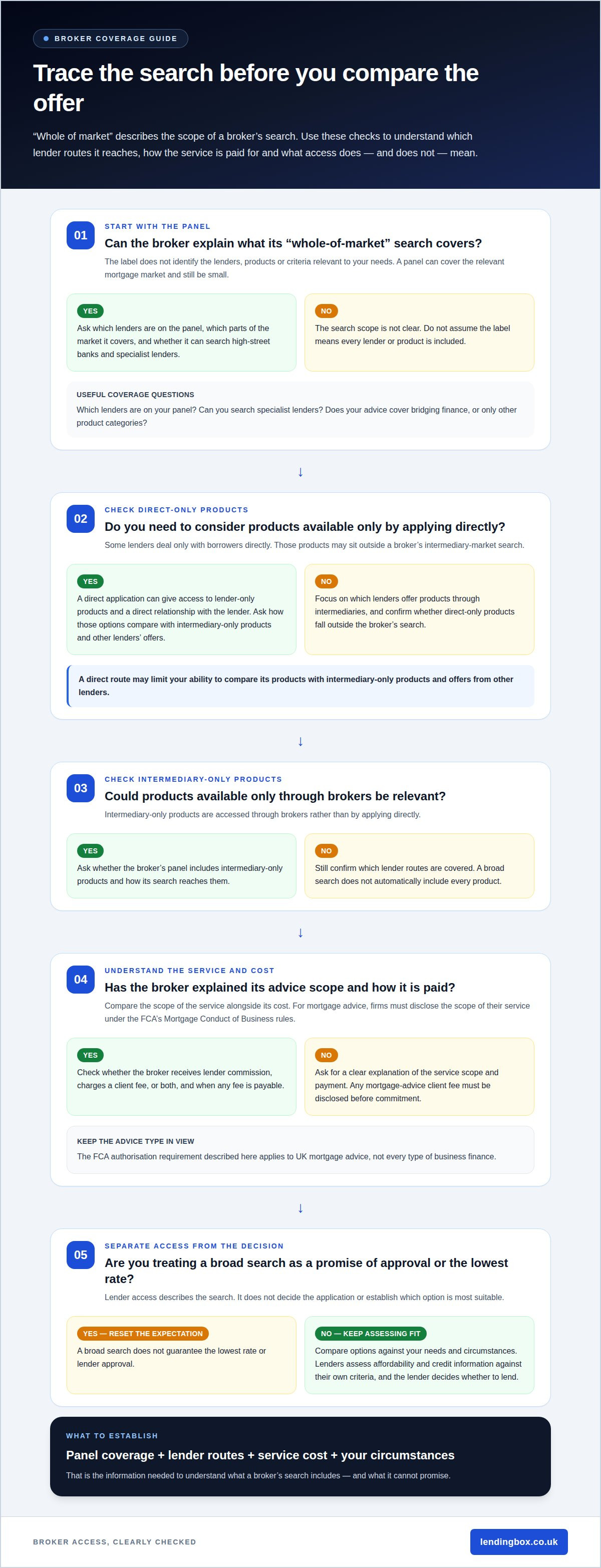
Ask what “whole of market” means in practice. It describes the scope of a broker’s search, not automatic access to every lender or product. In mortgage advice, a broker may search a panel covering the relevant market, even if that panel is small. The label alone does not tell you which lenders or criteria are relevant to your needs.
Use specific questions to understand the search:
- Which lenders are on your panel, and which parts of the market does it cover?
- Can you search specialist lenders as well as high-street banks?
- Do you consider direct-only products, or products available only through intermediaries?
- Does your advice cover bridging finance, or only offer products in other categories?
The answers should clarify whether the broker’s coverage affects your options and whether it can explain how lender criteria relate to your circumstances, rather than simply presenting a shortlist.
Ask how the broker is paid, too. For mortgage advice, firms must disclose the scope of their service under the Financial Conduct Authority’s Mortgage Conduct of Business rules. Ask whether the broker receives lender commission, charges a client fee, or both, and when any fee is payable. A clear explanation helps you understand the cost before deciding to proceed.
Most importantly, distinguish lender access from a lending decision. A broad search does not promise approval or the lowest rate. Lenders assess applications against their own criteria, including affordability and credit information. A broker can compare available routes, but the lender decides whether to lend.
For business funding, the same practical approach starts with the amount, purpose and repayment plan. Exploring business finance options can help frame which funding route may suit those needs.
How brokers assess a borrower’s needs
Start by identifying the funding purpose, amount required and planned repayment source. A broker can then consider the business’s cash flow, trading pattern, existing commitments and timing. These details help distinguish a short-term cash-flow need from funding for equipment or growth, and identify which lender criteria and finance structures merit consideration.
Different products address different cash-flow needs. Revenue-based finance links repayments to business revenue, while invoice finance uses unpaid invoices as the funding basis. Asset finance is designed around equipment or another business asset. A broker considers the purpose of borrowing and repayment structure, then assesses how each route may fit the company’s trading pattern.
For mortgage products, the headline rate alone doesn’t show suitability. Fees, early repayment charges, affordability, lender criteria and features such as overpayment options can affect the overall fit. A landlord with 10 buy-to-let properties, for example, may need a lender that assesses the portfolio as a whole. Rental stress tests and portfolio rules can differ between lenders.
Eligibility is considered before a full application. Lending Box’s initial matching process has no impact on your credit score. A credit search only happens at full application, and only with your agreement. The early review can help identify relevant options and details that need explaining, such as uneven income or existing credit commitments.
Mortgage advice uses a structured Fact Find, which is compulsory with every application. It records the borrower’s needs and circumstances and supports a suitability assessment. A whole-of-market mortgage broker can compare relevant options, but flexibility matters only if the payments remain manageable. Consider charges alongside the terms, features and repayment plan.
How whole-of-market and tied broker models differ
A tied adviser offers lending from one lender, while a restricted broker searches a selected panel. A whole-of-market broker searches across lenders for the relevant product type. The distinction is about search scope, not the quality of advice or the outcome.
For example, a bank adviser can explain that bank’s mortgage products and criteria. A broker tied to that bank cannot compare its offer with another lender’s interest rate. A restricted broker can compare lenders on its panel, but products outside that panel are not part of its search.
Whole-of-market access may widen the routes considered, including products distributed through intermediaries. It does not necessarily include products available only directly from a lender. Some lenders also reserve products exclusively for broker applications. The label describes market coverage, not access to every contract or deal.
“Independent” has a specific meaning in UK mortgage advice: a firm using the term must offer products from across the whole market for the relevant product type. That does not mean every mortgage is available through it. A whole-of-market adviser may still recommend a product transfer or further advance from the borrower’s existing lender if it suits their needs.
A wider search can matter when income, credit history or business plans do not fit one lender’s criteria, but the lender still decides whether to approve finance. Compare the broker’s service scope, payment arrangement and coverage of the product type you need. A wider panel is useful when it includes relevant options and the advice considers features, charges and repayment terms.
If your business is weighing funding routes, explore business finance options against your purpose and repayment plan.
Lending Box
Lending Box helps UK limited companies and LLPs explore business finance through a whole-of-market brokerage service. The initial matching process has no impact on your credit score. One named relationship manager guides you through the options and paperwork, with no long forms before you see anything useful.
This can help when you are weighing funding routes against your company’s plans and cash flow. Options include business loans, revenue-based finance, invoice finance and asset finance. The right fit depends on your purpose, repayment capacity and lender criteria.
Start with your company name and funding needs to explore suitable options. There is no obligation at any stage. Contact Lending Box to discuss your business finance requirements.
Move from lender access to a funding decision
The useful next step is to connect your funding need with a repayment plan your business can support. When considering what a whole-of-market finance broker can do, focus on how the options relate to your company’s cash flow, purpose and circumstances, not simply how many lenders appear in a search.
Lending Box helps UK limited companies and LLPs explore business finance routes, including business loans, revenue-based finance and invoice finance. The right route depends on what the funding needs to achieve and how repayments fit your trading pattern. A clear discussion can turn a broad search into practical options to consider.
Share your business needs and discuss the next steps with Lending Box. A considered funding decision starts with a clear view of what your business needs to move forward.
Frequently Asked Questions
Are there any issues with going to the whole of the market?
Whole-of-market access can still leave gaps: products available only directly from lenders sit outside an intermediary search. A broker may also have a smaller panel, so the label alone does not show which lenders are considered. Ask how the search covers your borrowing purpose. Lender access and lending decisions are separate matters.
What Does the Broker Research?
A broker considers which finance routes and lender criteria may fit your business’s purpose and repayment capacity. That can involve how lenders assess turnover, trading history, credit commitments and the planned use of funds. For example, funding equipment calls for a different assessment from managing cash flow against unpaid invoices. The aim is to connect your business’s circumstances with relevant options, not simply list products.
Who Benefits Most from Whole of Market Advice?
This can be particularly useful when a business does not fit a straightforward lending profile. A company with uneven cash flow, existing credit commitments or a specific asset purchase may need lenders with different criteria. Comparing those approaches can reveal which funding structures merit consideration. Weigh repayment capacity and the purpose of borrowing rather than choosing a route solely because it appears available.
What does a whole-of-market finance broker mean in the UK?
In the UK, a whole-of-market finance broker searches across lenders for the relevant type of business finance, rather than advising only on one lender’s products. The search can include lenders that work through intermediaries, but not necessarily those that deal only with borrowers directly. The phrase describes the broker’s search scope. It does not mean every lender or product is included for every funding need.
How does a whole-of-market broker differ from a tied or multi-tied broker?
A tied broker works with one lender, while a multi-tied broker can select from several lenders. A whole-of-market broker searches across lenders for the relevant product type. The practical difference is the range considered, not who makes the lending decision. A tied adviser can assess one lender’s criteria, while a wider search can compare that approach with others.
How do whole-of-market finance brokers charge fees and earn commission?
Payment arrangements depend on the broker and finance type, so clarify how the service is funded before proceeding. Lending Box’s business finance service is free to the business, with payment coming from commission or a finder’s fee received from lenders. The borrower does not pay a direct fee to Lending Box.
Frequently Asked Questions
Whole-of-market access can still leave gaps: products available only directly from lenders sit outside an intermediary search. A broker may also have a smaller panel, so the label alone does not show which lenders are considered. Ask how the search covers your borrowing purpose. Lender access and lending decisions are separate matters.
A broker considers which finance routes and lender criteria may fit your business’s purpose and repayment capacity. That can involve how lenders assess turnover, trading history, credit commitments and the planned use of funds. For example, funding equipment calls for a different assessment from managing cash flow against unpaid invoices. The aim is to connect your business’s circumstances with relevant options, not simply list products.
This can be particularly useful when a business does not fit a straightforward lending profile. A company with uneven cash flow, existing credit commitments or a specific asset purchase may need lenders with different criteria. Comparing those approaches can reveal which funding structures merit consideration. Weigh repayment capacity and the purpose of borrowing rather than choosing a route solely because it appears available.
In the UK, a whole-of-market finance broker searches across lenders for the relevant type of business finance, rather than advising only on one lender’s products. The search can include lenders that work through intermediaries, but not necessarily those that deal only with borrowers directly. The phrase describes the broker’s search scope. It does not mean every lender or product is included for every funding need.
A tied broker works with one lender, while a multi-tied broker can select from several lenders. A whole-of-market broker searches across lenders for the relevant product type. The practical difference is the range considered, not who makes the lending decision. A tied adviser can assess one lender’s criteria, while a wider search can compare that approach with others.
Payment arrangements depend on the broker and finance type, so clarify how the service is funded before proceeding. Lending Box’s business finance service is free to the business, with payment coming from commission or a finder’s fee received from lenders. The borrower does not pay a direct fee to Lending Box.