Which Alternatives to a Bank Business Loan Can UK SMEs Consider?
30 October 2026 · 12 min read

 Business funding
A bank isn’t the only route to business finance. Alternatives to a bank business loan include government-backed Start Up Loans, merchant cash advances, peer-to-peer lending and specialist finance such as invoice, asset and revenue-based funding. Each works differently, so the right option depends on your business stage, cash flow and what you need the money for.
Compare the full picture, not just how quickly an application might move. Repayment structure, eligibility and security requirements all affect whether an option fits your plans.
This guide explains which alternative business finance providers and options UK SMEs can consider, and how Start Up Loans, merchant cash advances and peer-to-peer lending work. You’ll also see where invoice, asset and revenue-based finance may fit, so you can weigh the routes against your business’s needs.
Key Takeaways
- Compare alternative finance by how repayments work and what they’re tied to, not just by how quickly funding may arrive.
- Community Development Finance Institutions can be a route to explore when mainstream finance is harder to access; the right fit depends on your business and funding needs.
- Start Up Loans, merchant cash advances and peer-to-peer lending suit different situations. Understand their eligibility and repayment structures before deciding.
- Match the funding type to the need: consider whether a loan, invoice finance, asset finance or revenue-based finance aligns best with your cash flow and plans.
What are the benefits of alternative business bank loans?
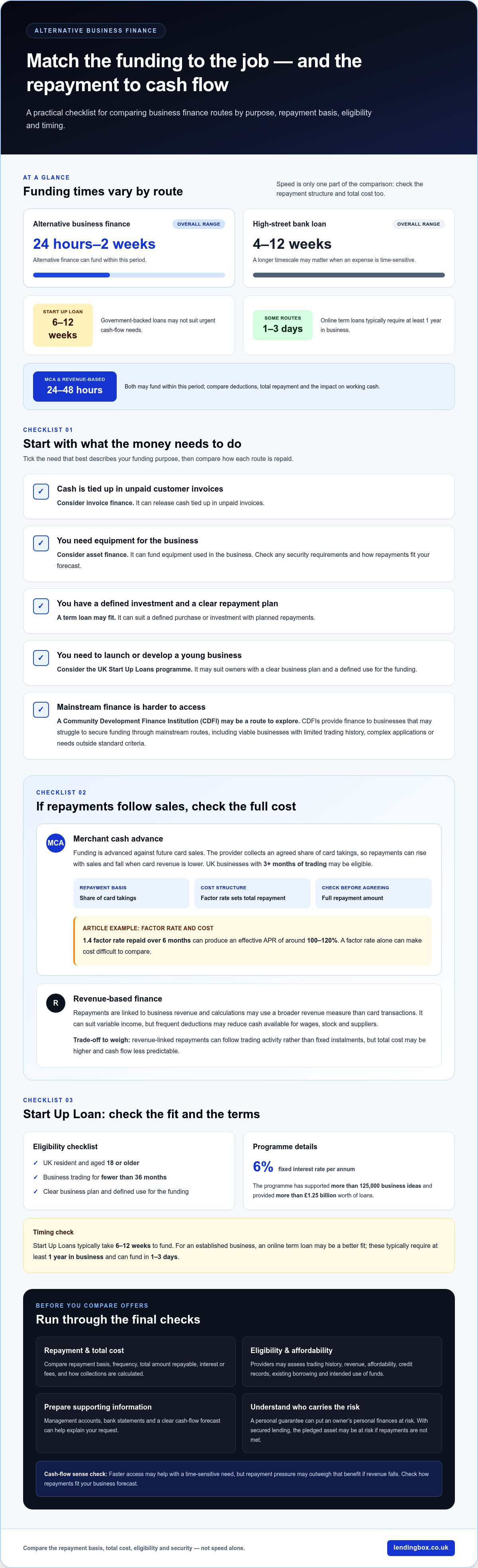
For UK SMEs, alternatives to a bank business loan include online lenders, Community Development Finance Institutions (CDFIs), invoice finance and asset finance. Alternative business finance can fund in 24 hours to 2 weeks, compared with 4 to 12 weeks for a high-street bank loan. That difference can matter when a supplier invoice or equipment purchase needs attention sooner.
Community Development Finance Institutions (CDFIs) provide finance to businesses that may struggle to secure funding through mainstream routes. They can suit a viable business with limited trading history, a complex application or a funding need that doesn’t fit standard criteria. A CDFI loan is debt, not equity: the business borrows capital and repays it under agreed terms. For example, a community café could explore this route to fund equipment while keeping ownership with its founders.
Match the finance to the purpose. Invoice finance can release cash tied up in unpaid customer invoices, while asset finance can fund equipment used in the business. A term loan may suit a defined investment with a clear repayment plan. Compare the repayment basis, total cost, security requirements and effect on cash flow, not just the speed of a decision.
Eligibility varies by lender and product. Providers may assess trading history, revenue, affordability, credit records, existing borrowing and how you plan to use the funds. Prepare management accounts, bank statements and a clear cash-flow forecast to explain your request. A newer firm with limited accounts may face different criteria from an established company with steady revenue.
A personal guarantee can put an owner’s personal finances at risk if the business cannot repay. With secured lending, the pledged asset may be at risk if repayments aren’t met. Before accepting either, understand who or what carries the obligation and how repayments fit the business’s forecast. Faster access to capital can help meet a time-sensitive need, but repayment pressure may outweigh that benefit if revenue falls.
What are government-backed start-up loans?
The UK Start Up Loans programme offers a route for founders who need funding to launch or develop a young business. It has supported more than 125,000 business ideas and provided more than £1.25 billion worth of loans. The fixed interest rate is 6% per annum. Applicants must be UK residents aged 18 or older, with a business trading for fewer than 36 months.
These loans suit owners with a clear business plan and a defined use for the funding. Government-backed loans typically take 6 to 12 weeks to fund, so they may not fit urgent cash-flow needs. For an established business, an online term loan may be a better fit. These typically require at least 1 year in business and can fund in 1-3 days.
Smaller loans can suit businesses whose needs don’t justify a larger term loan. Compare the repayment schedule and intended use: a start-up loan may support launch costs, while a term loan could fund planned growth. Bank loans, government-backed schemes and online finance each have different eligibility criteria and application processes.
Business credit cards and overdrafts provide flexible access to borrowing rather than a single lump sum repaid on a fixed schedule. They can help manage short-term working capital needs, while term loans are better suited to a defined purchase or investment with planned repayments.
To compare offers, review the total amount repayable, interest or fees, repayment frequency, security and any personal guarantee. If you need to check a lender’s FCA authorisation, search its exact name on the FCA Financial Services Register and compare its listed permissions with the finance offered.
For a practical comparison across different business needs, explore business finance options alongside start-up and bank lending.
What is a merchant cash advance?
A merchant cash advance gives a business funding against future card sales. The provider advances capital, then collects an agreed share of card takings as they come in. Repayments can therefore rise with sales and fall when card revenue is lower. UK businesses with 3+ months of trading may be eligible.
Some advances can be funded within 24 to 48 hours. That can suit a retailer facing a stock opportunity or urgent repair. The trade-off is cost: a factor rate sets the total repayment against the advance, rather than charging interest in the same way as a conventional loan. Check the full repayment amount before agreeing.
For example, a 1.4 factor rate repaid over 6 months can produce an effective APR of around 100-120%. The example shows why a factor rate alone can make the cost hard to compare. Ask how much will be repaid overall, how collections are calculated, and what happens if card sales change.
Revenue-based finance also links repayments to business revenue and can typically fund in 24 to 48 hours. Unlike a merchant cash advance tied to card transactions, repayment calculations may use a broader revenue measure. This flexibility can help businesses with variable income, but frequent deductions can still reduce the cash available for wages, stock and suppliers.
Revenue-linked repayments can follow trading activity rather than requiring a fixed instalment regardless of sales. The trade-off may be a higher total cost and less predictable cash flow. Before choosing this option, compare the collection method, total repayment, factor rate and any personal guarantee or security requirement. A guarantee can leave an owner personally responsible if the business cannot meet its obligations.
Merchant cash advances and revenue-based finance offer funding repaid through deductions from sales. The deductions can strain cash flow, and the total cost may exceed that of a conventional loan.
Peer-to-peer lending
Peer-to-peer (P2P) lending connects a business seeking finance with investors who fund loans through an online platform. The Federal Reserve Board describes platforms as connecting borrowers and lenders, while helping investors identify loans that meet their investment criteria. The platform facilitates the exchange; the borrower repays under the agreed loan terms.
Unlike equity investment, P2P borrowing doesn’t give investors ownership of the business. It creates a debt obligation, so owners need to assess repayments against forecast cash flow. Some online term loans can fund in 1-3 days, and typically require at least 1 year in business. A quick decision still needs to be weighed against the repayment schedule and total amount payable.
Debt funds offer another lending route, providing loans from pooled investor capital. They usually assess the business’s finances, borrowing purpose and ability to repay. A term loan creates a defined repayment commitment; a revolving facility may let a business draw funds as needed, subject to its terms. Match the facility to your intended use and cash-flow pattern.
UK businesses can raise money through crowdfunding by presenting a campaign to potential backers; campaigns can take weeks or months, depending on preparation, campaign length and fulfilment. P2P lending instead involves borrowing through a platform and repaying the loan. Angel investors provide capital in exchange for an ownership stake, so founders should consider how equity sharing affects control and future growth.
Compare the funding structure, repayment obligations and effect on ownership before choosing. P2P or debt-fund borrowing preserves equity but creates repayments; angel investment avoids loan instalments but dilutes ownership. For a wider view of borrowing routes, compare business loan options alongside P2P finance.
Lending Box: Business loan
Lending Box helps UK limited companies and LLPs compare business finance options when a bank loan isn’t the right fit. As a whole-of-market broker, it matches businesses with funding options from lenders rather than lending directly. Options include unsecured business loans, revenue-based finance, invoice finance and asset finance. Indicative only. Subject to lender assessment and approval.
Lending Box analyses company data through its in-house lending model to provide initial eligibility insights with no impact on your credit score. A full credit search occurs only at full application with your agreement. A dedicated relationship manager guides you through the options and paperwork, helping you compare a fixed loan with funding linked to revenue, invoices or business assets.
Consider Lending Box when you want to compare finance routes around a specific business need, such as managing cash flow or funding equipment. To discuss your options, contact Lending Box or visit lendingbox.co.uk.
Choose funding that supports your next move
Connect the funding decision to a specific business outcome. Identify what the money needs to achieve, how repayments could fit your cash flow and what flexibility you may need if plans change. This gives you a clearer basis for weighing alternatives to a bank business loan against your priorities.
Lending Box helps UK limited companies and LLPs explore business loans, revenue-based finance and invoice finance. Its whole-of-market brokerage matches businesses with lender options, while a dedicated relationship manager guides the process and paperwork. This can help when you want to compare funding structures for a defined business need. The service is free to the borrower; Lending Box receives a commission or finder’s fee from lenders.
Bring your intended use of funds and a realistic view of repayments into the conversation. A clearer brief helps focus the comparison on what matters to your business, not just the headline offer. Contact Lending Box to discuss funding and consider the options for your next step.
Frequently Asked Questions
What alternative bank loan providers are available?
UK businesses can seek finance from online lenders, peer-to-peer lending platforms, Community Development Finance Institutions and specialist finance brokers. The provider type often reflects the funding structure: invoice finance is linked to unpaid business invoices, while asset finance supports equipment purchases. A broker can compare suitable lender options across the market, while a direct lender assesses and provides its own finance.
What is the easiest business loan alternative to access in the UK?
There isn’t one easiest option for every business. A merchant cash advance is designed for businesses taking card payments, and may be available after 3+ months of trading. It links repayments to card sales, so assess how deductions could affect daily working capital. A start-up with no card revenue may need a different route, such as a government-backed Start Up Loan.
How does invoice factoring work?
Invoice factoring lets a business access money tied up in unpaid business-to-business invoices. The factoring provider advances part of an eligible invoice, then collects payment from the customer. Once the customer pays, the provider passes on the remaining balance after applicable charges. It can help bridge payment terms of 30, 60 or 90 days, but it relies on invoiced sales to business customers.
How does revenue-based financing work?
Revenue-based finance advances capital to a business, then collects repayments as an agreed share of daily or weekly card takings. Repayments move with sales, which may help a business with fluctuating turnover plan around quieter periods. The trade-off is that deductions reduce the cash available for operating costs, and the total cost is usually higher than a term loan. Compare the total repayment and collection basis with your revenue forecast before committing.
What are the main alternatives to a UK bank business loan?
Common routes include Start Up Loans, online term loans, peer-to-peer lending, merchant cash advances, invoice finance, asset finance and crowdfunding. Choose according to the need: equipment finance is tied to an asset purchase, while invoice finance uses unpaid customer invoices. Crowdfunding involves raising contributions from backers. These routes differ in repayment, ownership impact and application process, so compare the structure as well as the funding purpose.
How do UK government-backed Start Up Loans work and what are the eligibility rules?
The Start Up Loans programme provides government-backed finance for eligible business owners. Applicants must be UK residents aged 18 or older, and their business must have traded for fewer than 36 months. The loan has a fixed interest rate of 6% per annum. Government-backed loans typically take 6 to 12 weeks to fund, so plan around that timescale when setting a launch or growth date.
Frequently Asked Questions
UK businesses can seek finance from online lenders, peer-to-peer lending platforms, Community Development Finance Institutions and specialist finance brokers. The provider type often reflects the funding structure: invoice finance is linked to unpaid business invoices, while asset finance supports equipment purchases. A broker can compare suitable lender options across the market, while a direct lender assesses and provides its own finance.
There isn’t one easiest option for every business. A merchant cash advance is designed for businesses taking card payments, and may be available after 3+ months of trading. It links repayments to card sales, so assess how deductions could affect daily working capital. A start-up with no card revenue may need a different route, such as a government-backed Start Up Loan.
Invoice factoring lets a business access money tied up in unpaid business-to-business invoices. The factoring provider advances part of an eligible invoice, then collects payment from the customer. Once the customer pays, the provider passes on the remaining balance after applicable charges. It can help bridge payment terms of 30, 60 or 90 days, but it relies on invoiced sales to business customers.
Revenue-based finance advances capital to a business, then collects repayments as an agreed share of daily or weekly card takings. Repayments move with sales, which may help a business with fluctuating turnover plan around quieter periods. The trade-off is that deductions reduce the cash available for operating costs, and the total cost is usually higher than a term loan. Compare the total repayment and collection basis with your revenue forecast before committing.
Common routes include Start Up Loans, online term loans, peer-to-peer lending, merchant cash advances, invoice finance, asset finance and crowdfunding. Choose according to the need: equipment finance is tied to an asset purchase, while invoice finance uses unpaid customer invoices. Crowdfunding involves raising contributions from backers. These routes differ in repayment, ownership impact and application process, so compare the structure as well as the funding purpose.
The Start Up Loans programme provides government-backed finance for eligible business owners. Applicants must be UK residents aged 18 or older, and their business must have traded for fewer than 36 months. The loan has a fixed interest rate of 6% per annum. Government-backed loans typically take 6 to 12 weeks to fund, so plan around that timescale when setting a launch or growth date.