Revenue-based finance for UK SaaS cash flow and risks
31 October 2026 · 10 min read

 Business funding
A funding deal can sit outside consumer credit regulation and still create real cash-flow risk. Some UK revenue-based finance products are structured to fall outside FCA consumer credit regulation. Revenue-based finance for UK SaaS companies does not dilute ownership, but repayments linked to revenue can still reduce the cash available to run and grow the business.
That trade-off matters. Flexible repayments may be easier to manage than fixed debt payments when sales fluctuate, but the total repayment and pace of deductions still affect the cost and pressure on cash flow.
This guide explains how revenue-based finance works, what its UK regulatory position means, and how its risks compare with debt financing. It also covers what to weigh before choosing a structure, including how revenue changes can affect repayments and whether the terms fit your SaaS business’s cash-flow pattern.
Key Takeaways
- Understand why some UK revenue-based finance products sit outside consumer credit regulation, and what that means when comparing funding providers.
- Assess how revenue-linked repayments could ease pressure when sales dip, but reduce the cash available during stronger trading periods.
- Use the repayment share and cap to model the total commitment against your SaaS revenue pattern before accepting an offer.
- Compare the flexible repayment profile with fixed debt repayments, then choose the structure that best fits your cash-flow needs and funding purpose.
Is revenue-based finance regulated in the UK?
Some UK revenue-based finance products are structured to fall outside FCA consumer credit regulation. That does not mean every agreement has the same legal treatment. Read the contract’s repayment terms and legal structure before comparing offers, rather than assuming one provider’s position applies across the market.
Unlike equity funding, revenue-based finance gives the funder no ownership interest, so it does not dilute existing shareholders. In return for capital, the business agrees to repay an agreed amount, often through a share of revenue until a repayment cap is reached. Repayments linked to sales are not cost-free: compare the total repayment with the advance and consider how the revenue share affects operating cash.
For a SaaS provider comparison, focus on the same details in every offer: advance, repayment cap, revenue share, collection schedule and early repayment terms. UK revenue-based finance can usually be repaid early by paying the outstanding balance up to the cap, and typically has no early repayment penalties. Providers commonly look for monthly revenue of £10,000-£20,000 and at least six months of trading data. These are useful figures when assessing eligibility, not a substitute for comparing the agreement itself.
Prepare an application by organising trading records, revenue data and a clear funding purpose. For example, show how the capital would support product development, customer acquisition or planned hiring. Then compare each offer’s deductions with recurring subscriptions, annual billing and customer churn. This helps you assess whether repayments fit the company’s actual cash cycle.
R&D tax relief is a separate source of support, not a repayment feature of finance. UK SaaS companies can use R&D tax credits to offset costs associated with innovation and new product development. R&D-intensive SMEs investing at least 30% of total expenditure in R&D can claim up to 27% of total R&D costs. Treat potential relief and funding as separate parts of a cash-flow plan.
Benefits and risks for cash flow
Revenue-based finance for SaaS companies in the UK can make repayments more responsive to sales than a fixed schedule. That may help when subscription renewals fluctuate: lower receipts can mean lower deductions, leaving more cash for essential costs. The trade-off is that every deduction reduces the money available for payroll, hosting, product development and customer support. Even flexible repayments need room in the operating budget.
Map the cash cycle before committing. Compare subscription collection dates with payroll, tax payments and supplier bills. If customers pay annually, a large receipt may trigger a larger deduction just when the business needs cash for delivery costs. Monthly billing creates a different pattern, so test the repayment method against actual collection timing, not just reported revenue.
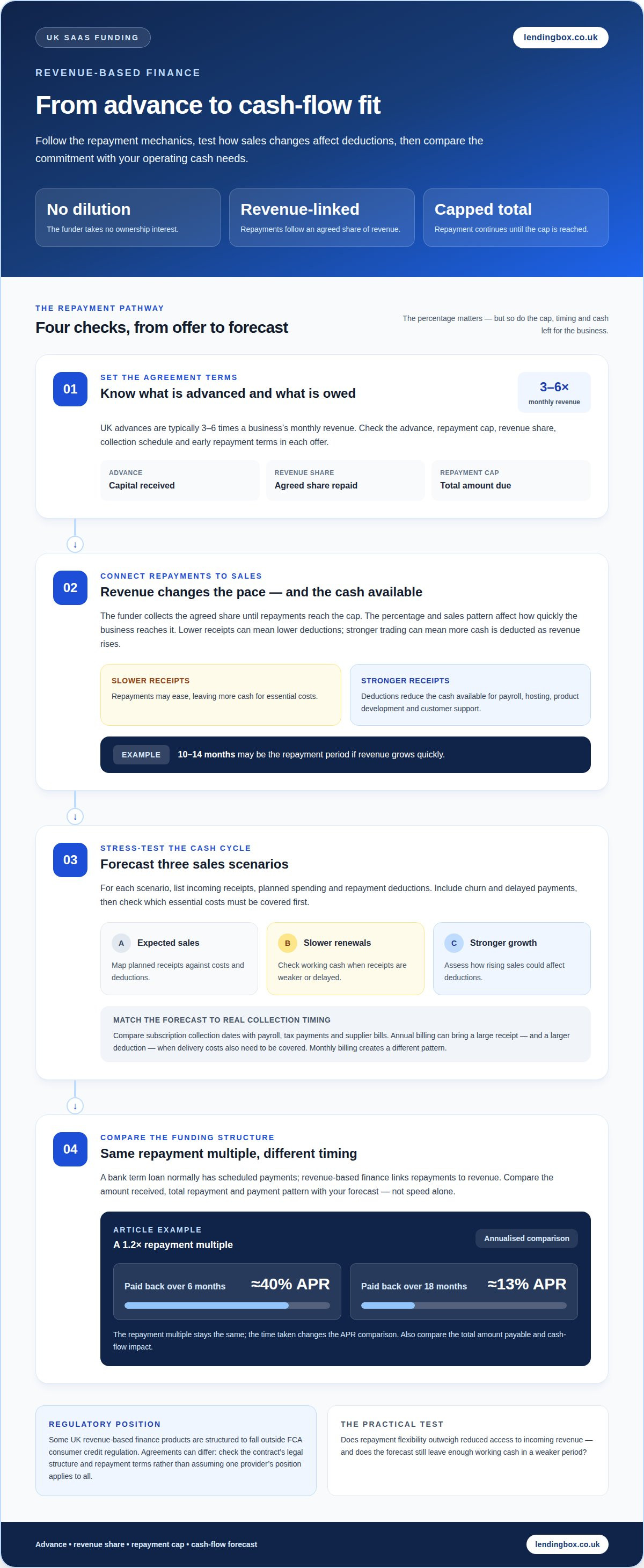
Build a simple forecast with three scenarios: expected sales, slower renewals and stronger growth. For each, list incoming receipts, planned spending and repayment deductions. Include customer churn and delayed payments, then identify which essential costs must be covered first. This shows whether the structure leaves enough working cash in a weaker period and how rising sales could affect deductions.
For revenue-based finance for SaaS companies in the UK, the practical test is whether repayment flexibility outweighs the reduced access to incoming revenue. Compare the collection schedule and total commitment with your forecast, then revisit the plan as trading changes. If you’re weighing structures, cash-flow funding options can help frame the comparison around your operating pattern.
How revenue-based finance works
Revenue-based finance for SaaS companies in the UK provides capital in return for repayments linked to revenue. The agreement sets the advance, the percentage of receipts used for repayment and a cap on the total repayment. This structure may suit a company with recurring subscription income because repayments follow sales rather than a fixed schedule.
The funder collects the agreed share of revenue until repayments reach the cap. The cap sets the total amount due, while the percentage and sales pattern affect how quickly the business reaches it.
Repayment speed changes with revenue. These examples show how recurring income can shape the repayment period and the capital available for growth.
If revenue grows quickly, repayment may take 10-14 months. For revenue-based finance for SaaS companies in the UK, compare the cap with the advance before focusing on the repayment percentage. That reveals the full commitment, not just the amount deposited.
UK advances are typically 3-6 times a business’s monthly revenue. To assess the fit, map subscription receipts against planned growth spending and operating costs. Then review the agreement’s calculation method, payment frequency and cap. A SaaS company with predictable recurring revenue can use these details to estimate available capital as repayments continue. Include realistic assumptions about renewals and customer demand in the forecast.
SaaS revenue-based finance compared with debt financing
For a UK SaaS business, the key difference is how repayments respond to trading. A bank term loan normally has scheduled payments, while revenue-based finance links repayments to revenue. That distinction matters when subscription income changes. Compare the amount received, total repayment and payment pattern against your forecast, rather than judging funding by speed alone.
Headline repayment multiples need careful interpretation. A 1.2x repayment multiple paid back over six months is approximately 40% APR. The same 1.2x multiple paid back over 18 months is approximately 13% APR. The repayment multiple stays the same, but the time taken changes the annualised comparison. Use APR to understand the effect of timing, then compare the total amount payable and cash-flow impact.
Speed and security can also affect the decision. UK revenue-based finance is generally arranged in days, compared with weeks for a bank term loan. It generally requires no personal guarantee, unlike some other business funding arrangements. These differences may matter when a SaaS company needs capital for a time-sensitive growth plan, but faster access does not automatically make the repayment terms more suitable.
- Choose revenue-linked payments when matching deductions to sales is central to your cash-flow plan.
- Compare term debt when fixed scheduled payments better fit predictable receipts and budgeting.
- Review the agreement for the total repayment, payment timing, credit requirements and any guarantee obligations.
Before deciding, test both structures against the same revenue forecast and spending plan. Include a slower sales period, then check which repayment pattern leaves workable cash for operations. Compare business funding options against your SaaS company’s cash-flow needs.
Lending Box: Business loan
Lending Box helps UK limited companies and LLPs compare funding from across the market. Its in-house lending model analyses company data and provides eligibility insights without impacting credit scores during the initial match. A dedicated relationship manager guides businesses through funding options and handles the paperwork.
For a SaaS company, that can mean considering revenue-based finance alongside a business loan, invoice finance or asset finance. The right route depends on the funding purpose, available business assets, customer payment timing and how repayments fit projected cash flow. Compare these factors to find a structure that supports your plans while accounting for its obligations.
Contact Lending Box to discuss your funding needs, or visit lendingbox.co.uk.
Choose funding that supports your next stage
For UK SaaS companies considering revenue-based finance, connect the funding choice to a specific business priority. Set out what the capital needs to achieve, such as accelerating product development or strengthening customer acquisition. Then decide what evidence will show whether that investment is working. A clear purpose makes it easier to assess whether a funding commitment supports the plan or simply fills a short-term gap.
Lending Box can help you compare a business loan, revenue-based finance and invoice finance against your objective. Bring your growth plan and cash-flow priorities into the discussion so the options can be considered in the context of your business. The most suitable route depends on your circumstances and the purpose of the funding.
Contact Lending Box to discuss funding and take a considered next step for your SaaS business.
Frequently Asked Questions
Funding for SaaS | SaaS finance explained: what is it?
SaaS finance is business funding used to support a software company’s operating or growth plans. The right structure depends on the need: a team launching a product may prioritise development spending, while a business managing delayed customer payments may need working capital. Start by defining the use, timing and how the investment will support revenue or operations.
How does SaaS debt financing work?
SaaS debt financing provides capital that the company must repay under agreed terms. Before applying, prepare a forecast showing how repayments fit alongside payroll, software infrastructure, tax and supplier commitments. Map expected customer renewals against regular outgoings, then test what happens if a renewal is delayed. This helps you assess whether the repayment schedule fits the business’s budget.
What can I use the funds for?
Funding can support a defined business need, such as developing a product feature, hiring engineers, improving customer onboarding or investing in sales activity. Match the proposed use to a practical outcome. Identify which team will spend the capital, what work it will complete and how you will track progress. This creates a clearer basis for planning and managing the investment.
What revenue level is required to access RBF in the UK?
Most UK revenue-based finance providers require monthly revenue of £10,000-£20,000, and typically expect at least six months of trading data. These are common eligibility benchmarks, not a universal rule for every funder. Prepare records that show recurring income clearly, including subscription receipts and changes in customer numbers. Consistent, well-organised records make it easier to assess the business’s trading pattern.
What types of business can apply?
Lending Box funding options are available to active UK limited companies and LLPs registered at Companies House. Sole traders and unregistered businesses are not eligible. Prepare company details, bank statements, filed accounts and director identification for a full application. A SaaS company should also organise its subscription and trading records to make its business activity clear.
Which UK lenders offer revenue-based finance to SaaS businesses?
Lending Box is a whole-of-market broker that matches UK businesses with funding from lenders across the market. Lender names aren’t disclosed until options have been shortlisted. This means you can assess relevant funding structures before reviewing the lender behind an option. Compare the proposed agreement’s repayment method, total commitment and fit with your business plan before proceeding.
Frequently Asked Questions
SaaS finance is business funding used to support a software company’s operating or growth plans. The right structure depends on the need: a team launching a product may prioritise development spending, while a business managing delayed customer payments may need working capital. Start by defining the use, timing and how the investment will support revenue or operations.
SaaS debt financing provides capital that the company must repay under agreed terms. Before applying, prepare a forecast showing how repayments fit alongside payroll, software infrastructure, tax and supplier commitments. Map expected customer renewals against regular outgoings, then test what happens if a renewal is delayed. This helps you assess whether the repayment schedule fits the business’s budget.
Funding can support a defined business need, such as developing a product feature, hiring engineers, improving customer onboarding or investing in sales activity. Match the proposed use to a practical outcome. Identify which team will spend the capital, what work it will complete and how you will track progress. This creates a clearer basis for planning and managing the investment.
Most UK revenue-based finance providers require monthly revenue of £10,000–£20,000, and typically expect at least six months of trading data. These are common eligibility benchmarks, not a universal rule for every funder. Prepare records that show recurring income clearly, including subscription receipts and changes in customer numbers. Consistent, well-organised records make it easier to assess the business’s trading pattern.
Lending Box funding options are available to active UK limited companies and LLPs registered at Companies House. Sole traders and unregistered businesses are not eligible. Prepare company details, bank statements, filed accounts and director identification for a full application. A SaaS company should also organise its subscription and trading records to make its business activity clear.
Lending Box is a whole-of-market broker that matches UK businesses with funding from lenders across the market. Lender names aren’t disclosed until options have been shortlisted. This means you can assess relevant funding structures before reviewing the lender behind an option. Compare the proposed agreement’s repayment method, total commitment and fit with your business plan before proceeding.