How Unsecured Business Loans Work for Service Businesses
6 November 2026 · 11 min read

 Business funding
A business loan doesn’t always require putting property on the line. An unsecured business loan for a service business doesn’t use assets such as property or vehicles as collateral. Instead, lenders assess the company’s financial position and ability to repay.
It’s sensible to understand the repayments before borrowing, especially when income varies from month to month. This guide explains how unsecured business loans work in the UK, what lenders consider and what to expect as you explore your options.
You’ll also learn how repayment terms and personal guarantees can affect a decision, and how to judge whether this finance suits your business. That gives you a clearer basis for weighing up the options and planning your next step.
Key Takeaways
- Plan for regular monthly repayments over an agreed term, and consider how they fit your service business’s cash flow.
- Understand what a personal guarantee could mean for you if the business can’t meet its repayments.
- Use repayment estimates to see how changing the loan term can affect monthly payments and total interest.
- Set out your existing borrowing and financial commitments to build a clearer picture of what new repayments your business can manage.
How do business loans work?
UK banks and specialist business lenders offer unsecured business loans to service businesses, assessing the company rather than taking assets as collateral.
Unsecured loan arrangements
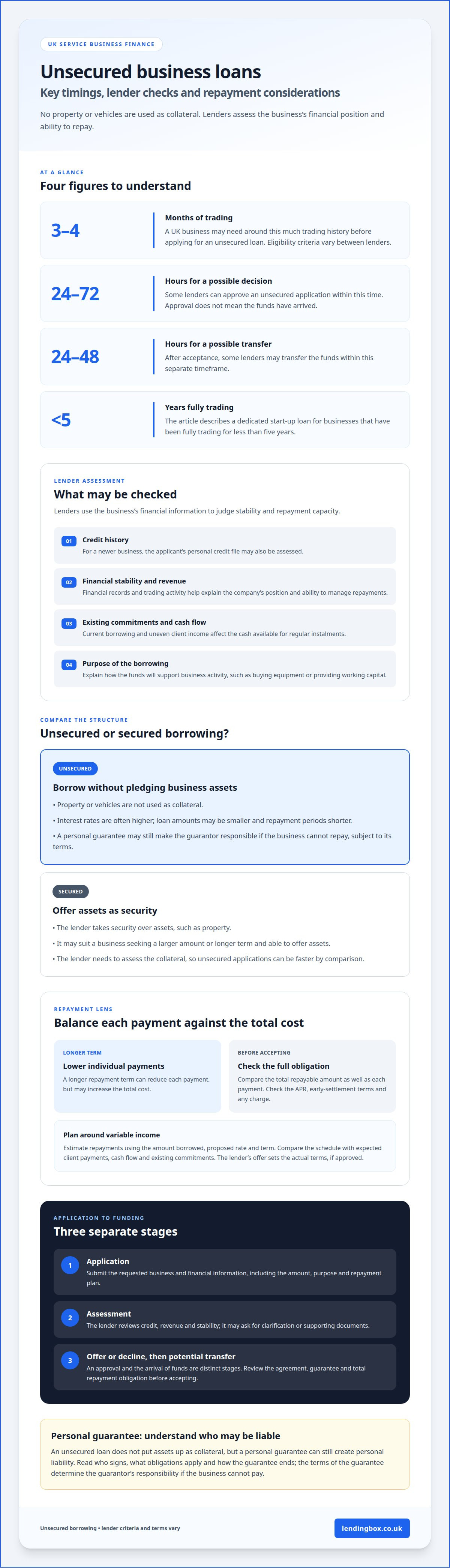
With an unsecured business loan, the business borrows an agreed amount and repays it in monthly instalments at a fixed rate over an agreed term. The lender assesses credit history, financial stability and revenue. A personal guarantee may still be required, which can make the guarantor responsible for repayment if the business cannot pay.
By contrast, secured business loans use assets such as property as security. Unsecured loans often have higher interest rates, and may offer smaller amounts and shorter repayment periods. The right structure depends on the funds needed, business finances and willingness to put assets at risk.
Personal unsecured loans can also be used for business purposes, but the individual borrower is responsible for repayments. A dedicated start-up loan may suit some businesses with smaller borrowing needs. The business must have been fully trading for less than 5 years.
Comparing borrowing options
Compare the repayment structure as well as the security. Secured loans may suit businesses able to offer assets and seeking a larger amount or longer term. Unsecured borrowing avoids pledging those assets, but can cost more in interest. For an unsecured business loan for a service business, consider whether regular repayments fit the timing of client payments.
A business credit card can cover spending that is repaid flexibly, but extra fees or interest may apply if the balance isn’t repaid in full each month or at least the minimum monthly amount isn’t paid. An overdraft is intended for short-term needs, although interest and fees can be high. Compare these options by matching the borrowing period and repayment pattern to the business expense.
Application and approval process
Prepare a clear application showing how the borrowing supports the business. Lenders assess its finances, credit history and ability to manage repayments.
Preparing application documents
Start with the information that explains your business, its trading activity and the purpose of the funds. Lenders commonly review financial records and revenue to understand stability and repayment capacity. For a UK Start Up Loan, applicants submit a business plan and cashflow forecast for assessment. If the funding will buy equipment or provide working capital, explain how it supports business activity.
Eligibility and lender assessment
Eligibility criteria differ between lenders. A UK business may need around 3-4 months of trading before applying for an unsecured loan. Lenders consider business credit history, financial stability and revenue. For a newer business, they may also assess the applicant’s personal credit file. This helps them judge whether projected income and current finances can support the repayments.
A personal guarantee may form part of a loan offer. It can make the guarantor personally responsible for repayment if the business cannot pay, according to the guarantee’s terms. Read the proposed agreement carefully, including the guarantee and total repayment obligation. A secured loan differs because the lender also takes security over assets.
Funding decision stages
The process moves from application to assessment, then an offer or a decline. First, submit the business and financial information requested. The lender reviews the company’s credit, revenue and stability, then may request clarification or supporting documents. Responding promptly helps keep the application moving.
Unsecured applications can be faster than secured-loan applications because lenders don’t need to assess collateral. Some lenders can approve applications within 24 to 72 hours. After acceptance, some may transfer funds within 24 to 48 hours. These are separate stages: approval doesn’t mean the funds have already arrived.
Set out the amount, intended use and repayment plan clearly. To explore the business loan application process, organise your financial details and funding purpose before applying.
What is an unsecured loan?
UK unsecured business loans don’t require assets as collateral. Rates and repayment terms vary between lenders, so check the APR and repayment terms before applying. A personal guarantee can make the guarantor responsible for repayment if the business can’t pay.
Repayment terms and early repayment
Estimate repayments by considering the amount borrowed, the proposed rate and the term. A longer term can reduce each payment but may increase the total cost, so compare any estimate with the business’s cash flow. Treat estimates as a planning tool: the lender’s offer sets the actual terms, if approved.
Before accepting, check the agreement for early-settlement terms and any charge. If a service business receives a client payment earlier than expected, repaying early may be an option, but the contract determines the cost and process. Compare the total repayable amount as well as each payment.
Credit checks and personal liability
Lenders assess credit history, financial stability and revenue before approving unsecured business loans. A credit check helps them judge repayment risk, while existing commitments and uneven client income affect the cash available for instalments. If a business is relatively new, lenders may also assess the applicant’s personal credit file.
An unsecured loan doesn’t use property or vehicles as collateral, but a personal guarantee can still create personal liability. If the company cannot repay, the guarantor may have to meet the debt under the guarantee’s terms. Read who signs, what obligations apply and how the guarantee ends before agreeing.
Funding speed and repayment duration are separate considerations. The agreed term determines how long repayments continue. Compare the proposed schedule with expected income and existing commitments before accepting an offer.
Looking for a business loan?
Choose finance around the business’s cash flow, existing commitments and funding purpose. Working capital to cover a quiet trading period, for example, calls for a different repayment plan from funding for equipment.
Borrowing without asset security
An unsecured loan can suit a business that needs capital but doesn’t want to pledge property, vehicles or other assets. The lender still assesses the business’s finances and ability to repay. Unsecured borrowing may involve smaller amounts and shorter terms than secured business finance, though the terms vary.
List existing loans, credit commitments and regular outgoings before deciding how much to borrow. These affect the cash available for new repayments. Most lenders on our panel ask directors for a personal guarantee, so weigh the guarantor’s risk alongside the benefit of borrowing without pledging business assets.
Suitability for service businesses
A service business with few physical assets may consider unsecured borrowing for working capital, recruitment or equipment. The key question is whether expected income can cover repayments alongside payroll, rent and existing borrowing. For a consultancy awaiting client payments, expected invoice dates matter when planning regular commitments.
Can a UK startup or sole trader in the service sector get an unsecured business loan? Yes, they can apply, but lenders assess the applicant’s circumstances and repayment capacity. Newer businesses may also face checks on the applicant’s personal credit file. For a UK Start Up Loan, applicants must live in the UK, have the right to work there, base their business there, and have traded fully for less than 5 years.
Compare unsecured and secured business borrowing against your assets, existing debt and funding timeline. A secured loan may offer a longer repayment period, but uses assets as security; unsecured finance avoids that pledge, while potentially costing more in interest. Match the structure to the purpose, then consider whether repayments remain manageable if client income arrives later than expected.
Review business finance options against your commitments and funding needs, then explore business loan options.
Lending Box: Business loan
Lending Box helps UK limited companies and LLPs explore business funding options as a whole-of-market broker. It matches your company with potential finance options rather than lending directly. Its in-house model analyses company data to provide eligibility insights without affecting credit scores.
If an unsecured business loan may suit your service business, Lending Box can help you consider it alongside revenue-based finance, invoice finance or asset finance. One named relationship manager guides you through the options and handles the paperwork. The service is free to the business, with no obligation at any stage.
Contact Lending Box to discuss your business’s funding needs.
Make your next funding decision with clarity
Before borrowing, define what the funds need to achieve and how that fits your business plans. A clear purpose can help you focus on suitable finance rather than borrowing more or for longer than needed. Consider, too, how a change in client income could affect your ability to repay.
If an unsecured business loan for a service business is on your shortlist, Lending Box can help you explore suitable funding options. These include business loans, revenue-based finance and invoice finance. The right fit depends on what you need the funds for and how your business manages cash flow.
Start with the amount you need, the purpose and your expected repayment capacity. Contact Lending Box about your options to discuss the next step. A clear funding plan gives you a practical starting point for moving forward.
Frequently Asked Questions
How does unsecured lending differ from secured lending?
Unsecured lending doesn’t use business assets as collateral, while secured lending ties borrowing to specified assets. That distinction matters if your firm owns property or equipment it needs to protect. A service company with few assets may focus on unsecured options, while a business with suitable assets might consider secured finance. Compare the risks as well as the repayments.
How long will it take?
Application and funding times vary. Indicative only. Subject to lender assessment and approval. Some UK lenders may approve an unsecured application within 24 to 72 hours, while others may take longer. The approval decision and the transfer of funds are separate stages. Indicative only. Subject to lender assessment and approval. Some lenders may transfer funds within 24 to 48 hours after acceptance. Keep planned spending flexible until funding arrives.
How much money can I apply for?
Indicative only. Subject to lender assessment and approval. The amount available depends on the lender and your business’s financial profile. Set your request around a defined business cost, then consider whether forecast income can cover repayments alongside existing commitments.
What is an unsecured business loan for a UK service business?
It’s business borrowing for a service firm that doesn’t require property or vehicles as collateral. Funding could support a practical need such as hiring staff, covering operating costs or buying equipment. For instance, a consultancy might use funds to meet payroll while waiting for client invoices. The business must still repay under the agreed schedule, and most lenders on our panel ask directors for a personal guarantee.
What are the eligibility criteria for an unsecured business loan in the UK?
Criteria vary by lender, but applicants must be at least 18 and lenders assess the business’s finances and credit history. A business may need around 3-4 months of trading; newer firms may also face a personal credit assessment. Start Up Loan applicants have separate conditions: they must live and have the right to work in the UK, base their business there, and have fully traded for less than 5 years.
How much can a UK service business borrow without security?
There isn’t one fixed borrowing limit for every service business. Indicative only. The amount depends on the lender and the business’s financial profile, including revenue, existing borrowing and capacity to manage repayments.
Frequently Asked Questions
Unsecured lending doesn’t use business assets as collateral, while secured lending ties borrowing to specified assets. That distinction matters if your firm owns property or equipment it needs to protect. A service company with few assets may focus on unsecured options, while a business with suitable assets might consider secured finance. Compare the risks as well as the repayments.
Application and funding times vary. Indicative only. Subject to lender assessment and approval. Some UK lenders may approve an unsecured application within 24 to 72 hours, while others may take longer. The approval decision and the transfer of funds are separate stages. Indicative only. Subject to lender assessment and approval. Some lenders may transfer funds within 24 to 48 hours after acceptance. Keep planned spending flexible until funding arrives.
Indicative only. Subject to lender assessment and approval. The amount available depends on the lender and your business’s financial profile. Set your request around a defined business cost, then consider whether forecast income can cover repayments alongside existing commitments.
It’s business borrowing for a service firm that doesn’t require property or vehicles as collateral. Funding could support a practical need such as hiring staff, covering operating costs or buying equipment. For instance, a consultancy might use funds to meet payroll while waiting for client invoices. The business must still repay under the agreed schedule, and most lenders on our panel ask directors for a personal guarantee.
Criteria vary by lender, but applicants must be at least 18 and lenders assess the business’s finances and credit history. A business may need around 3–4 months of trading; newer firms may also face a personal credit assessment. Start Up Loan applicants have separate conditions: they must live and have the right to work in the UK, base their business there, and have fully traded for less than 5 years.
There isn’t one fixed borrowing limit for every service business. Indicative only. Subject to lender assessment and approval. The amount depends on the lender and the business’s financial profile, including revenue, existing borrowing and capacity to manage repayments.