Invoice Finance for Recruitment Agencies and How Factoring Works
27 October 2026 · 12 min read

 Invoice finance
Late-paying clients can leave a recruitment agency funding wages while waiting for payment. Invoice finance for recruitment agencies can release typically 80% to 95% of an invoice’s value before the client pays. With factoring, the finance provider collects the invoice payment, then passes on the remaining balance after fees.
Invoice finance for recruitment agencies can help ease cash-flow gaps, but it’s natural to want to understand how it works and what it means for client relationships. An agency’s eligibility may depend on factors such as its payment terms and the invoices it wants to fund.
This article explains how factoring works, why recruitment businesses use it when clients pay late, and what established agencies can expect when considering eligibility. You’ll also see how factoring differs from other invoice finance arrangements, so you can judge whether it suits the way your agency operates.
Key Takeaways
- Compare disclosed and confidential facilities to understand how each affects what your clients see.
- Know when factoring releases funds and how the provider handles invoice collection and the remaining balance.
- Map payment delays against payroll commitments to see where a cash-flow gap can arise.
- Assess eligibility by looking at your agency’s invoices, payment terms and established trading history.
What is invoice finance?
Invoice finance releases money tied up in unpaid invoices, giving a recruitment agency working capital before clients pay. The agency raises an invoice after placing a candidate, then uses that invoice to access an advance. Recruitment finance providers typically advance 80% to 95% of an invoice’s value. A bank or lender may allow a business to draw down up to 90%.
The advance can help bridge the gap between paying workers and collecting client payments. Recruitment businesses may access a percentage of invoice funds within 24 hours. The available amount depends on the invoices and facility terms. As placements increase and invoice volumes grow, a facility can scale to provide more working capital.
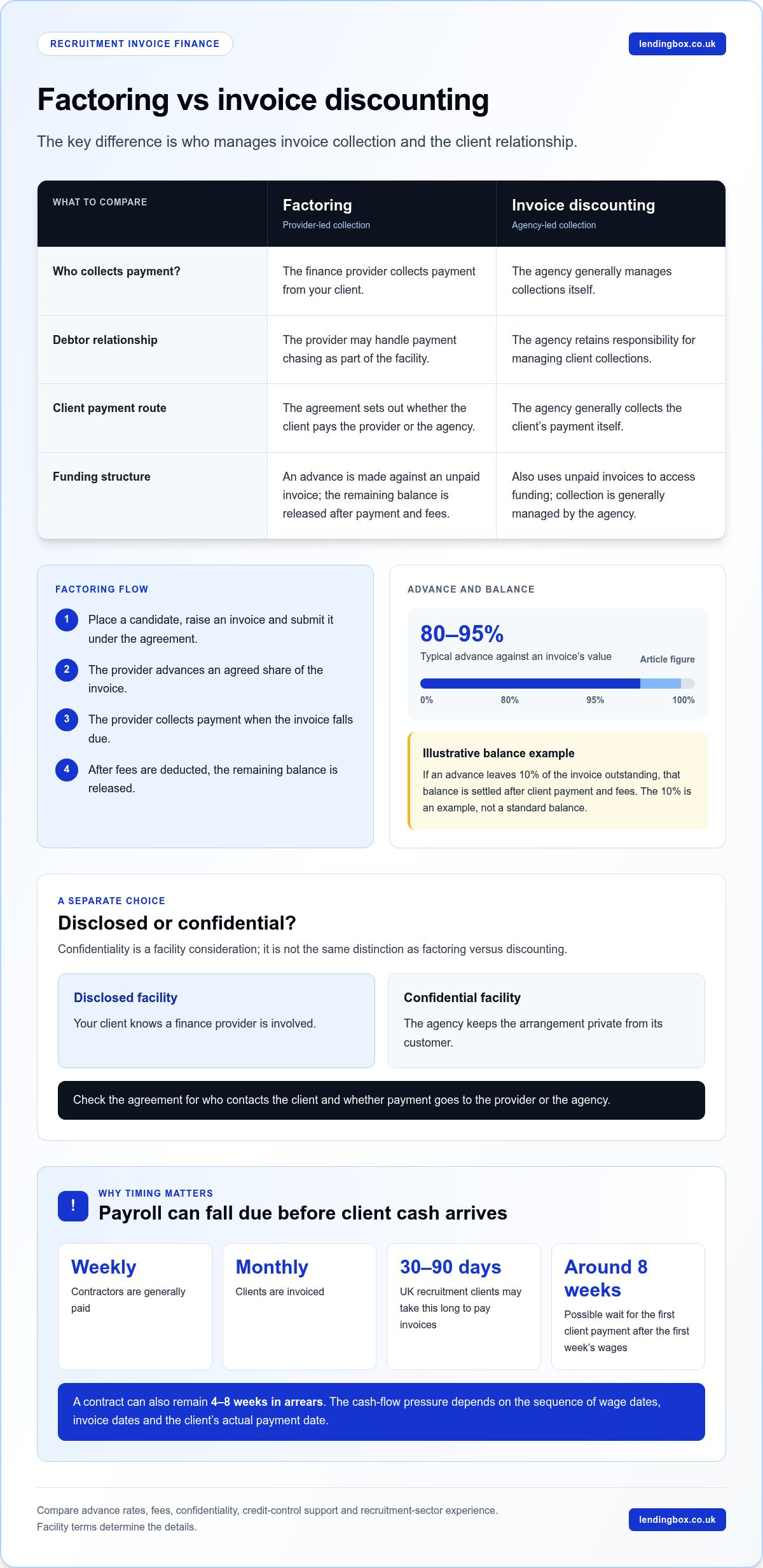
Disclosure is another consideration. With a disclosed facility, the client knows a finance provider is involved. With a confidential facility, the agency keeps the arrangement private from its customer. This can affect invoice handling and who receives payment. The agreement sets out whether the client pays the provider or the agency.
For example, an agency that wants clients to keep paying its own account may consider a confidential facility. An agency seeking support with payment collection may focus on how the provider manages that process. Either way, invoice finance has a cost and can affect margins, so the advance and service should suit the agency’s cash-flow needs.
If a proposal is labelled a “Capital Boost facility”, assess how it works rather than relying on the name. Consider the advance against each invoice, whether the facility is confidential or disclosed, and how payment collection works. Then compare those details with payroll timing, expected invoice volumes and the agency’s wider working-capital needs.
WHAT IS INVOICE FACTORING?
Factoring converts an unpaid recruitment invoice into an advance, with the finance provider collecting payment. The difference between factoring and other invoice finance affects who manages the debtor relationship and how funds reach your agency.
Factoring and recruitment finance
Invoice finance is the wider category; factoring and invoice discounting are two facility types within it. With factoring, the provider collects payment from your client. With discounting, the agency generally manages collections itself. Recruitment-focused providers and broader UK invoice finance providers can both fund recruitment invoices. Compare their advance rates, fees, confidentiality, credit-control support and recruitment-sector experience. Alternatives include revenue-based finance and asset finance, which use different funding structures rather than relying on unpaid invoices.
How invoice factoring works
After placing a candidate, the agency invoices its client and submits the invoice under its factoring agreement. The provider advances an agreed share, then collects payment when the invoice falls due. Depending on the agreement, the client pays the provider or the agency. Once payment arrives, the provider releases the remaining balance after deducting fees. For example, where an advance leaves 10% of the invoice value outstanding, that balance is settled after client payment and fees.
Some facilities include bad debt protection, which may protect the agency if a customer fails to pay. Check how the agreement defines this protection and which invoices it covers.
Factoring for start-up agencies
Start-up status can affect how a facility is assessed. One market classification treats agencies operating for 0-6 months as start-ups, a useful distinction when considering trading history. A new agency should understand how its invoices, client payment terms and expected placements fit the facility. Factoring can support cash flow, but it depends on eligible invoices and client payments, not simply the agency’s plans to grow.
Fees and interest rates
There is no single fee or interest rate for every recruitment agency. The total cost depends on the facility terms, how you use the funding and the invoice profile. Compare the advance rate with all charges, including costs linked to collections or unused funding. Review the contract for notice periods, minimum terms, termination charges and charges triggered by late payment. Fees reduce the balance ultimately received and can affect agency margins.
Before signing, match each charge to a service or event in the agreement. This makes the costs and risks easier to assess.
Recruitment agencies’ delayed client payments
Cash flow can tighten when client payments fall due after wages need to be paid. The timing gap is especially relevant for temporary and contract agencies that pay workers before collecting invoices.
Delayed client payments
UK recruitment clients may take 30 to 90 days to pay invoices, while contractors are generally paid weekly and clients invoiced monthly. That mismatch leaves an agency covering wages and operating costs before cash arrives. A recruitment business may wait around 8 weeks for its first client payment after paying the first week’s wages. A contract can also remain 4-8 weeks in arrears, making payment timing important when planning payroll.
For example, an agency placing a contractor raises an invoice after the placement, but the first weekly wage falls due before the client’s monthly invoice is settled. A 30-day delay can extend the gap further. The pressure comes from the sequence of wage dates, invoice dates and the client’s actual payment date, not simply from placement volume.
Credit control and client collections
Credit control involves managing invoices and following up with clients to secure payment as agreed. A factoring facility may include credit-control services, taking payment chasing off the agency’s hands. The agency still needs clear records of placements, hours worked and agreed rates. Accurate records can help resolve invoice queries that might otherwise delay collection.
Client notification depends on the facility. Disclosed factoring tells the client that a finance provider is involved; a confidential facility keeps the arrangement private. Before submitting invoices, understand who will contact the client, which payment details appear on invoices and where the client should send payment. Clear communication can prevent confusion if a client receives a collection reminder or sees different payment instructions.
Track overdue invoices alongside weekly payroll dates. That gives the agency a clearer view of which client payments could affect upcoming wage commitments.
Eligibility for established agencies
An established agency may qualify if it has reliable business-to-business invoices and clients with clear payment obligations. For an application, prepare company details, accounts, invoice records and client payment terms. These help assess both the agency and the invoices it wants to fund.
Trading history helps explain how the agency operates, but eligibility also depends on the quality of its debtors. A provider will consider who owes the money, whether invoices are genuine and undisputed, and whether clients have a record of paying. Consistent placements and a clear link between timesheets, agreed rates and invoices can make receivables easier to assess.
Payment terms matter too. Providers may require invoices with terms guaranteeing repayment within 30-120 days. An established agency should compare each client’s agreed terms with its actual payment pattern. A strong trading record cannot remove the risk of disputed invoices, long payment delays or concentrated exposure to one debtor.
Prepare a clear application pack with recent accounts, management figures, an aged debtor report, sample invoices and relevant client contracts. Explain any large overdue balances or disputed invoices rather than leaving gaps in the records. A provider reviewing an invoice should be able to trace its value to the placement and agreed terms. Complete records help distinguish routine late payment from a genuine billing issue.
Before accepting an offer, compare the advance, fees, collection arrangements and contract exit terms. Check whether the facility covers the agency’s core client invoices and how changes in invoice volume affect available funding. An established business with several dependable clients may present a different debtor profile from one relying heavily on a single account. Explore funding options for your recruitment agency to consider how invoice finance fits its working-capital needs.
Lending Box: Business loan
Lending Box helps UK limited companies and LLPs compare funding options when invoice factoring may not fit their cash-flow needs. Its platform analyses company data to provide eligibility insights in minutes without impacting credit scores. A dedicated relationship manager guides businesses through available options and handles the paperwork.
For a recruitment agency, invoice finance may suit funding needs tied to unpaid invoices. A business loan, revenue-based finance or asset finance may be worth considering when the funding purpose or repayment structure differs. The right option depends on the agency’s cash flow, funding needs and business position.
Explore your options and discuss which type of finance may suit your agency’s needs. Visit lendingbox.co.uk to get started.
Choose funding that fits your next stage
Before choosing invoice finance for recruitment agencies, define the cash-flow pressure you need to address. Is your priority to release funds against invoices, support wider working capital or invest in business assets? Consider how much control you want over client collections and which repayment structure suits your cash flow. These answers provide a clearer basis for comparing options and choosing what fits your agency’s plans.
Lending Box helps UK limited companies and LLPs compare finance options across the market. Its offerings include invoice finance, business loans and revenue-based finance. Each works differently, so start by considering your funding purpose, invoices and wider business position. Comparing options together can clarify the trade-offs before you move forward.
Bring your funding priorities into focus and contact Lending Box to discuss your options. A clear next step can make your agency’s financing decision easier to manage.
Frequently Asked Questions
How does invoice finance work for UK recruitment agencies?
Invoice finance for recruitment agencies turns eligible unpaid client invoices into working capital before their due dates. The agency submits invoices under an agreed facility, then receives an advance based on their value. With factoring, the provider collects from the client; with discounting, the agency usually handles collections. The arrangement can help match incoming cash with business costs, but fees reduce the final amount received.
What types of invoice finance are available to recruitment agencies in the UK?
The main options are factoring and invoice discounting. With factoring, the provider collects payment from the agency’s client and may provide credit-control support. With discounting, the agency generally remains responsible for collecting invoices. Either type can be disclosed or confidential, depending on the facility. The practical differences are who manages collections and whether clients know a finance provider is involved. Compare these features with your agency’s preferred client processes.
How much of an invoice will a UK recruitment agency receive upfront?
Recruitment invoice finance providers typically advance 80% to 95% of an invoice’s value. The exact advance depends on the facility and the invoices being funded. The provider releases the remaining balance after the client pays, less applicable fees. For cash-flow planning, work from the advance rather than the full invoice amount, and account for the time between submitting an invoice and receiving cleared funds.
What eligibility criteria do UK invoice finance providers use for recruitment agencies?
Providers assess the agency’s invoices, client payment terms and the businesses that owe the money. They may require invoices with payment terms guaranteeing repayment within 30-120 days. Clear records linking placements, agreed rates and invoices help demonstrate what each debt relates to. An established agency can prepare its accounts, debtor information and sample invoices to show how its trading activity supports the facility request.
How does invoice finance help recruitment agencies pay temporary workers before clients pay invoices?
Invoice finance can provide access to part of an invoice’s value before the client pays, helping an agency meet wage commitments from available working capital. This matters when contractors are paid weekly but clients are invoiced monthly. An agency can consider funding eligible invoices to bridge the timing gap, then use the client’s payment to settle the facility and associated charges.
How do confidential invoice finance and disclosed factoring differ for UK recruitment agencies?
With disclosed factoring, the client is told that a finance provider is involved, and the provider collects payment when the invoice falls due. A confidential facility keeps the arrangement private from the client, with payment handling set out in the agreement. The choice affects invoice instructions and client communications. Consider how each approach fits existing accounts processes and the relationship your agency wants to maintain with customers.
Frequently Asked Questions
Invoice finance for recruitment agencies turns eligible unpaid client invoices into working capital before their due dates. The agency submits invoices under an agreed facility, then receives an advance based on their value. With factoring, the provider collects from the client; with discounting, the agency usually handles collections. The arrangement can help match incoming cash with business costs, but fees reduce the final amount received.
The main options are factoring and invoice discounting. With factoring, the provider collects payment from the agency’s client and may provide credit-control support. With discounting, the agency generally remains responsible for collecting invoices. Either type can be disclosed or confidential, depending on the facility. The practical differences are who manages collections and whether clients know a finance provider is involved. Compare these features with your agency’s preferred client processes.
Recruitment invoice finance providers typically advance 80% to 95% of an invoice’s value. The exact advance depends on the facility and the invoices being funded. The provider releases the remaining balance after the client pays, less applicable fees. For cash-flow planning, work from the advance rather than the full invoice amount, and account for the time between submitting an invoice and receiving cleared funds.
Providers assess the agency’s invoices, client payment terms and the businesses that owe the money. They may require invoices with payment terms guaranteeing repayment within 30-120 days. Clear records linking placements, agreed rates and invoices help demonstrate what each debt relates to. An established agency can prepare its accounts, debtor information and sample invoices to show how its trading activity supports the facility request.
Invoice finance can provide access to part of an invoice’s value before the client pays, helping an agency meet wage commitments from available working capital. This matters when contractors are paid weekly but clients are invoiced monthly. An agency can consider funding eligible invoices to bridge the timing gap, then use the client’s payment to settle the facility and associated charges.
With disclosed factoring, the client is told that a finance provider is involved, and the provider collects payment when the invoice falls due. A confidential facility keeps the arrangement private from the client, with payment handling set out in the agreement. The choice affects invoice instructions and client communications. Consider how each approach fits existing accounts processes and the relationship your agency wants to maintain with customers.