Next steps after a bank rejects your business loan
28 October 2026 · 12 min read

 Business funding
A bank rejection is a reason to pause, not to apply elsewhere immediately. If your business loan has been rejected by a bank, what to do next is ask for a clear explanation, review your finances and address any gaps before choosing another funding route. One bank’s decision does not automatically rule out other lenders, whose criteria can differ.
It’s understandable to feel frustrated, especially when you needed the funding for a practical business purpose. But the rejection may offer useful direction: the lender’s feedback could point to cash flow, credit history, existing commitments or information missing from your application.
This article explains how to review those areas, explore options such as Community Development Finance Institutions (CDFIs), and ask the bank for specific feedback. You’ll also learn how to decide whether to improve and reapply, adjust the amount or consider a different type of finance. Start by understanding why the bank declined your application.
Key Takeaways
- Ask the bank for a clear reason for its decision before applying again, then use the feedback to strengthen your next application.
- Review personal and business credit files, cash flow and existing commitments to identify issues you can address.
- Explore Community Development Finance Institutions (CDFIs) if traditional bank criteria don’t fit your business.
- Match the funding to the need, and consider whether a different finance type or a revised loan amount makes more sense.
1. What should you do if your business loan is rejected?
Ask the bank for the specific reasons behind its decision before submitting another loan application. Common reasons include poor credit, limited trading history, high existing debt, weak cash flow, insufficient collateral or incomplete financial records. A lender may also doubt that your business plan will generate enough income to repay the borrowing. Fewer than half of SME loan applications succeed in the UK.
Use the explanation to identify what needs to change. Traditional banks often look for two to three years of accounts and a proven trading record. A newer business, or one with gaps in its accounts, may not meet that preference. One bank’s rejection does not mean another will automatically decline you, because lenders use different criteria. Before approaching another lender, check that your figures and requested amount reflect what the business can afford to repay.
Interest rates, fees and repayment terms differ between UK providers. Compare the total amount repayable, fees and term, not just the headline rate, and check that repayments fit your cash flow.
Prepare company accounts, recent bank statements, current financial records, a business plan and cash-flow forecasts. Show how you calculated expected income and costs, and how repayments fit alongside existing commitments. The documents requested can vary according to the application and business structure.
After a rejection, UK options include the Growth Guarantee Scheme, a government-backed scheme intended to help businesses that may struggle to access finance through normal routes. Start Up Loans are unsecured personal loans for business use; a business less than 60 months old may qualify, and recipients receive 12 months of free mentoring.
Keep your application focused. If the bank questioned affordability, update your forecast and explain what has changed. If you requested more than the business needs, revise the amount. A stronger reapplication should show what is different since your previous submission, rather than repeat the same figures and explanation.
2. Credit history, cash flow and existing commitments
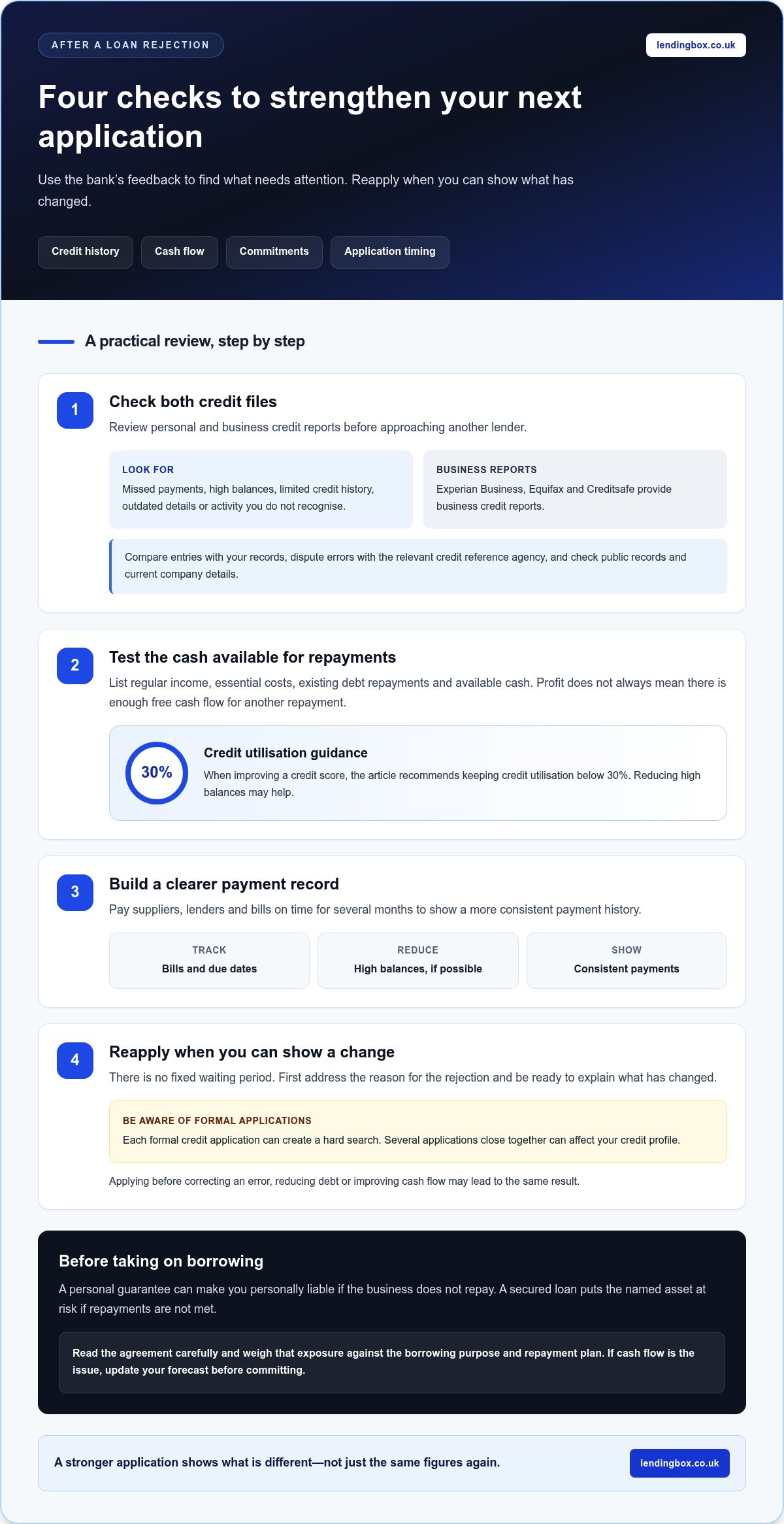
Review personal and business credit reports before applying again. Look for missed payments, high balances, limited credit history, outdated details or activity you don’t recognise. Experian Business, Equifax and Creditsafe provide business credit reports. Compare the entries with your records, then dispute errors with the relevant credit reference agency. Check public records too, and make sure the company’s information reflects its current position.
Next, test the figures a lender may assess against its criteria. List regular income, essential costs, existing debt repayments and available cash. A business can appear profitable yet lack enough free cash flow to manage another repayment. If credit utilisation is high, reducing balances may help; the guidance recommends keeping it below 30% when improving a credit score. Pay suppliers, lenders and bills on time for several months to show a more consistent payment history.
How long should you wait before reapplying for a UK business loan? There’s no fixed waiting period. Reapply when you’ve addressed the reason for rejection and can show what has changed. Applying again before correcting an error, reducing debt or improving cash flow may lead to the same result. Each formal credit application can create a hard search, and several applications close together can affect your credit profile.
A personal guarantee can make you personally liable if the business doesn’t repay. A secured loan also puts the named asset at risk if repayments aren’t met. Read the agreement carefully and weigh that exposure against the borrowing purpose and repayment plan. If cash flow is the issue, update your forecast before committing. Reviewing suitable business finance options can help you compare routes against your needs.
3. Community Development Finance Institutions (CDFIs)
Community Development Finance Institutions (CDFIs) are non-profit lenders with a relationship-focused approach. They offer loans and support to businesses that may struggle to access finance through traditional routes. A CDFI may consider your business’s purpose, trading position and repayment plan alongside its credit history. This can provide an alternative when a bank’s criteria don’t fit your circumstances.
In 2023, CDFIs lent £287m to businesses across the UK, reaching over 90,000 businesses. These figures show their role in business funding, but the right option still depends on the amount and purpose of the capital you need.
Consider whether borrowing is the right fit. Grants usually don’t require repayment, so they may suit a defined project with eligible costs. Equity finance brings investment in exchange for shares, meaning you share ownership and potentially decision-making. Compare these routes with business loans by weighing repayment obligations, control and how soon the business needs funding.
Before applying again, bring your bookkeeping up to date. Reconcile bank transactions, record outstanding customer payments and supplier bills, and separate business spending from personal transactions. Then check that your accounts, management figures and cash-flow forecast tell the same story. For example, explain a temporary sales dip in the context of seasonal patterns or a delayed customer payment. Clear records help a lender understand your position and assess whether repayments are affordable.
If you use a finance broker, ask how it matches applications to lenders and what paperwork it handles. Before proceeding, understand any charges that may apply and whether you’ll pay a fee if finance doesn’t complete. A useful broker explains the options in plain terms, including repayment structures and any security involved. This helps you compare the proposed funding with your needs, rather than focusing only on the likelihood of approval.
4. Requesting feedback after a loan rejection
A rejection letter may give a clear reason or little detail. Contact the bank calmly and ask what specifically affected its decision. Request practical feedback, rather than asking for a reconsideration by default. For example, ask whether affordability, credit history, trading performance, security or missing information weakened your application. The answer can help you decide what to change before borrowing again.
Make your request specific. Ask which part of the application fell short, what evidence could address the concern, and whether reapplying later may help. If the bank mentions repayments, ask which figures caused concern, such as projected cash flow or existing commitments. If it refers to a guarantee or security, clarify what it expects and how that affects your risk. Keep a written record of the response and the changes you plan to make.
Ask whether the decision involved a credit score or another lending criterion. A score may be only one part of the assessment, so find out whether stronger forecasts, updated accounts or evidence of regular customer payments could help. If the lender identifies a correctable issue, address it first. A new application is more persuasive when it shows what has changed, rather than repeating the same case.
The Bank Referral Scheme offers another route. Certain major banks must offer to refer an SME whose finance application they decline to designated finance platforms, which can introduce alternative funding providers. The scheme launched in November 2016, but treat a referral as one possible route, not your only next step. Ask what the referral involves, then compare it with other suitable lending options and the repayment terms.
Turn the bank’s feedback into a short action plan: record the reason, gather evidence, update your figures and choose your next route. If you’re ready to explore alternatives, review business finance options against your funding needs and repayment capacity.
Lending Box: Business loan
Lending Box is a whole-of-market broker matching UK limited companies and LLPs with business finance options when a bank’s criteria don’t fit. Its in-house model analyses company data to provide eligibility insights without impacting credit scores at the initial matching stage. A dedicated relationship manager can guide you through unsecured business loans, revenue-based finance, invoice finance or asset finance, and handle the paperwork.
Consider these options in light of why your application was rejected and how your business will use the funds. For example, invoice finance may suit a business waiting for customer payments, while asset finance may fit an equipment purchase. The right route depends on the funding need and repayment plan, not just the previous bank decision.
To discuss your options, contact Lending Box.
Choose a funding route that fits your next move
If your business loan has been rejected by a bank, deciding what to do next starts with identifying your business’s priority. Is the funding needed to manage a short-term cash gap, buy equipment or support planned growth? Match the finance to that purpose, then check that the repayment structure works alongside your expected income and commitments.
Use the bank’s feedback as a decision tool, not a verdict on your business. If the issue is fixable, make the change and strengthen your application. If the original borrowing doesn’t suit your needs, consider a different route rather than repeating the same request. Keep your forecasts realistic and understand the obligations before proceeding.
A considered next step can help you move forward with more clarity. Discuss your funding needs with Lending Box and explore a suitable way to support your plans.
Frequently Asked Questions
What should you do if your business loan is rejected?
If your business loan has been rejected by a bank, review the decision before applying elsewhere. Note whether the issue is something you can correct quickly, such as an account error, or a broader concern, such as limited trading history. Then decide whether to amend the amount, change the finance type or wait until your business can better support the repayments.
What types of finance are available after a bank rejection?
Options include loans from CDFIs, grants, equity investment and other forms of business finance. Match the structure to your need: invoice finance can release cash tied up in unpaid invoices, while asset finance may suit equipment purchases. Revenue-based finance links repayments to revenue, which can suit businesses with fluctuating sales. Compare repayment obligations and the effect of equity on ownership before choosing.
Will applying again affect my credit score?
A formal finance application can trigger a hard credit search, and several searches close together may affect your credit profile. Before applying, ask whether the lender will carry out a credit search and at what stage. Avoid sending identical applications to multiple lenders at once. Check your personal and business reports afterwards so you can spot unfamiliar searches and query anything you don’t recognise.
Why was my UK business loan application rejected by the bank?
If a bank has rejected your business loan, identify the reason before deciding what to change. A bank may decline an application if it can’t establish that repayments are affordable. Seasonal income, overdue invoices or existing borrowing can complicate that assessment. Limited trading history or incomplete accounts may also leave gaps. Ask which factor mattered most to find out whether the concern is affordability or documentation.
Can I ask a UK bank to explain or review a rejected business loan application?
Yes. Contact the bank and ask for the main reasons for its decision, what evidence could strengthen a future application, and whether reapplying later would make sense. If new information was missing or an error affected the assessment, explain what it is and ask whether the bank can reconsider the decision. Keep your request polite, specific and in writing.
How do I check and improve my business and personal credit reports in the UK?
Get both reports and compare names, addresses, account details, payment entries and searches with your records. Experian Business, Equifax and Creditsafe provide business credit reports. Query inaccurate or unfamiliar entries with the relevant agency and keep evidence of your correction request. To strengthen your profile, manage existing debt and make payments on time; sustained changes help build a clearer payment history.
Frequently Asked Questions
If your business loan has been rejected by a bank, review the decision before applying elsewhere. Note whether the issue is something you can correct quickly, such as an account error, or a broader concern, such as limited trading history. Then decide whether to amend the amount, change the finance type or wait until your business can better support the repayments.
Options include loans from CDFIs, grants, equity investment and other forms of business finance. Match the structure to your need: invoice finance can release cash tied up in unpaid invoices, while asset finance may suit equipment purchases. Revenue-based finance links repayments to revenue, which can suit businesses with fluctuating sales. Compare repayment obligations and the effect of equity on ownership before choosing.
A formal finance application can trigger a hard credit search, and several searches close together may affect your credit profile. Before applying, ask whether the lender will carry out a credit search and at what stage. Avoid sending identical applications to multiple lenders at once. Check your personal and business reports afterwards so you can spot unfamiliar searches and query anything you don’t recognise.
If a bank has rejected your business loan, identify the reason before deciding what to change. A bank may decline an application if it can’t establish that repayments are affordable. Seasonal income, overdue invoices or existing borrowing can complicate that assessment. Limited trading history or incomplete accounts may also leave gaps. Ask which factor mattered most to find out whether the concern is affordability or documentation.
Yes. Contact the bank and ask for the main reasons for its decision, what evidence could strengthen a future application, and whether reapplying later would make sense. If new information was missing or an error affected the assessment, explain what it is and ask whether the bank can reconsider the decision. Keep your request polite, specific and in writing.
Get both reports and compare names, addresses, account details, payment entries and searches with your records. Experian Business, Equifax and Creditsafe provide business credit reports. Query inaccurate or unfamiliar entries with the relevant agency and keep evidence of your correction request. To strengthen your profile, manage existing debt and make payments on time; sustained changes help build a clearer payment history.